Free Daily Podcast Summary
Exercise Science: Daily Summaries Delivered
by Exercise Science
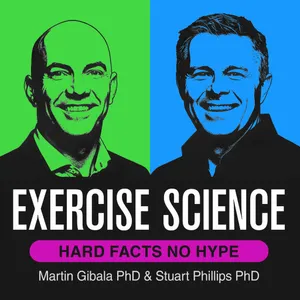
Hosts Martin Gibala, PhD & Stuart Phillips, PhD share exercise science expertise, separating hype from hard facts.
Latest Episodes
The most recent episodes — sign up to get AI-powered summaries of each one.
- Aug 18, 202639 min
Orthometria and the Future of Wellness | Gary LeBlanc, EverMe
In a special episode that concludes the first season of Exercise Science we invited on Gary LeBlanc, the COO and president of our title sponsor, EverMe, to discuss the future of wellness in our first-ever live taping in downtown Toronto. Gary LeBlanc has been studying wellness and personal optimization for decades. As a leader at EverMe, Gary and his team are creating an agentic AI that breaks down complex longevity research, trending topics and expert perspectives into evidence-backed guidance. It also tracks your wearable data and provides guidance on the best way to achieve your health goals. Together, Stu, Marty and Gary discuss: • Orthometria, Stu’s term describing an obsession with correct measurement of the self• How different wearables can assess the same things differently• The lack of standardization between devices like the Apple Watch, Whoop band or Oura ring• The EverMe origin story• The confusing world of signals we get from social media, wearables and agentic AIs, and how EverMe is designed to improve things• Where this world of AI and wearables will eventually lead Send us ideas for future episodes, comments and listener questions at realexercisescience@gmail.comExercise Science is powered by EverMe, the longevity intelligence app. To get a free, no credit card two-month trial to EverMe exclusively for Exercise Science listeners, go to:everme.ai/exercisescienceEPISODE LINKSStu’s orthometria post on LinkedInGoogle search crediting Stu with coining the termThe EverMe websiteLive Long and Prosper: The Globe and Mail’s feature article on EverMeGary LeBlanc’s book, Find Your Superhuman, and personal website. He’s also on InstagramSHOW LINKSFollow or subscribe at your favourite platform @realexercisescience: Substack. YouTube. TikTok. Instagram. Apple Podcasts. Spotify. On X you can find us @realexscience. Find Stu on Instagram and X. Follow him on TikTok.Marty is on Instagram. He’s also on X.Exercise Science is produced by Ghost Bureau, the Toronto content agency. DISCUSSION POINTS00:00 Wearable tech experiences00:36 Podcast introduction01:21 Episode overview02:19 Defining orthometria02:57 Introducing Everme06:25 Gary's origin story07:42 Everme's distinct features09:31 Data obsession10:22 Infor
- Aug 11, 202638 min
Cardio Training Guidance for Recreational Athletes | Alex Hutchinson, Sweat Science
You’re a busy person. Career, family, social obligations and everything else. What SHOULD you be doing for your cardio if you have just five hours a week to devote to your training? What’s the proper mix of long, slow effort, interval sessions and tempo bouts? How many times a week should you be getting out? And what’s the ideal duration per workout?To work out the answer, Marty and Stu invite on to the show the science journalist Alex Hutchinson, who has a physics Ph.D. from Cambridge and was on the Canadian national running team. He writes the Sweat Science column, on the science of human performance, for Outside magazine. He’s also the author of the bestselling books Endure and The Explorer’s Gene. Together, the guys discuss:• the challenge of cardio training when you’re not a professional athlete. • the current vogue for Marius Bakken and Norwegian Threshold training• Norwegian Threshold Training’s implications for Zone 2 and other training protocols• The optimal cardio training regimen for those who have five hours a week for training• The challenge of intensity guidance and training thresholds Send us ideas for future episodes, comments and listener questions at realexercisescience@gmail.comExercise Science is powered by EverMe, the longevity intelligence app. To get a free, no credit card two-month trial to EverMe exclusively for Exercise Science listeners, go to:everme.ai/exercisescienceThanks also to our sponsor BiaFit, your all-in-one fitness platform designed to help you become the best version of yourself. Enter the promotional code HARDFACTS at checkout to receive a 10% discount. Download BiaFit at your favorite app store, and learn more here: https://getbiafit.com/Exercise Science sponsor Precision Nutrition is the #1 most recommended nutrition certification program in the world. And now it specializes in GLP-1 coaching. For a free assessment to learn your GLP-1 type, visit GLPCoaching.com. EPISODE LINKSAlex Hutchinson’s Sweat Science website. Substack. He’s also on Instagram. Hutchinson’s books: Endure. The Explorer’s Gene. 1964 5,000m final Olympic final results. Mentioned in this episode: The Norwegian Method Applied: Threshold Training and Intensity Control for Faster, More Durable Running at Every Level. Book by Marius Bakken MDAlso here’s Brendan Gurd from Queen’s University. Recent guidance from the ACSM & ESSA: Physical Activity and Exercise Intensity Terminology. This episode’s listener question comes from Sandi Nypaver. Here’s here Instagram and her bio at Higher RunningSHOW LINKSFollow or subscribe at your favourite platform @realexercisescience: Substack. YouTube. TikTok. Instagram. Apple Podcasts. Spotify. On X you can find us @realexscience. Stu is everywhere, too, but mostly on Instagram and X. Follow him on
- Aug 4, 202636 min
Carbs vs. Keto: Fueling Optimal Performance with Louise Burke, Ph.D.
What’s the most efficient way to fuel human performance during endurance sports? For decades, adherents of keto- and low-carb high-fat diets have battled online with those who favor carbohydrate-burning approaches. In this episode, we have on the global scientific expert whose fascinating studies solved the debate. Australian Louise Burke is one of the best-known sports nutritionists on the planet, known for her Supernova race-walking studies that showed that keto- and low carb, high fat diets don’t fuel endurance athletes as well as carbohydrate-burning approaches. She also practices what she researches, holding the women’s Australian marathon record in her age group—the age group, she jokes, of “never you mind.” In this episode Dr. Burke walks Stu and Marty through her research that found carb-based approaches to fueling yield about 5% more of the muscle cell’s energy currency, ATP, compared to fat-burning approaches, with carb-burning also yielding 7-8% better performance. “Even though fat can do the job,” Dr. Burke says, “it’s not going to be able to produce the same amount of ATP so therefore you’re going to be slightly slower even though you’re working at the same relative oxygen utilization.” She also:—discusses her own approach to fuelling endurance events, before and during races—provides tips on carbohydrate periodization for everyone from elite performers to recreational athletes—explains how to train the body to become a fat- or carb-burning machine—describes the swings between carb- and fat-fuelled approaches to endurance training —answers a listener question about carb-loading—tells the origin story of the important Supernova race-walking studies—explains why race-walking is so perfect for nutrition studies—shows that carbs during a race are good not only for muscle but also for the brain —describes the high-fat approach to fuelling she used to help the swimmer Eva Buzo become the first woman to swim from Italy to AlbaniaGUEST BIOProfessor Louise Burke OAM, PhD, APDLouise is a sports dietitian with 45 years of experience in the education and counselling of elite athletes. She worked at the Australian Institute of Sport for thirty years, first as Head of Sports Nutrition and then as Chief of Nutrition Strategy. She has attended 6 Summer Olympic Games with the Australian Olympic Team (1996-2012 and 2021). Her publications include over 450 peer- reviewed papers and book chapters, and the authorship or editorship of several textbooks on sports nutrition. Louise was a founding member of the Executive of Sports Dietitians Australia and is a Director of the IOC Diploma in Sports Nutrition. She was awarded a Medal of the Order of Australia in 2009 for her contribution to sports nutrition, and a Doctor of Science (Honoris causa) from McMaster University, Canada in 2024. Louise was appointed as Chair in Sports Nutrition in the Mary MacKillop Institute of Health Research at Australian Catholic University in Melbourne in 2014 and took up this position in a full-time capacity in 2020.SOCIALSX: @LouiseMBurkeIG: https://www.instagram.com/louiseburke4Send us ideas for future episodes, comments and listener questions at realexercisescience@gmail.comExercise Science is powered by EverMe, the longevity intelligence app. To get a free two-month trial to EverMe exclusively for Exercise Science listeners, go to: everme.ai/exercisescienceThanks also to our sponsor Biafit, your all-in-one fitness platform designed to help you become the best version of yourself. Enter the promotional code HARDFACTS at checkout to receive a one-time 10% discount on the purchased subscription. Download BiaFit at your favorite app store, and learn more here: https://getbiafit.com/Exercise Science sponsor Precision Nutrition is the #1 most recommended nutrition certification program in the world. And now it specializes in GLP-1 coaching. For a free assessment to learn your GLP-1 type, visit GLPCoaching.com. EPISODE LINKSScientific articles by Louise Burke, or that reference her work:American Journal of Clinical Nutrition May 2026 featureDoes a low-carbohydrate diet impede endurance sports performance? YesDoes a low-carbohydrate diet impede endurance sports performance? No<a target="_blank" hre
- Jul 28, 202642 min
Fighting Frailty: Maintaining Muscle as You Age
You have an older person in your life, or perhaps you are an older person yourself and you need that push to start strength training. This is the episode for you—because today we’re talking with Ashley Gluchowski, Ph.D., one of the most enthusiastic evangelists on strength training around and the University of Salford exercise scientist who helps older adults get stronger, improve balance and reduce risk of falls. In this episode we discuss:—The surprising activities of daily living that require strength as we get older—Why older adults should be doing strength training—The association between strength and decreased dementia risk—How to get over being intimidated by strength training—The long-term benefits of making exercise social —Tips on how older adults can stick with strength-building programsAshley is a clinical exercise physiologist and former student of Stu Phillips’ who has gone on to found Stronger At Home, a program designed to get older adults to start and stick with strength training (link below). She has years of experience working with older adults on how to start and stick with strength training—and in this episode, Stu and Marty interview her about what works (exercise classes), and what doesn’t (patronizing trainers). According to Ashley, “the short-term benefits of becoming stronger and more active include better glucose regulation, improved mood, increased energy, and better sleep.” The stereotype is that strength training is just for young people. But older people fighting sarcopenia are the ones who will most benefit from strength training most of all!Send us ideas for future episodes, comments and listener questions at realexercisescience@gmail.comExercise Science is powered by EverMe, the longevity intelligence app. To get a free two-month trial to EverMe exclusively for Exercise Science listeners, go to: everme.ai/exercisescienceThanks also to our sponsor Biafit, your all-in-one fitness platform designed to help you become the best version of yourself. Enter the promotional code HARDFACTS at checkout to receive a one-time 10% discount on the purchased subscription. Download BiaFit at your favorite app store, and learn more here: https://getbiafit.com/Exercise Science sponsor Precision Nutrition is the #1 most recommended nutrition certification program in the world. And now it specializes in GLP-1 coaching. For a free assessment to learn your GLP-1 type, visit GLPCoaching.com. EPISODE LINKSDr. Ashley Gluchowski on instagram @drashleygstrongerwithageDr. Ashley Gluchowski’s website strongerahome.comThe Antifrail paper that Stu and Ashley wrote Handgrip strength and all-cause dementia incidence and mortality: UK Biobank studySHOW LINKSFollow or subscribe at your favourite platform @realexercisescience: Substack. YouTube. TikTok. Instagram. Apple Podcasts. Spotify. On X you can find us @realexscience. Stu is everywhere, too, but mostly on Instagram and X. Follow him on TikTok too!Marty just started his own Instagram. Give him a follow! He’s also on X!Exercise Science is produced by Ghost Bureau, the Toronto content agency. DISCUSSION POINTS00:00 Cold open01:03 Dr. Ashley Gluchowski’s story06:48 Why strength train08:30 Starting
- Jul 21, 202646 min
Stuart Phillip's FINAL WORD on Protein!
It’s no longer just the longevity bros and fitness fiends obsessing over their protein intake — protein is currently on EVERYONE’S agenda. The more you eat, the more you build and maintain muscle, right? NOT SO FAST! What does the science actually say about protein consumption, and where does it intersect with optimal training? More vexing, why does everything from ketchup to donuts seem to have added protein these days? And finally: How much do you truly need, and what’s the best way to get it? In today’s episode, Marty takes our own in-house world-renowned protein expert Stuart Phillips through the math behind the macros. Does more protein really equal more muscle? And what do you truly need to know about this hot (and much-politicized) nutrient? Stu and Marty break down the surprising truth: while more protein does help, the actual return on investment is much smaller than the hype suggests. Does the benefit of protein hit a hard plateau at 1.6 g per kg per day? And if most of your lifetime gains come from training consistency rather than your protein intake, could we be focusing on the wrong variable all along? Find out if your protein habit is building muscle or just slimming your wallet in this episode of Exercise Science!In this episode Stu and Marty discuss:—How our understanding of protein has changed over time—Stu says why the old guideline of 0.8 g/kg body weight wasn’t enough — and where it came from—How much protein do you need if you want to lose weight but hold on to muscle?—How much protein do you need if you want to stay strong as you get older?—We’ll describe what happens when you eat more protein than you need — teeing up the term “expensive urine”—What’s better, vegan or animal-derived protein?—Listener question: What type of protein is easiest on the stomach to avoid bloating? Send us ideas for future episodes, comments and listener questions at realexercisescience@gmail.comExercise Science is powered by EverMe, the longevity intelligence app. To get a free two-month trial to EverMe exclusively for Exercise Science listeners, go to:everme.ai/exercisescienceThanks also to our sponsor Biafit, your all-in-one fitness platform designed to help you become the best version of yourself. Enter the promotional code HARDFACTS at checkout to receive a one-time 10% discount on the purchased subscription. Download BiaFit at your favorite app store, and learn more here: https://getbiafit.com/Exercise Science sponsor Precision Nutrition is the #1 most recommended nutrition certification program in the world. And now it specializes in GLP-1 coaching. For a free assessment to learn your GLP-1 type, visit GLPCoaching.com. LINKS Stu’s essay on protein in The Conversation: The Year that Protein Jumped the SharkHigh-Protein Food Market Size to Hit USD 117.44 Billion by 2034Mentioned in the podcast: The book, Nutrient Timing, by John IvyShawn Arent paper Stu mentions: Nutrient Timing: A Garage Door of OpportunityLoad-induced Human Skeletal Muscle Hypertrophy - Journal of Sport and Health ScienceProtein supplementation on resistance training-induced gains in muscle mass and strength in healthy adults - British Journal of Sports MedicineStu calls this the “Tom Longland” paper in the episode, from the American Journal of Clinical Nutrition: Higher compared with lower dietary protein during an energy deficit combined with intense exercise promotes greater lean mass gain and fat mass loss: a randomized trial Application of the COSIAM method for muscle protein turnover and skeletal muscle mass in young females: A comparison of methods for body composition assessment - Advanced Exercise and Health Science<a target="_bla
- Jul 14, 202627 min
Exercise Snacks & VILPA: The Ultimate Explainer
A little morsel of an episode on exercise snacks and Vigorous Intermittent Lifestyle Physical Activity, known as VILPA. Along with a handful of scientists around the world, such as Emmanuel Stamatakis and Jon Little, Marty is leading research into the health benefits of short, vigorous bouts of exercise that are scattered through the day. One key finding is that just four minutes of vigorous physical activity per day can decrease risk of all-cause mortality by 25%—which those of us at Exercise Science find remarkable. So in our eighth episode, Stu leads Marty through a discussion of the ongoing and future research into the benefits of short, vigorous bouts of physical activity throughout the day. The guys discuss:—What’s the difference between exercise snacks and VILPA?—What health benefits are provided by short, vigorous bursts of exercise scattered throughout the day?—What are some examples of great exercise snacks that anyone can do?—What’s the shortest amount of exercise that will make a difference to one’s health?Finally, we explore the idea that exercise snacks and VILPA may be able to liberate physical activity from the confines of planned gym visits that require special clothing and fancy equipment. Traditional guidelines have not done much to get more people exercising. In this episode, Stu and Marty explore their ultimate aim of getting more people engaging in strength and cardio with shorter, less-structured bouts of physical activity. Send us ideas for future episodes, comments and listener questions at realexercisescience@gmail.comExercise Science is powered by EverMe, the longevity intelligence app. To get a free two-month trial to EverMe exclusively for Exercise Science listeners, go to:everme.ai/exercisescienceThanks also to our sponsor Biafit, your all-in-one fitness platform designed to help you become the best version of yourself. Enter the promotional code HARDFACTS at checkout to receive a one-time 10% discount on the purchased subscription. Download BiaFit at your favorite app store, and learn more here: https://getbiafit.com/Exercise Science sponsor Precision Nutrition is the #1 most recommended nutrition certification program in the world. And now it specializes in GLP-1 coaching. For a free assessment to learn your GLP-1 type, visit GLPCoaching.com. EPISODE LINKSGreat explainer video on exercise snacking featuring Martin GibalaMarty and Jon Little Diabetologia study: Bodyweight exercise snacks totalling 4 min of vigorous activity per day led to small, yet statistically significant improvements in indices of glycaemic variability and postprandial hyperglycaemia in insufficiently active individuals living with well-controlled type 2 diabetes. Technology-Enabled Exercise Snacks - Scandinavian Journal of Medicine and Science in SportsOnce and thrice weekly interval training in adults with central obesity: a randomized controlled trial: Gibala 2026: https://www.nature.com/articles/s41467-025-68149-7The Stamatakis study that Marty co-authored: The sample median VILPA duration of 4.4 min per day was associated with a 26%–30% reduction in all-cause and cancer mortality risk SHOW LINKSFollow or subscribe at your favourite platform @realexercisescience: Substack. YouTube. TikTok. Instagram. Apple Podcasts. Spotify. On X you can find us @realexscience. Stu is everywhere, too, but mostly on Instagram and X. Follow him on TikTok too!Marty just started
- Jul 7, 202642 min
Mythbusting the Most-Hyped Peptides
Peptides like BPC-157, TB-500, CJC-1295 and retatrutide are among the hottest trends for optimizers, gym bros, looksmaxxers and the longevity crowd. But is it wise to inject bioactive molecules into the bloodstream that haven’t passed the drug approval process? In this episode, Marty and Stu welcome the Harvard- and Stanford-educated Leigh Baxt, who mythbusts about peptides and other panaceas on Instagram @sciencemomscicomm. Baxt is a translational scientist who specializes in drug development. She points out the many problems with injecting peptides into the body, including the major one that many of these peptides are activating biological pathways that cancer cells love. In this episode we discuss the following questions: —What are peptides?—Why are peptides so hot?—Are peptides safe? —What do peptides do?—What is a wolverine stack?We also provide a quick guide to peptides like BPC-157, TB-500, CJC-1295 and retatrutide, and walk through the drug-approval process that protects human beings from predatory marketing. The episode concludes with a discussion of what Marty, Stu and Leigh think is so wrong about promoting peptides to young people. What scientific evidence supports peptide use? Find out in our latest episode!Exercise Science is powered by EverMe, the longevity intelligence app. To get a free two-month trial to EverMe exclusively for Exercise Science listeners, go to:everme.ai/exercisescienceThanks also to our sponsor Biafit, your all-in-one fitness platform designed to help you become the best version of yourself. Enter the promotional code HARDFACTS at checkout to receive a one-time 10% discount on the purchased subscription. Download BiaFit at your favorite app store, and learn more here: https://getbiafit.com/#BPC157 #wolverinestack #peptides #looksmaxxing #longevityEPISODE LINKSLeigh Baxt is on Instagram @sciencemomscicommLeigh collaborates heavily with Unbiased Science: https://www.unbiasedscience.com/Leigh was also on Simon Hill: Are Peptides Safe? What You Need to Know About BPC-157Retatrutide phase 2 trial for obesity in the New England Journal of MedicineGood overview from Patricia Brubaker on problems with injecting peptidesWant to hack your body with peptides? The Economist opinesSHOW LINKSFollow or subscribe at your favourite platform @realexercisescience: Substack. YouTube. TikTok. Instagram. Apple Podcasts. Spotify. On X you can find us @realexscience. Stu is everywhere, too, but mostly on Instagram and X. Follow him on TikTok too!Marty just started his own Instagram. Give him a follow! He’s also on X!Exercise Science is produced by Ghost Bureau, the Toronto content agency. DISCUSSION POINTS00:00 Cold open01:02 Introducing Leigh Baxt04:54 What are peptides?07:25 Antivaxxers09:24 BPC-15711:05 TB-50012:20 Wolverine stacking13:10 CJC-129513:55 Retatrutide16:28 Drug approval process18:08 Peptides & cancer20:12 Most drugs fail22:03 Are peptides safe<
- Jun 30, 202648 min
What to Do Instead of Zone 2
Semaglutide, sold as Ozempic and Wegovy, and tirzepatide, sold as Zepbound and Mounjaro, are new weight loss drugs that actually work, helping millions around the world to feel better and become healthier. But some people are fearful of side effects, such as loss of muscle mass. Are their fears warranted?To find out, Marty and Stu talk to the two University of Kansas weight loss scientists, Renee Rogers and ACSM president-elect John Jakicic, who are leading a clinical trial investigating the way aerobic and resistance training can affect the muscle mass of people who are on GLP-1s, or the other new weight loss drugs.In this episode we discuss:—the latest findings on how GLP-1s affect muscle mass—the difference between lean mass and muscle mass—the research that Jakicic and Rogers are doing into GLP-1s, weight loss and muscle mass—we provide guidance on whether people should be concerned about GLP-1s and muscle mass—we also provide pointers on how to minimize muscle loss while on GLP-1sPlus, Renee and John answer a listener question about whether the new weight loss drugs affect men and women differently.Have a listener question or an idea for a future episode? Email us at realexercisescience@gmail.comExercise Science is powered by EverMe, the longevity intelligence app. Exercise Science listeners get a free two-month trial to EverMe at this link. You can also download EverMe for free at your favourite app store.LINKSFollow or subscribe at your favourite platform @realexercisescience: Substack. YouTube. TikTok. Instagram. Apple Podcasts. Spotify. On X you can find us @realexscience.Stu is everywhere, too, but mostly on Instagram and X. Follow him on TikTok too!Marty just started his own Instagram. Give him a follow! He’s also on X!Exercise Science is produced by Ghost Bureau, the Toronto content agency.EPISODE LINKSNew York Times: They Hated Exercise. Weight Loss Drugs Changed Everything.Renee Rogers and John Jakicic’s clinical trial: Muscle and Movement With Anti-Obesity Medications (M3)A paper by John Jakicic and Renee Rogers advocating for a prescription of exercise along with obesity medication in obesity treatment: The Role of Exercise in the Contemporary Era of Obesity Management Medications - ACSM-CSMRJakicic led, and Rogers coauthored, the largest targeted NIH investment of funds into the mechanisms of how physical activity improves health and prevents disease. Study website. Article from the Journal of Applied Physiology: Molecular Transducers of Physical Activity Consortium (MoTrPAC): human studies design and protocolAnalysis: Preserving muscle mass on GLP-1 weight loss drugs: Big Deal or Nothing to Worry About? By Stuart PhillipsDISCUSSION POINTS00:00 Cold open01:29 Muscle mass and GLP-1s04:19 Introducing Renee and John06:19 GLP-1 context07:50 How GLP-1s work10:50 More than GLP-1s12:44 Body composition & weight loss15:00 Lean tissue is not muscle16:50 Overblown fears18:55 Muscle moment20:39 R01 study described23:15 Early re
Get Exercise Science summaries in your inbox
Free AI-powered daily recaps. Key takeaways, quotes, and mentions — in a 5-minute read.
Get Free Summaries →Free forever for up to 3 podcasts. No credit card required.
You Might Also Like
Podcasts in similar categories.
The Jamie Kern Lima Show
Entrepreneur Jamie Kern Lima interviews experts and celebrities about overcoming self-doubt and building self-belief.

The Mel Robbins Podcast
A motivational podcast offering research-backed tools and personal stories to help listeners make positive life changes.
We're Out of Time
Discusses the fentanyl crisis, mental health, and resilience through interviews with recovery experts, survivors, and public figures.

Biohack-it
A weekly exploration of biohacking, holistic health, and science-driven strategies for optimizing physical and mental well-being.

Something You Should Know
Expert interviews and practical tips to improve your life, career, finances, and relationships.
Tony Mantor: Why Not Me ?
Explores autism, mental health, and human stories to promote understanding, challenge stigma, and support neurodiversity.

The Dylan Gemelli Podcast
Experts in health, fitness, and biohacking share science-backed strategies to improve well-being and performance.

Passion Struck with John R. Miles
Explores human flourishing through science-based conversations on resilience, purpose, and intentional living.
Habits and Hustle
Explores the daily habits and personal routines of successful entrepreneurs and thought leaders through candid interviews.
Ten Minute Bible Talks Devotional Bible Study
A daily devotional exploring one Bible passage with practical insights for everyday life.
The Thyroid (and Hormone) Fixer Podcast: Thyropause, Menopause, Metabolism and How to Fix It
A doctor explains science-based approaches to managing hypothyroidism and Hashimoto’s symptoms such as fatigue, weight gain, and brain fog.
Huberman Lab
Explores neuroscience and science-based tools for understanding and improving brain function, behavior, and health.
About Exercise Science
Hosts Martin Gibala, PhD & Stuart Phillips, PhD share exercise science expertise, separating hype from hard facts.
Customized Recaps
AI-powered recaps with compact key takeaways, quotes, and insights.
Straight to Your Inbox
Get key takeaways from Exercise Science in a 5-minute read.
Save Hours Every Week
Stay current on your favorite podcasts without falling behind.
Frequently Asked Questions
What is Podzilla's Exercise Science daily summary?
It's a free AI-powered email that summarizes new episodes of Exercise Science as soon as they're published. You get the key takeaways, notable quotes, and links & mentions — all in a quick read.
How does the Exercise Science podcast summary work?
When a new episode drops, our AI transcribes and analyzes it, then generates a personalized summary tailored to your interests and profession. It's delivered to your inbox every morning.
Is this an official Exercise Science product?
No. Podzilla is an independent service that summarizes publicly available podcast content. We're not affiliated with or endorsed by Exercise Science.
Can I get summaries of other podcasts too?
Absolutely! The free plan covers up to 3 podcasts, any in the catalog. Basic raises that to 15, Pro to 40 and Max to 100. Browse our full catalog at /podcasts.
How often does Exercise Science release new episodes?
Exercise Science publishes weekly. Our AI generates a summary within hours of each new episode.
What topics does Exercise Science cover?
Exercise Science covers topics including Fitness, Health & Fitness. Our AI identifies the specific themes in each episode and highlights what matters most to you.
Start getting Exercise Science summaries tomorrow morning.
Free forever for up to 3 podcasts. No credit card required.
Free forever for up to 3 podcasts. No credit card required.