Free Daily Podcast Summary
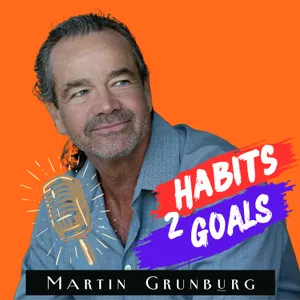
Habits 2 Goals: The Habit Factor Podcast with Martin Grunburg: Daily Summaries Delivered
by Martin Grunburg
If you’ve ever struggled to achieve your goals you are not alone! The reason just might be because ALL prior goal achievement methods missed ONE key element— habit! That's right, The Habit Factor® (bestselling book and app) exposed a timeless truth that helped to launch an entirely new genre of productivity apps (habit trackers) and help thousands around the world achieve their goals faster! There’s a reason top coaches, consultants, trainers, Professional athletes, Olympians, PhD’s and the very best learning institutions world-wide have adopted and recommend The Habit Factor®. Learn The Habit Factor's method for goal achievement and how to use Habit Alignment Technology™ to achieve your most important goals faster than you ever thought possible!
Latest Episodes
The most recent episodes — sign up to get AI-powered summaries of each one.
- Aug 20, 202641 min
What Is Basic Behavior Literacy?
What Is Basic Behavior Literacy?Not therapy. It’s upstream EDUCATION. Four elements. Thirty-ish minutes. Since the Unified Behavior Model went public (preprint 7/8/2025), the same critiques keep returning. Most aren’t objections to the model — they’re misconceptions about what a foundational framework is.👋 Hey, Martin Grunburg — U at the end. Not the FDIC chair. Ha! 😄 Author of the Habit Factor® trilogy, creator of the Unified Behavior Model™ (UBM), and host of the Habits 2 Goals podcast.Start hereBehavioral science has spent nearly 150 years producing complications, distinctions, and competing frameworks.That’s all important work. It just isn’t upstream education. It’s downstream therapy.Basic Behavior Literacy — not behavioral, not academic — is something different. It’s the elemental foundation that has eluded the field since day one.BBL is something anyone can learn, apply, and teach. No need to wait until something feels off, broken, or wrong.Simple enough for any adolescent. Rigorous enough to withstand 400+ days — and counting — without a single scientific refutation.Four elements. Just four pieces that explain the entire behavioral spectrum.Let’s go.Lesson 1 — Two Nouns. Distinct. Observable.A human being is a noun. A person. Biology. DNA.Behavior is also a noun. An observable event. Distinct and separate from the person performing it.The surprising thing is this distinction has appeared to elude most of the field for nearly 150 years.Conflating the two is a category error that creates enormous fog — and real damage.“You are NOT your behavior. You are RESPONSIBLE for it. But you are not the act.”You are the vehicle behavior is delivered from. Behavior is the route. Your body is the car you can never exit.Biology behaves — but biology isn’t the behavior.This matters because behavior is separate, selectable, and steerable.I can go for a run or sit on the couch. Either way — behavior is observable, distinct, and mine. That separateness is what makes behavior modelable. And changeable.Lesson 2 — Four Elements. Not Five. Not Eleven.Once behavior is recognized as distinct — separate — the next question is simple: what influences it in the moment and shapes it over time?To model behavior — not the person — we begin with, you guessed it:Element 1 — BEHAVIORS / Habits / Skills: Actions in the moment, including inaction, and those shaped over time.Element 2 — Environment: The place you behave in — and your body. The body is the most proximate behavioral stimulus. A toothache, poor sleep, hunger — all may change how you think, feel, and act. Behaviorally speaking, a toothache and a construction site outside your window belong in the same category. Both are stimuli.Element 3 — Cognition / Stories: How you think. When it comes to behavior, thinking happens predominantly in the form of narratives — stories — to plan, predict, and explain events and circumstances. Einstein smoked. Not logical. Pure story: “it helps me think.” Stories drive behavior constantly — it’s precisely why marketing works.Element 4 — Emotions and Feelings: We are sentient beings. Feelings are variable conduits — relays of information and energy throughout the system.Key idea: think of feelings and emotions as SIGNALS. Not commands.What’s worth understanding: concepts like motivation, willpower, discipline, and the “mind” are not elemental. Each arises from — or can be subsumed into — some combination of the four elements.Motivation? Could be a story (”I don’t want to do this”), a feeling (low energy), or an environmental trigger (blood sugar crash). It’s a compound — not a primitive.This is precisely why these are the four elements. It’s why the model is elementally sufficient. And it’s why — despite a year-long open global challenge, despite the world’s top frontier AI systems attempting — no fifth element has been produced.Four. Nothing outside them. Nothing left out.Lesson 3 — The Behavior Echo-SystemThe four elements don’t operate in a straight line.No flowchart. No staged sequence. No unidirectional arrows. No steps, no preset order.The key insight: the four elements interrelate within what’s called the Behavior Echo-System — not ecosystem. Echo, as in reverberation.
- Aug 6, 202629 min
Where Logic Hides
Since the Unified Behavior Model went public (preprint 7/8/2025), the same critiques keep returning. Most aren’t objections to the model — they’re misconceptions about what a foundational framework is.👋 Hey, Martin Grunburg — U at the end. Not the FDIC chair. Ha! 😄 Author of the Habit Factor® trilogy, creator of the Unified Behavior Model™ (UBM), and host of the Habits 2 Goals podcast."Narrative imagining — story — is the fundamental instrument of thought. Rational capacities depend upon it. It is our chief means of looking into the future, of predicting, of planning, and of explaining."— Mark Turner, The Literary MindStart hereHumans are NOT logic machines.We are primarily STORY machines that happen to have the capacity for logic.Mark Turner’s work makes this undeniable — and it’s precisely why the third book in The Habit Factor® trilogy was titled EVERYTHING is a Fcking Story.* (Pardon the French.)Story dominates our behavior.Logic rides shotgun — and sometimes it doesn’t even make it into the car.Which raises an uncomfortable question: if stories are running the show, where is the logic hiding?Welcome to the Behavior Echo-System audit.Case 1 — The Greatest Mind of the 20th CenturyAlbert Einstein smoked. Heavily. Consistently. For decades.Here was arguably the most logical human being alive — a man who rewrote the laws of physics — doing something every shred of available evidence condemned as lethal. Even by the standards of his era, the data pointed clearly toward early death and a compromised cardiovascular system.His story? “It helps me relax. It helps me think.”Not logic. Nothing logical about it.Einstein: Story 1. Logic 0.Case 2 — The Man Who Outsmarted the SeatbeltI know an old man. Graduated high school at 16. Chemical engineering degree. Harvard MBA. Decades as a senior executive — entertainment, finance, international consulting. He even helped establish government infrastructure in Kazakhstan.Far from stupid.Eighty-six years old. Still drives — just to the store, maybe three miles. And he categorically refuses to wear his seatbelt.In fact, so annoyed by the automated ding, ding, ding — he keeps the seatbelt permanently plugged in and simply sits on top of it.The joke is, he’s the man who outsmarted the seatbelt. 😄Never mind physics. Never mind statistics. Never mind that at 86, a fender-bender is a very different proposition than it was at 46.His story? We can only guess — but it probably sounds something like: “It’s a nuisance. Takes longer to buckle and unbuckle than to drive. It’s just three miles.”To him, the story is airtight. Internally consistent. Completely comfortable.Where’s the logic — for one of the smartest men I’ve ever known?Harvard MBA: Story 1. Logic 0.Case 3 — Me: A Cat, a Golf Tee Time, and an Idiotic MoveMy wife leaves town to... This is a public episode. If you'd like to discuss this with other subscribers or get access to bonus episodes, visit habits2goals.substack.com/subscribe
- Jul 30, 202633 min
Psychology Decided to Build a Science upon a Concept with No Objective Definition
Psychology defines itself as the scientific study of mind and behavior. Yet there is no scientific consensus on what the “mind” actually is.Not even close.Think about how “crazy” that is. No pun intended.Physicalists say it’s brain chemistry. Functionalists say it’s software. Phenomenologists say it’s subjective experience. Pick your camp — that’s just the beginning of the confusion.The field has been arguing for nearly 150 years. And counting.The surprising thing is this isn’t a minor footnote. It’s a structural flaw at the foundation of an entire field of science.How do you build a science upon an undefined concept?This is just one reason behavioral science has openly described itself as “pre-paradigmatic” and an “incoherent mess.” Instead of harmony and agreement, you get what Arthur Staats described directly in 1999 — a “would-be science” plagued by “mutual discreditation, inconsistency, redundancy, and controversy.”Sounds fun. 😄To compound matters, the field didn’t stop there. It labeled itself a science with a nonsense definition — then proceeded to conflate biology (a noun, the person) with behavior (also a noun, distinctly not the person).This is where the fun really begins. And why, more than a century earlier in 1892, William James — a founder of American psychology — could see the whole mess unfolding. He put it bluntly: “This is no science; it is only the hope of a science.”UBM resolves both — with ONE ELEMENTAL STONE.The fix is straightforward: remove the undefined variable entirely. Goodbye, “mind.” You’re very important — just not elemental.Focus strictly on what is objective, empirical, and scientifically discernible — BEHAVIOR. What influences human action in the moment and shapes it over time.Four elements. No fifth. One year. Zero point zero refutations.Mind — removed.Conflation — removed.Coherence — emerges.D. O. N. E. 🙌Simple. Elegant. Truth.“Truth is ever to be found in simplicity, and not in the multiplicity and confusion of things.” — Isaac Newton This is a public episode. If you'd like to discuss this with other subscribers or get access to bonus episodes, visit habits2goals.substack.com/subscribe
- May 21, 202627 min
Why Science Exists
Behavior Architecture, the 8-Day Cohort & Scholarship Applications are now open. Next cohort begins Thursday, June 18th.👋 Hey, Martin Grunburg (mg) here, author of the Habit Factor® trilogy, creator of the Unified Behavior Model™ (UBM), and host of the Habits 2 Goals podcast — possibly the longest-running habits, goals, and performance podcast. For 20+ years, I’ve researched, trained, and coached with a SINGLE objective: to make behavior change, habit development, and achieving goals EASIER to understand, implement, and teach. That twenty-year concentrated effort yielded the world’s first elemental, unified, goal-directed behavioral model. Important: Quality scientific theories are subject to disproof because they are testable. Unfortunately, behavioral science, since its inception, has failed to produce a single elemental and unified model of behavior. Thus, the Unified Behavior Model™ (UBM) is presented as falsifiable, which means it is testable.The best part— the ONLY reason YOU ought to care… is that UBM provides the highest-goal probabilistic outcome of ANY goal framework, ever. Of course, that statement is independently verifiable, so please DO NOT take my word for it, visit unifiedbehaviormodel.com and download the white paper and LLM Primer 5.1— keep reading, listening, and please, always test and experiment for yourself.🎓 Next cohort: Behavior Architecture on Maven → | 6/18/26 - 6/25/26🎙️ Habits 2 Goals Podcast 📄 Free habit tracking templateRead time: 4 minutesWhy Does Science Exist?Let’s begin with why science does NOT exist. Science doesn’t exist to win awards or fill thick textbooks with complicated diagrams and formulas.Science does not exist to gatekeep, lecture from ivory towers, or foster incestuous citation cartels,Science does not exist to make other scientists feel good.Science exists for one reason:To understand phenomena.Life, experience, and human behavior are mysterious “phenomena.”Science, then, is (ideally) the simple tool used to pull back the curtain to understand and learn about such phenomena.Yet, there’s a massive problem, particularly in BEHAVIORAL SCIENCE…Without a shared paradigm or ontology, behavioral scientists have no basis upon which to fundamentally present theories.The “Napkin” TestEinstein famously said that if you can’t explain a theory to a child, it’s probably useless.Double click to interact with videoGreat science must have a simple pictorial representation.The “Behavior Echo-System” 2021 - Presented on a Napkin just before the release of EVERYTHING is a Freakin’ STORY.According to the best scientists, including Einstein, worth consideration…If you can’t draw it on a napkin, it may not be ready.If it requires a PhD to decode, it probably lacks elementality.Good science brings with it accessibility.Good science is easy to learn, teach, and—most importantly—USE.The Myth of ComplexityWe’ve been taught to respect complicated things.We think “complex” equals “intelligent.”It’s almost always the opposite.“Simplicity is the ultimate sophistication.” ~Leonardo da Vinci“Truth is ever to be found in simplicity, and not the multiplicity and confusion of things.” ~ Sir Isaac NewtonComp
- May 7, 202635 min
The 16 Year Habit-Tracking Flip-Flop
Happiness on a WhimThe surprising truth is that happiness and every other emotion are not mysteries. This framework proves it.Start hereHappiness might be the most talked-about behavioral concept of all time. Thousands of books. Tens of thousands of blogs and podcast episodes. And yet — for most people — it remains a mystery.The first key: happiness is not simply a feeling that happens to you.Happiness is both a primary, elemental emotion/feeling — raw, immediate, requiring no explanation — AND an emergent compound: a resultant cocktail produced by one, several, or all of the elements within your “Behavior Echo-System” (see image below) working in concert.That’s what this episode is about. And once you see it this way, you can never unsee it.Why elemental thinking matters (and why “simple” is powerful)Before we get to happiness, here’s the setup that makes everything else click.The reason UBM — the Unified Behavior Model™ — works is precisely because it’s elemental. Some people push back on that word. “Elemental sounds reductive,” they say.The surprising thing is that the opposite is true. Elemental means learnable. Elemental means teachable. Elemental means powerful.Consider: every podcast, every video, every download, all of artificial intelligence — runs on just two digits. A one and a zero. That’s the binary system. Remove the zero? Goodbye, information age. But wait, isn’t elemental too simple to be userful? Apparently not.The key phrase here is elemental sufficiency — what is truly necessary, and when combined, does it produce sufficiency? A “2” might seem necessary. It isn’t. It emerges from the “1.” UBM applies this same principle to behavior.This is why, 10 months since publication (pre-print), no behavioral scientist has been able to disprove it — including every major LLM. Several top theorists have given it a serious look. A few shots hit the rim— a few airballs. Nobody has formally entered, because UBM’s logic and scientific rigor are airtight.What’s worth noting is this is what experts call “hard,” testable science — something the behavioral sciences, particularly around a unified model, have never had.The bottom line: a truly elemental, unified model has been sought since the founding of behavioral science. William James himself called for a “closed causal system.” UBM is it.The four — and only four — primary elements that categorize and describe ALL behavior This is a public episode. If you'd like to discuss this with other subscribers or get access to bonus episodes, visit habits2goals.substack.com/subscribe
- May 3, 202626 min
“The Seeker”: The Habit Factor & Pattern Recognition (Shhh 🤫)
Happiness on a WhimThe surprising truth is that happiness and every other emotion are not mysteries. This framework proves it.Start hereHappiness might be the most talked-about behavioral concept of all time. Thousands of books. Tens of thousands of blogs and podcast episodes. And yet — for most people — it remains a mystery.The first key: happiness is not simply a feeling that happens to you.Happiness is both a primary, elemental emotion/feeling — raw, immediate, requiring no explanation — AND an emergent compound: a resultant cocktail produced by one, several, or all of the elements within your “Behavior Echo-System” (see image below) working in concert.That’s what this episode is about. And once you see it this way, you can never unsee it.Why elemental thinking matters (and why “simple” is powerful)Before we get to happiness, here’s the setup that makes everything else click.The reason UBM — the Unified Behavior Model™ — works is precisely because it’s elemental. Some people push back on that word. “Elemental sounds reductive,” they say.The surprising thing is that the opposite is true. Elemental means learnable. Elemental means teachable. Elemental means powerful.Consider: every podcast, every video, every download, all of artificial intelligence — runs on just two digits. A one and a zero. That’s the binary system. Remove the zero? Goodbye, information age. But wait, isn’t elemental too simple to be userful? Apparently not.The key phrase here is elemental sufficiency — what is truly necessary, and when combined, does it produce sufficiency? A “2” might seem necessary. It isn’t. It emerges from the “1.” UBM applies this same principle to behavior.This is why, 10 months since publication (pre-print), no behavioral scientist has been able to disprove it — including every major LLM. Several top theorists have given it a serious look. A few shots hit the rim— a few airballs. Nobody has formally entered, because UBM’s logic and scientific rigor are airtight.What’s worth noting is this is what experts call “hard,” testable science — something the behavioral sciences, particularly around a unified model, have never had.The bottom line: a truly elemental, unified model has been sought since the founding of behavioral science. William James himself called for a “closed causal system.” UBM is it.The four — and only four — primary elements that categorize and describe ALL behavior This is a public episode. If you'd like to discuss this with other subscribers or get access to bonus episodes, visit habits2goals.substack.com/subscribe
- Apr 16, 202621 min
Happiness on a Whim
Happiness on a WhimThe surprising truth is that happiness and every other emotion are not mysteries. This framework proves it.Start hereHappiness might be the most talked-about behavioral concept of all time. Thousands of books. Tens of thousands of blogs and podcast episodes. And yet — for most people — it remains a mystery.The first key: happiness is not simply a feeling that happens to you.Happiness is both a primary, elemental emotion/feeling — raw, immediate, requiring no explanation — AND an emergent compound: a resultant cocktail produced by one, several, or all of the elements within your “Behavior Echo-System” (see image below) working in concert.That’s what this episode is about. And once you see it this way, you can never unsee it.Why elemental thinking matters (and why “simple” is powerful)Before we get to happiness, here’s the setup that makes everything else click.The reason UBM — the Unified Behavior Model™ — works is precisely because it’s elemental. Some people push back on that word. “Elemental sounds reductive,” they say.The surprising thing is that the opposite is true. Elemental means learnable. Elemental means teachable. Elemental means powerful.Consider: every podcast, every video, every download, all of artificial intelligence — runs on just two digits. A one and a zero. That’s the binary system. Remove the zero? Goodbye, information age. But wait, isn’t elemental too simple to be userful? Apparently not.The key phrase here is elemental sufficiency — what is truly necessary, and when combined, does it produce sufficiency? A “2” might seem necessary. It isn’t. It emerges from the “1.” UBM applies this same principle to behavior.This is why, 10 months since publication (pre-print), no behavioral scientist has been able to disprove it — including every major LLM. Several top theorists have given it a serious look. A few shots hit the rim— a few airballs. Nobody has formally entered, because UBM’s logic and scientific rigor are airtight.What’s worth noting is this is what experts call “hard,” testable science — something the behavioral sciences, particularly around a unified model, have never had.The bottom line: a truly elemental, unified model has been sought since the founding of behavioral science. William James himself called for a “closed causal system.” UBM is it.The four — and only four — primary elements that categorize and describe ALL behavior This is a public episode. If you'd like to discuss this with other subscribers or get access to bonus episodes, visit habits2goals.substack.com/subscribe
- Feb 26, 202620 min
Find Your Way Out! Begin Architecting
Important: The Behavior Architecture 8-Day Cohort Scholarship Application is now open. The next cohort starts on March 19.There’s a different sort of “stuck” that doesn’t seem too disarming from the outside.Life appears to “work.” Stuff gets done. The bills get paid. The calendar is full. You’re busy. Busy. Busy. Busy.And yet…You wake up one day, despite all the busyness, you wonder what you’ve accomplished.This is tenant mode.I lived in it for far too long…Something deep down always felt like ‘something’ was missing.It’s easy to ignore: stay busy, check off the next box, doom scroll.Check. Check. Check.In the silence, you wonder, “Am I leaving something on the table?”Maybe (like me) you even hear the late Dr. Wayne Dyer’s voice:“Don’t die with your music still in you.”ShareEnter: Your Behavior Echo-System (BES): This is your behavioral “home.”You’re in it right now. You’ll be in it tomorrow and (wait for it…) forever.You don’t just live in “the world.”You live in your personal Behavior Echo-System.Your Behavior Echo-System shapes and influences your behaviors in the moment and over time.Right now, you’re reading this (environment). That may make you think, “This is dumb,” or “This is helpful,” or… ???Then you may feel something or do something…Sidenote: UBM scientifically presents the long-sought “causal” behavioral structure (architecture) that William James argued behavioral science must identify back in 1892: “This is no science. It is only the hope of a science.”Let me be clear: UBM wasn’t assembled—or rather, “unearthed”—without the century-long discoveries, academic research, struggles, and insights behavioral science has produced since those statements.Having said that, this is precisely what the Behavior Echo-System and UBM scientifically demonstrate: the causal structure. And UBM goes further by demonstrating elemental sufficiency through its “No Fifth Element” Challenge, now almost eight months strong. This is a public episode. If you'd like to discuss this with other subscribers or get access to bonus episodes, visit habits2goals.substack.com/subscribe
Get Habits 2 Goals: The Habit Factor Podcast with Martin Grunburg summaries in your inbox
Free AI-powered daily recaps. Key takeaways, quotes, and mentions — in a 5-minute read.
Get Free Summaries →Free forever for up to 3 podcasts. No credit card required.
You Might Also Like
Listeners also like.
Habits and Hustle
Explores the daily habits and personal routines of successful entrepreneurs and thought leaders through candid interviews.
Growth Mindset Psychology: The Science of Self-Improvement
Explores the science behind lasting self-improvement through psychology, neuroscience, and timeless wisdom traditions.
The ONE Thing with Geoff Woods
Examines how high achievers prioritize one key task to excel in productivity, business, health, and habits.

Hacks and Hobbies with Junaid Ahmed
Creators and entrepreneurs discuss turning hobbies into income through podcasting, content, and personal branding.
The Learning Leader Show With Ryan Hawk
Conversations with top leaders across industries exploring how continuous learning drives success.
Happier with Gretchen Rubin
Two sisters explore practical strategies for building happier lives and better habits through conversational, relatable weekly discussions.
The Nick Bare Podcast
Nick Bare discusses nutrition, performance, and habits for consistent personal growth through disciplined, principle-driven conversations.

Total Disruption Podcast
Entrepreneurs discuss mindset, business growth, and operational frameworks to move beyond hustle culture and build scalable companies.

Working Hard with Grace Beverley
Conversations with diverse achievers reveal raw insights on redefining success, balancing ambition, and learning from failure.
The Unstuck High Performer Podcast - Hypnotherapy and Mindset Coaching for High-Performers
Helps high-achievers overcome mental blocks like overthinking, burnout, and self-sabotage to consistently perform at their potential.

The Daily Motivation
A daily podcast delivering motivational insights from experts and thought leaders to help listeners stay inspired and driven.
The Mindset Mentor
A motivational podcast blending neuroscience and psychology to help listeners understand their minds and achieve personal growth.
About Habits 2 Goals: The Habit Factor Podcast with Martin Grunburg
If you’ve ever struggled to achieve your goals you are not alone! The reason just might be because ALL prior goal achievement methods missed ONE key element— habit! That's right, The Habit Factor® (bestselling book and app) exposed a timeless truth that helped to launch an entirely new genre of productivity apps (habit trackers) and help thousands around the world achieve their goals faster! There’s a reason top coaches, consultants, trainers, Professional athletes, Olympians, PhD’s and the very best learning institutions world-wide have adopted and recommend The Habit Factor®. Learn The Habit Factor's method for goal achievement and how to use Habit Alignment Technology™ to achieve your most important goals faster than you ever thought possible!
Customized Recaps
AI-powered recaps with compact key takeaways, quotes, and insights.
Straight to Your Inbox
Get key takeaways from Habits 2 Goals: The Habit Factor Podcast with Martin Grunburg in a 5-minute read.
Save Hours Every Week
Stay current on your favorite podcasts without falling behind.
Frequently Asked Questions
What is Podzilla's Habits 2 Goals: The Habit Factor Podcast with Martin Grunburg daily summary?
It's a free AI-powered email that summarizes new episodes of Habits 2 Goals: The Habit Factor Podcast with Martin Grunburg as soon as they're published. You get the key takeaways, notable quotes, and links & mentions — all in a quick read.
How does the Habits 2 Goals: The Habit Factor Podcast with Martin Grunburg podcast summary work?
When a new episode drops, our AI transcribes and analyzes it, then generates a personalized summary tailored to your interests and profession. It's delivered to your inbox every morning.
Is this an official Habits 2 Goals: The Habit Factor Podcast with Martin Grunburg product?
No. Podzilla is an independent service that summarizes publicly available podcast content. We're not affiliated with or endorsed by Martin Grunburg.
Can I get summaries of other podcasts too?
Absolutely! The free plan covers up to 3 podcasts. Upgrade to Pro for 15, or Premium for 50. Browse our full catalog at /podcasts.
How often does Habits 2 Goals: The Habit Factor Podcast with Martin Grunburg release new episodes?
Habits 2 Goals: The Habit Factor Podcast with Martin Grunburg publishes weekly. Our AI generates a summary within hours of each new episode.
What topics does Habits 2 Goals: The Habit Factor Podcast with Martin Grunburg cover?
Habits 2 Goals: The Habit Factor Podcast with Martin Grunburg covers topics including Education, Fitness, Health & Fitness, Alternative, Self-Improvement. Our AI identifies the specific themes in each episode and highlights what matters most to you.
Start getting Habits 2 Goals: The Habit Factor Podcast with Martin Grunburg summaries tomorrow morning.
Free forever for up to 3 podcasts. No credit card required.
Free forever for up to 3 podcasts. No credit card required.