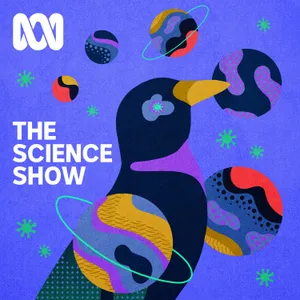
Free Daily Podcast Summary
The Science Show: Daily Summaries Delivered
by ABC Australia
The Science Show gives Australians unique insights into the latest scientific research and debate, from the physics of cricket to prime ministerial biorhythms.
Latest Episodes
The most recent episodes — sign up to get AI-powered summaries of each one.
- Yesterday10 min
Lab Notes: Eel sex ball
We don't know a lot about deep-sea eels, so when 2.8 million of them are found in the same place every year, scientists (and science reporters) get excited.Why are they there? Where are they coming from, and why should we care about these creatures from the depths?Jonathan Webb dives into this world of eels off the coast of Tasmania with environment reporter Peter de Kruijff.You can binge more episodes of the Lab Notes podcast with science editor and presenter Jonathan Webb on the ABC Listen app (Australia). You'll find episodes on animal behaviour, human health, space exploration and so much more.Get in touch with us: labnotes@abc.net.auFeaturing:Peter de Kruijff, environment reporterFurther information:Australia's giant spawning eel ball estimated to contain 2.8 million eelsThis episode of Lab Notes was produced on the lands of the Gadigal, Ngunnawal and Ngambri people.
- 5 days ago54 min
The British Science Festival
Robyn Williams reports from The British Science Festival in Southampton UK.
- 1 weeks ago10 min
Lab Notes: Bogong moths bounce back?
Across south-eastern Australia, bogong moths seem to be everywhere.A few years ago, it was a different picture: scientists witnessed a population crash, and habitat threats put the species on the IUCN Red List. Are we seeing a bogong bounce-back? Jonathan Webb speaks to Dr Kate Umbers about these incredible critters, the many unsolved mysteries of their lives — and what their future could look like.You can binge more episodes of the Lab Notes podcast with science editor and presenter Jonathan Webb on the ABC Listen app (Australia). You'll find episodes on animal behaviour, human health, space exploration and so much more.Get in touch with us: labnotes@abc.net.auFeaturing:Associate Professor Kate Umbers, Western Sydney UniversityFurther information:iNaturalist Bogong watchBogong watch projectThis episode of Lab Notes was produced on the lands of the Gadigal, Ngunnawal and Ngambri people.
- 1 weeks ago54 min
Collaboration between life forms and how bees protect their hives from disease
Plus a call for accuracy in dinosaur displays.
- 2 weeks ago10 min
Lab Notes: What's in store for wildlife this summer?
Over the past few years, our environment seems to have experienced multiple extreme events in quick succession.With a summer fuelled by what may be the strongest and wettest El Niño ever, can our wildlife withstand more extremes?Jonathan Webb speaks with Professor Euan Ritchie about what we're currently seeing with flying foxes, what could happen to other species over the summer, and what we can do to help our native creatures.You can binge more episodes of the Lab Notes podcast with science editor and presenter Jonathan Webb on the ABC Listen app (Australia). You'll find episodes on animal behaviour, human health, space exploration and so much more.Get in touch with us: labnotes@abc.net.auFeaturing:Professor Euan Ritchie, Deakin UniversityFurther information:WIRES wildlife rescue assistance on 1300 094 73724-hour Emergency Animal Disease Hotline on 1800 675 888This episode of Lab Notes was produced on the lands of the Burramattagal, Ngunnawal and Ngambri people.
- 2 weeks ago54 min
72 per cent of UK trees threatened by changing climate, plus the simple spud’s complex genetics
And palm oil producers in South-East Asia have changed their ways, considering the environment more than they did. Brendan May is turning his attention now to nickel mines in tropical countries.
- 3 weeks ago10 min
Lab Notes: When astronomers make mistakes
In March 2018, a South African astronomer looking into the distant universe "discovered" a bright red spot in the sky that hadn't been there previously; it felt like an exciting potential discovery. A message was sent to other astronomers, asking them to look at this new dot and study it further.After forty minutes and a few more calculations, he realised this "star" was much closer to home and nothing new at all: it was the planet Mars.According to Dr Kat Ross, making this kind of mistake is something of a rite of passage for astronomers.You can binge more episodes of the Lab Notes podcast with science editor and presenter Jonathan Webb on the ABC Listen app (Australia). You'll find episodes on animal behaviour, human health, space exploration and so much more.Get in touch with us: labnotes@abc.net.auFeaturing:Dr Kat Ross, Curtin UniversityThis episode of Lab Notes was produced on the lands of the Gadigal, Ngunnawal and Ngambri people.
- 3 weeks ago54 min
Nobel Prizes, kitchen fumes and a biography of Francis Crick
* 2026 Nobel prizes in science* Air fryer vs deep fryer: Which produces more indoor air pollution?* First major biography of Francis Crick
Get The Science Show summaries in your inbox
Free AI-powered daily recaps. Key takeaways, quotes, and mentions — in a 5-minute read.
Get Free Summaries →Free forever for up to 3 podcasts. No credit card required.
You Might Also Like
Listeners also like.
Science In Action
The BBC covers the latest weekly developments and news in science.
A Question of Science
Experts answer public questions on pressing scientific issues, from cancer and nutrition to AI and climate change.
Science Quickly
A bite-sized science podcast exploring discoveries with journalists and experts.

CrowdScience
Explores listener-submitted questions about life, Earth, and the universe with scientists at the forefront of research.
Discovery
Explores various topics in the field of science.
The Life Scientific
A scientist discusses their research, inspirations, and career with physicist Jim Al-Khalili.
5 Live Science Podcast
Dr Chris and the Naked Scientists present the latest science news and analysis.
BBC Inside Science
Explores the latest scientific discoveries and debates shaping our understanding of the world.
In Our Time: Science
Discusses scientific principles, theories, and influential figures in the development of science.
Unexpected Elements
Explores hidden scientific connections behind global news and everyday phenomena.

Science Magazine Podcast
Weekly episodes covering original scientific research, global science news, and expert commentary.
Science Vs
A show that investigates popular topics and myths by analyzing scientific evidence to determine what’s fact, fiction, or uncertain.
About The Science Show
The Science Show gives Australians unique insights into the latest scientific research and debate, from the physics of cricket to prime ministerial biorhythms.
Customized Recaps
AI-powered recaps with compact key takeaways, quotes, and insights.
Straight to Your Inbox
Get key takeaways from The Science Show in a 5-minute read.
Save Hours Every Week
Stay current on your favorite podcasts without falling behind.
Frequently Asked Questions
What is Podzilla's The Science Show daily summary?
It's a free AI-powered email that summarizes new episodes of The Science Show as soon as they're published. You get the key takeaways, notable quotes, and links & mentions — all in a quick read.
How does the The Science Show podcast summary work?
When a new episode drops, our AI transcribes and analyzes it, then generates a personalized summary tailored to your interests and profession. It's delivered to your inbox every morning.
Is this an official The Science Show product?
No. Podzilla is an independent service that summarizes publicly available podcast content. We're not affiliated with or endorsed by ABC Australia.
Can I get summaries of other podcasts too?
Absolutely! The free plan covers up to 3 podcasts, any in the catalog. Basic raises that to 15, Pro to 40 and Max to 100. Browse our full catalog at /podcasts.
How often does The Science Show release new episodes?
The Science Show publishes 2x weekly. Our AI generates a summary within hours of each new episode.
What topics does The Science Show cover?
The Science Show covers topics including Science, Natural Sciences. Our AI identifies the specific themes in each episode and highlights what matters most to you.
Start getting The Science Show summaries tomorrow morning.
Free forever for up to 3 podcasts. No credit card required.
Free forever for up to 3 podcasts. No credit card required.