Free Daily Podcast Summary
Unexpected Elements: Daily Summaries Delivered
by BBC World Service
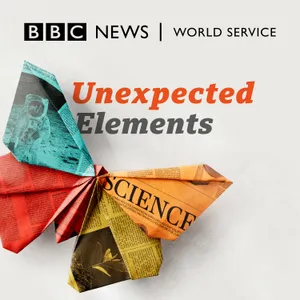
The news you know, the science you don’t. Unexpected Elements looks beyond everyday narratives to discover a goldmine of scientific stories and connections from around the globe. From Afronauts, to why we argue, to a deep dive on animal lifespans: see the world in a new way.
Latest Episodes
The most recent episodes — sign up to get AI-powered summaries of each one.
- 2 days ago49 min
A distorted view
With the United Nations encouraging wider use of the Equal Earth map, a projection designed to better represent the true size of Earth's landmasses, the Unexpected Elements team have been thinking about distortion and the surprising new ways we can see the world and beyond. We discover that every city's subway system has its own unique microbial fingerprint, so distinctive that researchers can identify a location from a simple swab. Then we meet the black-capped chickadee, a tiny bird whose remarkable memory-map helps it keep track of thousands of hidden food stores.Astrophysicist Miguel Zumalacárregui joins us to explain gravitational lensing, the phenomenon that bends and distorts light as it travels through the Universe. We hear how these cosmic distortions help astronomers study distant galaxies, dark matter and even black holes.We also learn why Europe's mountain summits are becoming greener while still losing rare plants, ask why many continents seem to point downwards, and explore the story behind the online maps in our pockets.All that, plus many more Unexpected Elements.Presenter: Marnie Chesterton, with Andrada Fiscutean and Paul Adepoju Producers: Alice Lipscombe Southwell, with Ella Hubber and Debbie Kilbride
- 1 weeks ago49 min
The phizz-whizzing science of Roald Dahl
Roald Dahl Day is celebrated each year on 13 September. Dahl gave us much-loved children’s books like Matilda, The BFG and Charlie and the Chocolate Factory, which have captivated kids for generations.Dahl is also a controversial figure, and made anti-semitic remarks that his family have since apologised for. We explore the separation of art and artist, and go looking for the science hidden in Dahl’s fantastical stories.We find out about the scientists brewing up chocolate – not in a factory, but in a laboratory. And remember how the BFG sent ‘golden dreams’ into kids’ bedrooms? We hear how anaesthetists are ensuring that patients enjoy good dreams while sedated. And remember Bruce Bogtrotter, the much-loved side character in Matilda who famously scoffed a gigantic chocolate cake? Inspired by his story, we decided to chew over the science behind eating competitions with Professor James Smoliga from Tufts University School of Medicine.Presenter: Marnie Chesterton, Tristan Ahtone and Sandy Ong Producer: Alice Lipscombe-Southwell, Sophie Ormiston and Debbie Kilbride
- 2 weeks ago49 min
The show must go on
The 80th birthday celebrations of the late, great Queen frontman Freddie Mercury have us marvelling at mercury at an elemental level: as a killer, a cure and more.First, we hear about how to make a telescope mirror out of a spinning bowl of liquid mercury. Then we hear about killer queens; it’s a gruesome tale of pheromone-induced ant warfare.Next, Freddie’s rare condition that caused him to have four extra incisors in his upper jaw leads us to discuss the secrets hidden within our teeth. We’re joined by archaeologist Carolyn Freiwald from the University of Mississippi, whose work on the teeth of ancient people tells us much about both their lives and our own.Also, the secret to getting rid of earworms, ancient civilisations hidden beneath the Amazon, and why you should never mess with dimethyl mercury.Presenter: Marnie Chesterton, Kai Kupferschmidt and Camilla Mota Producer: Lucy Davies, Alice Lipscombe-Southwell, Imy Harper and Debbie Kilbride
- 3 weeks ago49 min
A very dry episode
Vast swathes of Europe and Asia are experiencing drought conditions, thanks to relentless heatwaves and lack of rain. This week, we find out why drought conditions could unexpectedly lead to an increase in water-borne disease. Next up, we take a trip to Lake Malawi to discover why a tiny fly could help us rewrite the science of insects. Also on the show, we’re joined by Professor Dan Parsons from Loughborough University in the UK, who tells us about the rivers that lurk beneath the sea. Elsewhere, we hear about the tech that could help reduce textile waste, we find out why rehydrating raisins won’t turn them back into grapes, and discover how to suck water from thin air. All that, plus many more Unexpected Elements. Presenter: Marnie Chesterton, with Chhavi Sachdev and Phillys Mwatee Producers: Alice Lipscombe-Southwell, with Debbie Kilbride and Imy Harper
- Aug 21, 202649 min
Fashionably late
News of an Australian library book finally finding its way home 150 years after it was borrowed has the Unexpected Elements team thinking about things that get forgotten, filed away or simply turn up much later than expected.We start with the story of a meteorite from Mars that spent millions of years travelling through space before ending up in a university drawer. Then, we investigate why scientists believe California may be centuries overdue for a massive earthquake known as "The Big One".Next, Martin Woodward from GitHub joins us to explain how millions of lines of computer code are being preserved deep beneath the Arctic in a vault designed to protect humanity's digital knowledge for generations to come.Plus, we hear about the penguin vaccinators working to protect Australian wildlife from bird flu, discover if smells, tastes and touch can be measured, and explore the dying art of reading a book. All that, plus many more, unexpected elements.Presenter: Marnie Chesterton Producers: Lucy Davies, Ella Hubber, Imy Harper and Robbie Wojciechowski
- Aug 14, 202649 min
Light entertainment
As Europe experiences its first total solar eclipse in almost 30 years this week, Unexpected Elements investigates the surprising science that emerges when sunlight is blocked out. We travel to the forests of Italy, where we investigate whether trees can communicate their eclipse plans to each other. We learn about an ambitious scientific plan to launch a wall of bubbles the size of Brazil into outer space. And we contemplate whether astronauts will ever need to take rice cookers the moon. Also on the show, Annaliese Hodge, a doctoral researcher from the University of Plymouth in the UK joins us to help us learn more about how sunscreen - while good for us humans - can be destructive to marine life. Elsewhere in the programme, we hear about the newly arrived crows bothering the people of Nairobi, Kenya, and discuss another pesky problem: people not wearing headphones on public transport. All that plus more unexpected elements. Presenter: Alex Lathbridge Producers: Dan Welsh, Lucy Davies and Robbie Wojciechowski
- Aug 7, 202649 min
Someone's always watching
The UK's Royal Society for the Protection of Birds has found that birdwatching is the second-fastest growing hobby amongst Gen Z with 750,000 of them regularly venturing into the outdoors to spot some of our feathered friends. Inspired by this new appreciation for an old pastime, the Unexpected Elements team are on the lookout for some birdwatching science. First, we watch birds, but did you know they watch us back? We hear how crows don't just hold grudges; they also pass on those grudges to their peers. Then, from birds watching us to birds watching for us. We learn all about the patterns of vulture crime scene detectives. Inspired by the citizen science nature of bird watching we talk to Professor Brooke Simmons about Galaxy Zoo, a website where people can volunteer to sort through images of galaxies and perhaps stumble on some mysterious green blobs. We also bring you the newest evidence of ice age-old bird appreciation, explore BALLS or the ambitious pan-African experiment to send spherical radio antennae to the moon, and ask does music distract or help you concentrate? The answer might depend on your social skills. All that plus more unexpected elements. Presenter: Marnie ChestertonProducers: Ella Hubber, Lucy Davies and Robbie Wojciechowski
- Jul 31, 202649 min
Down The Rabbit Hole
75 years ago, Walt Disney's Alice in Wonderland hit our screens, welcoming us into a technicolour, topsy-turvy world of eccentric characters – including the Mad Hatter, the Cheshire Cat, the Queen of Hearts, the White Rabbit and many more.On Unexpected Elements, we're tumbling down the rabbit hole to uncover the strange and surprising science hidden within the classic story.We’ll find out how bizzarro land of Lewis Carroll's original novel was inspired by the real scientific discoveries of his time? Dr. Franziska Kohlt tells us how Wonderland made sense of science for children – and we learn about a few scientific theories that have taken inspiration from Alice herself.We also meet shrinking shrews, get wide-eyed over some adorable animals, and go underground to solve a subatomic puzzle.All that, plus many more Unexpected Elements.Presenter: Marnie Chesterton Producers: Robbie Wojciechowski, Alice McKee, Imy Harper, and Nada Soufi
Get Unexpected Elements summaries in your inbox
Free AI-powered daily recaps. Key takeaways, quotes, and mentions — in a 5-minute read.
Get Free Summaries →Free forever for up to 3 podcasts. No credit card required.
You Might Also Like
Listeners also like.
Science In Action
The BBC covers the latest weekly developments and news in science.
Discovery
Explores various topics in the field of science.
The World, the Universe and Us
Explores big scientific questions about life, consciousness, climate, and the cosmos with expert scientists and New Scientist journalists.
Unsung Science
Explores the overlooked stories behind major scientific and technological breakthroughs and the people who created them.
Curious Cases
Hannah Fry and Dara Ó Briain use science to solve listeners' questions and mysteries.
In Our Time: Science
Discusses scientific principles, theories, and influential figures in the development of science.

CrowdScience
Explores listener-submitted questions about life, Earth, and the universe with scientists at the forefront of research.
BBC Inside Science
Explores the latest scientific discoveries and debates shaping our understanding of the world.
The Life Scientific
A scientist discusses their research, inspirations, and career with physicist Jim Al-Khalili.
Short Wave
A daily science podcast exploring discoveries, everyday mysteries, and the stories behind scientific headlines.

What in the World
A daily podcast exploring major and minor global events to help listeners understand current affairs and feel more informed.

Uncharted with Hannah Fry
Hannah Fry explores data-driven stories and the people behind groundbreaking discoveries.
About Unexpected Elements
The news you know, the science you don’t. Unexpected Elements looks beyond everyday narratives to discover a goldmine of scientific stories and connections from around the globe. From Afronauts, to why we argue, to a deep dive on animal lifespans: see the world in a new way.
Customized Recaps
AI-powered recaps with compact key takeaways, quotes, and insights.
Straight to Your Inbox
Get key takeaways from Unexpected Elements in a 5-minute read.
Save Hours Every Week
Stay current on your favorite podcasts without falling behind.
Frequently Asked Questions
What is Podzilla's Unexpected Elements daily summary?
It's a free AI-powered email that summarizes new episodes of Unexpected Elements as soon as they're published. You get the key takeaways, notable quotes, and links & mentions — all in a quick read.
How does the Unexpected Elements podcast summary work?
When a new episode drops, our AI transcribes and analyzes it, then generates a personalized summary tailored to your interests and profession. It's delivered to your inbox every morning.
Is this an official Unexpected Elements product?
No. Podzilla is an independent service that summarizes publicly available podcast content. We're not affiliated with or endorsed by BBC World Service.
Can I get summaries of other podcasts too?
Absolutely! The free plan covers up to 3 podcasts. Upgrade to Pro for 15, or Premium for 50. Browse our full catalog at /podcasts.
How often does Unexpected Elements release new episodes?
Unexpected Elements publishes weekly. Our AI generates a summary within hours of each new episode.
What topics does Unexpected Elements cover?
Unexpected Elements covers topics including Science. Our AI identifies the specific themes in each episode and highlights what matters most to you.
Start getting Unexpected Elements summaries tomorrow morning.
Free forever for up to 3 podcasts. No credit card required.
Free forever for up to 3 podcasts. No credit card required.