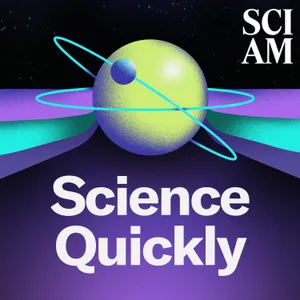
Free Daily Podcast Summary
Science Quickly: Daily Summaries Delivered
by Scientific American
Host Rachel Feltman, alongside leading science and tech journalists, dives into the rich world of scientific discovery in this bite-size science variety show.
Latest Episodes
The most recent episodes — sign up to get AI-powered summaries of each one.
- 2 days ago19 min
Can you hear a forest disappear?
In this episode of Science Quickly, filmmaker and journalist Leah Varjacques takes us to a Bornean rainforest area, where centuries-old patterns of human and wildlife behavior are being disrupted by the construction of a new capital city. In the midst of all this change, Varjacques documents the work of Wendy Erb, a primatologist and bioacoustic scientist at the Cornell Lab of Ornithology. Erb’s team, working with members of the local Balik population, placed audio recorders around the forest to capture the sounds of this diverse ecosystem before it changes forever. Recommended Reading: Can you hear a forest disappearing? Scientists are trying to find out E-mail us at sciencequickly@sciam.com if you have any questions, comments or ideas for stories we should cover! Discover something new every day: subscribe to Scientific American and sign up for Today in Science, our daily newsletter. Science Quickly is produced by Rachel Feltman, Fonda Mwangi, Allison Rodgers and Jeff DelViscio. This episode was edited by Alex Sugiura, with fact-checking by Marielle Issa and Aaron Shattuck. Our theme music was composed by Dominic Smith. This episode was reported and narrated by Leah Varjacques, with additional voiceover work by Rizky Rahad. This story was made possible by a grant from the Pulitzer Center and published in partnership with Project Multatuli. Learn more about your ad choices. Visit megaphone.fm/adchoices
- 4 days ago26 min
Unexplainable: What happened before the big bang?
In this special crossover episode, Science Quickly shares an appearance by host Rachel Feltman on Vox’s Unexplainable. Together with host Noam Hassenfeld, she explores Scientific American’s special issue on impossible questions, diving into some of science’s biggest mysteries, from how common medications can work without scientists fully understanding them to whether there’s a limit to what humans can ever know. The conversation also ventures to the edge of cosmology, examining competing theories about what may have come before the big bang and why some questions might remain forever unanswered. Recommended Reading: Finding meaning in the impossible The questions science may never answer Listen to Unexplainable Unexplainable on Spotify E-mail us at sciencequickly@sciam.com if you have any questions, comments or ideas for stories we should cover! Discover something new every day: subscribe to Scientific American and sign up for Today in Science, our daily newsletter. Science Quickly is produced by Rachel Feltman, Fonda Mwangi, Allison Rodgers and Jeff DelViscio. This episode was edited by Alex Sugiura, with fact-checking by Marielle Issa and Aaron Shattuck. Our theme music was composed by Dominic Smith. Learn more about your ad choices. Visit megaphone.fm/adchoices
- 6 days ago12 min
From 9/11’s lasting legacy to AI’s disruptive future
In this episode of Science Quickly, we explore newly released 9/11 records and their revelations about the attacks’ lasting health impacts, unpack a controversial artificial intelligence breakthrough that solved one of mathematics’ biggest problems and examine the growing backlash to a massive AI data center as communities grapple with the costs of powering the AI boom. Recommended Reading: 25 years after 9/11, survivors are still getting sick—here are the numbers AI may have just solved a million-dollar math problem. The field will never be the same The data center backlash comes for SpaceXAI’s Colossus E-mail us at sciencequickly@sciam.com if you have any questions, comments or ideas for stories we should cover! Discover something new everyday: subscribe to Scientific American and sign up for Today in Science, our daily newsletter. Science Quickly is produced by Rachel Feltman, Fonda Mwangi, Allison Rodgers and Jeff DelViscio. This episode was edited by Alex Sugiura, with fact-checking by Marielle Issa and Aaron Shattuck. Our theme music was composed by Dominic Smith. Learn more about your ad choices. Visit megaphone.fm/adchoices
- 1 weeks ago26 min
Is AI making us less human?
Can an artificial intelligence really be a friend? In this episode of Science Quickly, Scientific American books and culture lead Bri Kane sits down with Massachusetts Institute of Technology researcher Sherry Turkle to discuss the rise of AI chatbots and their effect on human connection. Turkle explains why she believes AI can imitate intimacy, from empathy and companionship to friendship and love, without truly caring and what we risk losing as machines play a bigger role in our emotional lives. Recommended Reading: Artificial Intimacy. Sherry Turkle. Little, Brown and Company, 2026 E-mail us at sciencequickly@sciam.com if you have any questions, comments or ideas for stories we should cover! Discover something new everyday: subscribe to Scientific American and sign up for Today in Science, our daily newsletter. Science Quickly is produced by Rachel Feltman, Fonda Mwangi, Allison Rodgers and Jeff DelViscio. This episode was edited by Alex Sugiura, with fact-checking by Emily Makowski, Marielle Issa and Aaron Shattuck. Our theme music was composed by Dominic Smith. Learn more about your ad choices. Visit megaphone.fm/adchoices
- 1 weeks ago17 min
The surprising science of friendship
Friendships are key to our well-being, but what kind of friendships do we really want? Despite being such a foundational part of the human experience, the science of friendship is still mysterious. Assistant professor of psychology Jessica Ayers is trying to fill in the blanks. While it’s long been assumed that people want either a few close friends or a large network of friendships, her recent research shows that many people need a mix of both friendship types to feel connected. Her research points to new ways we can understand our own friendship styles and gives insight to the loneliness epidemic. Recommended Reading: A lot of casual friends, or only a few you’re really close with? New research questions that trade‑off Love Isn’t Just about Romance. Here’s How Nonromantic Bonds Shape Our Lives The Evolutionary Origins of Friendship How Nostalgia Keeps Friendships Alive E-mail us at sciencequickly@sciam.com if you have any questions, comments or ideas for stories we should cover! Discover something new everyday: subscribe to Scientific American and sign up for Today in Science, our daily newsletter. Science Quickly is produced by Rachel Feltman, Fonda Mwangi, Allison Rodgers and Jeff DelViscio. This episode was edited by Alex Sugiura, with fact-checking by Emily Makowski, Marielle Issa and Aaron Shattuck. Our theme music was composed by Dominic Smith. Learn more about your ad choices. Visit megaphone.fm/adchoices
- 2 weeks ago15 min
What if a dating app matched you with a dead body?
What if a dating app could optimize human connection, even after death? In this episode of Science Quickly, books and culture editor Bri Kane speaks with author Sarah Pierce about her debut novel For Human Use, a darkly comic thriller centered on a dating app that matches users with dead bodies. Pierce discusses dating apps, human behavior and the search for meaningful connection. Together, they explore what modern dating technology can and can’t offer and what our reactions to a truly bizarre innovation reveal about human behavior. Recommended Reading: For Human Use. Sarah G. Pierce. Run for It, 2026 E-mail us at sciencequickly@sciam.com if you have any questions, comments or ideas for stories we should cover! Discover something new everyday: subscribe to Scientific American and sign up for Today in Science, our daily newsletter. Science Quickly is produced by Rachel Feltman, Fonda Mwangi, Allison Rodgers and Jeff DelViscio. This episode was edited by Alex Sugiura, with fact-checking by Marielle Issa and Aaron Shattuck. Our theme music was composed by Dominic Smith. Learn more about your ad choices. Visit megaphone.fm/adchoices
- 2 weeks ago15 min
The hackers fighting to keep our water safe
Across the U.S., the digital infrastructure that runs our utilities is quickly aging, becoming more vulnerable to cyber attacks. Recently at least a dozen states reported attacks on their water systems. Stepping up to defend these utilities is DEF CON Franklin, an organization that pairs expert volunteers with infrastructure operators who want to step up their cyberdefense. To learn about how the program works, Science Quickly host Rachel Feltman talks with Eric Geller, a senior reporter at Cybersecurity Dive. They talk about why so many water treatment plants need a cybersecurity glow-up, how DEF CON Franklin came into being, how cybersecurity volunteers are helping protect rural communities and what the future of cybersecurity might look like. Recommended Reading: Hackers Could Use Electric Vehicle Chargers to Attack the Power Grid Massive CrowdStrike Tech Outage Highlights Global Vulnerabilities Scientists just built a powerful AI computer worm that learns as it spreads E-mail us at sciencequickly@sciam.com if you have any questions, comments or ideas for stories we should cover! Discover something new everyday: subscribe to Scientific American and sign up for Today in Science, our daily newsletter. Science Quickly is produced by Rachel Feltman, Fonda Mwangi and Jeff DelViscio. This episode was edited by Alex Sugiura, with fact-checking by Marielle Issa and Aaron Shattuck. Our theme music was composed by Dominic Smith. Learn more about your ad choices. Visit megaphone.fm/adchoices
- 2 weeks ago14 min
NASA’s Roman Space Telescope launches
In this episode of Science Quickly, NASA’s Nancy Grace Roman Space Telescope begins its mission to probe dark energy, hunt for distant worlds and map the cosmos in unprecedented detail. The mission’s senior project scientist Julie McEnery explains why astronomers are so excited about what Roman might discover. Recommended Reading: NASA’s newest telescope is about to rewrite how we study the universe Can NASA’s Roman Space Telescope solve the biggest problem in the universe? E-mail us at sciencequickly@sciam.com if you have any questions, comments or ideas for stories we should cover! Discover something new everyday: subscribe to Scientific American and sign up for Today in Science, our daily newsletter. Science Quickly is produced by Rachel Feltman, Fonda Mwangi and Jeff DelViscio. This episode was edited by Alex Sugiura, with fact-checking by Marielle Issa and Aaron Shattuck. Our theme music was composed by Dominic Smith. Learn more about your ad choices. Visit megaphone.fm/adchoices
Get Science Quickly summaries in your inbox
Free AI-powered daily recaps. Key takeaways, quotes, and mentions — in a 5-minute read.
Get Free Summaries →Free forever for up to 3 podcasts. No credit card required.
You Might Also Like
Listeners also like.

Science Friday
Explores diverse science and technology topics, from space to microscopic life, with engaging educational stories.
Science Vs
A show that investigates popular topics and myths by analyzing scientific evidence to determine what’s fact, fiction, or uncertain.

Science Magazine Podcast
Weekly episodes covering original scientific research, global science news, and expert commentary.
Science In Action
The BBC covers the latest weekly developments and news in science.
The World, the Universe and Us
Explores big scientific questions about life, consciousness, climate, and the cosmos with expert scientists and New Scientist journalists.
Short Wave
A daily science podcast exploring discoveries, everyday mysteries, and the stories behind scientific headlines.
Sidenote by AsapSCIENCE
Greg and Mitch explore the science behind controversial topics using research and anecdotes to inform and entertain.
BBC Inside Science
Explores the latest scientific discoveries and debates shaping our understanding of the world.
Seeking A Scientist
A chemist hosts conversations with scientists to explore futuristic scientific possibilities and their real-world implications.
Unsung Science
Explores the overlooked stories behind major scientific and technological breakthroughs and the people who created them.
Inquiring Minds
Explores the intersection of science and society through critical thinking and in-depth analysis.
Unexpected Elements
Explores hidden scientific connections behind global news and everyday phenomena.
About Science Quickly
Host Rachel Feltman, alongside leading science and tech journalists, dives into the rich world of scientific discovery in this bite-size science variety show.
Customized Recaps
AI-powered recaps with compact key takeaways, quotes, and insights.
Straight to Your Inbox
Get key takeaways from Science Quickly in a 5-minute read.
Save Hours Every Week
Stay current on your favorite podcasts without falling behind.
Frequently Asked Questions
What is Podzilla's Science Quickly daily summary?
It's a free AI-powered email that summarizes new episodes of Science Quickly as soon as they're published. You get the key takeaways, notable quotes, and links & mentions — all in a quick read.
How does the Science Quickly podcast summary work?
When a new episode drops, our AI transcribes and analyzes it, then generates a personalized summary tailored to your interests and profession. It's delivered to your inbox every morning.
Is this an official Science Quickly product?
No. Podzilla is an independent service that summarizes publicly available podcast content. We're not affiliated with or endorsed by Scientific American.
Can I get summaries of other podcasts too?
Absolutely! The free plan covers up to 3 podcasts. Upgrade to Pro for 15, or Premium for 50. Browse our full catalog at /podcasts.
How often does Science Quickly release new episodes?
Science Quickly publishes every few days. Our AI generates a summary within hours of each new episode.
What topics does Science Quickly cover?
Science Quickly covers topics including Science. Our AI identifies the specific themes in each episode and highlights what matters most to you.
Start getting Science Quickly summaries tomorrow morning.
Free forever for up to 3 podcasts. No credit card required.
Free forever for up to 3 podcasts. No credit card required.