Free Daily Podcast Summary
Race Against Mind: An Alzheimer's Prevention Investigation: Daily Summaries Delivered
by Sarah Kuhn
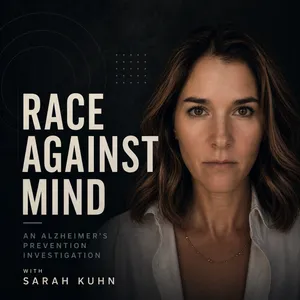
Race Against Mind is an Alzheimer's prevention investigation hosted by Sarah Kuhn, a double APOE4 carrier with a family history of early-onset Alzheimer's disease. Instead of waiting, Sarah started asking a different question: what does the research actually say, and what happens when you take it seriously?Each episode goes deep on one piece of the prevention puzzle: exercise, sleep, metabolic health, alcohol, hormones. Sarah breaks down the science, examines how strong it really is, and shares what she did with that information in her own life. What worked, what didn't, and what she changed her mind about along the way.If you carry APOE4, have a family history of Alzheimer's, or simply refuse to leave your brain health to chance, this show is for you.
Latest Episodes
The most recent episodes — sign up to get AI-powered summaries of each one.
- 1 weeks ago25 min
Hearing Loss, Hearing Aids, and Dementia Risk: What the Research Shows
I have worn hearing aids since I was 31, and I wear them less consistently than I should. Then I started reading about hearing loss and dementia, and I realized I had never actually looked at the evidence.In this episode I go through what the Lancet Commission, the Framingham Heart Study, and the ACHIEVE trial do and do not show. I look at why the type of hearing loss may matter, including what a new analysis says about otosclerosis, the condition I have. I also share the small change I am making so my hearing aids actually get worn.This is one of the largest modifiable risk factors we know of, but the science is still unsettled on whether treating it prevents dementia. I try to be honest about both halves of that.Show Notes
- Oct 30, 202621 min
Ep. 16 Creatine for Brain Health: The Research, the Hype and What the Science Actually Says
I've mentioned creatine twice on this show and never explained it. This is that episode.I started taking creatine for my muscles, not my brain. I was entering perimenopause, taking resistance training seriously for the first time, and creatine had the strongest evidence base of any supplement I was considering. The brain research came later. And when the first clinical study on creatine and Alzheimer's disease dropped this year, my Instagram told me to take more. A lot more. I listened before I read the paper.This episode covers what creatine actually is, why the muscle evidence for women in midlife is genuinely strong, what the brain research does and does not show, and the honest gap between what circulated online and what the studies actually said. Including why I went from 5 grams a day to 15, and what happened next.Show Notes
- Oct 19, 202617 min
Ep. 15 Prevention Without Panic: Reading Bloodwork Without Spiraling as an APOE4 Carrier
Getting bloodwork back when you carry APOE4 is not the same as getting bloodwork back without it. A cholesterol marker becomes a brain health question. A glucose marker becomes a question about cognitive decline. One number can feel like the whole web lighting up at once.This episode is about the skill that lives underneath the protocol. Learning how to receive health data without immediately handing your nervous system over to it. Not prevention without concern. Prevention without panic.I introduce a framework I call the Five Passes: five categories for sorting any lab result, biomarker, or wearable data point before you decide what it means or what to do with it. Signal. Trend. Lever. Context. Noise. I walk my own ApoB data through all five, and then give real examples for each pass including a p-tau217 story that taught me the most important question to ask before you spiral on any result.Show Notes
- Oct 12, 202622 min
Ep.14 The Exercise Update: More Research, More Nuance
A few months ago I told you that sprint training was the session I protect above everything else and that intensity was the active ingredient for Alzheimer's prevention. Then four new trials landed. This episode is the update.I walk through what each study actually found, what it does and does not prove, and what I have changed in my own protocol as a result. Including a finding about tau that directly contradicts how I was framing the exercise-brain relationship, a resistance training study with a subgroup result that every APOE4 carrier should know about and also approach carefully, and a large randomized trial that raises a question I had not taken seriously enough: what if the plan and the accountability matter as much as the workout itself.Show Notes
- Oct 2, 202625 min
Ep. 13 Does ADHD Increase Your Risk of Alzheimer's? What the Research Actually Says
Does ADHD increase your risk of Alzheimer's disease, or dementia more broadly? This episode breaks down what the research actually shows, including major cohort studies from Taiwan and Israel, a 2026 meta-analysis, the APOE4 gene, and the locus coeruleus as a possible shared brain mechanism. I also share my own 20-year history with ADHD medication, including a study I badly misread and why I eventually switched to Strattera. If you have ADHD, carry APOE4, or care about dementia prevention, this one's for you.Show Notes
- Jul 28, 202616 min
Ep. 12 Does Botox Touch the Brain? What the Research Shows for APOE4
I've been getting Botox on and off since I was 38. I never once thought about what it might mean for my brain until another APOE4 carrier asked me directly. So I went looking for the research. What I found wasn't the verdict I expected in either direction, it was a genuine gap. This episode walks through what the actual studies say, where they contradict each other, why dose and route matter more than headlines suggest, and how I made a decision without getting the certainty I wanted.This episode breaks from the usual protocol format, there's no clean "here's what works" takeaway. Instead I trace how I went looking for evidence that cosmetic Botox affects the brain in someone with my genetics, and ended up with a research gap instead of an answer. I cover the biological reasons APOE4 carriers have a different baseline worth asking about, walk through the specific studies that pointed in different directions, explain how dose and exposure route changed my read of the evidence, and get honest about the fact that vanity, not brain safety, is what actually got me back in the chair.Show Notes
- Jul 10, 202616 min
Ep. 11 The Accumulation: What I Do When the Research Doesn't Give Me an Answer
This episode is different. No protocol, no experiment, no takeaways in the usual sense. Instead, I'm sitting with what happens when APOE4 research keeps getting more specific and doesn't hand me anything to actually do about it.I walk through a new study on how APOE4 disrupts a backup fuel system in aging neurons, my own spiral into APOC1 research after a confident claim from a longevity doctor turned out to be more complicated than advertised, and what it's actually like to keep learning about a gene that touches nearly every system tied to Alzheimer's risk. This one is about the accumulation, not the answer.Show Notes
- Jun 25, 202623 min
Ep. 10 Chronic Stress, Cortisol & Alzheimer's Risk: The APOE4 Vulnerability No One Talks About
Chronic stress is one of the most underappreciated risk factors for Alzheimer's disease and for APOE4 carriers, the relationship between stress hormones and neurodegeneration is not just additive. It's amplified through a distinct biological mechanism that operates independently of every other pillar in your prevention protocol.In this episode, Sarah walks through three years of personal HRV data that told her something her protocol wasn't accounting for, the research on why APOE4 carriers are fundamentally more vulnerable to the effects of chronic cortisol elevation, and what the science actually supports when it comes to stress reduction and Alzheimer's prevention. This is also the episode where the show's format changes and why.This episode covers: what HRV actually measures and why longitudinal trends matter more than daily scores, the APOE4-specific stress vulnerability equation, the odds ratio for Alzheimer's from chronic stress that rivals almost every other modifiable risk factor, the mitochondrial mechanism that makes cortisol more damaging in APOE4 brains, what the FINGER trial found about who benefits most from lifestyle intervention, and what Sarah is currently exploring.Show Notes
Get Race Against Mind: An Alzheimer's Prevention Investigation summaries in your inbox
Free AI-powered daily recaps. Key takeaways, quotes, and mentions — in a 5-minute read.
Get Free Summaries →Free forever for up to 3 podcasts. No credit card required.
You Might Also Like
Listeners also like.
FoundMyFitness
A podcast exploring health, science, nutrition, aging, and fitness.

The Peter Attia Drive
Conversations with experts on health, longevity, performance, and critical thinking led by physician Peter Attia.

The Dr. Hyman Show
Explores root causes of chronic disease and promotes functional medicine, nutrition, and preventive health through expert discussions.
The Human Upgrade: Biohacking for Longevity & Performance
Dave Asprey explores biohacking, longevity, and performance through science and expert interviews to improve energy, focus, and resilience.

The Dan Buettner Podcast
Shares practical habits and insights from the world’s longest-lived populations to improve longevity and well-being.
Thinking Health Podcast
Explores health and wellness through expert interviews, focusing on low-carb science and practical strategies for improving well-being.
The Proof with Simon Hill
A physiotherapist and nutritionist discusses science-based approaches to health, longevity, exercise, nutrition, sleep, and mindfulness.

Health vs Hype with the American Medical Association
A medical expert debunks viral health trends and misinformation with science-backed insights from physicians.

TED Health
Explores the science behind health, habits, and medical breakthroughs through expert TED talks hosted by Dr. Shoshana Ungerleider.
Red Pill Your Healthcast
Two healthcare providers discuss overlooked health issues and empower listeners to make informed decisions for their families.

Everyday Wellness: Midlife Hormones, Menopause, and Science for Women 35+
A nurse practitioner shares science-based strategies for managing midlife hormones, menopause, and women's health.

BETTER! with Dr. Stephanie Estima | Women's Strength, Body Composition and Hormones
Women in perimenopause and menopause learn science-based strategies for strength, hormones, and body composition from expert interviews.
About Race Against Mind: An Alzheimer's Prevention Investigation
Race Against Mind is an Alzheimer's prevention investigation hosted by Sarah Kuhn, a double APOE4 carrier with a family history of early-onset Alzheimer's disease. Instead of waiting, Sarah started asking a different question: what does the research actually say, and what happens when you take it seriously?Each episode goes deep on one piece of the prevention puzzle: exercise, sleep, metabolic health, alcohol, hormones. Sarah breaks down the science, examines how strong it really is, and shares what she did with that information in her own life. What worked, what didn't, and what she changed her mind about along the way.If you carry APOE4, have a family history of Alzheimer's, or simply refuse to leave your brain health to chance, this show is for you.
Customized Recaps
AI-powered recaps with compact key takeaways, quotes, and insights.
Straight to Your Inbox
Get key takeaways from Race Against Mind: An Alzheimer's Prevention Investigation in a 5-minute read.
Save Hours Every Week
Stay current on your favorite podcasts without falling behind.
Frequently Asked Questions
What is Podzilla's Race Against Mind: An Alzheimer's Prevention Investigation daily summary?
It's a free AI-powered email that summarizes new episodes of Race Against Mind: An Alzheimer's Prevention Investigation as soon as they're published. You get the key takeaways, notable quotes, and links & mentions — all in a quick read.
How does the Race Against Mind: An Alzheimer's Prevention Investigation podcast summary work?
When a new episode drops, our AI transcribes and analyzes it, then generates a personalized summary tailored to your interests and profession. It's delivered to your inbox every morning.
Is this an official Race Against Mind: An Alzheimer's Prevention Investigation product?
No. Podzilla is an independent service that summarizes publicly available podcast content. We're not affiliated with or endorsed by Sarah Kuhn.
Can I get summaries of other podcasts too?
Absolutely! The free plan covers up to 3 podcasts, any in the catalog. Basic raises that to 15, Pro to 40 and Max to 100. Browse our full catalog at /podcasts.
What topics does Race Against Mind: An Alzheimer's Prevention Investigation cover?
Race Against Mind: An Alzheimer's Prevention Investigation covers topics including Fitness, Health & Fitness. Our AI identifies the specific themes in each episode and highlights what matters most to you.
Start getting Race Against Mind: An Alzheimer's Prevention Investigation summaries tomorrow morning.
Free forever for up to 3 podcasts. No credit card required.
Free forever for up to 3 podcasts. No credit card required.