Free Daily Podcast Summary
Office Hours with Arthur Brooks: Daily Summaries Delivered
by Arthur Brooks
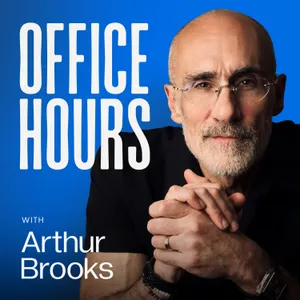
Hi Friends, I’m Arthur Brooks, a social scientist, Vanderbilt professor, and columnist at The Free Press. I write, speak, and teach about the science of human happiness, blending neuroscience, behavioral science, philosophy, and religion for insights on how to live better and be happier. Each week on Office Hours, you’ll get a glimpse into the cutting edge research on happiness, and explore how you can use it to improve your life—and share what you learn with those you love.
Latest Episodes
The most recent episodes — sign up to get AI-powered summaries of each one.
- 6 days ago50 min
5 Ways to Kill Your Envy and Get Happier
Dante had a particularly gruesome punishment for the envious: their eyes were wired shut. In this episode of Office Hours, I explore why envy is such a powerful happiness killer—and how to stop feeding it in your own life.—Brought to you by:• Noble Mobile—With Noble, there is only one plan: The No-Bull Plan. It’s simple. It’s transparent. And if you use less data, you get cash back. Get an exclusive offer at: https://noblemobile.com/arthurbrooks—Where to find Arthur Brooks: • Website: https://arthurbrooks.com/• In-person Retreats: https://retreats.arthurbrooks.com/ • Newsletter: https://www.arthurbrooks.com/newsletter • X: https://x.com/arthurbrooks• Instagram: https://www.instagram.com/arthurcbrooks/• Facebook: https://www.facebook.com/ArthurBrooks/• YouTube: https://www.youtube.com/channel/UCGuyFRjJQFGCKzfHTBvWM6A• LinkedIn: https://www.linkedin.com/in/arthur-c-brooks/• Email: officehours@arthurbrooks.com—Timestamps:00:00 Intro7:15 Dante’s Divine Comedy11:56 Definition of envy and its purpose18:46 Benign and malicious envy24:13 The effects on the brain when you’re feeling envy28:30 What people envy33:25 5 ways to be less envious and much happier45:06 Q&A: Four classic temperaments46:34 Q&A: Developing your PhD research question48:40 Q&A: Romantic love: addiction or happiness?—Referenced: • The Meaning of Your Life: Finding Purpose in an Age of Emptiness: https://www.arthurbrooks.com/the-meaning-of-your-life • Arthur’s newsletter: https://www.arthurbrooks.com/newsletter • The Happiness Scale: https://learn.arthurbrooks.com/the-happiness-scale• Dante’s Purgatorio, Canto 13: http://dantelab.dartmouth.edu/reader?reader%5Bcantica%5D=2&reader%5Bcanto%5D=13• Josef Epstein. Envy: https://www.amazon.com/dp/B00VQVKUPC?lv=shuf&channelId=500&plpRedirect=mhFallback •Envy: An Adversarial Review and Comparison of Two Competing Views: https://journals.sagepub.com/doi/abs/10.1177/1754073919873131•The Role of Subjective and Objective Social Status in the Generation of Envy: https://www.frontiersin.org/journals/psychology/articles/10.3389/fpsyg.2020.513495/full•When your gain is my pain and your pain is my gain: https://pubmed.ncbi.nlm.nih.gov/19213918/ •Is envy harmful to a society's psychological health and wellbeing?: <a href="https://pubmed.ncbi.n
- 1 weeks ago50 min
What Is the Happiest Personality? (It Actually Might Be Yours)
If you’re an introvert, you might not like what the research has to say: Extroverts tend to be happier. But before you start striking up conversations with strangers in the elevator, there’s more to the story. In this episode of Office Hours, I explore how your personality might shape your happiness, what introverts and extroverts can learn from each other, and why understanding your natural tendencies can help you cultivate habits towards a more connected and, therefore, happier life.—Brought to you by:• Noble Mobile—With Noble, there is only one plan: The No-Bull Plan. It’s simple. It’s transparent. And if you use less data, you get cash back. Get an exclusive offer at: https://noblemobile.com/arthurbrooks• LMNT—A science-backed electrolyte drink mix that helps you feel and perform your best, without sugar, artificial ingredients, or gimmicks. Get a free sample pack at DrinkLMNT.com/Arthur—Where to find Arthur Brooks: • Website: https://arthurbrooks.com/• In-person Retreats: https://retreats.arthurbrooks.com/ • Newsletter: https://www.arthurbrooks.com/newsletter • X: https://x.com/arthurbrooks• Instagram: https://www.instagram.com/arthurcbrooks/• Facebook: https://www.facebook.com/ArthurBrooks/• YouTube: https://www.youtube.com/channel/UCGuyFRjJQFGCKzfHTBvWM6A• LinkedIn: https://www.linkedin.com/in/arthur-c-brooks/• Email: officehours@arthurbrooks.com—Timestamps: Intro Personality traits and genetics Jung’s work on personality The Big Five personality traits (OCEAN) Eysenck’s theories on introversion and extroversion Why extroverts tend to have a happiness advantage What introverts can learn from extroverts What extroverts can learn from introverts Happiness homework for introverts and extroverts Q&A: Budgeting, vacations, and happiness Q&A: Dealing with romantic failure —Referenced: • The Meaning of Your Life: Finding Purpose in an Age of Emptiness: themeaningofyourlife.com• Meaning
- 2 weeks ago50 min
5 Ways to Find Your Faith
Why do so many people drift from faith in early adulthood, only to feel drawn back to it later in life? In this episode of Office Hours, I explore the Hindu concept of Ashramas and the parallels with what modern science tells us about how our priorities change with age. As we get older, the worldly rewards we once chased can start to feel less satisfying. We begin asking deeper questions about wisdom, meaning, and transcendence. That’s what happens when you enter Vanaprastha—the stage of life when we turn our attention inward. I also share five practical steps for beginning (or rebeginning) your own spiritual journey. —Brought to you by:• Noble Mobile—With Noble, there is only one plan: The No-Bull Plan. It’s simple. It’s transparent. And if you use less data, you get cash back. Get an exclusive offer at: https://noblemobile.com/arthurbrooks—Where to find Arthur Brooks: • Website: https://arthurbrooks.com/• In-person Retreats: https://retreats.arthurbrooks.com/ • Newsletter: https://www.arthurbrooks.com/newsletter • X: https://x.com/arthurbrooks• Instagram: https://www.instagram.com/arthurcbrooks/• Facebook: https://www.facebook.com/ArthurBrooks/• YouTube: https://www.youtube.com/channel/UCGuyFRjJQFGCKzfHTBvWM6A• LinkedIn: https://www.linkedin.com/in/arthur-c-brooks/• Email: officehours@arthurbrooks.com—Timestamps: Intro Lessons from Hinduism Ashramas: The four stages of lifeBrahmacharyaGrihasthaVanaprasthaSannyasa The link between spirituality and midlife #1: Loosen your commitments to not believing #2. Spirituality as an entrepreneurial endeavor #3: Walk towards what you seek #4. Get a buddy #5. Find a teacher Q&A: The evolutionary purpose of dark triads Q&A: Having a two-way relationship with god —Referenced: • The Meaning of Your Life: Finding Purpose in an Age of Emptiness: https://www.arthurbrooks.com/the-meaning-of-your-life • Arthur’s newsletter: https://www.arthurbrooks.com/newsletter • The Happiness Scale
- 3 weeks ago45 min
The Three Secrets to Raising Great Kids
Being a parent is one of the most meaningful things you can do with your life, and one of the easiest things to worry about getting wrong. Most of us ultimately want the same things for our children: for them to grow up to be good people and have a good life. But how much influence do parents actually have over those outcomes?In this episode of Office Hours, I explore what the research can teach us about raising happy, well-adjusted kids, including how much of our children’s personalities are inherited, where we as parents really can make a difference, and why what we model often matters more than what we say. —Brought to you by:• Noble Mobile—With Noble, there is only one plan: The No-Bull Plan. It’s simple. It’s transparent. And if you use less data, you get cash back. Get an exclusive offer at https://noblemobile.com/arthurbrooks• LMNT—A science-backed electrolyte drink mix that helps you feel and perform your best, without sugar, artificial ingredients, or gimmicks. Get a free sample pack at DrinkLMNT.com/Arthur—Where to find Arthur Brooks: • Website: https://arthurbrooks.com/• In-person Retreats: https://retreats.arthurbrooks.com/ • Newsletter: https://www.arthurbrooks.com/newsletter • X: https://x.com/arthurbrooks• Instagram: https://www.instagram.com/arthurcbrooks/• Facebook: https://www.facebook.com/ArthurBrooks/• YouTube: https://www.youtube.com/channel/UCGuyFRjJQFGCKzfHTBvWM6A• LinkedIn: https://www.linkedin.com/in/arthur-c-brooks/• Email: officehours@arthurbrooks.com—Timestamps: Intro What most parents want for their kids What the research has revealed about nature vs. nurture How parenting impacts personality Parenting principle #1: Even a hot mess can be a great parent Parenting principle #2: Be warm and loving Parenting principle #3: Be an actor Q&A: Overcoming bad habits learned from your parents Q&A: How to support a child with a toxic partner Q&A: Teaching children the discipline of happiness—Referenced: • The Meaning of Your Life: Finding Purpose in an Age of Emptiness: https://www.arthurbrooks.com/the-meaning-of-your-life • Meaning Membership: https://hub.arthurbrooks.com/the-meaning-membership • Arthur’s newsletter: https://www.arthurbrooks.com/newsletter • The Happiness Scale: https://learn.arthurbrooks.com/the-happiness-scale • The Pursuit of Happiness with Arthur Brooks: https://www.thefp.com/s/the-pursuit-of-happiness-with-arthur• Parenting in America Today: https://www.pewresearch.org/social-trends/2023/01/24/parenting-in-america-today• OCEAN: https://pubmed.ncbi.nlm.nih.gov/1635039/ • Heritability of the big five persona
- Aug 17, 202648 min
Success Secret: Finding People Who Disagree With You
Most of us prefer spending time with people who are like us. They think like us, share our values, and make us feel comfortable. But while similarity may be easy, it isn't always what helps us grow.In this episode of Office Hours, I explain why some of the greatest benefits in life come from building relationships with people who think, believe, and live differently from us. I explore the science behind why diversity of thought can make us wiser and more successful, and share three practical ways to bring more variety of opinions and values into your life. And if you want to get better at disagreeing better, check out one of my earlier episodes on loving your “enemies.”—Brought to you by:• LMNT—A science-backed electrolyte drink mix that helps you feel and perform your best, without sugar, artificial ingredients, or gimmicks. Get a free sample pack at DrinkLMNT.com/Arthur• Magic Mind—Magic Mind is a mental performance shot with vitamins and clinically backed ingredients like Ashwagandha and Lion’s Mane for a sharper mind and sustained energy. Get 50% off your first order at magicmind.com —Where to find Arthur Brooks: • Website: https://arthurbrooks.com/• In-person Retreats: https://retreats.arthurbrooks.com/ • Newsletter: https://www.arthurbrooks.com/newsletter • X: https://x.com/arthurbrooks• Instagram: https://www.instagram.com/arthurcbrooks/• Facebook: https://www.facebook.com/ArthurBrooks/• YouTube: https://www.youtube.com/channel/UCGuyFRjJQFGCKzfHTBvWM6A• LinkedIn: https://www.linkedin.com/in/arthur-c-brooks/• Email: officehours@arthurbrooks.com—Timestamps: Intro Bonding vs. bridging social capital Why we prefer people who are like us Why diversity makes us happier Demographic diversity vs. diversity of ideas How disagreement can improve your thinking Step 1: Talk to strangers Step 2: Become a social scientist Step 3: Celebrate heresy Q&A: How video games affect happiness Q&A: What happens when positivity goes too far Q&A: How to avoid being ruled by pleasure—Referenced: • The Meaning of Your Life: Finding Purpose in an Age of Emptiness: https://www.arthurbrooks.com/the-meaning-of-your-life • Meaning Membership: https://hub.arthurbrooks.com/the-meaning-member
- Aug 10, 20261h 18m
One Year of Office Hours: Lessons on Love and Friendship
In this special one-year anniversary episode of Office Hours, I'm joined by six young adults to discuss the modern crisis of meaning and why so many people feel disconnected despite having more ways to connect than ever. Together, we explore why friendship and romantic love seem harder to find and maintain, what gets in the way of deep connection, and what young adults are actually looking for in relationships, community, and life. Along the way, the participants share their experiences navigating friendship, dating, marriage, graduate school, and major life transitions.If there's one hope I have for this episode—and for this podcast—it's that it helps us all build lives that are richer in meaning, connection, and love.Whether you've been with us all year or this is your first episode, thank you for listening. I'm grateful you're joining me in the mission to lift people up and bring us together in bonds of happiness and love.—Where to find Arthur Brooks: • Website: https://arthurbrooks.com/• In-person Retreats: https://retreats.arthurbrooks.com/ • Newsletter: https://www.arthurbrooks.com/newsletter • X: https://x.com/arthurbrooks• Instagram: https://www.instagram.com/arthurcbrooks/• Facebook: https://www.facebook.com/ArthurBrooks/• YouTube: https://www.youtube.com/channel/UCGuyFRjJQFGCKzfHTBvWM6A• LinkedIn: https://www.linkedin.com/in/arthur-c-brooks/• Email: officehours@arthurbrooks.com—Timestamps: Intro Introducing the young participants The three macronutrients of happiness, and the crisis of loss of meaning The three parts of meaning The decline in friendship and romantic love The challenges of making friends in adulthood Friendship after marriage Making friends in graduate school Best friends Going deeper in a friendship The seven lessons of friendship Why falling in love seems harder today Dating off the apps The limitations of dating apps What the participants want out of a relationship Why deep friendship is the key and what's getting in the way The rules for successful love and dating —Production and marketing by https://penname.co/.
- Aug 3, 202637 min
Why You Should Let People Help You More
We usually think generosity means helping other people. But what if accepting help is generous, too?In this episode of Office Hours, I explore why letting others help us can be a gift. We’ll look at the science of why helping makes people happier, why others enjoy doing us favors more than we expect, the four rules for asking well, and how receiving with grace creates a virtuous cycle of generosity.—Brought to you by:• Noble Mobile—With Noble, there is only one plan: The No-Bull Plan. It’s simple. It’s transparent. And if you use less data, you get cash back. Get an exclusive offer at: https://noblemobile.com/arthurbrooks. • Helix Sleep—A mattress designed for every body. Go to helixsleep.com/brooks for 20% off sitewide, 25% off Luxe Mattresses, and 30% off Elite Mattresses for their Fourth of July Sale—Extended!—Where to find Arthur Brooks: • Website: https://arthurbrooks.com/• In-person Retreats: https://retreats.arthurbrooks.com/ • Newsletter: https://www.arthurbrooks.com/newsletter • X: https://x.com/arthurbrooks• Instagram: https://www.instagram.com/arthurcbrooks/• Facebook: https://www.facebook.com/ArthurBrooks/• YouTube: https://www.youtube.com/channel/UCGuyFRjJQFGCKzfHTBvWM6A• LinkedIn: https://www.linkedin.com/in/arthur-c-brooks/• Email: officehours@arthurbrooks.com—Timestamps: Intro The benefits of giving to others Why asking for help is an act of generosity Rule #1: How much is too much Rule #2: Asking is not demanding Rule #3: Don’t wreck it Rule #4: Being generous requires nothing Q&A: Resources for aporia Q&A: Marrying outside your faith —Referenced: • The Meaning of Your Life: Finding Purpose in an Age of Emptiness: https://www.arthurbrooks.com/the-meaning-of-your-life • Meaning Membership: https://hub.arthurbrooks.com/the-meaning-membership • Arthur’s newsletter:<a href="https://www.arthurbrooks.com/newsletter" target="_blank" rel="ugc noopener no
- Jul 27, 202645 min
The Power of Sunlight: Protocols for Better Mood, Sleep & Happiness
It's easy to assume that we'd be happier if we lived somewhere with more sunshine. But how much does sunlight actually matter?In this episode of Office Hours, I examine what the research says about the relationship between sunlight and happiness, why some people benefit more than others, and how much sunlight you really need. I also share three practical ways to build healthier light habits.—Brought to you by:• Noble Mobile—With Noble, there is only one plan: The No-Bull Plan. It’s simple. It’s transparent. And if you use less data, you get cash back. Get an exclusive offer at: https://noblemobile.com/arthurbrooks • Helix Sleep—A mattress designed for every body. Go to helixsleep.com/brooks for 20% off sitewide, 25% off Luxe Mattresses, and 30% off Elite Mattresses for their Fourth of July Sale—Extended!—Where to find Arthur Brooks: • Website: https://arthurbrooks.com/• In-person Retreats: https://retreats.arthurbrooks.com/ • Newsletter: https://www.arthurbrooks.com/newsletter • X: https://x.com/arthurbrooks• Instagram: https://www.instagram.com/arthurcbrooks/• Facebook: https://www.facebook.com/ArthurBrooks/• YouTube: https://www.youtube.com/channel/UCGuyFRjJQFGCKzfHTBvWM6A• LinkedIn: https://www.linkedin.com/in/arthur-c-brooks/• Email: officehours@arthurbrooks.com—Timestamps: Intro What the research shows about the effects of sunlight What Seasonal Affective Disorder (SAD) is The small percentage of people who react negatively to sunlight How sunlight affects mood and the role of vitamin D How much sunlight you need to get the benefits Why some people overdo it with sunlight Make sunshine a daily routine Get your morning light even without the sun When to avoid the light Why you probably don’t need to move to be by the sun Q&A: Finding meaning after a life change Q&A: Relating to friends with different tolerance for conflict —Referenced: • The Meaning of Your Life: Finding Purpose in an Age of Emptiness: https://www.arthurbrooks.com/the-meaning-of-your-life • Meaning Membership: https://hub.arthurbrooks.com/the-meaning-membership • Arthur’s newsletter: https://www.arthurbrooks.com/newsletter • The Happiness Scale: https://learn.arthurbrooks.com/the-happiness-scale • The Pursuit of Happiness with Arthur Brooks: https://www.thefp.com/s/the-pursuit-of-happiness-with-arthur• The Meaning of Your Life Retreats: <a href="https://r
Get Office Hours with Arthur Brooks summaries in your inbox
Free AI-powered daily recaps. Key takeaways, quotes, and mentions — in a 5-minute read.
Get Free Summaries →Free forever for up to 3 podcasts. No credit card required.
You Might Also Like
Listeners also like.
The Happiness Lab with Dr. Laurie Santos
A Yale psychologist examines misconceptions about happiness through science and expert insights.
10% Happier with Dan Harris
Practical mindfulness and meditation advice from experts, blending science and ancient wisdom for skeptics.
The Science of Happiness
Explores scientific research on compassion, gratitude, mindfulness, and awe to foster greater happiness and meaning in daily life.

Huberman Lab
Explores neuroscience and science-based tools for understanding and improving brain function, behavior, and health.

Dear HBR:
Two Harvard Business Review editors offer practical, research-backed advice to solve common workplace challenges.

Happier with Gretchen Rubin
Two sisters explore practical strategies for building happier lives and better habits through conversational, relatable weekly discussions.
A Bit of Optimism
Conversations with thinkers and doers exploring what drives purpose, growth, and meaning in life.

Passion Struck with John R. Miles
Explores purpose, resilience, and connection through science-backed conversations with experts in psychology, neuroscience, and performance.
Being Well with Forrest Hanson and Dr. Rick Hanson
Explores the science of lasting well-being through psychology, neuroscience, and mindfulness with expert guests.
How to Be a Better Human
Conversations exploring practical ways to improve yourself and connect more meaningfully with others, inspired by TED’s Ideas blog.

Happier in Hollywood
Two veteran TV writers share candid insights on surviving and thriving in Hollywood’s competitive entertainment industry.
Growth Mindset Psychology: The Science of Self-Improvement
Explores the science behind lasting self-improvement through psychology, neuroscience, and timeless wisdom traditions.
About Office Hours with Arthur Brooks
Hi Friends, I’m Arthur Brooks, a social scientist, Vanderbilt professor, and columnist at The Free Press. I write, speak, and teach about the science of human happiness, blending neuroscience, behavioral science, philosophy, and religion for insights on how to live better and be happier. Each week on Office Hours, you’ll get a glimpse into the cutting edge research on happiness, and explore how you can use it to improve your life—and share what you learn with those you love.
Customized Recaps
AI-powered recaps with compact key takeaways, quotes, and insights.
Straight to Your Inbox
Get key takeaways from Office Hours with Arthur Brooks in a 5-minute read.
Save Hours Every Week
Stay current on your favorite podcasts without falling behind.
Frequently Asked Questions
What is Podzilla's Office Hours with Arthur Brooks daily summary?
It's a free AI-powered email that summarizes new episodes of Office Hours with Arthur Brooks as soon as they're published. You get the key takeaways, notable quotes, and links & mentions — all in a quick read.
How does the Office Hours with Arthur Brooks podcast summary work?
When a new episode drops, our AI transcribes and analyzes it, then generates a personalized summary tailored to your interests and profession. It's delivered to your inbox every morning.
Is this an official Office Hours with Arthur Brooks product?
No. Podzilla is an independent service that summarizes publicly available podcast content. We're not affiliated with or endorsed by Arthur Brooks.
Can I get summaries of other podcasts too?
Absolutely! The free plan covers up to 3 podcasts. Upgrade to Pro for 15, or Premium for 50. Browse our full catalog at /podcasts.
How often does Office Hours with Arthur Brooks release new episodes?
Office Hours with Arthur Brooks publishes weekly. Our AI generates a summary within hours of each new episode.
What topics does Office Hours with Arthur Brooks cover?
Office Hours with Arthur Brooks covers topics including Fitness, Health & Fitness, Mental Health. Our AI identifies the specific themes in each episode and highlights what matters most to you.
Start getting Office Hours with Arthur Brooks summaries tomorrow morning.
Free forever for up to 3 podcasts. No credit card required.
Free forever for up to 3 podcasts. No credit card required.