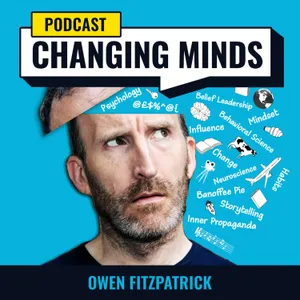
Free Daily Podcast Summary
Inner Propaganda with Owen Fitzpatrick: Daily Summaries Delivered
by Owen Fitzpatrick
The most powerful propagandist in your life is you. Inner Propaganda with Owen Fitzpatrick explores the unconscious beliefs and stories that shape how we think, decide, and lead. Owen is a social psychologist, keynote speaker, and author of Inner Propaganda (Ideapress, 2026). For over two decades, he's studied belief systems, from global boardrooms to field research in North Korea, Rwanda, and Afghanistan. Each episode unpacks how beliefs form, why they resist change, and what it takes to lead through uncertainty. Ideas for leaders, thinkers, and anyone tired of soft-skill clichés.
Latest Episodes
The most recent episodes — sign up to get AI-powered summaries of each one.
- 4 days ago28 min
Reflections on my TEDx talk 10 years ago
Ten years ago, I stood on a TEDx stage and delivered an entire talk in rhyme, including a rap battle with the voice in my head. It has since been viewed more than 1.4 million times, and it was the first time I ever said the words "inner propaganda" in public. This episode includes a discussion of suicide. If you are struggling, please reach out. In the US, you can call or text 988. In Ireland and the UK, you can call Samaritans free, day or night, on 116 123. Wherever you are in the world, you can find a free helpline at https://findahelpline.com/ The idea at the heart of the talk is simple. We influence ourselves in the very same way that propaganda influences us. Our inner dictator uses our biases, our moods, and our fears to sell us stories about who we are and what we deserve. In this episode of Inner Propaganda, I explore the talk line by line, pausing to share the thinking behind it. I talk about the struggles I faced at 14, the travels that shaped my understanding of propaganda, the one line I deliberately left without a rhyme, and the moment I nearly stumbled, forgetting a line mid-rhyme. What you will discover: How the concept of inner propaganda was born Why confirmation bias and our emotions make us so certain we are right <span style= "font-size: 11pt; font-family: Arial,sans-serif; color: #000000; background-color: transparent; font-weight: 400; font-style: normal; font-variant: norma
- 1 weeks ago51 min
The most important persuasive factor today with Henna Pryor
A school principal receives a long, heartfelt email from a worried mother. She writes back a thoughtful, personal reply in eight minutes, and the mother's first reaction is that AI must have written it. Henna Pryor says moments like this are now happening everywhere. Henna calls this the signal gap: the distance between the message we hope to send and what a verifying audience actually receives. We used to trust people until they gave us a reason to check. Today we check first and decide whether to trust afterward. In this episode of Inner Propaganda, I explore with Henna the four types of congruence that close the signal gap, the cognitive and emotional walls people bring into conversations, and why we can be deeply skeptical of institutions while trusting a favorite creator without question. Henna also shares how she answers questions outside her expertise without sounding vague, and why every post you publish sets a standard people will hold you to. What you will discover: Why we now verify first and trust second The four types of congruence and how each one builds believability How to recognize and lower the emotional wall in a conversation Why polished, safe "executive beige" language erodes trust How to diversify your inputs when the algorithm keeps feeding you more of the same <span style= "font-size: 11pt; font-family: Arial,sans-serif; color: #000000; background-color: transparent; font-weig
- 2 weeks ago17 min
How to have better conversations
Every time I speak with someone, eight conversations are going on at once. Most of them happen inside our heads, and they shape everything about how the real conversation unfolds. Some of these conversations are about me, some are about the other person, and two are about the topic we're discussing. Each one carries information that can make me a more understanding, persuasive, and influential communicator, if I learn to notice it. In this episode of Inner Propaganda, I explore the eight conversations framework one step at a time, from the story I tell myself about myself to the story the other person wants me to believe about them. I share how a single mention of a Ferrari can trigger a silent conversation about status, why feedback at work often goes unheard, and how to prepare for any conversation by mapping what each person is thinking. I finish with a distinction I find invaluable: separating facts, interpretations, opinions, and truth. What you will discover: The eight conversations taking place in every interaction How your self-talk can quietly sabotage what you hear from others How to close the gap between how people see you and how you want to be seen Why recognizing how someone sees themselves makes them more receptive to you How separating facts, interpretations, and opinions leads to smarter disagreements <span style= "font-size: 11pt; font-family: Arial,sans-serif; color: #000000; backg
- 3 weeks ago49 min
How to fix burnout with Cait Donovan
Cait Donovan burned out while working around 25 hours a week. She had time for long lunches with friends and mornings free to exercise, yet she still felt exhausted, irritated, and stuck. Years later, a single line in the burnout research gave her the answer she had been searching for. Cait's central idea is that burnout grows out of mismatches between people and their work, their families, their coping habits, and the environments around them. Workload matters, though it is only one piece of a much bigger picture. In this episode of Inner Propaganda, I explore the six workplace mismatches with Cait, why organizations that ignore them invite attrition and disengagement, and the personal factors that lead good people to accept mismatches in the first place. Cait also shares how she learned to disappoint people in small ways for practice, and why "pee when you need to pee" might be some of the best burnout advice you'll ever hear. What you will discover: Why the largest driver of burnout is a mismatch between a person and their role The six workplace mismatches and how to recognize them How interoception helps you notice burnout before it takes hold Why aiming for a 75% match works better than chasing perfection Simple ways to practice people pleasing less and asking for help more Cait's brilliant new book, Mismatch: Why Good People Burn Out in Good Organizations<span style= "font-size: 11pt;
- Oct 19, 202626 min
5 steps to becoming the hero of your life
Over 30 years as a therapist and executive coach, I noticed that almost every person I worked with explained their problems using one of two stories. Some saw themselves as the victim of everything happening around them. Others saw themselves as the villain, the reason everything kept falling apart. Both stories can feel completely true, and sometimes the evidence backs them up. The trouble is that the inner dictator only shows us the evidence that supports the story it wants us to believe. Each of us has been a victim, a villain, and a hero at different moments, which means we have more choice in the story we sell ourselves than we realize. In this episode of Inner Propaganda, I explore the victim story and the villain story, how the inner dictator uses each one as a tactic, and how the arcs of Darth Vader and Luke Skywalker show us what it looks like to move toward a hero story. I also share the five steps I have used with clients for decades to help them build a hero narrative and an antifragile identity. What you will discover: The two stories most people tell about their problems, and how to spot which one you are running Why being a villain is another way of being a victim How the inner dictator chooses evidence to make its narrative feel like fact The five As: awareness, agency, alternatives, adapt, and accept How Viktor Frankl's search for meaning and Nassim Nicholas Taleb's idea of antifragility can help you keep moving forward <p dir="ltr" style= "line-height: 1.38; mar
- Oct 12, 202623 min
Why we need to learn to disagree
When was the last time you sat down with someone who sees the world very differently and listened to understand them? I believe the biggest problem in the world today is that we are not disagreeing effectively enough. Too often, we decide it is pointless even to try. Polarization, echo chambers, and media that amplify the most extreme voices have convinced many of us that the gap between "us" and "them" is too wide to cross. Research shows we consistently overestimate how extreme the other side is, and when we respond with shame and moral outrage, we often push people further away. In this episode of Inner Propaganda, I explore why shaming backfires, what the rise of the Nazis teaches us about ignoring people's grievances, and why identity-protective cognition makes us reject views that challenge who we are. I also share a conversation with my guide in Afghanistan that tested my ability to disagree well, along with research on deep canvassing and what it reveals about how people change their minds. What you will discover: Why we overestimate how extreme the other side really is How shaming and moral outrage can create the very thing they oppose What identity-protective cognition means for every difficult conversation How the illusion of explanatory depth opens the door to more flexible thinking Why curiosity and respect give us the best chance of changing minds <span style= "font-size: 11pt; font-fam
- Oct 5, 202637 min
Why doing good as an organization pays with Jess Pettitt
What if your competitors are wrestling with the same dilemma you are, and nobody is brave enough to ask? My friend Jess Pettitt, a Hall of Fame speaker and crisis advisor, believes this fear is keeping good organizations from doing better. In her new book, Doing Good Better, Jess adapts Maslow's hierarchy of needs for organizations. At the top sits outlasting the cycle: surviving recession, disruption, and crisis while staying true to your values. She argues that every mistake you have made prepares you to recognize the next one faster. In this episode of Inner Propaganda, I explore with Jess why leaders fear admitting mistakes, the internal and external pressures behind that fear, and the two questions she asks leadership teams that reveal where they really stand. We also discuss the shareholder-versus-stakeholder debate, a protein loophole in the food industry, an oil refinery racing its competitors, and what it would take for AI leaders to agree on a shared off button. What you will discover: How organizations can climb their own version of Maslow's hierarchy Why past mistakes are preparation for recognizing new ones How internal and external pressure shape the decisions leaders make Why collaboration with competitors can create collective decisions that do good How to take back control of your own sense of urgency <span style= "font-size: 11pt; font-family: Arial,sans-serif; color: #000000; back
- Sep 28, 202632 min
How to talk back to the voice that hates you
Whenever I feel anxious or down, a voice in my head speaks with complete authority. It tells me I'm a fraud, that I'm broken, that nothing I do matters. I call it the inner dictator, and I have named him Dick. Inner propaganda is how we convince ourselves of the ideas we hold. The stories we sell to ourselves become the beliefs we buy into, and the inner dictator is the voice that sells the darkest of them with total certainty. In this episode of Inner Propaganda, I explore why recognizing the inner dictator weakens its hold, drawing on the persuasion knowledge model and my own experiences of propaganda in North Korea. I then go through the most common lines Dick uses on me, from "You're a freak" to "The world is so full of pain," and share how I talk back to each one. What you will discover: Why naming the inner dictator makes its messages less convincing How the change of meaning principle works inside your own mind Why your mood decides which evidence feels like proof Simple questions that expose the vague claims behind self-doubt How to judge a thought by its usefulness rather than its accuracy If you enjoyed this episode, check out my brand-new book, Inner Propaganda<span style= "font-size: 11pt; font-family: Arial,sans-serif; color: #000000; background-color: transparent; font-weight: 400; font-style: normal; font-variant: normal; text-decoration: none; vertical-align: baseline; white-space: p
Get Inner Propaganda with Owen Fitzpatrick summaries in your inbox
Free AI-powered daily recaps. Key takeaways, quotes, and mentions — in a 5-minute read.
Get Free Summaries →Free forever for up to 3 podcasts. No credit card required.
You Might Also Like
Listeners also like.

The One You Feed | Personal Growth, Emotional Resilience & Purpose
Conversations with thought leaders explore personal growth, emotional resilience, and living with purpose through small, consistent actions.
A Bit of Optimism
Conversations with thinkers and doers exploring what drives purpose, growth, and meaning in life.

The Knowledge Project
Explores the mental models and decision-making strategies of high-performing individuals across disciplines.

The Jordan Harbinger Show
Conversations with top performers across fields, distilling actionable insights on success, relationships, and personal growth.

Decoded | Unlock The Secrets of Human Behavior, Emotion and Motivation
Analyzes subconscious patterns in human behavior and provides methods to change them.

The Daily Motivation
Daily motivational messages featuring expert interviews and practical advice on personal growth and mindset.

Modern Wisdom
Discussions with experts on psychology, philosophy, and self-improvement to help navigate life’s challenges.

ReThinking
Adam Grant explores how top thinkers and achievers challenge assumptions and rethink their paths to success.

Growth Mindset Psychology: The Science of Self-Improvement
Explores the science behind lasting self-improvement through psychology, neuroscience, and timeless wisdom traditions.

Leading Outward
Leaders tackle culture, accountability, and conflict with real-time coaching and insights from global executives.

Chase Hughes: Behavior, Influence, Lies & Interrogation
A former U.S. Navy chief teaches behavior profiling, lie detection, and interrogation tactics to read people and control conversations.

Life is an Inside Job with Coach Mike Basevic
Explores subconscious emotional patterns affecting high achievers who struggle with self-doubt despite external success.
About Inner Propaganda with Owen Fitzpatrick
The most powerful propagandist in your life is you. Inner Propaganda with Owen Fitzpatrick explores the unconscious beliefs and stories that shape how we think, decide, and lead. Owen is a social psychologist, keynote speaker, and author of Inner Propaganda (Ideapress, 2026). For over two decades, he's studied belief systems, from global boardrooms to field research in North Korea, Rwanda, and Afghanistan. Each episode unpacks how beliefs form, why they resist change, and what it takes to lead through uncertainty. Ideas for leaders, thinkers, and anyone tired of soft-skill clichés.
Customized Recaps
AI-powered recaps with compact key takeaways, quotes, and insights.
Straight to Your Inbox
Get key takeaways from Inner Propaganda with Owen Fitzpatrick in a 5-minute read.
Save Hours Every Week
Stay current on your favorite podcasts without falling behind.
Frequently Asked Questions
What is Podzilla's Inner Propaganda with Owen Fitzpatrick daily summary?
It's a free AI-powered email that summarizes new episodes of Inner Propaganda with Owen Fitzpatrick as soon as they're published. You get the key takeaways, notable quotes, and links & mentions — all in a quick read.
How does the Inner Propaganda with Owen Fitzpatrick podcast summary work?
When a new episode drops, our AI transcribes and analyzes it, then generates a personalized summary tailored to your interests and profession. It's delivered to your inbox every morning.
Is this an official Inner Propaganda with Owen Fitzpatrick product?
No. Podzilla is an independent service that summarizes publicly available podcast content. We're not affiliated with or endorsed by Owen Fitzpatrick.
Can I get summaries of other podcasts too?
Absolutely! The free plan covers up to 3 podcasts, any in the catalog. Basic raises that to 15, Pro to 40 and Max to 100. Browse our full catalog at /podcasts.
How often does Inner Propaganda with Owen Fitzpatrick release new episodes?
Inner Propaganda with Owen Fitzpatrick publishes weekly. Our AI generates a summary within hours of each new episode.
What topics does Inner Propaganda with Owen Fitzpatrick cover?
Inner Propaganda with Owen Fitzpatrick covers topics including Science, Education, Social Sciences, Self-Improvement. Our AI identifies the specific themes in each episode and highlights what matters most to you.
Start getting Inner Propaganda with Owen Fitzpatrick summaries tomorrow morning.
Free forever for up to 3 podcasts. No credit card required.
Free forever for up to 3 podcasts. No credit card required.