Free Daily Podcast Summary
Hypertrophy Past and Present: Daily Summaries Delivered
by Chris Beardsley and Jake Doleschal
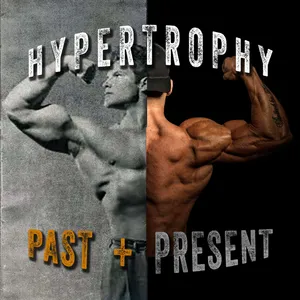
A deep dive into the science of muscle growth. Hosted by Chris Beardsley and Jake Doleschal, this podcast explores hypertrophy training through the lens of pre-steroid era bodybuilding and modern muscle physiology.
Latest Episodes
The most recent episodes — sign up to get AI-powered summaries of each one.
- Today1h 48m
070 A 67 exercise upper body workout with Soren Lemrant
In this episode of Hypertrophy Past & Present, Jake and Chris welcome their first-ever guest, Soren, the “67-set upper day guy.” Soren takes us through his upper-body workout exercise by exercise, explaining the reasoning behind some of his more unconventional setups.Key topics include:Soran’s 67-set upper-body workout and the philosophy behind training so many individual muscle functionsModifying pec decks ad pullover machines to target different regions of the chestTraining the lats through sagittal, frontal, and scapular-plane movementsDirect training for the traps, scapular muscles, neck, and shoulder rotatorsHow Soren manages 67 exercises without spending several hours in the gymCheck out Soren on social media at lemrant_da_liftaWant to train like a Silver-Era bodybuilder? Join our Hypertrophy Past and Present Training group on TrainHeroic.com
- 1 weeks ago1h 26m
069 Evaluating a new hypertrophy model
In this episode of Hypertrophy Past & Present, Jake and Chris begin with Vern Weaver’s 1961 two-day-per-week routine, providing an interesting example of how effective training can potentially be structured around only two weekly gym sessions. The conversation then shifts into the philosophy of hypertrophy research: what actually constitutes a scientific model, what a hypertrophy model is supposed to explain, and how different models have shaped both research and training recommendations. Chris traces the progression from muscle damage and metabolic stress explanations through to the stimulating reps model, before examining a recently proposed alternative in which every repetition provides some degree of hypertrophy stimulus.Key topics include:Vern Weaver’s 1961 two-day-per-week bodybuilding routineWhat a scientific model actually isHow the muscle damage and metabolic stress models arose to explain unexpected findings in the strength-training literatureWhether criticisms of “the last five reps” are actually criticisms of the stimulating reps model or simply disagreements about its practical applicationA recently proposed model in which every repetition provides some hypertrophy stimulusHow someone might go about constructing a new hypertrophy modelWant to train like a Silver-Era bodybuilder? Join our Hypertrophy Past and Present Training group on TrainHeroic.com
- 2 weeks ago1h 17m
068 Optimal volumes and frequencies for each muscle
In this episode of Hypertrophy Past & Present, Jake and Chris begin by reviewing an early female bodybuilding routine: a six-day-per-week program. Despite some problems with the weekly structure, the relatively low number of sets per exercise and surprisingly comprehensive exercise selection make it one of the more interesting Golden-Era routines covered on so far!The conversation then turns to a common question: do different muscles actually require different numbers of sets or different training frequencies?Key topics include:An early female bodybuilding six-day-per-week routine and how it differs from modern female training programsWhy hypertrophy being muscle-fibre specific challenges the idea that larger muscles inherently require more setsWhether slow-twitch dominant muscles such as the calves, quads, glutes and traps can tolerate more training volumeWhy being able to recover from additional sets does not necessarily mean those sets will produce substantially more hypertrophyHow exercise selection changes volume tolerance, including the difference between exercises that load muscles in lengthened versus shortened positionsHow to adjust volume slightly upward or downward depending on the muscle, exercise, individual recovery and training goalsWant to train like a Silver-Era bodybuilder? Join our Hypertrophy Past and Present Training group on TrainHeroic.com
- 2 weeks ago1h 13m
067 Why you’re not progressing (and why it might not be a plateau)
In this episode of Hypertrophy Past & Present, Jake and Chris begin by reviewing Stuart McRobert’s 1989 hardgainer routine, a minimalist two-day-per-week program designed as an alternative to the increasingly extreme bodybuilding routines of the late 1980s. The conversation then explores an important distinction: is every period of stalled progress really a plateau, or are there times when we should simply expect progress to slow or stop?Key topics include:Stuart McRobert’s 1989 twice-weekly full-body hardgainer routineThe difference between a true plateau and a program that was never capable of producing continued progressWhy strength gains can sometimes make a poorly designed hypertrophy program appear to be workingWhy life stress, poor sleep, dieting, or adding other forms of exercise may cause you to stop progressing without necessarily creating a true plateauWhy coaches should investigate what has changed before immediately modifying a client’s training programThe difference between managing a temporary lack of progress and actively trying to “bust” a plateauWhy temporary stressors may only require reducing training volume, while long-term lifestyle changes may require rebuilding the program entirelyWant to train like a Silver-Era bodybuilder? Join our Hypertrophy Past and Present Training group on TrainHeroic.com
- 4 weeks ago1h 9m
066 Do you need to feel a muscle for it to grow?
In this episode of Hypertrophy Past & Present, Jake and Chris begin with another Leroy Colbert routine, this time examining an over 100 set silver-era routine. The conversation then explores whether you actually need to “feel” a muscle for it to grow, what the pump can tell us about muscle recruitment, and where the mind-muscle connection may or may not be useful.Key topics include:Leroy Colbert’s extreme 10-set-per-exercise Silver Era routineWhy “feeling” a muscle and getting a pump are not necessarily the same thingWhy stretch, cramping, and soreness can be misleading indicators of muscle activationMind-muscle connection, internal focus, and how they change muscle recruitmentWhy exercise selection may be a better solution than trying to force a mind-muscle connectionWhen mind-muscle connection and isometric contractions may actually be usefulWhy constantly using a mind-muscle connection can interfere with progressive overloadWhy pre-fatiguing a muscle doesn’t cause the other muscles in a compound exercise to “do more work”What motor learning research tells us about training and practising skills while fatiguedJoin our Hypertrophy Past and Present Training group on TrainHeroic.com
- Aug 17, 20261h 37m
065 How anabolics changed the fitness industry
In this episode of Hypertrophy Past & Present, Jake and Chris begin with Leroy Colbert’s late-1970s enormous volume training plan. The conversation then explores whether using pre-steroid bodybuilders as a model for natural training is really an “appeal to tradition,” before examining the evidence that anabolic steroids can directly stimulate muscle growth even without resistance training.Key topics include:Leroy Colbert’s high-volume late-1970s routineWhy bodybuilding training changed so dramatically after the introduction of anabolic steroidsForcing Chris into a philosophy conversation: appeal to tradition fallacy, Chesterton’s fence, the Lindy effect, and Occam’s razorEvidence that anabolic steroids can build muscle without a resistance-training stimulusWhy steroid-induced muscle growth cannot simply be dismissed as water weight or sarcoplasmic hypertrophyThe dose-response relationship between testosterone and muscle growthWhy “replacement” doses of testosterone may still produce supraphysiological effects at the muscleJoin our Hypertrophy Past and Present Training group on TrainHeroic.com
- Aug 11, 20261h 6m
064 Is time under tension important for muscle growth?
In this episode of Hypertrophy Past & Present, Jake and Chris begin with Reg Park’s 1949 pre-contest routine, which involved training six days per week, twice per day, including the infamous 20-rep breathing squat. This leads into a deep dive on time under tension: Does making a set last longer actually increase muscle growth? Jake and Chris explore why total time under tension may be the wrong thing to measure and whether we should instead be thinking about “time under stimulating tension.”Key topics include:Reg Park’s 1949 twice-a-day, six-day-per-week routineWhy total time under tension may be a misleading measure of stimulusThe difference between time under tension and time under stimulating tensionWhy the early repetitions of a high-rep set may contribute little to muscle growthWhether slowing down the concentric can maintain stimulus with fewer repetitionsWhy very slow eccentrics may actually reduce the hypertrophy stimulusWhether the final repetition of a set is really the most stimulatingUsing isometrics to replicate the stimulus of a conventional setJoin our Hypertrophy Past and Present Training group on TrainHeroic.com
- Aug 4, 20261h 27m
063 Are workouts over an hour killing your gains?
In this episode of Hypertrophy Past & Present, Jake and Chris begin with a full-body routine from legendary bodybuilding coach Vince Gironda and the unusual reliance on isolation exercises. The conversation then shifts to workout duration: Is there any truth to the claim that workouts must be kept under 45, 60 or 90 minutes? Jake and Chris examine what actually happens as a workout becomes longer, including declining motivation, cardiovascular fatigue, exercise-order effects, cortisol, and the post-workout MPS elevation.Key topics include:Vince Gironda’s beginner full-body routineWhy Gironda avoided conventional bench presses and squatsCan isolation-only training build a complete physiqueWhether exercise-induced cortisol interferes with muscle growthWhy muscle growth is regulated at the muscle-fibre level, not across the whole bodyWhen an extremely long workout may stop stimulating the same muscleWhy returning to the same muscle several hours later may be redundantWhether cardio after resistance training interferes with hypertrophyJoin our Hypertrophy Past and Present Training group on TrainHeroic.com
Get Hypertrophy Past and Present summaries in your inbox
Free AI-powered daily recaps. Key takeaways, quotes, and mentions — in a 5-minute read.
Get Free Summaries →Free forever for up to 3 podcasts. No credit card required.
You Might Also Like
Listeners also like.

The Stronger By Science Podcast
A science-focused fitness podcast that breaks down research, trends, and practical strategies for strength and health.

Muscle for Life with Mike Matthews
Discusses science-based strategies for building muscle, losing fat, and improving overall health and well-being.

Modern Wisdom
Discussions with experts on psychology, philosophy, and self-improvement to help navigate life’s challenges.

FoundMyFitness
A podcast exploring health, science, nutrition, aging, and fitness.

Mind Pump: Raw Fitness Truth
Three fitness experts debunk myths and expose science-backed truths about training, nutrition, and health in the fitness industry.

The Model Health Show
Shawn Stevenson explores health and fitness topics including nutrition, sleep, hormones, and exercise with expert guests.

Peak Performance Life Podcast
Covers health, energy, and mental performance optimization through biohacking, nutrition, and lifestyle strategies.

The Ultimate Human with Gary Brecka
Gary Brecka explores health, longevity, and human performance through conversations with experts in science, fitness, and wellness.

Health Optimization Medicine Podcast
Experts discuss health optimization, performance, and decision-making with insights from neuroscience, medicine, and consciousness.

The Human Upgrade: Biohacking for Longevity & Performance
Discusses biohacking, longevity, and performance with experts in science and medicine.

The Nick Bare Podcast
Nick Bare discusses nutrition, performance, and habits for consistent personal growth through disciplined, principle-driven conversations.

TRAINED
Discusses fitness and wellness through interviews with athletes, scientists, and health experts on mindset, nutrition, movement, recovery, and sleep.
About Hypertrophy Past and Present
A deep dive into the science of muscle growth. Hosted by Chris Beardsley and Jake Doleschal, this podcast explores hypertrophy training through the lens of pre-steroid era bodybuilding and modern muscle physiology.
Customized Recaps
AI-powered recaps with compact key takeaways, quotes, and insights.
Straight to Your Inbox
Get key takeaways from Hypertrophy Past and Present in a 5-minute read.
Save Hours Every Week
Stay current on your favorite podcasts without falling behind.
Frequently Asked Questions
What is Podzilla's Hypertrophy Past and Present daily summary?
It's a free AI-powered email that summarizes new episodes of Hypertrophy Past and Present as soon as they're published. You get the key takeaways, notable quotes, and links & mentions — all in a quick read.
How does the Hypertrophy Past and Present podcast summary work?
When a new episode drops, our AI transcribes and analyzes it, then generates a personalized summary tailored to your interests and profession. It's delivered to your inbox every morning.
Is this an official Hypertrophy Past and Present product?
No. Podzilla is an independent service that summarizes publicly available podcast content. We're not affiliated with or endorsed by Chris Beardsley and Jake Doleschal.
Can I get summaries of other podcasts too?
Absolutely! The free plan covers up to 3 podcasts. Upgrade to Pro for 15, or Premium for 50. Browse our full catalog at /podcasts.
How often does Hypertrophy Past and Present release new episodes?
Hypertrophy Past and Present publishes weekly. Our AI generates a summary within hours of each new episode.
What topics does Hypertrophy Past and Present cover?
Hypertrophy Past and Present covers topics including Fitness, Health & Fitness. Our AI identifies the specific themes in each episode and highlights what matters most to you.
Start getting Hypertrophy Past and Present summaries tomorrow morning.
Free forever for up to 3 podcasts. No credit card required.
Free forever for up to 3 podcasts. No credit card required.