Free Daily Podcast Summary
Breaking Cycles with Maria: Daily Summaries Delivered
by Maria Shkreli
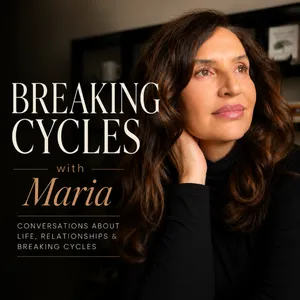
Breaking Cycles with Maria is an honest and relatable podcast about relationships, emotional patterns, self-awareness, anxiety, attachment, dysfunctional dynamics, and the things we normalize without even realizing it.Hosted by Maria Shkreli, LMHC, author of Breaking Cycles and Breaking Up with Toxicity, the podcast explores the messy, complicated, and very human side of life — from unhealthy relationship patterns and family dynamics to workplace stress, life transitions, emotional reactions, and the cycles that quietly shape us.Some episodes are educational. Some are conversational. Some may challenge the way you see yourself, your relationships, or the people around you.Because the truth is… we all have patterns.Some help us grow.Some quietly keep us stuck.Through real conversations, psychological insight, personal reflection, and a little bit of spice, Maria helps listeners better understand the patterns they repeat, the emotional experiences they normalize, and how to navigat
Latest Episodes
The most recent episodes — sign up to get AI-powered summaries of each one.
- 3 days ago21 min
EP 37: They Graduated. They're Home. Now What?
They Graduated. They're Home. Now What? | Parenting Adult Children After CollegeYour child graduated from college, moved back home, and suddenly you're having the same arguments you had when they were sixteen. What happened?In this episode of Breaking Cycles with Maria, licensed mental health counselor Maria Shkreli explores the challenges parents and adult children face when college graduates return home.Why do parents struggle to step back? Why do young adults feel controlled, criticized, or misunderstood? And how do unspoken expectations, fear of failure, and changing family roles create tension under the same roof?Drawing from her clinical experience and her book They're Home… Now What?, Maria challenges both generations to examine their behaviors, understand each other's perspectives, and recognize how old family patterns can interfere with adult independence.This conversation explores parenting adult children, post-college transitions, family communication, expectations, emotional maturity, and the difference between offering guidance and continuing to parent a grown child like a teenager.Because your child may have graduated from college, but has your relationship graduated with them?
- 1 weeks ago37 min
EP 36: Your Experience Is Not Everyone's Diagnosis: Who Made You the Villain?
When did we start diagnosing everyone around us based on social media checklists?Narcissism, narcissistic personality disorder (NPD), toxic relationships, emotional manipulation, avoidant attachment, anxiety, ADHD, and borderline personality disorder (BPD) are frequently discussed online. But recognizing a behavior doesn't mean we understand what's causing it.In this episode of Breaking Cycles with Maria, licensed mental health counselor and author Maria Shkreli challenges mental health misinformation, the misuse of psychological labels, and how personal experiences can turn into judgments about someone else's character.Maria explores how the gray-rock method can be misapplied in relationships, why men and women are sometimes judged differently for cheating and financial struggles, and the difference between accountability, understanding, and excusing harmful behavior.She also introduces her upcoming book, Who Made You the Villain?, which challenges how quickly we turn difficult behaviors, misunderstandings, and relationship struggles into permanent labels.Before you make another checklist about someone else's personality, consider one question:Is that checklist really about them, or is it about you?
- 2 weeks ago33 min
EP 35: Expectations — When Your Way Becomes the Only Right Way
Have you ever felt disappointed because someone didn't behave the way you expected? Or found yourself constantly trying to meet someone else's expectations, only to feel that nothing you do is ever enough?In this episode of Breaking Cycles with Maria, licensed mental health therapist Maria Shkreli explores how expectations shape our relationships, marriages, friendships, and family dynamics—and how easily disappointment can turn into resentment, criticism, and judgment.We often assume that the way we were raised, the way we communicate, or the way we show love is how everyone else should behave. But what happens when someone sees things differently?Through relatable examples and honest conversations, Maria challenges listeners to examine where their expectations come from, how unspoken expectations affect emotional well-being, and the difference between healthy relationship standards and expecting others to live by our personal rules.Just because someone would do things differently than you doesn't automatically mean they're wrong.An episode about communication, emotional exhaustion, family expectations, understanding different perspectives, and learning to recognize when our own beliefs may be contributing to relationship conflict.
- 3 weeks ago31 min
EP 34: Four People, Four Attachment Styles: When a Family Keeps Missing Each Other
What happens when four people in the same family love each other—but each one reaches for safety differently?In this episode of Breaking Cycles with Maria, I take attachment styles out of the dating world and bring them into the family. Through one family, we look at anxious, avoidant, fearful-avoidant, and secure attachment—and what can happen when those different needs for closeness, reassurance, independence, and space collide under one roof.But this isn't about diagnosing your parents, your partner, or your children. It's about recognizing the pattern—including your part in it.Through real-life family scenarios, we'll look at how worry can start sounding like control, how needing space can turn into emotional withdrawal, why someone may push you away and still want connection, and how the “mature” child can quietly become the family regulator.And here's the challenge: What do you do when you stop feeling emotionally safe—and what does your way of protecting yourself trigger in the people around you?Sometimes families aren't fighting because they don't love each other. They're fighting because they're trying to feel safe in completely different ways.
- Oct 8, 202625 min
EP 33: When Helping Becomes Control
When does helping someone stop being support and start becoming control?In this episode of Breaking Cycles with Maria, I’m looking at something that can be difficult to recognize because it often comes from a good place. We love someone, we see them struggling, and naturally we want to step in. But when we constantly fix problems, give advice, rescue, remind, manage, or remove consequences, our help may actually be making it harder for the other person to develop confidence and independence.I talk about how this shows up between parents and adult children, in marriages and relationships, and even in friendships. We’ll look at over-functioning, anxiety and control, financial rescuing, family boundaries, the need to be needed, and why some of us have such a hard time watching someone we love struggle.This isn’t about becoming cold or refusing to help. It’s about learning the difference between supporting someone and taking over for them.And sometimes the harder question isn't, “Why do they need me so much?”It’s: “Why do I need to be needed?”Before you step in and fix the next problem, ask yourself:Am I helping this person build capacity—or am I making myself necessary?Topics discussed: family dynamics, parents and adult children, controlling parents, boundaries, codependency, over-functioning, people-pleasing, anxiety and control, emotional independence, relationship patterns, rescuing, enabling, parenting adult children, marriage and communication, healthy relationships, and emotional boundaries.
- Oct 1, 202626 min
EP 32: Love Bombing or Just Intense? Why We Need to Stop Diagnosing Every Strong Connection
Someone texts you every morning, wants to see you constantly, brings flowers, gives compliments, and seems completely taken with you.Today, we’re quick to call it love bombing. But is it?Love bombing and emotional manipulation are real—but intensity can also come from anxious attachment, insecurity, loneliness, fear of abandonment, borderline traits, poor relationship pacing, or simply genuine excitement.In this episode of Breaking Cycles with Maria, Maria Shkreli, LMHC looks beyond the label and asks a more important question: What happens when you slow things down, set a boundary, say no, disagree, or spend time apart?Because the difference between intensity and manipulation may not be in the flowers, compliments, or constant texting. The pattern often reveals itself when boundaries and reality enter the relationship.Sometimes it is love bombing. Sometimes it’s a human being navigating their own fears, attachment patterns, insecurities, and emotions.Before you diagnose the behavior, understand the pattern.Topics: love bombing, anxious attachment, emotional manipulation, borderline traits, insecurity, dating, boundaries, narcissism, intimacy, relationship patterns, and healthy relationships.
- Sep 19, 202636 min
EP 31: Why Knowing Better Doesn’t Mean Doing Better — The Cycle Breaker Method
In this episode of Breaking Cycles with Maria, Maria Shkreli, LMHC introduces the Cycle Breaker Method™, a practical framework for understanding how everyday behaviors and interactions become repeated patterns—and where we have the power to interrupt them.Drawing from more than two decades of clinical experience, Maria explores the space between knowing and doing. Why do we keep rescuing, chasing, overexplaining, people-pleasing, giving in, or saying yes when we already know the pattern isn’t working?Maria also explores how the Cycle Breaker Method™ complements popular behavior-change approaches such as James Clear’s Atomic Habits and BJ Fogg’s Tiny Habits —while going deeper into what happens when emotions, relationships, guilt, fear, boundaries, and other people enter the equation.You’ll be introduced to the five-part Cycle Breaker framework:Event → Interpretation → Response → Reinforcement → NormalizationBecause sometimes you don’t need more information. You need to understand what keeps the pattern alive.You’re not stuck. You’re patterned. And a pattern can change.
- Jun 11, 202644 min
EP 30: Maria & Madge: The Fixer’s Trap — When Control Becomes Comfort
In this episode of Breaking Cycles with Maria, Maria and Madge explore a question many people quietly struggle with:Why do some of us feel responsible for fixing everything—and everyone?What begins as a conversation about problem-solving quickly reveals something deeper: the connection between anxiety, control, perfectionism, and the need to keep everything "just right" in order to feel okay.Maria challenges Madge to examine how fixing, organizing, cleaning, and managing situations can become ways of soothing internal discomfort. Together, they discuss anxiety, OCD tendencies, self-imposed rules, retirement, loneliness, and the difficulty of sitting with discomfort instead of immediately trying to make it disappear.The conversation also takes a personal turn as they explore friendship, aging, health challenges, independence, and what it means to stop fixing everyone else and start focusing on yourself.If you've ever thought:"I'll feel better when this is done.""I have to take care of everything.""No one will do it right unless I do it.""I can't relax until everything is in order."This episode is for you.Because sometimes the thing we're trying to control isn't our environment—it's our anxiety. And sometimes the hardest thing to fix is ourselves.
Get Breaking Cycles with Maria summaries in your inbox
Free AI-powered daily recaps. Key takeaways, quotes, and mentions — in a 5-minute read.
Get Free Summaries →Free forever for up to 3 podcasts. No credit card required.
You Might Also Like
Listeners also like.

Decoded | Unlock The Secrets of Human Behavior, Emotion and Motivation
Analyzes subconscious patterns in human behavior and provides methods to change them.
🎙️ Rebuild & Fulfill Real conversations on burnout, rebuilding, and becoming stronger than before.
Honest conversations about burnout, mental health, and resilience for high-functioning adults learning to rebuild and find fulfillment.

How Hard Can It Be? with Diana Maria Riva
A weekly conversation for GenX women navigating midlife challenges, from empty nesting to self-identity, with humor and honesty.

You Are Not Broken
Explores sex, hormones, and midlife for women with science, humor, and candid conversations about body and mind reconnection.
Therapist Uncensored Podcast
Explores mental health and secure relationships through science-backed insights, clinical expertise, and neuroscience.

Heal Squad x Maria Menounos
A daily podcast hosted by Maria Menounos exploring physical, emotional, and spiritual health through expert interviews and personal healing journeys.

Get Obsessed : With Living Your Best Life
Two hosts explore transformative stories and taboo topics with people challenging norms and living unfiltered lives.

Let's Get Naked
Anne Karber discusses personal growth, relationships, and difficult life topics through candid conversations with guests.

The Terri Cole Show
A licensed psychotherapist explores psychology and relationships to help listeners understand their patterns and create healthier lives.

Sh!t That Goes On In Our Heads
Friends discuss mental health, relationships, parenting, and pop culture with humor and honesty to encourage open conversations.
Mind If We Talk?
Two people share raw, intimate conversations about emotional struggles while a therapist guides understanding and growth.

The Sabrina Zohar Show
Explores modern dating, anxious attachment, and personal growth through raw conversations on healing and self-discovery.
About Breaking Cycles with Maria
Breaking Cycles with Maria is an honest and relatable podcast about relationships, emotional patterns, self-awareness, anxiety, attachment, dysfunctional dynamics, and the things we normalize without even realizing it.Hosted by Maria Shkreli, LMHC, author of Breaking Cycles and Breaking Up with Toxicity, the podcast explores the messy, complicated, and very human side of life — from unhealthy relationship patterns and family dynamics to workplace stress, life transitions, emotional reactions, and the cycles that quietly shape us.Some episodes are educational. Some are conversational. Some may challenge the way you see yourself, your relationships, or the people around you.Because the truth is… we all have patterns.Some help us grow.Some quietly keep us stuck.Through real conversations, psychological insight, personal reflection, and a little bit of spice, Maria helps listeners better understand the patterns they repeat, the emotional experiences they normalize, and how to navigat
Customized Recaps
AI-powered recaps with compact key takeaways, quotes, and insights.
Straight to Your Inbox
Get key takeaways from Breaking Cycles with Maria in a 5-minute read.
Save Hours Every Week
Stay current on your favorite podcasts without falling behind.
Frequently Asked Questions
What is Podzilla's Breaking Cycles with Maria daily summary?
It's a free AI-powered email that summarizes new episodes of Breaking Cycles with Maria as soon as they're published. You get the key takeaways, notable quotes, and links & mentions — all in a quick read.
How does the Breaking Cycles with Maria podcast summary work?
When a new episode drops, our AI transcribes and analyzes it, then generates a personalized summary tailored to your interests and profession. It's delivered to your inbox every morning.
Is this an official Breaking Cycles with Maria product?
No. Podzilla is an independent service that summarizes publicly available podcast content. We're not affiliated with or endorsed by Maria Shkreli.
Can I get summaries of other podcasts too?
Absolutely! The free plan covers up to 3 podcasts, any in the catalog. Basic raises that to 15, Pro to 40 and Max to 100. Browse our full catalog at /podcasts.
What topics does Breaking Cycles with Maria cover?
Breaking Cycles with Maria covers topics including Fitness, Health & Fitness, Mental Health. Our AI identifies the specific themes in each episode and highlights what matters most to you.
Start getting Breaking Cycles with Maria summaries tomorrow morning.
Free forever for up to 3 podcasts. No credit card required.
Free forever for up to 3 podcasts. No credit card required.