Free Daily Podcast Summary
The Next Experiment: Daily Summaries Delivered
by The Next Experiment
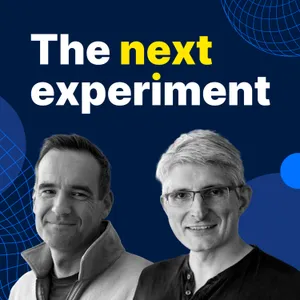
It's vital that we make progress in biology. Yet today, understanding complex living systems is hard.But does it have to be?We're Markus and Phil, a biologist and a statistician. We created this podcast for anyone who believes that there might be a better way. Together, we'll discuss the best experiments to cut through biological complexity.Join us to explore the shape of the next experiment.
Latest Episodes
The most recent episodes — sign up to get AI-powered summaries of each one.
- Jul 27, 202657 min
A Billion Oil Tankers and a Slice of Cheese (with Claes Gustafsson)
“We compress DNA from oil-tanker scale to 96 wells - and still capture everything that matters.”🎙️ The latest episode of The Next Experiment is out!Markus Gershater and Phil Kay sit down with Claes Gustafsson to talk about the power of design of experiments (DOE) in biology, how to get the most out of your data, and why smart experimentation beats brute force every time.Claes shares how DOE lets you compress enormous experimental spaces, optimize proteins, and even improve enzymes used in millions of cheeses worldwide. He dives into codon optimization, iterative rounds of testing, and why a good assay is always king.Some standout lines:🔹 “If your assay sucks, it doesn’t matter how much DOE you put on it - it will still suck.”🔹 “Biologists love collecting data, but more data isn’t better. The question is: how do you get the most bang for your data buck?”🔹 “You don’t need to understand every mechanism. You just need to know which experiments will reliably get the outcome you care about.”If you’re in biotech, protein engineering, or any field where structured experimentation matters, Claes’ insights are gold.
- Jun 15, 202652 min
Only the Robust Survive (with Rob Howes)
“Most assays don’t fail because they’re wrong… they fail because they’re fragile.”This time, Markus Gershater and Phil Kay sat down with Rob Howes (Head of Biology & DMPK at Charles River) to unpack what REALLY happens when you scale biology - and why most teams underestimate how quickly things fall apart.Rob’s been working with multi-dimensional experimentation since the early 2000s (back when most of us were still painfully tweaking one variable at a time). And the contrast is pretty stark:Some standout lines:🔹 “We used to optimise for the highest signal. Now we optimise for something that won’t break.”🔹 “If your data isn’t high quality, your AI model won’t be either. Garbage in, just faster garbage out.”🔹 “Why run every experiment, if you can predict most of them?”
- May 18, 202624 min
JMP Discovery Summit LIVE (with Linden Schrecker)
“Some people don’t want experiments to be repeatable, they want them to feel like magic in their hands.”🎙️The latest episode of “The Next Experiment” is here!This time, Markus and Phil sat down with Dr. Linden Schrecker, co-founder of SOLVE Chemistry, to explore the future of experimentation, automation, and why better data changes everything.From failed reactions caused by cold Oxford labs to disproving decades of accepted chemistry with a single well-designed experiment, Linden shares a fascinating perspective on how scientists should think about experimentation in the age of AI.The conversation dives into reproducibility, metadata, machine learning, and the cultural incentives that often prevent researchers from collecting truly meaningful data.Some standout lines:🔹 “You can collect 50 experiments in the same time as one, if you design the system properly.”🔹 “We’re not incentivising scientists to collect meaningful amounts of data. We reward novelty, not repeatability.”🔹 “We should be collecting data for a future we may never personally benefit from.”If you’re working in chemistry, biotech, automation, AI, or process development, this episode is packed with insights on how smarter experimentation can unlock entirely new ways of understanding complex systems.
- Mar 23, 20261h 1m
The Quest for the Global Maxima (with Adam Winnifrith)
“Drug-resistant bacteria played the ultimate uno reverse card on us.”🎙️The latest episode of “The Next Experiment” is here!This time, Markus and Phil sat down with Adam Winnifrith - who shared his unique perspective on experimentation, scaling, and why understanding your system is always step one.Adam dives deep into the realities of doing science at scale, the pitfalls of jumping straight to automation, and how small, smart experiments can save months of wasted effort.Some standout lines:🔹 “You can automate all you want, but if you don’t know what’s actually happening in your system, you’re just speeding up failure.” 🔹 “DOE isn’t just a tool; it’s a mindset shift. It forces you to question assumptions before spending a month chasing the wrong lead.” 🔹 “The real magic happens when you combine curiosity with disciplined experimentation.”If you’re in biotech, research, or any field where experimentation is key, Adam’s insights are not to be missed.
- Feb 16, 202649 min
Automation Saves Your Bacon (with Alex Rimmer)
"I wouldn’t describe DOE as easy — I’d describe it as extremely worthwhile.”🎙️The latest episode of “The Next Experiment” is here!This time, Markus and Phil sat down with Alex Rimmer, who brings a clear and practical perspective on DOE in biology – and some truly memorable lines about why experimentation so often fails to scale.Alex talks about discovering DOE out of necessity, not theory. When nothing else worked, DOE became the only way to make progress. A few great quotes:🔹 “Biology is basically the study of interactions that we largely don’t study interactions for.” 🔹 “I had a need to make a media and absolutely no idea how to get that to work via traditional non-DOE methods.” 🔹 “Automation on its own won’t be enough; it’s what you apply with that automation that really matters.”If you care about scalable experimentation, media development, or the practical reality of doing modern biology, this episode is full of insight.
- Jan 12, 202642 min
Choose Your Fighter: Bayesian vs DOE (with Owen Jonathan)
This time, Markus and Phil sat down with Owen Jonathan, who brings a refreshingly open and grounded perspective on learning – and teaching – DOE in real biological systems.What makes Owen’s story so compelling is how honestly he talks about coming into DOE with an open mind, realising what he hadn’t been taught, and then discovering how powerful the methodology becomes when biology is too complex for intuition alone.A few standout quotes:🔹 “I didn’t realize until later that I’d never actually been taught DOE.” 🔹 "Progress isn’t about doing more — it’s about asking the right questions first." 🔹 “Biology needs abstraction or it becomes impossible to model.”If you’re interested in practical experimentation, ML-enabled workflows, or how real scientists bring DOE into messy biology, this one’s packed with insight.
- Dec 15, 202550 min
DOE, The Right Thing (with Keara Sutherland)
If efficiency is the name of the game in process development, then Design of Experiments (DOE) is the playbook you didn’t know you needed. But how do you actually apply it in the messy, variable world of viral vector production? That’s exactly what we dig into in this episode. Keara Sutherland takes us through her journey from simple drug pairing experiments to complex, high-dimensional DOE campaigns that optimize biological processes in ways that feel almost magical – but are grounded in solid strategy.Conversation highlights:05:24 - Keara’s first exposure to DOE and transitioning from drug synergy studies to complex process optimization12:17 - The addictive efficiency of DOE: maximizing data points while minimizing time17:26 - DOE as a tool for biological flexibility: managing multiple outputs and future-proofing processes31:31 - Real-world challenges: balancing experimental ideal with practical constraints, including automation and scalability
- Dec 11, 20249 min
Bonus Episode: Statisticians vs Biologists
Making multidimensional experiments a reality doesn’t just sit with one discipline. Most commonly, it involves biologists and statisticians. So, what’s the key to open communication, and working together to do radically better biology? That’s what we explore, in this season’s bonus episode, filmed at Synthace’s Beer, Bytes and Biology annual event. Conversation highlights 00:00 - Introduction 00:49 - Condescending attitudes causing statisticians and biologists to butt heads 02:49 - The key to successful relationships between the 2 disciplines 04:09 - Markus’ experiences showing how he and his team bridged the communication gap 08:39 - Embodying the “George Box” attitude for successful collaboration
Get The Next Experiment summaries in your inbox
Free AI-powered daily recaps. Key takeaways, quotes, and mentions — in a 5-minute read.
Get Free Summaries →Free forever for up to 3 podcasts. No credit card required.
You Might Also Like
Listeners also like.
Inquiring Minds
Explores the intersection of science and society through critical thinking and in-depth analysis.
The Experiment
Explores how individuals navigate conflicts between personal beliefs and American ideals.

Galaxy Balance
Explores the intersection of biology, technology, and consciousness through deep conversations with innovators shaping humanity’s future.
A Question of Science
Experts answer public questions on pressing scientific issues, from cancer and nutrition to AI and climate change.

The World, the Universe and Us
Explores big scientific questions about life, consciousness, climate, and the cosmos with expert scientists and New Scientist journalists.

Science Magazine Podcast
Weekly episodes covering original scientific research, global science news, and expert commentary.
The Life Scientific
A scientist discusses their research, inspirations, and career with physicist Jim Al-Khalili.
Huberman Lab
Explores neuroscience and science-based tools for understanding and improving brain function, behavior, and health.
In the Interim...
Explores Bayesian statistics and adaptive clinical trial designs in medical research with insights from industry experts.
Into the Impossible With Brian Keating
Brian Keating explores profound scientific and philosophical questions with leading thinkers in physics, technology, and beyond.
The Biohacking Standards
A deep dive into biohacking fundamentals—nutrition, movement, sleep, and mindfulness—grounded in science and holistic wellness principles.
COMPLEXITY
Santa Fe Institute
About The Next Experiment
It's vital that we make progress in biology. Yet today, understanding complex living systems is hard.But does it have to be?We're Markus and Phil, a biologist and a statistician. We created this podcast for anyone who believes that there might be a better way. Together, we'll discuss the best experiments to cut through biological complexity.Join us to explore the shape of the next experiment.
Customized Recaps
AI-powered recaps with compact key takeaways, quotes, and insights.
Straight to Your Inbox
Get key takeaways from The Next Experiment in a 5-minute read.
Save Hours Every Week
Stay current on your favorite podcasts without falling behind.
Frequently Asked Questions
What is Podzilla's The Next Experiment daily summary?
It's a free AI-powered email that summarizes new episodes of The Next Experiment as soon as they're published. You get the key takeaways, notable quotes, and links & mentions — all in a quick read.
How does the The Next Experiment podcast summary work?
When a new episode drops, our AI transcribes and analyzes it, then generates a personalized summary tailored to your interests and profession. It's delivered to your inbox every morning.
Is this an official The Next Experiment product?
No. Podzilla is an independent service that summarizes publicly available podcast content. We're not affiliated with or endorsed by The Next Experiment.
Can I get summaries of other podcasts too?
Absolutely! The free plan covers up to 3 podcasts, any in the catalog. Basic raises that to 15, Pro to 40 and Max to 100. Browse our full catalog at /podcasts.
What topics does The Next Experiment cover?
The Next Experiment covers topics including Science, Life Sciences. Our AI identifies the specific themes in each episode and highlights what matters most to you.
Start getting The Next Experiment summaries tomorrow morning.
Free forever for up to 3 podcasts. No credit card required.
Free forever for up to 3 podcasts. No credit card required.