Free Daily Podcast Summary
The World, the Universe and Us: Daily Summaries Delivered
by New Scientist
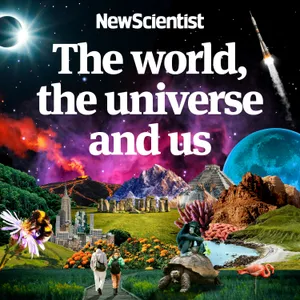
From the evolution of intelligent life, to the mysteries of consciousness; from the threat of the climate crisis to the search for dark matter, The world, the universe and us is your essential weekly dose of science and wonder in an uncertain world. Hosted by journalists Dr Rowan Hooper and Dr Penny Sarchet and joined each week by expert scientists in the field, the show draws on New Scientist’s unparalleled depth of reporting to put the stories that matter into context. Feed your curiosity with the podcast that will restore your sense of optimism and nourish your brain.
Latest Episodes
The most recent episodes — sign up to get AI-powered summaries of each one.
- Today48 min
How to Be Hopeful: Caitlin Moran and New Scientist Look to the Future
Episode 401 Anxiety is everywhere. Climate change, political turmoil and a constant stream of alarming headlines can make optimism feel impossible. But to be hopeful you don’t need to ignore reality. What if it’s about paying attention to the breakthroughs that are already changing the world? In this special episode Penny Sarchet and Rowan Hooper are joined by bestselling author Caitlin Moran, who spent a year chasing hope. Prompted by her new book How to Be Hopeful, the New Scientist team shares eight recent developments that genuinely make them optimistic about the future. From the explosive growth of solar energy and the possibility of crops that make their own fertiliser, to new classes of medicines, AI-assisted scientific discovery, and even the search for life beyond Earth, this episode is a celebration of progress, curiosity and human ingenuity. Also on the panel are Madeleine Cuff, Catherine de Lange, and Michael Le Page. To read more about these stories, visit https://www.newscientist.com/ Learn more about your ad choices. Visit megaphone.fm/adchoices
- 2 days ago31 min
THIS Is What You Need To Worry About With The Rise Of AI
Episode 400 Should we really be afraid of AI? Many headline statements from the likes of Anthrophic, OpenAI and even the King are raising alarm bells over the threat of AI to humanity. AI companies are even calling to be more highly regulated. But does that mean the threats are worth considering - or are there ulterior motives? Among the apocalyptic or disastrous ways it could go wrong, there are genuine issues we should be thinking about today. Alignment is one of those - how closely AI aligns with human values and whether it continues to obey us. And the threat of supercharged cyber attacks is another. But is extinction really on the cards? To discuss the reality of the situation we’re facing, Rowan Hooper and Penny Sarchet are joined by Timothy Revell, Matthew Sparkes and Jacob Aron. To read more about these stories, visit https://www.newscientist.com/ Image credits: Sam Altman: TechCrunch, CC BY 2.0 https://creativecommons.org/licenses/by/2.0 via Wikimedia Commons Mark Zuckerberg: Anthony Quintano from Honolulu, HI, United States, CC BY 2.0 https://creativecommons.org/licenses/by/2.0 via Wikimedia Commons Learn more about your ad choices. Visit megaphone.fm/adchoices
- 4 days ago23 min
The Mystery of Childbirth Is Finally Being Unravelled
Episode 399 Some aspects of childbirth have remained surprisingly mysterious - and scientists haven’t been able to agree on what actually kicks off the labour process. But they’ve finally worked out what’s going on - and the discovery could turn birth into a much more predictable occasion. The labour process in humans is much more complex than in other mammals. But researchers have now worked out the driving force that kicks it all off is the immune system - a special type of inflammatory macrophage sending mitochondria to the uterus just before birth. To explain this new discovery and why it might be game-changing for avoiding pre-term births, Rowan Hooper and Penny Sarchet are joined by Australia reporter Alice Klein. To read more about these stories, visit https://www.newscientist.com/ Learn more about your ad choices. Visit megaphone.fm/adchoices
- 1 weeks ago32 min
AI Just Solved One of the Hardest Problems in Mathematics
Episode 398 OpenAI says it has just solved one of the hardest problems in mathematics. The Navier-Stokes existence and smoothness problem has been unsolved for more than 200 years. Now AI has cracked it, some claim we’ve finally reached “AGI” - artificial general intelligence. Navier-Stokes is one of the Millennium Prize Problems, chosen for being famously challenging. And as OpenAI sets its sights on solving more of these problems, what does it mean for the future of mathematics and even for the future of humanity? This comes as fear mounts over the safety of AI - supercharged by the resignation of a researcher from Anthrophic who believes AI companies are “gambling with our lives.” So have we really reached AGI? Is this new solution a good thing for humanity? To discuss all of this, Rowan Hooper and Penny Sarchet are joined by Matthew Sparkes and Timothy Revell. To read more about these stories, visit https://www.newscientist.com/ Learn more about your ad choices. Visit megaphone.fm/adchoices
- 1 weeks ago23 min
New Discovery Reveals the Secret Lives of Denisovans
Episode 397 The first evidence has been discovered that Denisovans lived in south-west China. This ancient species of human spent over 100,000 years in the region and left behind incredible artefacts that tell us how they lived. 64,000 fragments of bone have been discovered from Bianfu Cave in Yunnan province. And the site tells us a lot about the food they ate and the animals they hunted - including rhinoceroses, hyenas and prime-age deers. As we discover an increasingly sophisticated culture in this previously mysterious species, what does it teach us about ourselves, and how exceptional Homo sapiens really are? To discuss the findings, Rowan Hooper and Penny Sarchet are joined by science writer Michael Marshall. To read more about these stories, visit https://www.newscientist.com/ Image Credits: Homo longi - Nobu Tamura, CC BY-SA 3.0 https://creativecommons.org/licenses/by-sa/3.0 via Wikimedia Commons Homo floresiensis - Cicero Moraes, CC BY-SA 4.0 https://creativecommons.org/licenses/by-sa/4.0 via Wikimedia Commons Neanderthal: Neanderthal-Museum, Mettmann, CC BY-SA 4.0 https://creativecommons.org/licenses/by-sa/4.0 via Wikimedia Commons Learn more about your ad choices. Visit megaphone.fm/adchoices
- 2 weeks ago23 min
The Nepal Disaster: How Climate Change is Reshaping the World
Episode 396 A devastating climate disaster has killed at least 1,200 people in Nepal. A mass of ice and rock came crashing down off the Langtang mountain into the valley below. The climate crisis has made events like this much more likely. This is just one of many retreating glaciers. We’re also on track for a record year of ice-loss in the European alps. As the world is reshaped before our eyes, what does this mean for the planet - and the 1.9 billion people who live downstream of glacier ice mountains? This all comes as experts predict this year’s Super El Nino event will be the biggest in 1,000 years - plus an admittance from The UN Environment Programme that we will overshoot 1.5 degrees of global warming. To discuss the tragedy in Nepal and the growing concern in the Alps, Rowan Hooper and Penny Sarchet are joined by Professor of Glaciology Bethan Davies and climate journalist Alec Luhn. To read more about these stories, visit https://www.newscientist.com/ Image Credit: The aftermath of severe flooding along the Bhotekoshi river in Nuwakot, Nepal, on 28 August Ambir Tolang/JNA/ZUMA Press/Alamy Learn more about your ad choices. Visit megaphone.fm/adchoices
- 2 weeks ago14 min
Scientists Find Best Evidence Yet For Dark Matter
Episode 395 Dark matter particles may have finally been spotted for the first time. LUX-ZEPLIN is the most sensitive dark matter detector on Earth - and what it’s discovered has the potential, if confirmed, to shake up all of physics. Despite making up about 85 per cent of the universe, dark matter has been notoriously difficult to spot. WIMPs, or weakly-interacting massive particles, are the leading theory to explain dark matter. That’s what this new, powerful detector has been built to search for. To explain how LZ works and what it means if its results are supported, Rowan Hooper is joined by space reporter Leah Crane. To read more about these stories, visit https://www.newscientist.com/ Image Credits: Dark Matter illustration: RubinObs/NOIRLab/SLAC/NSF/DOE/AURA/J. Pinto, CC BY 4.0 https://creativecommons.org/licenses/by/4.0 via Wikimedia Commons Dark matter gif: Hyper Suprime-Cam Survey, CC BY-SA 4.0 https://creativecommons.org/licenses/by-sa/4.0, via Wikimedia Commons Learn more about your ad choices. Visit megaphone.fm/adchoices
- 3 weeks ago13 min
Why Humans Like Bigger Breasts - And a New Way to Augment Them
Episode 393 A new technique using a woman’s own fat cells has been used to reconstruct her breast without silicone implants. By injecting her own tissue into a dissolving scaffold, it’s hoped this technique will make breast augmentation safer. Traditional plastic surgery involves silicone or saline, which can cause health issues like breast implant illness and even cancer. And they typically only last 10-20 years before needing to be removed. Penny Sarchet speaks to Australia reporter Alice Klein to find out how the surgery works and why humans evolved to prefer bigger breasts in the first place. To read more about these stories, visit https://www.newscientist.com/ Learn more about your ad choices. Visit megaphone.fm/adchoices
Get The World, the Universe and Us summaries in your inbox
Free AI-powered daily recaps. Key takeaways, quotes, and mentions — in a 5-minute read.
Get Free Summaries →Free forever for up to 3 podcasts. No credit card required.
You Might Also Like
Listeners also like.
Nature Podcast
Covers breakthrough research from Nature journal across all scientific fields, with insights from scientists and science journalists.

Inquiring Minds
Explores the intersection of science and society through critical thinking and in-depth analysis.
Science Weekly
The Guardian provides weekly updates on the latest science and environment news.
BBC Inside Science
Explores the latest scientific discoveries and debates shaping our understanding of the world.

Science Magazine Podcast
Weekly episodes covering original scientific research, global science news, and expert commentary.
The Naked Scientists Podcast
A weekly science podcast featuring news, expert interviews, experiments, and listener Q&A.
Science In Action
The BBC covers the latest weekly developments and news in science.
The Life Scientific
A scientist discusses their research, inspirations, and career with physicist Jim Al-Khalili.
Unexpected Elements
Explores hidden scientific connections behind global news and everyday phenomena.
Seeking A Scientist
A chemist hosts conversations with scientists to explore futuristic scientific possibilities and their real-world implications.

The Pulse
Explores surprising stories in health and science, from operating rooms and labs to breakthrough innovations.
Short Wave
A daily science podcast exploring discoveries, everyday mysteries, and the stories behind scientific headlines.
About The World, the Universe and Us
From the evolution of intelligent life, to the mysteries of consciousness; from the threat of the climate crisis to the search for dark matter, The world, the universe and us is your essential weekly dose of science and wonder in an uncertain world. Hosted by journalists Dr Rowan Hooper and Dr Penny Sarchet and joined each week by expert scientists in the field, the show draws on New Scientist’s unparalleled depth of reporting to put the stories that matter into context. Feed your curiosity with the podcast that will restore your sense of optimism and nourish your brain.
Customized Recaps
AI-powered recaps with compact key takeaways, quotes, and insights.
Straight to Your Inbox
Get key takeaways from The World, the Universe and Us in a 5-minute read.
Save Hours Every Week
Stay current on your favorite podcasts without falling behind.
Frequently Asked Questions
What is Podzilla's The World, the Universe and Us daily summary?
It's a free AI-powered email that summarizes new episodes of The World, the Universe and Us as soon as they're published. You get the key takeaways, notable quotes, and links & mentions — all in a quick read.
How does the The World, the Universe and Us podcast summary work?
When a new episode drops, our AI transcribes and analyzes it, then generates a personalized summary tailored to your interests and profession. It's delivered to your inbox every morning.
Is this an official The World, the Universe and Us product?
No. Podzilla is an independent service that summarizes publicly available podcast content. We're not affiliated with or endorsed by New Scientist.
Can I get summaries of other podcasts too?
Absolutely! The free plan covers up to 3 podcasts. Upgrade to Pro for 15, or Premium for 50. Browse our full catalog at /podcasts.
How often does The World, the Universe and Us release new episodes?
The World, the Universe and Us publishes 2x weekly. Our AI generates a summary within hours of each new episode.
What topics does The World, the Universe and Us cover?
The World, the Universe and Us covers topics including Science, News, Education. Our AI identifies the specific themes in each episode and highlights what matters most to you.
Start getting The World, the Universe and Us summaries tomorrow morning.
Free forever for up to 3 podcasts. No credit card required.
Free forever for up to 3 podcasts. No credit card required.