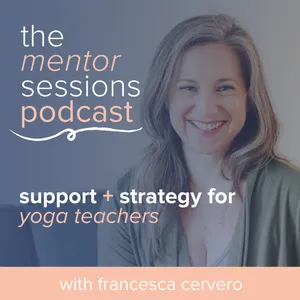
Free Daily Podcast Summary
The Mentor Sessions: Daily Summaries Delivered
by Francesca Cervero
With amazing guests or solo, I explore the craft of teaching yoga, as its own practice. I'm seeking answers to the questions about why we teach something the way we do, how we could be more expansive and inclusive in our teaching, and how we can continue to grow and evolve in our teaching practice.I'm so glad you are here because I believe the depth that arises in teaching comes from inquiry and relationship. Join me as I offer nourishing support to help you feel more confident in your teaching and realistic strategy to help you find more clarity on your career path.Francesca Cervero (she/her) has been a full-time yoga teacher since 2005. Her teaching is inspired by her foundational training with Cyndi Lee at OM Yoga Center, the years she spent as a dancer and the subsequent years she spent in physical therapy. Her teaching is also influenced by her love of Buddhist teachings and a constant curiosity about anatomy and biomechanics. She is in private practice teaching a full schedule
Latest Episodes
The most recent episodes — sign up to get AI-powered summaries of each one.
- Yesterday44 min
186: WTF Is Happening with Yoga Alliance?? And more! With Rebecca Sebastian
What is happening at Yoga Alliance, and what do the recent changes mean for yoga teachers, teacher trainers, and the broader yoga community? In this episode of The Mentor Sessions, I'm joined by Rebecca Sebastian, yoga teacher, yoga therapist, founder of Sunlight Media, and host of the Working in Yoga podcast. Rebecca has spent more than two decades working inside the yoga profession and has become an important voice examining the systems, economics, and culture that shape our industry. With Yoga Alliance recently announcing significant changes to its credentialing structure, I wanted to bring Rebecca on to help us understand what's actually happening, why these changes matter, and what yoga teachers should be thinking about. We unpack the shift from Yoga Alliance functioning primarily as a registry to moving toward a competency-based certification model, including the proposed 40-question test, the consolidation of existing credentials, and the introduction of specialty badges. We also discuss the decision to open membership to yoga students and what that could mean for the organization. But this conversation goes well beyond the new credentials. We explore the importance of transparency and trust, the financial realities of working as a yoga teacher, and the growing disconnect between the organizations representing our profession and the people doing the actual work. Rebecca also shares her perspective on the emerging American Yoga Council, whether yoga teachers really need professional designations, and the possibility of state-level yoga associations that give teachers a stronger voice in shaping their own futures. One of the most important themes of this conversation is that the people doing the work deserve a say in the decisions that affect their profession. Rather than automatically supporting or rejecting any particular organization, Rebecca encourages us to ask questions, understand the mission, examine the financials, and consider whether we're actually receiving value from the organizations we support. In this episode, you'll hear: The recent changes to Yoga Alliance's credentialing structure The difference between a registry, a credentialing body, and a certifying organization The proposed 40-question competency-based certification test Why transparency and organizational trust matter Yoga Alliance leadership salaries and the financial realities of yoga teachers The American Yoga Council and emerging alternatives for yoga professionals Whether yoga teachers actually need professional credentials or memberships The importance of reputation, experience, and building trust with the public What a 501(c)(6) trade organization is and what it means for its members The potential for state-level yoga associations and collective advocacy Connect with Rebecca: Instagram: @RebeccaSebastianYoga Website and newsletter: https://www.thesunlightexperience.com CEO & Founder, Sunlight Media | thesunlightexperience.com Editor, Inside Yoga Magazine | insideyogamagazine.com Host, Working In Yoga Podcast | workinginyoga.com Resources Mentioned: <a href= "https://yogaalliance.org/" target="_bl
- 2 weeks ago38 min
185: Dealing with Schedule Drama UPDATED
As yoga teachers, we often fall in love with the practice and the craft of teaching without realizing how much time and energy we'll spend managing our schedules and building our businesses. In this episode of The Mentor Sessions, I'm revisiting an early episode of the podcast to share what I've learned over the years about creating a more sustainable teaching career. Most yoga teachers are freelancers, piecing together a living one group class, private client, and workshop at a time. That means some instability is inevitable. Student schedules change, studios close, private clients cancel, and our own lives evolve. We can't eliminate all of that uncertainty, but we can create structures that make our schedules and businesses more stable. In this episode, I share practical strategies for designing a teaching schedule that reflects your energy, values, financial needs, and responsibilities outside of work. We'll talk about why it's important to know your ideal weekly and daily schedule, how to decide whether to keep or drop a group class, and why you may need to give a promising class at least six months to grow. The big takeaway: You can't control every fluctuation in freelance yoga teaching, but you can intentionally build a schedule, business, and teaching practice that become more sustainable over time. In this episode, you'll hear: Why yoga teachers need to think like freelancers and small-business owners How to identify your ideal weekly and daily teaching schedule The difference between having a flexible schedule and intentionally designing your workweek Why new teachers need a long-term vision for their ideal schedule How to decide whether to keep or drop a group class using eight practical criteria Why giving a promising group class six months to a year to grow can pay off Setting boundaries with clients who frequently cancel or reschedule without taking their behavior personally Why diversifying your private client roster and maintaining additional income sources can create financial stability The "Should I Keep This Class?" Formula Before dropping a class, consider whether you: love the students enjoy the material are learning as a teacher earn good money meet potential private clients value the studio find meaning in the service feel good about the time and location Aim for at least four yeses across these eight criteria. This episode is brought to you by OfferingTree, an easy-to-use, all-in-one online platform for yoga teachers that provides a personal website, booking, payment, blogging, and many other great features. The best thing about OfferingTree is you can get up and running in 10 minutes with no tech skills needed. As an added bonus, If you sign up at www.offeringtree.com/mentor, you'll get 50% off your first three months or 15% off any annual plan!
- 4 weeks ago25 min
184: The Myth of the Ideal Client UPDATED
Today I'm revisiting one of the ideas I talked about when I first started the podcast nine years ago: the idea that yoga teachers need to find their "ideal student" or a very specific niche in order to build a successful teaching career. I still believe there is some value in getting specific about who we're speaking to when we communicate about our work. Specific language can make our marketing more compelling and help potential students understand how our teaching might support them. But I've become increasingly convinced that the idea of finding your perfect student doesn't translate well to the actual work of teaching yoga. Teaching people is relational, creative, vulnerable, and challenging. There is no teaching practice where every student is effortless to work with. A student being difficult to teach doesn't automatically mean they are the wrong student for you, and it certainly doesn't mean you're a bad teacher. In this episode, I explore why the "ideal client" and "find your niche" advice can become problematic for yoga teachers—and what I think we should focus on instead. In this episode, you'll hear: Where the idea of the "ideal student," "ideal client," and "dream customer" comes from The difference between communicating specifically about your work and pigeonholing yourself into a narrow niche Why difficulty in a teacher-student relationship doesn't automatically mean it is a bad fit The normal challenges that come with teaching private clients, including boundaries, unclear goals, and difficulty reading a new student How surface-level demographics can unnecessarily limit your teaching practice Why helping students discover what they need, build trust, stay engaged, and maintain a consistent practice is part of our job How we can stop searching for the mythical "dream student" and instead develop the skills to teach many different kinds of people deeply and sustainably 🎯Workshop! All the decisions you need to make BEFORE you build your website Building a website for your wellness business sounds simple in theory. In practice, it means deciding what you're offering, how you want to talk about it, and what you're charging, and then sharing photos of yourself with the world. It's easy to get stuck somewhere in the middle. On Tuesday, October 27th at 2pm ET, I'm hosting a free support and strategy live session with OfferingTree on the decisions to make before you build your website. Whether you haven't started, started and paused, or have a site you don't love sharing, come join me. Click here to save your spot. And if you need help finding your first clients, I've got you! Check out this resource! This episode is sponsored by OfferingTree! Sign up at www.offeringtree.com/mentor to get 50% off your first three months (or 15% off any annual plan). With OfferingTree, yoga teachers put their schedule on a personally branded website where students can book classes and even pay or donate online.
- Sep 29, 202640 min
183: Teaching Asana Without Demonstrating: UPDATED
In this episode of The Mentor Sessions, I'm revisiting an idea I first explored many years ago: that teaching yoga asana primarily with words rather than relying on the body to demonstrate every pose is a skill many teachers benefit from working on. I demonstrate as little as possible when I teach. And while I don't think demonstrating is inherently bad, I do think it can become a habit that keeps us from developing our verbal skills as teachers. When I transitioned to teaching online in 2020, I realized just how valuable this approach had been. My students were already accustomed to practicing with my voice rather than watching my body. That experience made me even more curious about what is possible when we ask students to listen, feel, notice, and explore instead of simply copying what they see. In this episode, you'll hear: Why I demonstrate as little as possible when I teach yoga How teaching with words helps students pay attention to their own experience instead of copying a shape What I notice when I'm watching my students instead of practicing alongside them How a serious hip injury strengthened my verbal teaching skills Three experiments to help you teach without demonstrating When demonstrating does serve students, and how to make it an intentional choice Why teaching private students invites us to develop a shared language OfferingTree is a proud sponsor of this episode and I am honored to be an affiliate. Visit OfferingTree at www.offeringtree.com/mentor and you'll get 50% off your first three months or 15% off any annual plan. OfferingTree supports me with each sign-up and I'm proud to be supported by a public benefit company whose mission is to further wellness access and education for everyone.
- Sep 15, 202638 min
182: Tailoring A Yoga Practice for Private Lessons UPDATED
There is no cookie-cutter approach to private yoga teaching. The most effective private teachers learn to listen carefully, think critically, stay curious, and trust their ability to adapt. Private teaching is not about giving someone a customized version of a group class. It's about creating a collaborative practice that responds to who they are, what they need, and where they are right now. That requires both clarity of intention and flexibility of method. In today's episode we are looking back at one of the foundational ideas behind my work as a private yoga teacher: how to create a yoga practice that actually meets the needs of the person in front of you. We'll walk through four key principles for tailoring a private yoga session, including building trust, questioning the idea of a well-rounded practice, understanding the intended benefit of a pose, and staying creative and flexible in your teaching. In this episode, you'll hear: Why teaching private yoga lessons requires a different skill set than teaching group classes The difference between a teacher-driven group class and a student-driven private lesson How to distinguish between what a student wants and what they may actually need How to maintain the depth and heart of yoga while adapting the way you teach it Why students who appear "easy" to teach may actually require more creativity and attention How understanding the intended benefit of a pose can transform individualized teaching Helping students develop discernment about whether a practice is actually useful to them Creative alternatives to traditional centering practices at the beginning of a private lesson This episode is brought to you by OfferingTree, an easy-to-use, all-in-one online platform for yoga teachers that provides a personal website, booking, payment, blogging, and many other great features. If you sign up at www.offeringtree.com/mentor, you'll get 50% off your first three months or 15% off any annual plan!
- Aug 18, 20261h 2m
181: Introducing The American Yoga Council with Andrew Tanner
In this episode of The Mentor Sessions, Francesca talks with Andrew Tanner, founder and CEO of the American Yoga Council (AYC), about his vision for creating a healthier, more sustainable yoga ecosystem. Andrew brings more than 20 years of experience as a yoga teacher, studio owner, business consultant, technology leader, and former Yoga Alliance executive. His career has taken him from teaching and owning multiple yoga studios to working at Kripalu and Yoga Alliance, co-founding the Berkshire Yoga Festival, and now building a new credentialing and professional organization for yoga teachers. The conversation goes far beyond the American Yoga Council itself. Francesca and Andrew explore the problems with the current yoga teacher credentialing system, why yoga teachers need better business education, how mentorship can transform professional development, and why Andrew believes the yoga industry needs to "grow up." They also have an unusually candid conversation about Andrew's experience leaving a high-demand spiritual organization, the power dynamics that can exist within yoga communities, institutional resistance to change, and why transparency is one of AYC's core values. In this episode, you'll hear: The challenges of power, money, loyalty, and authority within spiritual communities About Andrew's work at Kripalu and his belief that institutions heal by creating something new rather than remaining stuck in the past Andrew's work at Yoga Alliance and the Standards Review Project Why he became disillusioned with the existing credentialing and accreditation model The creation and mission of the American Yoga Council Why AYC operates as a public benefit corporation rather than a nonprofit Why Andrew believes yoga studios should be viewed as "third places" and hospitality businesses Andrew's vision for the future of yoga and the American Yoga Council Resources Mentioned: www.americanyogacouncil.com Listeners can use the code FRANCESCA30 for 30% off an AYC membership. This episode is brought to you by OfferingTree, an easy-to-use, all-in-one online platform for yoga teachers that provides a personal website, booking, payment, blogging, and many other great features. As an added bonus, If you sign up at www.offeringtree.com/mentor, you'll get 50% off your first three months (or 15% off any annual plan)! I'm proud to be supported by a public benefit company whose mission is to further wellness access and education for everyone.
- Aug 4, 202627 min
180: A Sustainable Yoga Career Needs An Ecosystem, Not A Personal Brand
If you've ever felt like building a successful yoga career means becoming an influencer, constantly creating content, or perfecting your personal brand, this episode is for you. Today I'm sharing a different perspective—one that's rooted in the way I believe sustainable yoga careers are actually built. While marketing and visibility have their place, the longest-lasting teaching careers aren't created through algorithms or viral moments. They're built through relationships, trust, referrals, collaboration, and genuine participation in community. I explore the difference between building an audience and cultivating an ecosystem, and why focusing on your local yoga community, complementary professionals, mentorship, and authentic connections will serve your teaching career far better than chasing online attention. If your goal is to spend more time teaching and less time performing online, this episode offers a practical and deeply encouraging roadmap. In this episode, you'll hear: Why social media has encouraged yoga teachers to think like influencers The limitations of personal branding in a relationship-based profession How referrals become the foundation of long-term private yoga teaching The role teacher friendships and mentorship play in career longevity Creative ways to collaborate with studios and local businesses How building relationships with physical therapists and other practitioners can grow your private practice Why content creation should support your teaching—not replace it How community, reciprocity, and collaboration create a resilient yoga career Resources Mentioned: Mentorship for yoga teachers This episode is sponsored by OfferingTree! Sign up at www.offeringtree.com/mentor to get 50% off your first three months (or 15% off any annual plan). With OfferingTree, yoga teachers put their schedule on a personally branded website where students can book classes and even pay or donate online.
- Jul 21, 202626 min
179: Building The Confidence To Teach Private Clients
Many yoga teachers are intrigued by the idea of teaching private clients but feel held back by self-doubt, uncertainty, or the practical realities of self-employment. In this episode, I unpack the most common concerns I hear from teachers who want to teach one-on-one but don't yet feel confident enough to begin. Drawing from more than two decades of experience teaching private yoga clients, I explore why confidence isn't something you achieve before you start—it's something you build through experience, observation, relationships, systems, and practice. We talk about the difference between technical knowledge and relational skill, how vulnerability shows up in private teaching, and why teaching one-on-one can actually accelerate your growth as a teacher. I also address concerns about safety, imposter syndrome, and the administrative side of running a private yoga practice. Throughout the episode, I offer practical strategies and mindset shifts that can help you move from hesitation to action. If you've been waiting until you feel "ready" to teach private clients, this conversation is for you. In this episode, you'll hear: The difference between knowledge, expertise, and teaching capacity How vulnerability shows up in private yoga teaching Why relational skills matter more than having all the answers Why more certifications don't automatically lead to better private teaching Practical safety systems for working with new private clients How consultation calls help establish trust and assess fit The realities of self-employment and administrative labor Financial systems that simplify private yoga teaching Boundaries and communication practices that reduce overwhelm Resources Mentioned: The Science of the Private Lesson Previous episode: The Hidden Labor of Yoga Teaching OfferingTree is a proud sponsor of this episode and I am honored to be an affiliate. Visit OfferingTree at www.offeringtree.com/mentor and you'll get 50% off your first three months (or 15% off any annual plan).
Get The Mentor Sessions summaries in your inbox
Free AI-powered daily recaps. Key takeaways, quotes, and mentions — in a 5-minute read.
Get Free Summaries →Free forever for up to 3 podcasts. No credit card required.
You Might Also Like
Listeners also like.

Yoga Inspiration
A yoga teacher shares insights and conversations to help bring yoga's wisdom into daily life.

Healthy Living with Yoga Anita | inspiring wellness body, mind, soul
Explores yoga, meditation, and mindfulness for holistic wellness and healthy aging.

The Business of Boutique Fitness
A studio owner shares proven strategies for growing a boutique fitness business, from marketing to scaling operations.

Beyond the Reformer
Nic Lenny
Mindset Mastery Moments with Dr. Alisa Whyte
Examines mindset, psychology, and personal growth to help listeners overcome limitations and improve their lives.
Therapist Uncensored Podcast
Explores mental health and secure relationships through science-backed insights, clinical expertise, and neuroscience.
Tara Brach
Teaches mindfulness and self-compassion through meditation, blending psychology and Eastern spirituality to ease emotional suffering.
The Balanced, Beautiful and Abundant Show - Rebecca Whitman
A coach helps high-achieving women overcome burnout using a framework centered on spiritual, emotional, physical, and financial well-being.

Soul Sessions with Amanda Rieger Green
iHeartPodcasts
The Unfiltered Trainer: Mindset, Health and Real Life
Explores mindset, health, and personal growth through honest conversations on burnout, midlife change, and real-life challenges.

Rooted in Wellness with Mona Sharma
A holistic nutritionist blends ancient wellness practices with modern science to address mind, body, and soul health.

Marketing Therapy
Private practice therapists learn practical marketing strategies to attract ideal clients and grow their practices without burnout.
About The Mentor Sessions
With amazing guests or solo, I explore the craft of teaching yoga, as its own practice. I'm seeking answers to the questions about why we teach something the way we do, how we could be more expansive and inclusive in our teaching, and how we can continue to grow and evolve in our teaching practice.I'm so glad you are here because I believe the depth that arises in teaching comes from inquiry and relationship. Join me as I offer nourishing support to help you feel more confident in your teaching and realistic strategy to help you find more clarity on your career path.Francesca Cervero (she/her) has been a full-time yoga teacher since 2005. Her teaching is inspired by her foundational training with Cyndi Lee at OM Yoga Center, the years she spent as a dancer and the subsequent years she spent in physical therapy. Her teaching is also influenced by her love of Buddhist teachings and a constant curiosity about anatomy and biomechanics. She is in private practice teaching a full schedule
Customized Recaps
AI-powered recaps with compact key takeaways, quotes, and insights.
Straight to Your Inbox
Get key takeaways from The Mentor Sessions in a 5-minute read.
Save Hours Every Week
Stay current on your favorite podcasts without falling behind.
Frequently Asked Questions
What is Podzilla's The Mentor Sessions daily summary?
It's a free AI-powered email that summarizes new episodes of The Mentor Sessions as soon as they're published. You get the key takeaways, notable quotes, and links & mentions — all in a quick read.
How does the The Mentor Sessions podcast summary work?
When a new episode drops, our AI transcribes and analyzes it, then generates a personalized summary tailored to your interests and profession. It's delivered to your inbox every morning.
Is this an official The Mentor Sessions product?
No. Podzilla is an independent service that summarizes publicly available podcast content. We're not affiliated with or endorsed by Francesca Cervero.
Can I get summaries of other podcasts too?
Absolutely! The free plan covers up to 3 podcasts, any in the catalog. Basic raises that to 15, Pro to 40 and Max to 100. Browse our full catalog at /podcasts.
How often does The Mentor Sessions release new episodes?
The Mentor Sessions publishes biweekly. Our AI generates a summary within hours of each new episode.
What topics does The Mentor Sessions cover?
The Mentor Sessions covers topics including Fitness, Health & Fitness, Alternative. Our AI identifies the specific themes in each episode and highlights what matters most to you.
Start getting The Mentor Sessions summaries tomorrow morning.
Free forever for up to 3 podcasts. No credit card required.
Free forever for up to 3 podcasts. No credit card required.