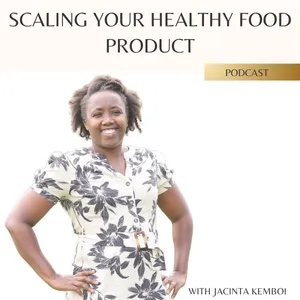
Free Daily Podcast Summary
Scaling Your Healthy Food Product: Daily Summaries Delivered
by Jacinta Kemboi
If you're building a better-for-you food product and you're at the point where growth is knocking (a retailer, a distributor, a co-manufacturer), this podcast is for you.Building a food business is hard, and scaling a better-for-you product brings its own technical challenges. But you shouldn't have to choose between growing your business and staying true to why you started.I'm Jacinta Kemboi, an independent food scientist with 12+ years in the food industry. I've managed products from idea to kitchen to commercial production to retail shelf, and I work closely with co-manufacturers to get products commercialized the right way. On this show, I'll help you get ready to say YES to the right opportunities, without compromising your product's integrity.No secret codes here. Each episode shows you what to do and why it works, so you can make informed decisions, protect your product and keep building on your own terms.You'll learn how to:-Get your technical foundation right with the ste
Latest Episodes
The most recent episodes — sign up to get AI-powered summaries of each one.
- Today21 min
Who Owns Your Recipe? Protecting Your Formula and Autonomy with a Co-Man
#93 If your co-manufacturer raised your price 30% tomorrow, could you take your exact product to another plant? For many better-for-you founders, the honest answer is no, because the formula on shelf quietly changed during scale-up and the changes belong to someone else. In this "no secret codes" episode, I explain what you can actually own when it comes to a recipe and the five places formulas leak in a co-manufacturing relationship. You'll walk away knowing exactly what to ask for to protect your formula, your clean-label claims and your autonomy before you sign. What We Cover Timestamps are estimates from the script; update them after editing. [0:00] Could you walk away from your co-man tomorrow? [2:30] The hard part: how one founder's formula changed during a plant trial, and why she couldn't take it with her [6:00] Trademarks, patents and trade secrets: what you can actually own in a recipe [10:00] Leak 1: sharing your formula before an NDA is signed [11:30] Leak 2: changes made during the plant trial [13:00] Leak 3: proprietary blends and house ingredients [14:30] Leak 4: why you probably don't own your flavor [15:30] Leak 5: a co-man using your formula for someone else [16:30] The small-budget version: three steps that cover most of the risk [17:00] Protecting your autonomy: change control and a clean exit [20:30] What opens up when you own your formula, plus your one action this week Key Takeaways Most food formulas are protected as trade secrets, which only stay protected if you take reasonable steps to keep them secret. Your protection comes from your habits and agreements, not from a certificate. Sign a mutual NDA before you share your full formula, and share in stages. An ingredient list and process steps are usually enough to get a quote. The production formula is the one that matters. Make sure your agreement says the formula and any changes made during scale-up belong to you, and that every change is written down. Ask before approving a co-man's proprietary blend or a flavor-house flavor: can I see the specs, buy it directly, and keep buying it if we part ways? An ingredient you can't verify is a claim you can't stand behind. Protect your autonomy with two clauses: change control (your written approval before any formula, ingredient, supplier or process change) and a clean exit (formula, specs and process handed over if you leave). Links & Resources Preorder the book titled (Building Retail Ready Food Products): Get free Ebook and Signed copy Episode 90, The Spec Sheet: Keeping Your Product the Same at Scale: Apply to Join the Retail Readiness Program upcoming cohort Join Emerging Food Business Newsletter here Connect With Me Instagram: @jacintakemboim Website: https://camaresearch.com Email: info@camaresearch.com Have a question or topic you want covered on the show? Send me a Voice note. I'd love to hear where you're at in your own co-manufacturing journey. Note: this episode shares practical food science experience, not legal advice. Have a food or CPG attorney review any agreement before you sign. <p da
- 1 weeks ago17 min
Cutting Sugar Without Losing Your Customers: How to Reduce Sugar Step by Step and Keep the Product People Love
Episode Summary #92 A buyer asks you to get the sugar down, so you cut it, and suddenly your regulars are asking, "Did you change something?" In this Better-for-You Formulation episode, Jacinta explains why sugar is doing five jobs in your product, not just making it sweet, and why swapping in a sweetener only fills one of them. She walks through a step-down method using the ETS Method, from locking in your gold standard to a kitchen-table blind test with your real customers, plus what "reduced sugar," "sugar free" and "no added sugar" actually mean on a label. You'll walk away knowing how to cut sugar in small, tested steps your loyal customers won't notice. What We Cover [0:00] The granola bar scenario: what happens when you cut sugar all at once [1:45] Sugar's five jobs: sweetness, structure, shelf life, browning and body [3:45] Two traps: over-correcting to zero and the silent swap [4:45] Your non-negotiables: what customers would never forgive you for changing [5:00] Evaluate: locking in your gold standard [5:45] Transform: stepping down 10–15% at a time [6:30] Flavor before sweeteners: vanilla, spices, salt and toasting [7:15] Rehiring for sugar's other jobs, and choosing sweeteners like allulose, stevia and monk fruit by the job [8:15] The kitchen-table blind test with your regulars [9:00] Scale: re-checking shelf life, plant trials and your spec sheet [9:30] Label claims: "reduced sugar," "sugar free," "no added sugar" and a heads-up on allulose [10:45] What opens up when you get it right, and this week's action Key Takeaways Sugar has a job description. Besides sweetness, it gives structure, protects shelf life, creates browning and adds body, so plan a replacement for every job you remove. Step down, don't jump. Small reductions of around 10–15% are much harder for customers to notice than cutting a third at once. Reach for flavor before sweeteners. Vanilla, warm spices, a pinch of salt and toasted ingredients make a product taste sweeter and keep your label simple. Let your customers decide. A simple blind test with a few regulars tells you whether a reduction is safe to keep. Know your claim before you print. "Reduced sugar" means at least 25% less than your original, and any front-of-pack sugar claim deserves a regulatory review. Upcoming Cohort Retain Readiness Program — Emerging food businesses with better for you food products looking to expand to other markets. Starts November 26th | "Limited to 10 Founders" The Retail Readiness Program is a 6-month program for emerging food and beverage founders, built on the ETS Method: Evaluate your product's readiness and pricing, Transform your production with the right manufacturing partner, and Scale into the retail channel your product is built for. By month six, you'll know exactly which retail path fits your brand and have a roadmap to get there. 👉 Apply to Join here Cohorts are kept small so every founder gets hands-on support, and spots for the next cohort are limited. Take the Retail Readiness Assessment by November 12th to find out if your brand is ready. 👉 [Take free Assessment here] Links & Resources New Book: Building Retail Ready Food Products — Ebook is ready. Preorder to get a signed copy Protein claim episode:What a plant trial actually is Why Skipping it is the most expensive shortcut in food. Join Emerging Food Business Newsletter here Connect With Me</h2
- 2 weeks ago16 min
The Spec Sheet: The One Document That Keeps Your Food Product the Same at Scale
#91 Your customers know exactly how your product should taste, look and crunch. But can a co-manufacturer make it the same way from day one? In this Co-Manufacturing & Scaling Up episode, Jacinta explains why the product spec sheet is the document that keeps your product the same as you move from a commercial kitchen to large-scale production. She shares what belongs in it, why it has to be a living document, and a real plant-trial story where one unrecorded oat flour change nearly cost a brand its signature crunch. You'll walk away knowing how to use your spec sheet to hand off production smoothly and shorten your scale-up timeline. What We Cover [0:00] Planning for 2027: why the spec sheet matters if you're moving to a co-manufacturer [1:15] Sales sheet vs. spec sheet: the document that's not getting enough attention [2:00] Where the spec sheet fits in the ETS Method (Evaluate, Transform, Scale) [2:45] "Passing the baton": going from 500 units to 100,000+ [3:45] Why scale-up can take 6–12 months, and how ingredients and your "gold standard" slow it down [5:15] What goes in a spec sheet: ingredients, process and quality tests like moisture, color, crunch and weight [6:30] Why it's a living document, and the changes founders forget to record [8:00] The oat flour story: what a plant trial uncovered [10:30] Cross-checking ingredient bags at the plant, and keeping a folder of supplier spec sheets [11:30] How a ready spec sheet can cut six months down to three [12:45] This week's challenge [13:30] Jacinta's new book and the One Million Better Food Businesses initiative Key Takeaways Your spec sheet is your product's manual. It translates what your customers love into details a co-manufacturer can reproduce. Ingredients are the biggest source of scale-up delays. A co-man may use different suppliers, so document exactly what you use and why it matters. Quantify your gold standard. If you check moisture, color, crunch or weight, write down the targets so a lab can measure against them. Treat it as a living document. Ingredient, process and packaging changes happen quietly, and unrecorded changes surface at the worst time. Being prepared puts the ball in the co-man's court. When your spec sheet is complete, you're not the one holding up the handoff, and a six-month process can shrink to three. Upcoming Cohort Retain Readiness Program — Emerging food businesses with better for you food products looking to expand to other markets. Starts November 26th | "Limited to 10 Founders" The Retail Readiness Program is a 6-month program for emerging food and beverage founders, built on the ETS Method: Evaluate your product's readiness and pricing, Transform your production with the right manufacturing partner, and Scale into the retail channel your product is built for. By month six, you'll know exactly which retail path fits your brand and have a roadmap to get there. 👉 Apply to Join here Cohorts are kept small so every founder gets hands-on support, and spots for the next cohort are limited. Take the Retail Readiness Assessment by November 12th to find out if your brand is ready. 👉 [Take free Assessment here] Links & Resources Building Retail-Ready Food Products — Be the first to know when it Launches Plant trial podcast episode:What a plant trial actually is Why Skipping it is the most expensive shortcut in food. Join Emerging Food Business Newsletter here Connect With Me <ul class= "[li_&]:mb-0 [li_&]:mt-1 [li_&]:gap-1 [&:n
- 3 weeks ago9 min
Can You Actually Call It "High Protein"? What It Takes to Back Up a Claim Before You Print the Label
#90 Your bar has 10 grams of protein, so it's "high protein," right? Not necessarily. In this Labels & Health Claims episode, Jacinta explains why regulators in the U.S. (FDA) and Canada (Health Canada and the CFIA) look at protein quality, not just grams, and why "high protein" means something different on each side of the border. You'll walk away knowing the four things to have on file before your label goes to print, so you can make your claim with confidence in every country you sell in. What We Cover [0:11] A pea protein bar that couldn't call itself "high protein" [1:30] Why protein claims are regulated wording, not marketing copy [2:00] Protein quality explained: tickets sold vs. seats filled [2:37] Blending plant proteins to raise your score, from a recent formulation project [3:30] Why processing and crop variation mean you test the finished product [4:00] U.S. rules (FDA): "high protein" vs. "good source" [4:59] Canadian rules (Health Canada / CFIA): the "high protein" twist [5:50] Why products sold in both countries carry separate labels [6:10] Four things to have on file before you print [7:19] What to do if you don't qualify, and why you need a regulatory sign-off [8:00] How a claim you can back up helps in buyer meetings [8:40] This week's action item Key Takeaways Grams aren't the whole story. Regulators in both the U.S. and Canada ask how much of your protein the body can actually use. Protein quality is a formulation decision. Single plant proteins like pea get less credit, but complementary blends like pea and rice can close the gap. Test your finished product, not just your formula. Heat, processing and year-to-year crop variation can all change protein quality. The same words don't mean the same thing everywhere. "High protein" is the top claim in the U.S. but the lower tier in Canada, and Canada only allows its approved wording. Build a re-check into your spec sheet. If your protein supplier, formula or process changes, re-run the numbers before you reprint. Upcoming Cohort Retain Readiness Program — Emerging food businesses with better for you food products looking to expand to other markets. Starts November 26th | "Limited to 10 Founders" The Retail Readiness Program is a 6-month program for emerging food and beverage founders, built on the ETS Method: Evaluate your product's readiness and pricing, Transform your production with the right manufacturing partner, and Scale into the retail channel your product is built for. By month six, you'll know exactly which retail path fits your brand and have a roadmap to get there. 👉 Apply to Join here Cohorts are kept small so every founder gets hands-on support, and spots for the next cohort are limited. Take the Retail Readiness Assessment by November 12th to find out if your brand is ready. 👉 [Take free Assessment here] Links & Resources Application link for Retail Readiness Program Related podcast episode:The Power of Focus:Scaling Your Food Product. Join Emerging Food Business Newsletter here Connect With Me Instagram: @jacintakemboim <li class=
- 4 weeks ago46 min
Food Science as a Calling: Why Your Gift Isn't an Accident (Guest on Yenga's Corner)
#89 Have you ever thought of your skills, your training or your expertise as a calling? In this episode of Yenga's Corner, host Yenga Ndinsil explores science in the Bible, starting with the perfumer God appointed in Exodus 30, and invites Jacinta to share what it means to do food science as a calling. Jacinta tells the stories that shaped her path: a parent's phone call about thickened water, her dad's diabetes diagnosis, and the cereal launch that showed her she'd been following a framework all along. She also explains how the ETS Method was born, how she balances motherhood and business, and why knowing exactly who you serve changes how confidently you show up. What We Cover [0:00] Yenga opens with a question: did science exist in biblical times? Exodus 30 and the perfumer's sacred formula [3:44] "When I'm in my element as a food scientist, I feel whole": the thickened water story and the parent's call that showed Jacinta the impact of her work [9:59] What a food scientist actually does: formulation, sensory, nutrition, and why it has to taste good or nobody buys it [13:36] The bad reputation of "lab-made" food, and the responsibility that comes with food science [15:21] Her dad's diabetes diagnosis, cranberry research that led to a patent, and why she studied health coaching to bridge food science and nutrition [20:15] The interview promise that got her hired, and launching a cereal in six months that had been stuck for two years [22:32] How the ETS Method was born, and why 99% of founders who were told "not ready" never came back [25:24] The ETS Method explained: Evaluate, Test, Scale [27:29] Proverbs 31 and juggling motherhood, marriage, faith and business: "It's not just my business, it's our business" [32:42] Imposter syndrome, and how getting clear on who you serve built her confidence [37:21] What keeps her going, the Road to 1 Million Better-for-You Food Products, and how one bold email led to a protein research grant Key Takeaways Your expertise may feel easy to you because of the "curse of knowledge," but someone on the other side is waiting for exactly what you know. A product can look great and still fail if it isn't structurally ready. Problems that slip through early get more expensive as you grow. The food industry has a low barrier to entry, but staying in takes the right tools: evaluate your product, test it at scale, then scale into retail. Hesitation often comes from not knowing who you serve. Once Jacinta got clear on better-for-you food founders, presenting herself and her business got easier. Go for it. One email to a professor Jacinta heard on the news became a podcast episode and then a funded research collaboration. You never know what an idea can turn into until you knock on the door. 🎧 Episodes Mentioned Episode 53 — How food founders can stay ahead of the protein trend 📣 READY TO SCALE? ➡️ Not sure if your product is structurally ready for retail? Take the Retail Readiness Quiz and find your product's gaps → [QUIZ LINK] ➡️ Loved this conversation? Share it with a woman who needs to hear that her gift is an appointment, not an accident. Links & Resources Visit Yenga's Corner Youtube channel → [Yenga's Corner] Join the Emerging Food Business Newsletter here Scale Up & Retail Readiness Quiz → [QUIZ LINK] Connect With Me Instagram: @jacintakemboim Website: https://camaresearch.com Email: info@camaresearch.com #FoodScientist #FaithAndBusiness #MomEntrepreneur #BetterForYouFood #ETSMethod)
- Oct 9, 202614 min
Would You Say Yes If a Retailer Called Today? Why You Need a Plant Trial First
#88 If a major retailer called you today, would you confidently say yes — or would you hesitate and say "give me a few more months"? Jacinta unpacks why that hesitation is valid, and the one thing every emerging food brand should do to test drive their product before scaling into retail: schedule a plant trial. Drawing from Chapter 2 of her upcoming book, Building Your Retail Ready Food Products ("The High Price of Hope"), Jacinta explains why a plant trial is the step that tells you whether your product can truly survive the move from small batches to large-scale production — and why skipping it to save money can end up costing you a whole production run. In this episode, Jacinta covers: The question every founder should ask: if a major retailer called today, is your product structurally ready to say yes? Why hesitation about packaging, substantiated claims, shelf life, or true product costing is a valid signal, not a weakness What a plant trial is and why it applies whether you're working with a co-manufacturer or self-manufacturing with new equipment Why you still need your own plant trial even when your co-man says "we make products like yours all the time" How a plant trial gives you a clear picture of real product costs and the changes your product may go through at scale Using the trial to "show and tell" your co-man exactly how your product should look, feel, taste, and smell A real example: a cracker that lost its crunch at scale because a packaging bottleneck let it absorb moisture — caught and fixed during a plant trial What a plant trial typically costs (roughly $1,000 to $3,500 depending on the facility) and how to reduce it by piggybacking on a similar product's run Key Takeaways Your hesitation about going into retail is valid — packaging, claims, shelf life, and costing gaps are real risks. A plant trial is your test drive for first production; skipping it puts an entire batch (and your product quality) at risk. Even an experienced co-man needs to see your specific product run through their line. The goal is for your product quality to stay the same whether you're making small batches or large ones. Ask your co-man about their minimum batch size or tagging onto the end of a similar product's run to lower the cost. Links & Resources Read and review Chapter 1 of Jacinta's upcoming book, Building Your Retail Ready Food Products: [Read Chapter 1 here] Strategies to prepare for your plant trial day: [Link here] Get Your ETS Stage (Free Scale Up & Retail Ready Quiz): Take the Quiz here For Weekly Tips and Strategies while building: Subscribe to the Emerging Food Business Newsletter Questions about planning your plant trial? Email Jacinta: info@camaresearch.com Next Steps If you're planning to scale into retail or move to a co-manufacturer, start here: Ask yourself honestly: if a retailer called today, what would make you hesitate? Write it down. Ask your co-man for their minimum batch size that still gives you a representative sample. Schedule your plant trial before your first production run — not instead of it. Show up to the trial ready to explain your product's target texture, taste, smell, and look, and observe every step from mixing to packaging (and even a trial shipment to your 3PL). Ask whether you can piggyback on the end of a similar product's run to cut the cost. About Your Host Jacinta is a food scientist and founder mentor, coaching better-for-you food founders toward one million healthier products in retail. Connect With Me Instagram: @jacintakemboim Website: https://camaresearch.com Email: info@camaresearch.com #planttrial #comanufacturer #copacker #retailreadiness #scalingfoodbusiness #foodmanufacturing #CPGfounder #foodentrepreneur #betterforyoubrand #foodcommercialization #shelflifetesting #foodfounderpodcast
- Oct 2, 202611 min
3 Trade Show Lessons I Brought Back From CHFA (And How You Can Use Them)
#87 Fresh off the show floor, Jacinta shares three real takeaways from CHFA — not theory, but what actually worked (and what she watched other food founders do right) to turn trade show moments into real momentum. This episode is a follow-up to last week's CHFA prep episode, covering what Jacinta noticed in practice: how competitions and awards create a "double whammy" of publicity, why the quiet in-between moments at a trade show are often the best time to talk to retailers, and why having fun — and not working the booth alone — can lead to the deals you didn't see coming. In this episode, Jacinta covers: Why applying to pitch competitions or launch pad showcases at a trade show gets you a "double whammy" of publicity — both from the pitch itself and from attendees who recognize you afterward How to use conference days (before the trade show floor opens) to have unhurried, no-agenda conversations with retailers Why scheduling meetings ahead of time — even just a week out — makes your trade show conversations more precise and effective Why having fun at your booth isn't a distraction from business — it's often what makes people want to engage with you Why founders shouldn't work the booth alone, and how having a second person frees you up for deeper conversations A real example of how casual, social conversations with ingredient suppliers can lead to advance pricing and sourcing information you wouldn't get in a formal meeting Key Takeaways Competitions and showcases at trade shows aren't just for the prize — they generate publicity before, during, and after the show. The best retailer conversations often happen in the in-between moments, not during the rush of the trade show floor. Plan ahead, but don't lose the ability to be relaxed and approachable — some of the best deals happen in casual, unstructured conversations. Links & Resources Free Webinar — "Retail Readiness Roadmap: What Buyers Need to See Before They Say Yes" (Thursday, Oct 8, 12–1pm EST): [Register Here] Get Your ETS Stage (Free Scale Up & Retail Ready Quiz): Take the Quiz here Apply to the Retail Readiness Program: Apply Here Companion episode: CHFA Trade Show Strategy — the exact questions to ask retailers, suppliers, and co-manufacturers (Episode 86) Download the CHFA Retail Readiness Checklist (Pocket + Worksheet): Download Checklist & Worksheet here For Weekly Tips and Strategies while building: Subscribe to the Emerging Food Business Newsletter Next Steps If you're heading to your next trade show, start here: Apply to a pitch competition or showcase if one's available — the exposure compounds even if you don't win. Use conference days (before the floor opens) to approach retailers casually, without an agenda. Schedule your must-have meetings ahead of time, even if it's just a week out. Bring someone to the booth with you so you're free to have real conversations, not just manage traffic. About Your Host Jacinta is a food scientist and founder mentor, coaching better-for-you food founders toward one million healthier products in retail. Connect With Me Instagram: @jacintakemboim Website: https://camaresearch.com Email: info@camaresearch.com #CHFA #tradeshow #retailreadiness #specialtyretail #groceryretail #retailbuyers #CPGfounder #foodentrepreneur #betterforyoubrand #foodcommercialization #tradeshowstrategy #foodfounderpodcast
- Sep 25, 202614 min
CHFA or Trade Show Survival Guide: What to Ask Retailers, Ingredient Suppliers & Co-Mans (So You Don't Waste 6 Months)
#86 If you're heading to CHFA, this episode gives you the exact questions to ask so you leave with requirements, next steps, and follow-ups—not just samples and business cards. This episode covers CHFA trade show strategy for better-for-you CPG founders, including retailer conversations, co-manufacturer vetting, shelf life documentation, labeling compliance, and retail readiness. In this episode, Jacinta covers: p]:inline" data-streamdown="list-item"> How to approach retailers at CHFA without pitching too soon (collect requirements first) p]:inline" data-streamdown="list-item"> The most important questions to ask about shelf life expectations + documentation p]:inline" data-streamdown="list-item"> What to ask ingredient suppliers so scaling doesn't break your product (specs, CoAs, variability, substitutions) p]:inline" data-streamdown="list-item"> What to ask co-manufacturers so you don't sign a "yes" that falls apart later (allergens, documentation, MOQs, onboarding) p]:inline" data-streamdown="list-item">A simple 48-hour follow-up system to turn CHFA conversations into real momentum Key Takeaways p]:inline" data-streamdown="list-item"> Don't pitch for validation—collect requirements. p]:inline" data-streamdown="list-item"> One conversation = one requirement + one next step + one follow-up date. p]:inline" data-streamdown="list-item"> Retailers move faster when you make follow-up easy to evaluate. Links & Resources p]:inline" data-streamdown="list-item"> Get Your ETS Stage (Free Scale Up & Retail Ready Quiz): {Take the Quiz here} p]:inline" data-streamdown="list-item"> Apply to the Retail Readiness Program (Deadline: Sept 30): {Apply Here} p]:inline" data-streamdown="list-item"> Companion episode: Inside CHFA Now Toronto: {Listen to the Episode here} p]:inline" data-streamdown="list-item"> Download the CHFA Retail Readiness Checklist (Pocket + Worksheet): {Download Checklist & Worksheet here} p]:inline" data-streamdown="list-item"> For Weekly Tips and Strategies while building Subscribe to the Emerging Food Business Newsletter Questions Mentioned in the Episode Retailers p]:inline" data-streamdown="list-item"> What does a "yes" look like in this category right now? p]:inline" data-streamdown="list-item"> What's the #1 reason you pass on emerging brands? p]:inline" data-streamdown="list-item"> What proof matters most before you bring a new product in? p]:inline" data-streamdown=
Get Scaling Your Healthy Food Product summaries in your inbox
Free AI-powered daily recaps. Key takeaways, quotes, and mentions — in a 5-minute read.
Get Free Summaries →Free forever for up to 3 podcasts. No credit card required.
You Might Also Like
Listeners also like.
Just Ingredients
Explores whole, non-toxic ingredients for nutrition, wellness, and daily living with expert guests discussing health and natural product choices.

Working Hard with Grace Beverley
Real people share hard-won lessons on success, resilience, and life balance across diverse fields, from activism to business and beyond.

Sue's Healthy Minutes with Sue Becker | The Bread Beckers
Sue Becker discusses nutritional science and the benefits of eating real food for better health.

Coaching Inc with Tom Krol
Teaches coaches and consultants how to generate consistent leads and increase income using proven, efficient marketing strategies.

The Dr. Hyman Show
Explores root causes of chronic disease and promotes functional medicine, nutrition, and preventive health through expert discussions.
Nutrition Made Simple
Nicole Aucoin

Walk-In Talk Podcast
Raw conversations with food industry professionals about restaurant operations, culinary leadership, and the business of hospitality.
Consulting Success Podcast
Strategies for building a profitable, scalable consulting business, from client acquisition to team management and marketing that works.

The EMPWR Podcast
A fitness entrepreneur shares workout tips, nutrition advice, and personal stories to support holistic wellness and self-empowerment.

Young and Profiting (YAP) with Hala Taha: Entrepreneurship and Self-Improvement Podcast
Interviews with top entrepreneurs and experts deliver actionable strategies for business growth, productivity, and personal development.
Seems Like Diet Culture
Mallory Page, RD

Sam Miller Science
Sam Miller
About Scaling Your Healthy Food Product
If you're building a better-for-you food product and you're at the point where growth is knocking (a retailer, a distributor, a co-manufacturer), this podcast is for you.Building a food business is hard, and scaling a better-for-you product brings its own technical challenges. But you shouldn't have to choose between growing your business and staying true to why you started.I'm Jacinta Kemboi, an independent food scientist with 12+ years in the food industry. I've managed products from idea to kitchen to commercial production to retail shelf, and I work closely with co-manufacturers to get products commercialized the right way. On this show, I'll help you get ready to say YES to the right opportunities, without compromising your product's integrity.No secret codes here. Each episode shows you what to do and why it works, so you can make informed decisions, protect your product and keep building on your own terms.You'll learn how to:-Get your technical foundation right with the ste
Customized Recaps
AI-powered recaps with compact key takeaways, quotes, and insights.
Straight to Your Inbox
Get key takeaways from Scaling Your Healthy Food Product in a 5-minute read.
Save Hours Every Week
Stay current on your favorite podcasts without falling behind.
Frequently Asked Questions
What is Podzilla's Scaling Your Healthy Food Product daily summary?
It's a free AI-powered email that summarizes new episodes of Scaling Your Healthy Food Product as soon as they're published. You get the key takeaways, notable quotes, and links & mentions — all in a quick read.
How does the Scaling Your Healthy Food Product podcast summary work?
When a new episode drops, our AI transcribes and analyzes it, then generates a personalized summary tailored to your interests and profession. It's delivered to your inbox every morning.
Is this an official Scaling Your Healthy Food Product product?
No. Podzilla is an independent service that summarizes publicly available podcast content. We're not affiliated with or endorsed by Jacinta Kemboi.
Can I get summaries of other podcasts too?
Absolutely! The free plan covers up to 3 podcasts, any in the catalog. Basic raises that to 15, Pro to 40 and Max to 100. Browse our full catalog at /podcasts.
What topics does Scaling Your Healthy Food Product cover?
Scaling Your Healthy Food Product covers topics including Business, Arts, Food, Entrepreneurship, Nutrition, Fitness, Health & Fitness. Our AI identifies the specific themes in each episode and highlights what matters most to you.
Start getting Scaling Your Healthy Food Product summaries tomorrow morning.
Free forever for up to 3 podcasts. No credit card required.
Free forever for up to 3 podcasts. No credit card required.