Free Daily Podcast Summary
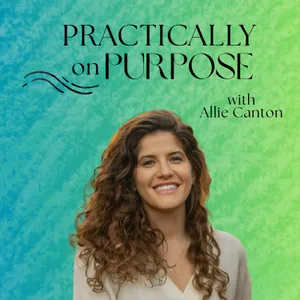
Practically on Purpose: Daily Summaries Delivered
by Allie Canton
Get key takeaways, quotes, and insights from Practically on Purpose in a 5-minute read. Delivered straight to your inbox.
Latest Episodes
The most recent episodes — sign up to get AI-powered summaries of each one.
- Feb 24, 202638 min
The Resume Game vs. Real Life
What does it actually cost to take the road less traveled — and what do you get back?In this episode, I sit down with my Amherst classmate Blake Murphey: liberal arts kid, former finance intern, and US Navy intelligence officer of 13 years. Blake's career reads like something out of a novel — aircraft carrier Intel cells in the Persian Gulf, supporting a SEAL Team deployment in East Africa, NATO in Sicily (yes, on the slopes of Mount Etna), the Pentagon, and now working alongside the people who literally defuse bombs for a living.But what strikes me most isn't the résumé. It's how Blake thinks about time — not as a backdrop to ambition, but as the whole point.We wander through the invisible curriculum of elite college culture: why so many brilliant people funnel into finance (spoiler: it's not just the money), what it actually felt like to leave that path, and what 13 years of high-pressure intelligence work teaches you about staying present when your amygdala is running the show.We also talk about the song Blake sings in his head when everything goes blank under pressure. It's Bob Seger. It works. And honestly, it makes complete sense.This is a conversation about the stories we inherit about success and the courage it takes to write a different one.In this episode:The "default path" trap at elite colleges — and why it's gotten more extremeFinance to the Navy: what a quarter-life crisis in London actually looks likeLife as a Navy Intel officer: aircraft carriers, SEAL teams, East Africa, NATO, the PentagonWorking with EOD (the bomb defusal community) — and what extreme stress teaches you about your own mindBreath work, sports psychologists, and the Bob Seger method for resetting under pressureWhy time — not titles, not money — is the only non-renewable resource"Do it now. You don't know what life looks like down the road." This is a public episode. If you would like to discuss this with other subscribers or get access to bonus episodes, visit alliecanton.substack.com
- Feb 10, 202642 min
Law Is For Smart People Who Don't Know What Else To Do
Jordan Nahmias didn’t grow up dreaming of being an entertainment lawyer. He wanted to be an artist. But a professor suggested he write the LSAT, he did well, and suddenly he was on a track.Once you’re on the track, it’s easy to mistake momentum for destiny.“It is a well-worn groove,” he told me. “Once you’ve made the choice… the blinders are on.” He continued, “Law is the thing that smart people do when they don’t know what to do.” OOFFor Jordan, there wasn’t one clean “I’m done” moment. It was more like epistemological dissonance, in his words. He knew for a long time, even going back to law school, but couldn't make himself act on that knowing.But then in 2021, he got into a fight with a long-term client and he was treated poorly in a way he could not shrug off.“I ended up firing them,” he said. “And that was really hard for me… but then I was like, whoa, wait a minute, you can fire people? You don’t have to do this. You don’t have to continually expose yourself to this.”And he realized that i you can fire one client, you can fire them all. This is a public episode. If you would like to discuss this with other subscribers or get access to bonus episodes, visit alliecanton.substack.com
- Jan 27, 202643 min
Start Being Heard
A Harvard Law grad, negotiation expert, and author of Unlearning Silence, Elaine has spent the last decade teaching people how to have difficult conversations. But it wasn’t until she confronted her own self-silencing that the real work began.We talk about how silence gets rewarded, how it gets internalized, and what it really means to reclaim voice.BioElaine Lin Hering is a speaker, facilitator, and former Lecturer on Law at Harvard Law School. She works with organizations and individuals to build skills in communication, collaboration, and conflict management. She has worked on six continents and facilitated executive education at Harvard, Dartmouth, Tufts, UC Berkeley, and UCLA. She has served as the Advanced Training Director for the Harvard Mediation Program and a Managing Partner for a global leadership development firm. She has worked with coal miners at BHP Billiton, micro-finance organizers in East Africa, mental health professionals in China, and senior leadership at the US Department of Commerce. Her clients include American Express, Chevron, Google, Nike, Novartis, PayPal, Pixar, and the Red Cross. She was named a Thinkers50 global management thinker to watch and is the author of the USA Today Bestselling book Unlearning Silence: How to Speak Your Mind, Unleash Talent, and Live More Fully (Penguin).* Free Newsletter: https://hello.elainelinhering.com/newsletter* Book: https://www.penguinrandomhouse.com/books/720975/unlearning-silence-by-elaine-lin-hering/ This is a public episode. If you would like to discuss this with other subscribers or get access to bonus episodes, visit alliecanton.substack.com
- Jan 20, 202612 min
Where Is My Mind?
On motherhood, meditation, science, psychedelics and spirituality. My brain used to be a steel trap. I negotiated multi-million dollar deals and tracked complex legal roadmaps in my head.These days, I can’t remember if I’ve put coffee in the coffee maker.At first I thought I was just “losing it.”But the more I learn about matrescence, psychedelics and the default mode network, the more I wonder if I’m not losing my mind so much as losing the illusion that it was ever mine. This is a public episode. If you would like to discuss this with other subscribers or get access to bonus episodes, visit alliecanton.substack.com
- Jan 13, 202634 min
Work Is a Prism (Not a Cage)
What if your job were less a grind and more a mirror, one that reflects your strengths, triggers, and patterns so you can grow on purpose? In this conversation with Erin Hinkle Robertson (fractional Chief People Officer; culture builder), we explore work as a practice of becoming. Erin discusses when she first she saw that work is a prism for self-knowledge.We also get honest about America’s ruthless work culture, the “cult of Steve Jobs,” and how easy it is to lose yourself when identity fuses with output. Then we talk about how to step off the hamster wheel without burning it all down.You’ll hear:* Why many of us were taught to become our jobs—and how to rewrite that script.* Erin’s line in the sand: “I’m not living depleting days.” What changes when you choose ease over depletion.* Chimp Empire ≈ evolutionary Succession: status games at work and how to stop letting them run you.* Practical support: coaches, therapy, and a simple “team of you” to keep your humanity intact.Bio: Erin is an HR strategist and leadership coach who works with managing partners of law firms as well as founders and leadership teams at VC-backed startups, helping them keep pace with rapid growth and change. She helps leaders build high-performing cultures by getting out of the weeds and into the work that actually matters: defining values that stick, developing leadership capacity, and creating teams people actually want to be on. After years leading people strategy inside organizations, she recently re-launched her own practice, BuildRiseHR to partner more deeply with the leaders shaping what's next across legal, AI, and B2B SaaS. This is a public episode. If you would like to discuss this with other subscribers or get access to bonus episodes, visit alliecanton.substack.com
- Dec 16, 202558 min
From NYC Grind to Full-Body Freedom: Catherine Boyko’s Wake-Up Call
My next guest is someone who used to speed-walk through Manhattan like it was an Olympic sport, turn a six-month project around in twenty-eight days, and secretly love the chaos because it proved she could do the impossible. Sound familiar?Meet Catherine Boyko, a former executive producer at one of the world’s top ad agencies, whose life was all grind and no sleep… until COVID, a breakup, and a deep dive into somatic and polarity work exposed the cracks that had been there all along.We talk about her shift from living in constant “Iron Man suit” mode to discovering softness, embodiment, and what it means to move at her own speed. Catherine shares the science and soul behind somatic work, the price we pay for running on adrenaline, and the power we reclaim when we finally allow ourselves to slow down.I also share some uncomfortable truths I uncovered about myself during my own session with Catherine, and she guides us through a five-minute grounding practice you can use anytime life feels like it’s moving too fast.TimestampsIntroduction - 00:00:00Catherine’s Career Transition - 00:03:00Discovering Somatic Work - 00:09:00Impact of Societal Expectations - 00:15:00Embracing Authenticity and Balance - 00:21:00Practical Somatic Exercises - 00:27:00About Catherine Boyko:Catherine Boyko is a Somatic Coach based in Austin, Texas. After a decade producing global advertising campaigns in New York City, she left the high-pressure world of “achievement at all costs” to help women reconnect with themselves in a deeper way.Through somatic practices, Catherine guides high-achieving women out of anxiety, perfectionism, and self-abandonment and back into joy, presence, and power.Catherine is trained through The Embody Lab and weaves trauma-informed somatics, nervous system regulation, and feminine leadership into her work. She believes that when we find presence in our everyday lives and have the right support along the way, real change becomes not only possible, but sustainable.Website: www.embodiedboss.comIG: https://www.instagram.com/theembodiedboss/ This is a public episode. If you would like to discuss this with other subscribers or get access to bonus episodes, visit alliecanton.substack.com
- Dec 9, 20253 min
The Parable of the Pillow People
Guys, it finally happened.The sleep, I mean. Knock on wood, but I’m sleeping again.I was getting to the point where my brain resembled the crumbling ruins of some once-majestic estate, like whatever moldy manor was in Great Expectations or Wuthering Heights. I don’t actually remember much about either book, just the feeling-tone of gray skies and decaying Victorian grandeur.Chunks of my sanity, logic, and clarity of thought were shedding daily. (My hair too, but that’s a separate postpartum battle.) The locals were starting to whisper to each other, “Tread very carefully. She’s unsound.”On a recent trip to NYC, I was unable to determine when, where, or how to feed myself lunch, despite being extremely hungry. I was spending the day between Tribeca and Chelsea, and yet I booked a hotel near Grand Central “to be in the heart of it all” like a grade A jabroni. And then… salvation arrived, tenderly enclosed in wrapping paper stamped with indeterminate constellations, tucked in a brown paper bag.“You might not want to open this here,” V whispered. We were seated in Grey Dog, contemplating whether to buy the completely rationally priced $20 avocado toast or the $18 egg-and-cheese croissant. “Maybe just tear a little corner,” she suggested.Images raced through my mind. What scandalous object had my beloved childhood friend bought me? A banned book? An adult toy?As it turns out, the second guess wasn’t so far off.It only took a tiny tear to reveal a shock of yellow yarn. I gasped.There she was, only decades delayed. My very own Pillow Person: a rectangular pillow with a giant cartoon face and stubby fabric arms and legs — the pinnacle of 80s comfort and consumerism and the object of five year old me’s most fervent obsession.We rode home together that afternoon on the Metro-North. My Pillow Person was indeed the platonic ideal of an extremely low-maintenance friend as I mentally reviewed my insecurity du jour: At the previous night’s events did I come off as tired yet thoughtful or as a standoffish b***h?If only I’d had her for the past 35 years. What would be different? Would anything be the same?My 5 year old son cackled as he fully unwrapped her from the star-strewn paper.“What even is this, bruh??”A few nights later, he chucked the Pillow Person into my daughter’s crib, unbeknownst to me. And like a face-printed polyester seed planted in the fertile soil of her star-printed muslin sheet, we found my daughter playing with her joyfully the next morning, watered only by one hour of tears from our fourth attempt at sleep training.Much like psychedelics, my Pillow Person worked on multiple timelines at once - giving both my inner 5 year old the object of her inexplicable longing and my actual 11 month old a friend so she wouldn’t feel so lonely in her room.Is there a moral to the story? I’m still working that out:Perhaps something about the uncanny wisdom of the people who know us best? Or that the object I was deprived of as a child is what my child most needed?Maybe we all just need our (pillow) person?Regardless, I’m sleeping, and it’s magic, and I’m so grateful for that damn Pillow Person. This is a public episode. If you would like to discuss this with other subscribers or get access to bonus episodes, visit alliecanton.substack.com
- Dec 5, 20259 min
10-Minute Reiki Meditation to Receive & Release
Feeling wired, tense, or caught in a loop of overthinking?This 10-minute Reiki-infused meditation is designed to help you receive exactly what you need and release what you’re ready to let go of.In this gentle practice, we’ll:Take three grounding breaths to land in the present momentTune into the natural rhythm of your breathWork with the simple mantra: “Breathing in, receiving. Breathing out, releasing.”Explore how even your exhale is an offering to the earth, a way your “waste” becomes nourishment for the world around youYou don’t need any Reiki training or prior meditation experience. Just a quiet-ish spot, a comfortable seat, and a willingness to notice what is happening inside you, right now. This is a public episode. If you would like to discuss this with other subscribers or get access to bonus episodes, visit alliecanton.substack.com
Get Practically on Purpose summaries in your inbox
Free AI-powered daily recaps. Key takeaways, quotes, and mentions — in a 5-minute read.
Get Free Summaries →Free forever for up to 3 podcasts. No credit card required.
You Might Also Like
Listeners also like.

You are meant for more
Barbara Culjak

The Everyday Mystic
Corissa Saint Laurent
Positive On Purpose
Jamie Schoepke and Jules Philippi
Soul Fusion with Penny Chiasson
Penny Chiasson

ALIGNED & ALIVE with Chrissy May
Chrissy May

Intentional: Mindset Coaching for Female Entrepreneurs
Stacy Musgrave

Align + Prosper with Elise Danielle
Elise Danielle
Repossible
Bradley Charbonneau

Inspired by Design with Sarah St Pierre
Sarah St Pierre

Fuller Expectations
Carrie Fuller

Mostly All Figured Out
Emily Rose

Project Joyful
Tracy Tutty
About Practically on Purpose
For high-achieving humans learning to release expectation and embrace cultivate deeper meaning and purpose. Through honest reflections and soulful conversations, we'll explore how to release the pressure to perform and remember who you truly are. It's time to stop chasing the success story and step into your life. alliecanton.substack.com
Customized Recaps
AI-powered recaps with compact key takeaways, quotes, and insights.
Straight to Your Inbox
Get key takeaways from Practically on Purpose in a 5-minute read.
Save Hours Every Week
Stay current on your favorite podcasts without falling behind.
Frequently Asked Questions
What is Podzilla's Practically on Purpose daily summary?
It's a free AI-powered email that summarizes new episodes of Practically on Purpose as soon as they're published. You get the key takeaways, notable quotes, and links & mentions — all in a quick read.
How does the Practically on Purpose podcast summary work?
When a new episode drops, our AI transcribes and analyzes it, then generates a personalized summary tailored to your interests and profession. It's delivered to your inbox every morning.
Is this an official Practically on Purpose product?
No. Podzilla is an independent service that summarizes publicly available podcast content. We're not affiliated with or endorsed by Allie Canton.
Can I get summaries of other podcasts too?
Absolutely! The free plan covers up to 3 podcasts. Upgrade to Pro for 15, or Premium for 50. Browse our full catalog at /podcasts.
How often does Practically on Purpose release new episodes?
Practically on Purpose publishes biweekly. Our AI generates a summary within hours of each new episode.
What topics does Practically on Purpose cover?
Practically on Purpose covers topics including Education, Business, Careers, Self-Improvement. Our AI identifies the specific themes in each episode and highlights what matters most to you.
Start getting Practically on Purpose summaries tomorrow morning.
Free forever for up to 3 podcasts. No credit card required.
Free forever for up to 3 podcasts. No credit card required.