Free Daily Podcast Summary
Period Recovery and Fertility Podcast: Daily Summaries Delivered
by Lindsey Lusson
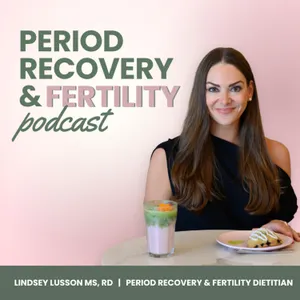
Welcome to the Period Recovery and Fertility Podcast! Here we discuss the challenging, rewarding, and life changing process of recovering your period and finding freedom with food and exercise. Whether you’re hoping to regain your cycle and get your health on track or you're ready to become a momma- this podcast is for you. While the recovery process isn't always rainbows and butterflies, it’s my hope to bring you both information and inspiration during your own recovery journey. I’m your host, Registered Dietitian and fellow HA woman Lindsey Lusson.
Latest Episodes
The most recent episodes — sign up to get AI-powered summaries of each one.
- 4 days ago32 min
Episode 121: Exercise and Fertility Part 2 | "But I'm Doing So Much Less Than I Used To"
You dropped the 6am HIIT class, swapped a couple of runs for Pilates, and you're "only" lifting four days a week now instead of six. You did it on purpose, because you've wondered if your training has something to do with your missing period. But you still don't have one. Your doctor says exercise is good for you, social media can't agree on anything, and AI will tell you whatever you want to hear. So you end up with the information you want, not the information you need.In Part 2 of the exercise and fertility series, Lindsey turns the spotlight back on you and shows where the tipping point for women actually is, and how surprisingly low the bar sits. Then she explains why your body doesn't track minutes. It tracks fuel.In this episode, we cover:Why most "exercise helps fertility" research was done on women with insulin resistance and PMOS, and why that's a different problem than under-fuelingThe simple blood sugar tests to ask for before accepting Metformin and a low-carb planWhy under-fueling can create the same low hormone pattern at a BMI of 28 as at a BMI of 18The 60-minutes-a-day threshold linked to a higher risk of anovulation (yes, the spin class plus the walk afterward counts)The Danish study where 5+ hours a week of vigorous exercise was tied to 32 to 42% lower odds of pregnancy each cycle, and what researchers actually meant by "moderate" exerciseRecreational runners doing about 17 miles a week who had regular cycles but ovulated in only 45% of themEnergy availability: why the same 45-minute class can be fine for one woman and enough to stop ovulation in anotherThe honest question to ask about your cutbacks: did you scale back to what your body needs, or just to what you could tolerate giving up?Why a bleed isn't the finish line, and how going straight back to your old training can leave you with a short luteal phaseThe biggest takeaway: your body doesn't track minutes, it tracks fuel. The research can't tell you exactly where your line is, but your body already has. If your period is missing, what you're doing right now is too much. Not too much for everyone. Too much for you, right now.This week, write down every workout you're still doing and ask, one by one, whether it's moving you closer to getting your period back or pushing you further away. Then pick one to let go of, just for this week, and notice how that feels, because that's exactly what Part 3 is about. If you're tired of piecing this together from advice that wasn't written for you, take the free Fertility Fix for the Fit Girl Quiz to see what's most likely keeping your period away. Links & ResourcesTake the Fertility Fix for the Fit Girl QuizBook a Discovery CallLearn More About LindseyJoin the Email List
- 2 weeks ago31 min
Episode 120: Exercise and Fertility Part 1 The Episode to Send Your Husband
Why kick off an exercise and fertility series by talking about men? Because male factor infertility is involved in roughly half of all infertility cases, and in 20 to 30% of couples it's the only cause. Yet in most fertility journeys, she gets the labs, the ultrasounds, the supplements and the medications, while he gets maybe one semen analysis and very little conversation about what his numbers mean or how to improve them.In this episode, Lindsey walks through what the research actually says about exercise and male fertility: where it helps, where it starts to hurt, and why the benefit lives in moderate, consistent movement rather than more and harder training. Then she goes beyond the gym to the food, habits, environmental exposures and supplements that almost never come up in a fertility appointment but make a real difference. And fair warning: as you listen to the warning signs of under-fueling in men, you might hear something that sounds a little too familiar about you.In this episode, we cover:Why your partner's lifestyle is half the equation, and why only about half of men in couples seeking fertility help ever get testedThe 2017 randomized trial where every exercise group improved sperm quality, and why the moderate group, not the HIIT group, improved the mostWhy the benefit of exercise lives at the bottom of the curve (going from nothing to something), and what that means if he's already very activeWhy consistency beats intensity, and how quickly improvements faded once the men stopped exercisingThe 3-month clock: why what he does today shows up in a semen analysis 3 months from nowWhen exercise flips for him, including cycling, heat exposure, and high-mileage runningThe "exercise-hypogonadal male condition," and why it's essentially the male version of what we see with HARED-S in men: the warning signs to watch for, from low libido and cold hands to a rigid relationship with food and trainingThe habits that matter most: smoking, cannabis, and why a 3-month break makes senseSimple, non-obsessive nutrition for sperm health, five easy swaps to cut down on BPA and phthalates, and a short list of supplements worth consideringThe biggest takeaway: exercise is genuinely good for male fertility, and the research links it to better sperm quality and higher pregnancy and live birth rates. But the benefit comes from moderate, consistent movement, not from pushing harder. Add in enough food, fewer toxin exposures, the right supplements, and at least 3 months of consistency, and he can make a meaningful difference that's completely in his hands.Before the end of today, send this episode to your partner. No long explanation, no lecture, just "I'd love for you to listen to this one." And if you checked off more of those RED-S warning signs for yourself than for him, don't miss Part 2 later this month, where Lindsey turns the microscope around to exercise and female fertility and where the tipping point actually is.Links & ResourcesBook a Discovery CallTake the Fertility Fix for the Fit Girl QuizLearn More About LindseyJoin the Email List
- Oct 19, 202629 min
Episode 119: Who Told You Period Recovery Could Take Years?
You finally work up the courage to ask your OB about getting your period back naturally, and the answer is “Keep doing what you’re doing, but this could take years. You might as well start fertility treatment.” If you’ve heard some version of that, this episode is for you. Across 400+ women, Lindsey has never once looked at a client’s labs and thought, “This is going to take you years.” On average, her clients get their period back in about 8 weeks, and 85% get it back within 90 days. Weeks and months, not years.In this episode, Lindsey walks through how she reads a hormone panel, why she can usually estimate someone’s recovery timeline from her labs, and why the numbers alone will never tell you what to actually change. Then she shares two real client stories, with their real lab values: Haley, who hadn’t had a natural period in 15 years, and Caroline, who’d gone more than 10.In this episode, we cover:The hormones Lindsey looks at first (estradiol, LH, FSH, androgens, and vitamin D) and what each one tells her about where you areThe HA spectrum: what it looks like when your brain has gone almost quiet compared to when your body is right on the edge of ovulatingHow starting labs can predict your timeline, and why one client took 15 weeks while another took just 5Why your labs show where you are but not why you’re there, and how you can sit at “almost ovulating” for months or even years if nothing changesHaley’s story: “clean” eating for her skin, food rules she didn’t recognize as rules, and why not having a period at 90 days didn’t mean her plan had failedHow one testosterone result could have sent Haley down the PCOS path, and the clue that showed it was actually her hormones surging right before ovulationCaroline’s story: a 10/10 stress level, a quiet fear of weight gain, and why knowing what your body needs isn’t the same as being able to do itWhy “close to ovulating” isn’t the same as “ready for pregnancy”The biggest takeaway: your labs are a snapshot, not a sentence. They can tell you how suppressed your hormones are and give you a sense of your timeline, but they can’t tell you what needs to change. That comes from connecting your numbers to your food, your training, your stress, and the rules you don’t even realize you’re following. When someone connects those dots, recovery happens in weeks and months, not years.If you’ve been sitting in your labs wondering what they mean, or you’ve been doing everything “right” and still don’t have your period back, the Missing Period Assessment is open now. You’ll get your hormone labs reviewed, your food log analyzed, a personalized video breakdown from Lindsey, a custom plan, and a 1:1 strategy call with the lead dietitian. Enrollment closes Thursday, October 22 at midnight Central, and this is the last time it’s opening this year.Links & ResourcesEnroll in the Missing Period Assessment (closes October 22)Book a Discovery CallTake the Fertility Fix for the Fit Girl QuizLearn More About LindseyJoin the Email List
- Oct 5, 202630 min
Episode 118: Food Rules and Your Fertility (Part 4: Finding Food Freedom)
When you hear “food freedom,” you probably picture one of two things. Either the donuts-for-breakfast, cake-for-dinner free-for-all that's all over social media, or the quieter version your favorite wellness accounts are selling: eat whatever you want… as long as it's 90% whole foods, portion controlled, and “in moderation.” One sounds like chaos. The other sounds balanced, but look closely and it's just more food rules wearing a cuter outfit.In the final part of the Food Rules and Your Fertility series, Lindsey redefines what food freedom actually is (hint: it was never about what's on your plate) and speaks directly to the three women most likely listening right now: the one who just had the lightbulb moment, the one who's already tried everything and doesn't believe she can change, and the one who wants to know if all this work will actually get her pregnant.This episode wraps up the series, so if you haven't listened yet, start with Episode 115, Episode 116, and Episode 117 first.In this episode, we cover:Why real food freedom happens in your head, not on your plate and what it looks like when food takes up almost zero space in your brainThe two biggest myths about food freedom, and why “food freedom with strings attached” is just more food rules in disguiseWhy realizing you have food rules is the fastest part of the process, and how to keep that clarity from cooling off into “that was a good episode”Why past attempts with a dietitian, a therapist, or going “all in” on your own may not have worked — and why that isn't a character flawHow food rules, resistance to body changes, and constant food noise tell your body it isn't a safe time to make a babyWhy your period was never proof of a healthy cycle, and what your options really look like when ovulation is missingA real-life picture of food freedom: a spontaneous weekend getaway with no workout plan, no menu research, and no fight in your own headThis episode is the final part of the Food Rules and Your Fertility series. Up next, Lindsey has one more mini series to share and she's saved the best for last.The biggest takeaway: food freedom isn't a rulebook or an all-or-nothing free-for-all. It's quiet. It's food taking up so little space in your head that you can say yes to the spontaneous trip, order what actually sounds good, and come home remembering the trip instead of managing it. That's what's on the other side of this work — not just a period or a positive pregnancy test, but your actual life, back in your own hands.Wherever you're standing after this series, there's a next step for you. If you just had your mind blown, book a discovery call. If you're not sure you're ready yet, get on the email list and keep listening. And if you need proof before you can believe any of this, join the waitlist for the Missing Period Assessment, opening October 15th.Mentioned in this episode:Episode 115 – Food Rules and Your Fertility (Part 1: What Food Rules Actually Are)Episode 116 – Food Rules and Your Fertility (Part 2: Naming Your Food Rules)Episode 117 – Food Rules and Your Fertility (Part 3: Common Pitfalls)Episode 112 – All About Ovulation: Why Your Period Is Not Proof You OvulatedEpisode 114 – Do Y
- Sep 21, 202631 min
Episode 117: Food Rules and Your Fertility (Part 3: Common Pitfalls)
You did the homework. You named a food rule, maybe two, and you started challenging it you added the snack back, skipped tracking for a day, even had the bagel you hadn't touched in a decade. And at first it felt fine. But a few weeks in, something feels off: your period still isn't back, you haven't ovulated, or you got one cycle and then stalled right back out.In part 3 of the Food Rules and Your Fertility series, Lindsey names the most common pitfalls that quietly stall period recovery, even when you're doing “everything right.” None of these mean you're doing it wrong or not trying hard enough most of them are subtle by design, which is exactly why they're worth naming out loud instead of circling for months hoping you catch them on your own.This episode builds on parts 1 and 2, so if you haven't listened yet, start with Episode 115 and Episode 116 first.In this episode, we cover:Why a food rule doesn't have to be about food to still be running the show and how to spot when it's relocated to weighing, comparison, or avoiding helpThe eight most common pitfalls keeping women stuck, including eating only “whole foods,” never actually naming your food rules, avoiding fear foods, the “unicorn” mindset, calling it “intuitive eating” while still under-eating, controlling your weight, ignoring sleep and stress, and comparisonHow to tell the difference between a genuine food preference and a fear-driven ruleWhy quasi-recovery (getting your cycle back without ever naming the underlying rules) isn't the same as full recoveryThis episode is part three of the Food Rules and Your Fertility series. In Episode 118, Lindsey wraps up the series with Part 4: Finding Food Freedom, walking through how to actually start letting go of these rules.The biggest takeaway: awareness without a decision is just a more informed version of staying stuck. Before you do anything else today, go back through the list of pitfalls and name the one that's actually yours not the easiest one, the one you felt your stomach drop on. Say it out loud, write it down, or tell one person. That's the assignment.If you recognized yourself in more than one of these, that's not a sign something is wrong with you it's a sign it's time to get honest about what's really driving your food decisions. Grab your list from the Part 2 homework, get some accountability, and meet Lindsey back for Part 4.Mentioned in this episode:Episode 115 – Food Rules and Your Fertility (Part 1: What Food Rules Actually Are)Episode 116 – Food Rules and Your Fertility (Part 2: Naming Your Food Rules)Episode 109 – Orthorexia Deep Dive: Why “Clean Eating” Can Tank Your HormonesFood Freedom and Fertility – Alliance for Eating Disorders supportLinks & ResourcesTake the Fertility Fix for the Fit Girl QuizFood Freedom Fertility Society
- Sep 7, 202653 min
Episode 116: Food Rules and Your Fertility (Part 2: Naming Your Food Rules)
Picture this: it's your birthday, and underneath the excitement there's a twinge of dread because you know dessert, family dinners, and “what will people think” are all coming with it. It's not just birthdays. Every holiday brings the same tug-of-war between excitement and anxiety, and if celebrations feel more like a threat than a gift, that's not “just being health conscious.” Those are your food rules running the show.This episode is part two of the Food Rules and Your Fertility series. Last episode named what food rules actually are today Lindsey gets specific, walking through the ten most common food rules she sees in her practice, why “just eat intuitively” isn't the fix yet, and a simple homework activity to help you start untangling your own.In this episode, we cover:How to tell the difference between a food rule and genuinely liking to eat healthy and why it comes down to your level of distress, not the food itselfA homework activity to help you identify your own food rules and what would change in your life if you let go of themThis episode is part two of the Food Rules and Your Fertility series. In Episode 117, Lindsey wraps up the series by walking through how to actually start letting go of these rules and moving toward a more peaceful relationship with food.The biggest takeaway: figuring out whether you have a food rule or just a preference isn't about the food itself, it's about the distress you feel when you can't follow it. Once you start noticing one rule, the floodgates open, and you'll likely be shocked at how many you actually have. Awareness is step one, and just listening to this episode already puts you ahead of most women.If you heard yourself in even one or two of these rules, that's not a sign something is wrong with you, it's a sign it's time to start naming them. Grab a notebook, do the homework in this episode, and meet Lindsey back for Part 3.Mentioned in this episode:Episode 86 – What Every Woman Needs to Know About Carbs and FertilityEpisode 109 – Why Clean Eating Can Tank Your Hormones (orthorexia deep dive)Food Freedom and Fertility – Alliance for Eating Disorders supportLinks & ResourcesTake the Fertility Fix for the Fit Girl QuizFood Freedom Fertility Society
- Aug 24, 202630 min
Episode 115: Food Rules and Your Fertility Part 1: What are Food Rules?
If you've ever felt a flicker of panic before a dinner out, or noticed quiet rules running in the background of what you “allow” yourself to eat, this episode is for you.This episode kicks off a new three-part series, Food Rules and Your Fertility, unpacking how these quiet, often invisible rules run in the background of your biggest trips and your most ordinary Tuesdays and how they can quietly suppress your hormones too.In this episode, we cover:What a food rule actually is, and why almost every one starts out as something genuinely healthy before it turns rigid and restrictiveWhy your body can't tell the difference between a real threat and a made-up one, and what that means for your hormones when you restrict, skip meals, or panic over foodHow survival mode shuts down the exact signals your hypothalamus sends to your ovaries, and why “survival mode does not equal fertility mode”The under-the-radar signs you might still be under-fueling even after correcting an obvious energy deficit, like a low resting heart rate, waking between 2–4am, and estrogen that won't climb above 30 pg/mLHow under-fueling impacts your digestion (including SIBO, bloating, and slowed transit time), your mental and emotional health, your muscles and bones, and your nervous systemWhat the Minnesota Starvation Experiment revealed about food obsession, mood, and mental health—even in men with no prior history of disordered eatingWhy you don't need to be in a measurable energy deficit for food restriction to impair your working memory and focusThe hidden, ritual-like behaviors around food that can be red flags for disordered eating, even when they feel like “just being healthy”This episode is part one of the Food Rules and Your Fertility series. In Episode 116, Lindsey gets specific—walking through the ten most common food rules she sees in her practice, a simple homework activity to help you identify your own, and the pitfalls of jumping straight into intuitive eating for period recovery.The biggest takeaway: almost every food rule started as something genuinely healthy, but the moment flexibility disappears and guilt shows up, your body reads it as a threat, not health. And your body will always choose keeping you alive over helping you conceive every single time.If you've caught yourself in the clean eater, the macro tracker, or the calorie queen, that's not a sign something is wrong with you. It's a sign your body has been running on a rulebook it never should have needed.Links & ResourcesTake the Fertility Fix for the Fit Girl QuizFood Freedom Fertility Society
- Aug 10, 202642 min
Episode 114: Do You Need Medication to Ovulate?
If you're standing at the crossroads between fertility treatment and working on restoring your fertility naturally, this episode is for you.The episode closes out the series with three sets of questions: ones to ask yourself, ones to bring to your reproductive endocrinologist, and ones to bring to your dietitian or root-cause practitioner, so you can move forward from a place of real information rather than defaulting to “what medication do we add next.”In this episode, we cover:Why ovulatory dysfunction isn't always just about under-fueling, and how autoimmune thyroid disease or PCOS can be a separate issue, or one made worse by under-fuelingThe real first question to ask when someone isn't ovulating: not “what medication fixes this,” but “why isn't this happening”How Clomid and Letrozole actually work, and why Letrozole has become the preferred first-line option for most womenWhy women who are under-fueled often already have a thinner uterine lining, and what that means when you add a medication that suppresses estrogen furtherWhy a short luteal phase can still show up even when ovulation is confirmed, and the questions worth asking if you're bleeding within a week of ovulating on medicationWhat the fertility intervention ladder can look like in practice: Letrozole, dose increases, Menopur, Estrace, trigger shots, and timed intercourse or IUIWhy there's no established medical standard for when to escalate from oral medication to injectables, and how a PCOS vs. HA misdiagnosis can send treatment in the wrong directionThree sets of questions to ask yourself, your reproductive endocrinologist, and your dietitian or root-cause practitionerThis episode is the final part of the All About Ovulation series. If you haven't listened to Episode 112, where Lindsey covers why bleeding isn't the same thing as ovulating, or Episode 113, where she introduces the HA Spectrum, start there first, since today's episode builds directly on both.The biggest takeaway: medication has a real place in fertility care, but it's a tool, not a starting point. The question is never just “how do we make ovulation happen.” It's “why isn't it happening, and what does my body actually need?”If you've been on the fertility treatment merry-go-round without anyone asking why ovulation stopped in the first place, that's not a sign you're doing something wrong. It's a sign you're missing a plan built around your actual body, not just the next prescription.Links & Resources:Free Training: How to Get Pregnant with a Missing PeriodFood Freedom Fertility SocietyEpisode 112: All About Ovulation, Part 1Episode 113: The HA Spectrumfoodfreedomandfertility.com
Get Period Recovery and Fertility Podcast summaries in your inbox
Free AI-powered daily recaps. Key takeaways, quotes, and mentions — in a 5-minute read.
Get Free Summaries →Free forever for up to 3 podcasts. No credit card required.
You Might Also Like
Listeners also like.

The Food Medic
Dr. Hazel Wallace

Red Pill Your Healthcast
Two healthcare providers discuss overlooked health issues and empower listeners to make informed decisions for their families.

The EMPWR Podcast
A fitness entrepreneur shares workout tips, nutrition advice, and personal stories to support holistic wellness and self-empowerment.

Afterpause
Evidence-based guidance on menopause, hormone health, sleep, and metabolism from a certified wellness coach and women's health experts.

Heart Led Wellness
Teaches women to heal their relationship with food through nervous system regulation and somatic practices.

Treated with Dr. Sara Szal
Dr. Sara Szal explores holistic health solutions through conversations with experts and patients seeking mind, body, and soul healing.
Everyday Wellness: Midlife Hormones, Menopause, and Science for Women 35+
A nurse practitioner shares science-based strategies for managing midlife hormones, menopause, and women's health.

The Tamsen Show
A journalist explores health, reinvention, and relationships with experts and women reshaping their lives.

Live Like a Girl with Dr. Mindy Pelz
Dr. Mindy Pelz explores women's health through hormone science and wellness conversations to help women live in rhythm with their bodies.

Weight Loss for Busy Physicians | Helping Women Physicians Lose Weight for the Last Time
Helps women physicians lose weight by addressing stress eating, exhaustion, and time constraints in their demanding careers.

Seems Like Diet Culture
Mallory Page, RD

Made for Health | Peptides | Lyme | Chronic Infections | Long Covid | Insulin Resistance | Hypermobility
A physician explores science-based approaches to treating chronic conditions and restoring health.
About Period Recovery and Fertility Podcast
Welcome to the Period Recovery and Fertility Podcast! Here we discuss the challenging, rewarding, and life changing process of recovering your period and finding freedom with food and exercise. Whether you’re hoping to regain your cycle and get your health on track or you're ready to become a momma- this podcast is for you. While the recovery process isn't always rainbows and butterflies, it’s my hope to bring you both information and inspiration during your own recovery journey. I’m your host, Registered Dietitian and fellow HA woman Lindsey Lusson.
Customized Recaps
AI-powered recaps with compact key takeaways, quotes, and insights.
Straight to Your Inbox
Get key takeaways from Period Recovery and Fertility Podcast in a 5-minute read.
Save Hours Every Week
Stay current on your favorite podcasts without falling behind.
Frequently Asked Questions
What is Podzilla's Period Recovery and Fertility Podcast daily summary?
It's a free AI-powered email that summarizes new episodes of Period Recovery and Fertility Podcast as soon as they're published. You get the key takeaways, notable quotes, and links & mentions — all in a quick read.
How does the Period Recovery and Fertility Podcast podcast summary work?
When a new episode drops, our AI transcribes and analyzes it, then generates a personalized summary tailored to your interests and profession. It's delivered to your inbox every morning.
Is this an official Period Recovery and Fertility Podcast product?
No. Podzilla is an independent service that summarizes publicly available podcast content. We're not affiliated with or endorsed by Lindsey Lusson.
Can I get summaries of other podcasts too?
Absolutely! The free plan covers up to 3 podcasts, any in the catalog. Basic raises that to 15, Pro to 40 and Max to 100. Browse our full catalog at /podcasts.
How often does Period Recovery and Fertility Podcast release new episodes?
Period Recovery and Fertility Podcast publishes biweekly. Our AI generates a summary within hours of each new episode.
What topics does Period Recovery and Fertility Podcast cover?
Period Recovery and Fertility Podcast covers topics including Nutrition, Fitness, Health & Fitness. Our AI identifies the specific themes in each episode and highlights what matters most to you.
Start getting Period Recovery and Fertility Podcast summaries tomorrow morning.
Free forever for up to 3 podcasts. No credit card required.
Free forever for up to 3 podcasts. No credit card required.