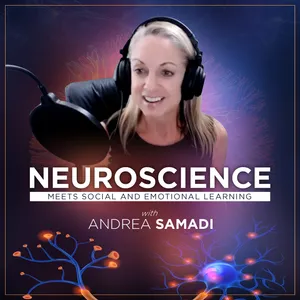
Free Daily Podcast Summary
Neuroscience Meets Social and Emotional Learning: Daily Summaries Delivered
by Andrea Samadi
Neuroscience Meets Social and Emotional Learning Podcast bridges the gap between cutting-edge neuroscience research and its practical application in education, business, leadership, athletics, health, and personal development. Since 2019, the podcast has published 400+ episodes featuring conversations with leading experts in neuroscience, psychology, education, medicine, and human performance, reaching listeners in more than 190 countries. The mission is to make neuroscience understandable, practical, and actionable—helping people learn, lead, and perform at their highest potential. Each episode translates complex brain science into evidence-based strategies that listeners can immediately apply to improve learning, strengthen emotional intelligence, optimize health, build resilience, and achieve measurable improvements in performance. The podcast has evolved over seven years, with each season building on the discoveries of the last. Season 1 – Foundations of Neuroscience & Social and Emotional Learning Introduced the neuroscience behind social and emotional learning (SEL) and emotional intelligence, providing educators and leaders with practical strategies for implementation in schools and workplaces. Season 2 – High Performance Across Domains Expanded into education, sports, and business, exploring how social, emotional, and cognitive strategies contribute to high performance. Season 3 – Motivation, Mindset & Peak Performance Connected influential business principles and motivational thinking with modern neuroscience to explore how mindset shapes achievement and productivity. Seasons 4 & 5 – Mental Health, Wellness & Applied Neuroscience Focused on stress management, mental health, cognitive resilience, and practical neuroscience strategies for improving well-being and performance. Seasons 6–8 – Brain Health & The Science of Learning Explored educational neuroscience, brain health, and the Science of Learning, demonstrating how understanding the brain improves learning across every stage of life. Seasons 9 & 10 – Neuroscience 101 Returned to the fundamentals, simplifying core neuroscience concepts and building a strong foundation for understanding learning, behavior, and performance. Seasons 11–13 – The Neuroscience of Self-Leadership Examined self-awareness, emotional regulation, habits, decision-making, identity, and purpose, showing how neuroscience can help people lead themselves before leading others. Season 14 – Reflect Reviewed the podcast's most impactful interviews, identifying recurring themes and timeless lessons from years of conversations with world-leading experts. Season 15 – Apply Moved from reflection to implementation by organizing key insights into practical, evidence-based strategies that listeners could apply immediately in their own lives. Season 16: The Brain's Operating System for Human Performance Introduced The Brain's Operating System for Human Performance—an evidence-based framework developed from more than 400 episodes and years of conversations with leading experts. The framework is organized into three interconnected phases: Phase 1 – Regulation & Safety Every high-performing brain begins with regulation. This phase explores how sleep, stress regulation, trauma, autonomic balance, recovery, and psychological safety create the biological foundation for learning, resilience, and peak performance. Phase 2 – The Motivation Loop Once the brain is regulated, motivation becomes possible. This phase explores how beliefs, thoughts, attention, dopamine, reward, and repetition shape behavior, build lasting habits, and sustain meaningful achievement. Phase 3 – The Movement Loop Movement is not simply exercise—it is
Latest Episodes
The most recent episodes — sign up to get AI-powered summaries of each one.
- 1 weeks ago41 min
When Sleep Isn't Rest: What 'Sleep Stress' Reveals About Recovery (Bonus Episode)
In this episode Andrea Samadi explains the concept of sleep stress — a wearable-device measured how physiologically activated your body remains during sleep — and places it within a neuroscience-based movement and recovery framework. She reviews the autonomic nervous system (sympathetic vs. parasympathetic), how WHOOP estimates sleep stress from heart rate and HRV, and why trends over weeks matter more than single nights. Using her six-month data, Andrea shares how recovery habits and removing alcohol coincided with an 89% drop in nightly high sleep stress. The episode ends with practical steps and a seven-day experiment to help you observe and reduce nighttime physiological activation by changing daytime behaviors, sleep environment, and training timing so your body can better recover and adapt. When Sleep Isn’t Rest—What “Sleep Stress” Reveals About Recovery: The Story Behind My 89% Drop in Sleep Stress Welcome back to the Neuroscience Meets Social and Emotional Learning Podcast, where we bridge neuroscience, social and emotional learning, and human performance so we can create measurable improvements in our well-being, achievement, leadership, productivity and results. I’m Andrea Samadi, and if you’ve been following along through Season 16, you’ll know that we have been building what I call The Brain’s Operating System for Human Performance—a neuroscience-based framework designed to help us understand how the different systems of the brain and body work together to influence how we learn, adapt, connect, lead and ultimately perform. We are currently in Phase 3: Movement, Learning and Cognition, where we have been following a central pathway: Movement → Adaptation → Performance Movement creates a stimulus. But movement alone does not make the brain or body stronger. We must be able to recover from that stimulus before adaptation can occur, to give us our desired outcome of improved performance. This is why our recent bonus episodes have moved beyond exercise itself and into the recovery signals that help us understand whether our bodies are successfully handling the demands we are placing upon them. In Bonus Episode 3[i], we explored the hidden story behind my resting heart rate. My data showed that it was not merely a measure of fitness—it was also reflecting the total load my body was carrying. During the higher-stress months of January and February, my resting heart rate remained elevated at approximately 56–58 beats per minute. As I placed greater emphasis on sleep, hydration, Zone 2 movement, sauna, meditation and recovery, it gradually fell to 54 and then 53 beats per minute. The lesson was that a lower resting heart rate signals that the body is working less during rest, and recovering more efficiently. The idea is to learn what your baseline is, and see how you can improve this number for a more efficient RHR. In Bonus Episode 4[ii], we explored restorative sleep and learned that sleep quality is not measured by duration alone. Deep sleep supports physical restoration and repair, while REM sleep plays an important role in memory, learning and emotional processing. Because longer REM periods tend to occur later in the night/morning time my regular 4:00 AM wake time may give me less opportunity for that REM-rich portion of sleep—which is the tradeoff I’m choosing--since waking early allows me to exercise. Two additional hours in bed would not guarantee two more hours of REM, but they could create a greater opportunity for more REM sleep. The lesson was not to choose sleep over movement or movement over sleep. It was to protect enough sleep while still making room for movement, so the brain and body have the opportunity to adapt. Throughout these bonus episodes, I’m sharing patterns from my WHOOP wearable device[iii] data—not because everyone’s numbers should look like mine, but to demonstrate what can happen when we measure consistently, look for trends and test small changes. The goal is not comparison. It is to help each of us better understand our own baseline and use that information to improve our habits, recovery and results. While examining my own sleep data for these recent bonus episodes, another question came to my mind. It was while looking this sleep stress score. What if we are sleeping—but our physiology remains unusually activated throughout the night? How would we even know if this was happening? This is another measurement I can see with this wearable device. What if our eyes are closed and we are technically asleep, but the body is still working harder than usual? What if our sleep isn’t giving us the rest and recovery that we need. This brings us to today’s question: What is Sleep Stress? One of the most valuable metrics I have been tracking this year is not sim
- 2 weeks ago46 min
Attention Is the Gate—How Movement Becomes Lasting Learning with Dr. John Medina
Episode 406 explains how movement prepares the brain but does not guarantee learning. It traces the full sequence—movement, RAS-driven readiness, salience and relevance, focused attention, encoding, retrieval and repetition, and recovery and sleep—that turns activation into lasting memory and performance. The episode offers practical steps in a Move–Focus–Learn protocol: use brief movement to create readiness, clearly identify and remove distractions for one learning target, interact with material in meaningful ways, practice retrieval and spaced repetition, and protect recovery to support consolidation. Listeners are encouraged to test these simple experiments for school, work, or personal learning to make experience more usable and improve attention, memory, and performance. ON THIS EPISODE, YOU’LL LEARN: ✔ Why movement prepares the brain but does not guarantee learning ✔ How attention directs the capacity movement creates ✔ Why meaning and emotional relevance capture attention ✔ The difference between paying attention and actually learning ✔ How retrieval and repetition help new information stick ✔ How seeing, hearing, explaining, and applying an idea can help us remember it ✔ How restorative sleep supports memory and learning ✔ A practical Move–Focus–Learn Protocol for school, work, or your own personal learning The central idea is simple: Movement opens the window. Attention determines what enters. Repetition strengthens what remains. And recovery helps the brain integrate what it has experienced. Welcome back to the Neuroscience Meets Social and Emotional Learning Podcast, where we bridge neuroscience, social and emotional learning, and human performance so we can create measurable improvements in our well-being, achievement, leadership, productivity, and results. I’m Andrea Samadi, and if you’ve been following along through Season 16, you’ll know that we have been building what I call The Brain’s Operating System for Human Performance—a neuroscience-based framework designed to help us understand how the different systems of the brain and body work together to influence how we learn, adapt, connect, lead, and ultimately, how we perform. We are currently in Phase 3, focused on Movement, Learning, and Cognition. As I prepared for this phase, I went back through more than 400 episodes of the podcast and organized them according to the five phases of this framework. I wanted to see whether any patterns would emerge. And some did. Phase 1, Regulation and Safety, includes 57 episodes. Phase 2, Neurochemistry and Motivation, includes 41 episodes—the smallest category, possibly because this is the area I have explored the least with my learning. Phase 3, Movement, Learning, and Cognition, includes 174 episodes—the largest category by far. Phase 4, Perception and Social Intelligence, includes 68 episodes. And Phase 5, Integration and Meaning, includes 71 episodes. When I saw that 174 episodes—more than 40 percent of the entire podcast—fit into Movement, Learning, and Cognition, it immediately showed me where much of my curiosity has been directed over the years. I have always been fascinated by learning: How do we prepare the brain to learn? What captures our attention? Why do some ideas (or people) remain with us while others disappear? How does knowledge become something we can retrieve, apply, and actually use to improve our lives? And while I am spending most of my spare time hiking, or at the gym over the years, I wonder, how does this movement that I’m doing help to improve my attention, or memory, and finally, where does recovery fit into this process? The past few weeks, I’m finally connecting the dots with how important recovery is with this equation. I’m also learning how to determine what’s important to me. John Medina’s Brain Rules book explains what holds our attention. He reminds us that “we don’t pay attention to boring things (or people).[i] As we continue through these five phases of The Brain’s Operating System for Human Performance, I’m especially curious about how we will move beyond understanding these lessons, to begin implementing what we are learning, and connecting more ways to improve how we learn, adapt, connect, lead, and ultimately perform in our day to day lives. That will become an important part of the upcoming workbook—which is a practical way for each of us to identify what we have already strengthened, where gaps may remain, and which specific actions can help us to improve our own learning, well-being, and performance. Because the purpose of this 5 Phase Framework is not simply to collect more information about the brain. It is to understand how the systems connect—and then
- 3 weeks ago29 min
The 4:00 AM Tradeoff: Movement, REM and Recovery (Bonus Episode)
In this episode Andrea Samadi explores how movement and sleep work together in a "brain operating system" for human performance, focusing on restorative sleep (deep + REM), personal WHOOP data, and the trade-offs created by early-morning exercise. She shares four lessons and a simple experiment to help listeners protect REM and deep sleep while maintaining an active life, emphasizing weekly rhythms, small changes, and tracking patterns rather than chasing perfect numbers. SEASON 16 | BONUS EPISODE 4 RESTORATIVE SLEEP Where Adaptation Happens Why deep sleep restores the body, REM helps integrate experience, and healthy habits must work together. ON BONUS EPISODE 4, YOU’LL LEARN: ✔ What restorative sleep really measures ✔ How deep sleep and REM support different forms of recovery ✔ Why REM percentage and duration tell different stories ✔ What my six-month sleep data revealed ✔ The hidden tradeoff behind my 4:00 AM hiking routine ✔ What happened when I slept just 21 minutes longer ✔ Why healthy habits can sometimes compete ✔ How to protect sleep without giving up movement ✔ 4 Lessons and a simple experiment for discovering your own best rhythm Episode Introduction Welcome back to the Neuroscience Meets Social and Emotional Learning Podcast, where we bridge neuroscience, social and emotional learning, and human performance to create measurable improvements in well-being, achievement, leadership, productivity and results. I’m Andrea Samadi, and throughout Season 16 we have been building what I call the Brain’s Operating System for Human Performance—a neuroscience-based framework for understanding how the systems of the brain and body work together to influence how we learn, adapt, connect, lead and ultimately perform. We are currently in Phase 3: Movement, Learning and Cognition. Movement is the foundation of this phase because it affects far more than our muscles. When we move, we activate processes throughout the brain and body. Movement supports neurogenesis—the development of new neurons—particularly in areas involved in learning and memory. It strengthens connections between neurons through synaptic plasticity. We covered neurogenesis on EP 141[i] if you want to revisit that episode, if you are as curious as I am about how to regrow our brain cells. Movement that we are learning in this phase, also influences brain chemicals such as dopamine, serotonin, norepinephrine and acetylcholine, which affect motivation, mood, attention and learning. Movement can also strengthen our resilience by helping us manage stress and become more emotionally flexible. It builds sleep pressure, (the longer we stay awake, the more adenosine accumulates that increases our need or “pressure” to rest) which can support deeper, more restorative sleep. And over time, these changes may contribute to greater creativity, insight, endurance and human potential. But movement only creates the stimulus. The benefits don’t come from movement alone. They come from the way the brain and body respond to that movement—and that response is called adaptation. Movement changes the brain. Adaptation changes the body. Recovery is what connects the effort we make today with the strength, resilience and capacity we hope to build tomorrow. Without adequate recovery, we can receive the stimulus without fully receiving the benefit. That is why sleep belongs inside the Movement Loop. Sleep is not separate from movement, learning or performance. It is one of the primary places where the brain and body respond to what we have asked them to do. Throughout Season 16, I’ve been sharing some of my own health and performance data as a living case study—not because everyone should try to reproduce my numbers, but because our individual trends can help us understand how neuroscience shows up in everyday life. I thought that if I was curious about understanding my numbers—and using them to improve my health, well-being and productivity—then other people might benefit from what I’ve learned along the way. My data has helped me see that movement, recovery and performance cannot be understood in isolation. They work together as a system: Movement creates the stimulus. Recovery creates the conditions for adaptation. Restorative sleep is one of the places where that adaptation unfolds. And this brings us to one of the most important recovery metrics I’ve learned to follow: Restorative sleep. We often celebrate what happens while we’re awake: Our productivity. Our focus. Our learning. Our movement. Our performance. But much of the adaptation supporting those abilities happens whil
- Aug 23, 202630 min
The Hidden Story Behind Your Resting Heart Rate: What Your RHR Can Reveal About Stress, Recovery & Adaptation
Andrea Samadi shares her personal resting heart rate data to show why measuring over time matters more than fixating on a single score. She explains how trends reveal stress, recovery, and adaptation, and why comparing yourself to your own baseline is the most useful approach. Learn practical steps to measure consistently, contextualize changes, experiment with one behavior, and use your physiological data to make intentional improvements in sleep, recovery, and performance. BONUS EPISODE 3: ON THIS EPISODE, WE’LL COVER ✔ What resting heart rate can reveal about stress, recovery, and adaptation over time ✔ The story hidden in my own data — from a high of 57 bpm in February to 53 bpm in August ✔ Why the six-month trend matters — and what my 2% lower average may be telling me ✔ How stress and training load can show up in your physiology before you consciously recognize it ✔ Why recovery and nervous-system regulation matter for building a more resilient baseline ✔ How to find your own RHR baseline instead of comparing yourself with someone else ✔ How to look for deviations and patterns across weeks and months—not individual days ✔ How to connect RHR with sleep, HRV, recovery, training, stress, and life events ✔ How to run your own personal experiment: change one variable, measure, and see what happens ✔ The bigger lesson: What gets measured over time can reveal a story you couldn't see day to day. Welcome back to the Neuroscience Meets Social and Emotional Learning Podcast, where we bridge neuroscience, social and emotional learning, and human performance so we can create measurable improvements in our well-being, achievement, leadership, productivity, and results. I’m Andrea Samadi, and if you’ve been following along through Season 16, you’ll know that we’ve been building what I call The Brain’s Operating System for Human Performance—a neuroscience-based framework designed to help us understand how the different systems of the brain and body work together to influence how we learn, adapt, connect, lead, and ultimately how we perform. We are currently in Phase 3 where we are covering Movement, Learning and Cognition. If you just finished Episode 405[i] with Dr. Kristen Holmes, you know we've been looking at recovery as an essential part of our Movement Loop. Movement → Brain Activation → Attention → Learning → Recovery → Adaptation → Performance → Greater Capacity. And Kristen's work has reinforced something I've learned after years of tracking my own physiology: What gets measured gets improved. But this week, I wanted to dive into my own personal data to show us something I think is easy to miss: Sometimes what gets measured over time reveals a story you simply couldn't see day to day. When we're looking at a wearable every morning, it's easy to become focused on today's number. Today's recovery score. Today's HRV. Today's resting heart rate. Was it higher? Was it lower? But one number—or even one week—rarely tells us very much about the direction we're actually moving. It's when we begin to zoom out that patterns emerge. And that's exactly what happened when I looked more closely at my resting heart rate this year. What initially looked like a collection of numbers began to tell a much bigger story about stress, recovery, consistency, and adaptation. So my hope for this episode isn't that you compare your resting heart rate to mine. Your numbers will be different. My hope is that this episode encourages you to become curious about your own data. Maybe you track sleep. Maybe it's HRV. Resting heart rate. Recovery. Exercise. Blood pressure. Steps. Or even something as simple as your energy, mood, or ability to focus. Take one metric and zoom out. Look at three months. Six months. Maybe even a year. And instead of asking, “Is today's number good or bad?” Ask a different question: “What is the trend that I’m seeing here, trying to tell me?” Is something improving? Is something slowly moving in the wrong direction? Does your physiology change during periods of higher stress? (like you will see mine did). Can you see what happens when you sleep more consistently, exercise differently, recover better, or change one habit? Because sometimes the most valuable insight isn't found in today's score. It's hidden in the pattern. And once you can see the pattern, you have information you can actually use. That's really the purpose of sharing my personal data with you today. Not to say, “Here's what worked for me, so you should do exactly the same thing.” But to show you what can happen when we become students of our own physiol
- Aug 16, 202645 min
The Science of Recovery—How Dr. Kristen Holmes Helps Us Turn Stress Into Greater Capacity
In this episode Andrea Samadi explores Phase 3 of the Brain's Operating System—movement, learning, and cognition—focusing on the recovery and adaptation side of the "movement loop." She revisits Dr. Kristen Holmes’ insights on measuring strain, sleep, and recovery to show how movement provides the stimulus while recovery enables lasting adaptation and greater capacity. The episode offers practical steps: identify your stimulus, track recovery, find your weakest link, and use feedback to train smarter—not just harder—so measurement becomes a tool for meaningful change. IN EPISODE 405, WE WILL COVER: ✔ Why recovery is not the absence of work—it is where adaptation occurs → How recovery allows the brain and body to absorb stress and build greater capacity. ✔ Where Dr. Kristen Holmes fits into the Movement Loop → Movement creates the stimulus; recovery determines how effectively we adapt. ✔ Why measuring your data matters → What gets measured can be adjusted, repeated, and improved. ✔ How to identify your personal recovery patterns → Using sleep, HRV, resting heart rate, strain, stress, and daily behaviors to uncover what helps—or limits—your performance. ✔ Why your recovery formula is uniquely yours → The habits that improve one person’s readiness may not produce the same results for someone else. ✔ How recovery helps create more predictable performance → When you understand your patterns, you can make better daily decisions instead of leaving your results to chance. ✔ How repeated behaviors become adaptation → Measure → Adjust → Repeat → Recover → Adapt → Build Capacity. ✔ Where the larger journey is taking us → A preview of The Journey of the Mind Workbook and its five-step process: Understand → Reflect → Apply → Measure → Become ✔ What comes next in the Movement Loop → A Bonus Episode applying recovery science to real-world data, followed by Dr. John Medina on how an activated brain turns experience into attention, learning, and lasting change. EP 405 — From Recovery to Adaptation: Revisiting Dr. Kristen Holmes in Phase 3 WELCOME BACK Welcome back to the Neuroscience Meets Social and Emotional Learning Podcast, where we bridge neuroscience, social and emotional learning, and human performance so we can create measurable improvements in our well-being, achievement, leadership, productivity, and results. I’m Andrea Samadi, and if you’ve been following along through Season 16, you’ll know that we’ve been building what I call The Brain’s Operating System for Human Performance—a neuroscience-based framework designed to help us understand how the different systems of the brain and body work together to influence how we learn, adapt, connect, lead, and perform. Our roadmap has five phases: Phase 1 — Regulation & Safety Where we built the foundation by asking: Is the nervous system regulated enough to learn and grow? Phase 2 — Neurochemistry & Motivation Where we explored the systems that drive us to act, persist, and pursue meaningful goals. And now, we are here—Phase 3: Movement, Learning & Cognition. This is where movement becomes the catalyst for learning, adaptation, and performance. The central idea of Phase 3 is that the brain does not change through information alone. It changes through experience. Through movement. Through challenge. Through recovery. And through the repeated process of adapting to what we ask our brain and body to do. I called the framework we are building in this phase: The Movement Loop: Movement (the stimulus) → Brain Activation (the brain responds) → Attention (the brain becomes engaged and ready to learn) → Learning (new information and experience begin changing neural pathways) → Recovery (the brain consolidates and restores) → Adaptation (the brain and body adjust to the repeated challenge) → Performance (the adaptation shows up in what we can do) → Greater Capacity (we become capable of more) Movement is the stimulus. Brain activation is the response. Attention opens the door to learning. Learning creates change. Recovery helps that change stick. Adaptation builds the system. Performance reveals the result. Greater capacity is what we gain. And then we repeat the cycle. In our last episode, EP 404, we revisited the groundbreaking work of Dr. John Ratey, who helped us understand the front end of this loop. Dr. Ratey showed us that: Movement changes the brain. Exercise activates the brain. It supports attention. It prepares us for learning. And it creates the biological conditions that allow the brain to change. <p
- Aug 9, 202630 min
Find Your Gap: How Recovery Unlocks Predictable Performance (Bonus Episode)
In this bonus episode Andrea Samadi introduces the Predictable Performance System, a practical roadmap from her Brain’s Operating System. She shows how measuring patterns—not chasing daily scores—plus consistent movement and targeted recovery behaviors create reliable adaptations and better performance over time. Andrea shares two real-world experiments (including a nine-day green recovery streak), five clear steps—measure, move, recover, adapt, perform—and a simple 7-day challenge to help you discover the single habit that unlocks more consistent results. On BONUS EPISODE 2, we will cover: Why high performance isn’t about being “green” every day (using a wearable device) What nearly 2,000 recovery scores taught me about consistency and performance Why your daily inputs matter more than any single recovery score How I reached a personal best of 9 green recoveries in a row What happened when hard training caused my recovery to drop—and why that wasn’t failure How another WHOOP user improved his recovery by identifying one key gap: hydration How to find your own gap in sleep, hydration, stress, movement, training load, or recovery The Predictable Performance System™: Measure → Move → Recover → Adapt → Perform → Repeat Why recovery is the bridge between today’s effort and tomorrow’s capacity How to create your own 7-Day Predictable Performance Experiment The key question to ask yourself: “What is the one missing input that could unlock my next level of performance?” The goal: Find your gap. Uncover your recipe. Build the system that works for you. BONUS EPISODE 2 The Predictable Performance System™ How Small Daily Inputs Create Better Recovery, Adaptation and More Consistent Results WELCOME BACK Welcome back to the Neuroscience Meets Social and Emotional Learning Podcast, where we explore how understanding the brain can help us create measurable improvements in our well-being, achievement, leadership, productivity, and results. I'm Andrea Samadi, and over the past several months, we've been building something much bigger than a collection of interviews. We've been building what I call The Brain's Operating System—a roadmap for understanding how our brain and body work together to create optimal human performance. Before we jump into today's second Bonus Episode, let's quickly remember where we've been. PHASE 1 — REGULATION & SAFETY Everything begins with regulation. Before the brain can learn, perform, or grow, it first needs the biological conditions that support safety and stability. In Phase 1, we explored sleep, stress regulation, trauma, resilience and the nervous system. The lesson was simple: Regulation creates the conditions for growth. PHASE 2 — NEUROCHEMISTRY & MOTIVATION Then we asked: What moves us into action? We explored dopamine, beliefs, motivation, habits, attention and sustained effort. We learned that motivation isn't simply about willpower. Our brain is continually learning: What's worth pursuing? What should I repeat? Where should I invest my energy with? Phase 2 gave us some direction. PHASE 3 — MOVEMENT, LEARNING & COGNITION And now we're deep inside Phase 3. This is where movement becomes much more than exercise. Movement activates the brain. It supports attention. Learning. Memory. Metabolism. And when movement is paired with adequate recovery, something important happens: Adaptation. That's where our system begins to change. So the basic sequence we've been studying is: Movement → Recovery → Adaptation → Performance. But while studying this process, another question kept coming back to me. Why do some people consistently improve...while others feel like they're starting over every Monday and they are searching for the right formula. That question led me to today's framework: THE PREDICTABLE PERFORMANCE SYSTEM™ And this Bonus Episode is where I want to put the science into action. Throughout The Brain's Operating System, these Bonus Episodes will give me an opportunity to step away from the interviews and show you what happens when I apply what we're learning to my own life. I'll share the experiments. The data. What worked. What didn't. And most importantly... what we can learn from it, so we can ALL apply this information to our own lives. Because neuroscience becomes much more useful when we can turn what we know into something we can actually do. THE QUESTION THAT STARTED THIS EXPERIMENT Over the past five years, I've tracked close to 2,000 recovery scores using WHOOP (wearable device). And recently something happened that surprised me. I
- Aug 2, 202621 min
Dr. John Ratey and The Movement Loop: How Movement Becomes Human Performance
In this episode Andrea Samadi explores Phase Three of the Brain’s Operating System — how movement acts as the essential input that activates the brain, sharpens attention, boosts learning, and improves social and emotional readiness. Drawing on Dr. John Ratey’s insights and related neuroscience research, she explains the chain reaction from exercise to brain activation, learning, and adaptation. The episode also emphasizes the vital role of recovery in consolidating gains so movement leads to lasting performance improvements, and invites listeners to adopt movement as a daily catalyst for clearer thinking, better learning, and greater resilience. Dr. John Ratey and The Movement Loop On this episode 404, we will: Explore where Dr. John Ratey's groundbreaking research fits within the Movement Loop. Understand how movement activates the brain and prepares us to learn. Discover why attention is the gateway to learning and performance. Connect Dr. Ratey's work with Dr. Chuck Hillman, Dr. John Medina, Kristen Holmes, and Jason Whitrock to see the bigger picture. Learn how movement becomes lasting human performance by building our capacity over time. How Movement Becomes Human Performance Welcome back to the Neuroscience Meets Social and Emotional Learning Podcast. I'm Andrea Samadi, and on this podcast, we bridge the science behind social and emotional learning, emotional intelligence, and practical neuroscience so we can create measurable improvements in well-being, achievement, productivity, and results. If you've been following along through Season 16, you'll know we've been building what I call The Brain's Operating System for Human Performance—a neuroscience-based framework that explains how movement, recovery, and adaptation work together to improve our health, learning, leadership, and performance. Over the past seven years and more than 400 episodes, I've had the privilege of interviewing neuroscientists, physicians, psychologists, educators, and high performers from around the world. As I looked across those conversations, I realized they weren't isolated ideas—they were pieces of a much larger system. I've organized that system into five interconnected phases that mirror how we grow and develop throughout life. And as we work through each of these phases, we are sharpening our saw for productivity, learning and high performance, really, with the brain and body in mind. Phase 1 is Regulation and Safety, we launched on EP 384[i] with Dr. Baland Jalal on Sleep, Safety and Curiosity. This phase is where we build the foundation by understanding the nervous system, stress, emotions, and the importance of creating internal and external safety before learning or productivity can take place. Phase 2 is Neurochemistry and Motivation, where we explore how dopamine, reward, purpose, and emotional regulation influence our choices, habits, and sustained effort. Today, we're in Phase 3: Movement, Learning, and Cognition. This is where movement becomes the catalyst that prepares the brain to pay attention, learn, adapt, and ultimately perform at a higher level. In Phase 4, we'll discover how perception and social intelligence shape the way we understand ourselves, communicate, build trust, and strengthen relationships. And finally, in Phase 5, we'll bring everything together through integration and meaning—understanding how our experiences become wisdom, resilience, purpose, and lifelong growth. Each phase builds on the one before it, because meaningful human performance isn't created in a single breakthrough—it's built one system at a time. Together, they create what I believe is the brain's operating system for human performance. If we want to improve the entire big picture of our results, we can dive deeper into these 5 phases to see what areas we could sharpen a bit. I’ve put the individual episodes of each phase in the show notes for a deeper dive. Today's episode is one of those foundational pieces of Phase 3. Because before we can improve performance, we first need to understand how movement changes the brain. In Episode 402[ii], we introduced The Movement Loop, built around one simple idea: Movement is the input—it's what we do. Recovery enables adaptation—it's how the brain and body grow stronger. Performance is the outcome—the results we can see, feel, and measure. Every cycle expands our capacity to learn, lead, and perform. Every movement we make sends a signal to the brain and body. That signal activates the brain— increasing blood flow, neurotransmitters, and neuroplasticity—preparing us to pay attention and learn. When movement is followed by adequate recovery, the brain and body adapt. Those adaptations become the foundation for better per
- Jul 25, 202616 min
Five Years, 1,905 Recoveries: How Daily Movement Rewires Your Brain (Bonus Episode)
Andrea Samadi shares a five-year self-experiment using a WHOOP wearable to track sleep, recovery, movement, and biological age. She reveals how daily low-intensity movement and consistent recovery—not one intense workout—produced lasting improvements in heart rate, recovery scores, and biological age. Andrea distills five lessons: movement prepares the brain, consistency beats intensity, recovery is where adaptation happens, small habits compound over time, and every step is an investment in your future brain. Practical takeaways include walking daily, adding 2–3 strength sessions per week, protecting sleep, and tracking trends instead of perfection. In this Bonus Episode you'll learn: Why recovery matters more than you think. What 1,905 recoveries taught me about human performance. Why consistency beats intensity. How movement changes the brain. How to create lasting biological adaptation. Why every walk is an investment in your future brain. EPISODE BONUS Move Today. Recover Tonight. Younger Tomorrow. Five Years. 1,905 Recoveries. One Lesson That Changed Everything. Welcome Back Welcome back to the Neuroscience Meets Social and Emotional Learning Podcast. I'm Andrea Samadi. Over the past seven years, I've had the privilege of interviewing many of the world's leading experts in neuroscience, psychology, learning, leadership, health, and human performance. Throughout Season 16, we've been connecting those conversations into a simple framework I call The Brain's Operating System for Human Performance—a practical way of understanding how the brain and body work together to help us learn better, think more clearly, live healthier, and perform at our highest potential. In Episode 402[i], we introduced The Movement Loop, built around one simple idea: Movement is the input. Adaptation is the process. Performance is the outcome. Then, in Episode 403[ii], Dr. Chuck Hillman helped us understand why movement changes the brain. Every step increases blood flow. Exercise stimulates Brain-Derived Neurotrophic Factor—BDNF—often called fertilizer for the brain. Movement strengthens the neural networks responsible for learning, memory, attention, and executive function. But after recording those episodes, I found myself asking a different question. What happens when we apply those principles consistently—not for days, weeks, or even months—but for years? Today's bonus episode is my attempt to answer that question. Not from another research study. Not from another interview. And definitely not to give you one more thing to add to your already busy schedule. Instead... I'd like to share a five-year experiment I never realized I was conducting—one that completely changed the way I think about health, movement, recovery, and human performance. Five Years Looking for the Answer When I started wearing a WHOOP device back in April of 2021, just before my fiftieth birthday, I thought I was buying a fitness tracker. I thought it would help me train harder. I thought it would reward intensity. Instead... It spent the next five years teaching me something far more valuable. How to recover. Over those five years I've tracked nearly everything I could measure. Sleep. Movement. Recovery. Resting heart rate. Heart rate variability. VO₂ Max. Biological age. Blood work. Thousands of workouts. And more than 1,905 recoveries. Nearly two thousand mornings of waking up and asking my body the same question. How well did I recover? At first, I didn't really know what I was looking for. I simply assumed the harder I trained... the healthier I'd become. The Mystery Then WHOOP introduced a new metric. WHOOP Age. The first time I looked at it, I honestly couldn't believe what I was seeing. My biological age measured 48.7 years old. I was fifty-five. More than six years younger biologically than chronologically. Of course, my first question wasn't, "That's great." My first question was... Why? What was I doing that created this result? Naturally, I assumed it was my hardest hikes. My toughest strength workouts. The mornings I pushed myself until I was completely exhausted. But that's not what the data showed. Not even close. The biggest contributor wasn't intensity. It was consistency. Daily walks. Steady hikes. Hours spent moving in Heart Rate Zones 1 through 3. The very workouts I used to think "didn't count." Ironically, even today, after finishing a workout, I still catch myself
Get Neuroscience Meets Social and Emotional Learning summaries in your inbox
Free AI-powered daily recaps. Key takeaways, quotes, and mentions — in a 5-minute read.
Get Free Summaries →Free forever for up to 3 podcasts. No credit card required.
You Might Also Like
Listeners also like.
Peak Performance Life Podcast
Covers health, energy, and mental performance optimization through biohacking, nutrition, and lifestyle strategies.
Growth Mindset Psychology: The Science of Self-Improvement
Explores the science behind lasting self-improvement through psychology, neuroscience, and timeless wisdom traditions.

Huberman Lab
Explores neuroscience and science-based tools for understanding and improving brain function, behavior, and health.

Passion Struck with John R. Miles
Explores purpose, resilience, and connection through science-backed conversations with experts in psychology, neuroscience, and performance.
The Psychology Podcast
Explores human potential and possibility through conversations with scientists, thinkers, and self-actualized individuals.
Stanford Psychology Podcast
Students interview psychologists about recent research and its real-world applications in mental health, behavior, and cognition.
TRAINED
Discusses fitness and wellness through interviews with athletes, scientists, and health experts on mindset, nutrition, movement, recovery, and sleep.

The One You Feed | Personal Growth, Emotional Resilience & Purpose
Insightful conversations with leading thinkers on personal growth, emotional resilience, and living with purpose.

The Dr. Hyman Show
Explores root causes of chronic disease and promotes functional medicine, nutrition, and preventive health through expert discussions.

The Model Health Show
Shawn Stevenson explores health and fitness topics including nutrition, sleep, hormones, and exercise with expert guests.

Health Optimization Medicine Podcast
Experts discuss health optimization, performance, and decision-making with insights from neuroscience, medicine, and consciousness.

Decoded | Unlock The Secrets of Human Behavior, Emotion and Motivation
Explores subconscious patterns behind human behavior and provides tools to rewire destructive cycles and live with intention.
About Neuroscience Meets Social and Emotional Learning
Neuroscience Meets Social and Emotional Learning Podcast bridges the gap between cutting-edge neuroscience research and its practical application in education, business, leadership, athletics, health, and personal development. Since 2019, the podcast has published 400+ episodes featuring conversations with leading experts in neuroscience, psychology, education, medicine, and human performance, reaching listeners in more than 190 countries. The mission is to make neuroscience understandable, practical, and actionable—helping people learn, lead, and perform at their highest potential. Each episode translates complex brain science into evidence-based strategies that listeners can immediately apply to improve learning, strengthen emotional intelligence, optimize health, build resilience, and achieve measurable improvements in performance. The podcast has evolved over seven years, with each season building on the discoveries of the last. Season 1 – Foundations of Neuroscience & Social and Emotional Learning Introduced the neuroscience behind social and emotional learning (SEL) and emotional intelligence, providing educators and leaders with practical strategies for implementation in schools and workplaces. Season 2 – High Performance Across Domains Expanded into education, sports, and business, exploring how social, emotional, and cognitive strategies contribute to high performance. Season 3 – Motivation, Mindset & Peak Performance Connected influential business principles and motivational thinking with modern neuroscience to explore how mindset shapes achievement and productivity. Seasons 4 & 5 – Mental Health, Wellness & Applied Neuroscience Focused on stress management, mental health, cognitive resilience, and practical neuroscience strategies for improving well-being and performance. Seasons 6–8 – Brain Health & The Science of Learning Explored educational neuroscience, brain health, and the Science of Learning, demonstrating how understanding the brain improves learning across every stage of life. Seasons 9 & 10 – Neuroscience 101 Returned to the fundamentals, simplifying core neuroscience concepts and building a strong foundation for understanding learning, behavior, and performance. Seasons 11–13 – The Neuroscience of Self-Leadership Examined self-awareness, emotional regulation, habits, decision-making, identity, and purpose, showing how neuroscience can help people lead themselves before leading others. Season 14 – Reflect Reviewed the podcast's most impactful interviews, identifying recurring themes and timeless lessons from years of conversations with world-leading experts. Season 15 – Apply Moved from reflection to implementation by organizing key insights into practical, evidence-based strategies that listeners could apply immediately in their own lives. Season 16: The Brain's Operating System for Human Performance Introduced The Brain's Operating System for Human Performance—an evidence-based framework developed from more than 400 episodes and years of conversations with leading experts. The framework is organized into three interconnected phases: Phase 1 – Regulation & Safety Every high-performing brain begins with regulation. This phase explores how sleep, stress regulation, trauma, autonomic balance, recovery, and psychological safety create the biological foundation for learning, resilience, and peak performance. Phase 2 – The Motivation Loop Once the brain is regulated, motivation becomes possible. This phase explores how beliefs, thoughts, attention, dopamine, reward, and repetition shape behavior, build lasting habits, and sustain meaningful achievement. Phase 3 – The Movement Loop Movement is not simply exercise—it is
Customized Recaps
AI-powered recaps with compact key takeaways, quotes, and insights.
Straight to Your Inbox
Get key takeaways from Neuroscience Meets Social and Emotional Learning in a 5-minute read.
Save Hours Every Week
Stay current on your favorite podcasts without falling behind.
Frequently Asked Questions
What is Podzilla's Neuroscience Meets Social and Emotional Learning daily summary?
It's a free AI-powered email that summarizes new episodes of Neuroscience Meets Social and Emotional Learning as soon as they're published. You get the key takeaways, notable quotes, and links & mentions — all in a quick read.
How does the Neuroscience Meets Social and Emotional Learning podcast summary work?
When a new episode drops, our AI transcribes and analyzes it, then generates a personalized summary tailored to your interests and profession. It's delivered to your inbox every morning.
Is this an official Neuroscience Meets Social and Emotional Learning product?
No. Podzilla is an independent service that summarizes publicly available podcast content. We're not affiliated with or endorsed by Andrea Samadi.
Can I get summaries of other podcasts too?
Absolutely! The free plan covers up to 3 podcasts. Upgrade to Pro for 15, or Premium for 50. Browse our full catalog at /podcasts.
How often does Neuroscience Meets Social and Emotional Learning release new episodes?
Neuroscience Meets Social and Emotional Learning publishes weekly. Our AI generates a summary within hours of each new episode.
What topics does Neuroscience Meets Social and Emotional Learning cover?
Neuroscience Meets Social and Emotional Learning covers topics including Education. Our AI identifies the specific themes in each episode and highlights what matters most to you.
Start getting Neuroscience Meets Social and Emotional Learning summaries tomorrow morning.
Free forever for up to 3 podcasts. No credit card required.
Free forever for up to 3 podcasts. No credit card required.