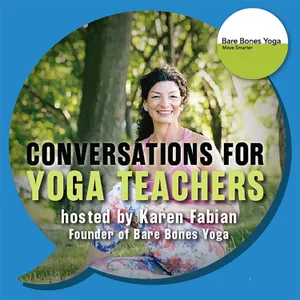
Free Daily Podcast Summary
Conversations for Yoga Teachers: Daily Summaries Delivered
by Karen Fabian
Listen to the podcast designed for yoga teachers to help you build your confidence and skill.
Latest Episodes
The most recent episodes — sign up to get AI-powered summaries of each one.
- Today37 min
How To Trust Yourself When You Feel Nervous Teaching Yoga (EP.423)
Have you ever walked into teach your class, started teaching and something triggered you to feel nervous or anxious? In this episode, we’ll talk about why this can happen even after you’ve completed your 200-hour teacher training and feel like you “should” be getting it by now. I’ll share how overcomplicated sequences, complex cues and the pressure to please or take care of your students can make teaching feel harder than it needs to be. You’ll learn simple strategies to help you stay grounded, including using a signature sequence, simplifying your cueing with action cues, and what to do in the moment when anxiety starts to take over. The other piece of the episode that will really shift your perspective is the section on mindset. The mindset you have about your role as a teacher, especially as it relates to you and the people in your class, is a huge part of how you feel when you teach This rarely gets discussed in teacher training and that’s why so many teachers end up feeling nervous when they teach. Trusting yourself as a yoga teacher doesn’t mean you’ll never feel nervous. It means having a clear approach you can rely on when you do. Here’s a download on how to create a Signature Sequence: https://barebonesyoga.lpages.co/how-to-create-a-signature-sequence And if you’re looking to get support to pull this all together, here’s how we can work on it together: https://barebonesyoga.thinkific.com/courses/Yoga-Anatomy-Accelerator
- 1 weeks ago23 min
A Simple Framework For Building A Yoga Sequence (EP.422)
How can anatomy actually help you build a yoga sequence? In this episode, I take you behind the scenes of a recent hip-focused Movement Lab and share the simple framework I used to create a 30-minute sequence leading to Half Pigeon. You’ll learn how starting with an objective, creating the structure of your class, and using movement to guide your pose choices can make sequencing feel simpler and more intentional. I’ll also show you how understanding the anatomy behind your sequence can help you create clearer, more effective cues. Links: https://barebonesyoga.lpages.co/how-to-build-a-yoga-sequence-lead-page https://barebonesyoga.thinkific.com/courses/Yoga-Anatomy-Accelerator
- 2 weeks ago1h 0m
7 Yoga Class Scenarios And How To Address Them (EP.421)
When you went to teacher training, how much “real life” support did you get around scenarios that come up when you’re teaching? If you’re like a lot of teachers I talk with, you didn’t get much. Now that you’re teaching weekly classes, you might feel like every class there’s a new situation that comes up where you’re not exactly sure how to handle it. In today’s episode, I cover 7 scenarios that arise and an approach to each. The conversation covers both the technical aspects of teaching, meaning cues and sequences, the anatomical aspect of teaching, meaning how you apply anatomy to movement as well as the mindset piece that can impact how you feel when you teach. As you listen, you’ll hear me refer to The Yoga Anatomy Accelerator. If you’re curious to find out more, here’s the link: https://barebonesyoga.thinkific.com/courses/Yoga-Anatomy-Accelerator If you have questions or are wondering if it’s a good fit for you, just reach out to me in my Instagram DM’s and let’s talk.
- 3 weeks ago37 min
September Reset: Simple Themes For More Confident Teaching This Fall (EP.420)
As we head into the fall, there’s a natural shift in energy, People get back to work, their regular schedules and children return to school. With that shift, we as yoga teachers can leverage this shift and speak to it in our classes to match how students are feeling. This can be a fun experiment and exercise in bringing in a theme to your class and also giving yourself a chance to speak to a theme that’s outside the technical aspect of teaching. In this episode, you’ll discover a way to approach your classes this fall that allows you to feel in control and calm and to have an approach that helps you build confidence. You’ll learn how to bring in simple movement based themes and a short exercise you can do after your class to track how you’re feeling- in an objective way. At the end of the episode, I speak about a new opportunity for you called, “September Sessions.” This is a series of 4 live teaching labs I’ve added for just the month of September for teachers inside my program, The Yoga Anatomy Accelerator. It’s designed to help you learn in real time how to apply anatomy to movement. All the details and dates of the live sessions are on the program page which you can see here: https://barebonesyoga.thinkific.com/courses/Yoga-Anatomy-Accelerator If you have questions, just send me a DM on Instagram.
- 3 weeks ago10 min
A Real Time Announcement For Listeners Of The Pod (EP.419)
If you've been following my Anatomy Breakdown videos on social media this summer and loving the format and content, this short bonus episode is for you. I'm sharing why those videos inspired something new I'm launching this September (2026)—and why learning how to think through movement is far more valuable than memorizing anatomy or repeating cues. In this special announcement episode, I’m sharing a new way for you to up level your confidence- it’s called September Sessions, a new series of Live Teaching Labs designed to help you learn how to apply anatomy to movement without having to memorize anatomy or feel like you’re just repeating what you were told in teacher training. You can discover the exciting details in the episode and of course, you’ll need the link to the Yoga Anatomy Accelerator which you can find here: https://barebonesyoga.thinkific.com/courses/Yoga-Anatomy-Accelerator
- 4 weeks ago42 min
Five Changes That Happen When You Truly Understand movement (EP.418)
In a number of episodes, I speak about the anatomy and how to apply it to your teaching. But in today’s episode, I take it up a notch and talk about once you’re the kind of teacher who truly understands not just the anatomy but how to apply it to movement, what’s the transformation? By this I mean what kind of transformation do you experience? This is the kind of episode that’s meant to inspire; to help you see what’s possible for you and to take you from the day to day teaching of classes, to the broader vision that describes the teacher you really want to be. In this episode, I share a Listener Appreciation Bonus. This is something that’s only available to listeners of the pod. Once you get to it, you’ll need these two links: https://barebonesyoga.thinkific.com/courses/Yoga-Anatomy-Accelerator https://barebonesyoga.thinkific.com/courses/blueprint-learning-program
- Aug 17, 202626 min
What This Summer Taught Me: Lessons For Yoga Teachers (EP.417)
As summer comes to a close, I found myself reflecting on the episodes I shared this summer, conversations I had with teachers and what’s coming up in the fall. The fall is always a busy time and for yoga teachers, you’ll find busier classes and more beginners. In today’s show, I share a few lessons I learned by really listening to the teachers who reached out, emailed or commented on my social media and I share these lessons with you in this episode. As you listen, see which ones resonate and what you might add that’s a lesson you learned from teaching this summer. As always, I love to hear from you so drop me a line and share any thoughts you have. Links: The Yoga Anatomy Blueprint Learning Program https://barebonesyoga.thinkific.com/courses/blueprint-learning-program The Yoga Anatomy Accelerator https://barebonesyoga.thinkific.com/courses/Yoga-Anatomy-Accelerator
- Aug 10, 202633 min
How To Cut The Overwhelm With Learning Anatomy (EP.416)
I hear from so many teachers that they feel overwhelmed learning anatomy. This leads to a host of problems like the teacher feeling like there’s something wrong with them because they can’t learn it but also that they aren’t able to feel confident teaching. The reasons behind why so many teachers feel this way have to do in part with how the yoga industry is set up to teach anatomy inside 200 hour trainings. But more importantly and connected to that is the lack of a step by step, proven method is what’s missing. Inside my programs, I have a step by step proven method that has helped teachers all over the world move past this feeling of overwhelm and instead feel confident that they know what they’re doing when they’re teaching. Today’s episode will give you the step by step way to learn anatomy and if you choose to work with me inside one of my two programs, I’ll walk you through it. You also learn about how people learn and the brain science behind it. You’re going to discover some things in this episode that will surprise you. Here are links to the two programs and my e book as well: The Yoga Anatomy Accelerator/ 30-day short program: https://barebonesyoga.thinkific.com/courses/Yoga-Anatomy-Accelerator The Yoga Anatomy Blueprint Learning Program/ 90 day coaching experience https://barebonesyoga.thinkific.com/courses/blueprint-learning-program The Bare Bones Yoga Guide to Yoga Teaching https://barebonesyoga.lpages.co/the-bare-bones-yoga-guide-to-incredible-yoga-teaching
Get Conversations for Yoga Teachers summaries in your inbox
Free AI-powered daily recaps. Key takeaways, quotes, and mentions — in a 5-minute read.
Get Free Summaries →Free forever for up to 3 podcasts. No credit card required.
You Might Also Like
Listeners also like.

Healthy Living with Yoga Anita | inspiring wellness body, mind, soul
Explores holistic health and mindfulness through conversations with wellness experts and practitioners.
The Balanced, Beautiful and Abundant Show - Rebecca Whitman
A coach helps high-achieving women overcome burnout using a framework centered on spiritual, emotional, physical, and financial well-being.
TRAINED
Discusses fitness and wellness through interviews with athletes, scientists, and health experts on mindset, nutrition, movement, recovery, and sleep.

Feel Better, Live More with Dr Rangan Chatterjee
A doctor-hosted podcast offering practical health advice on eating, sleeping, moving, and relaxing from medical experts and real-life stories.

Confessions by Anastazia
A self-care advocate explores wellness, relationships, and personal growth through candid conversations and practical insights.
You've Got This | Tips & Strategies for Meaningful Productivity and Alignment in Work and Life
Helps academics and higher education professionals build meaningful productivity and align work with personal values.

The One You Feed | Personal Growth, Emotional Resilience & Purpose
Insightful conversations with leading thinkers on personal growth, emotional resilience, and living with purpose.
Tara Brach
Teaches mindfulness and self-compassion through meditation, blending psychology and Eastern spirituality to ease emotional suffering.
A Bit of Optimism
Conversations with thinkers and doers exploring what drives purpose, growth, and meaning in life.
Know Thyself
Explores self-discovery, consciousness, and human potential through conversations with experts in spirituality, science, and creativity.

The Jamie Kern Lima Show
Jamie Kern Lima discusses self-belief, personal growth, and her journey from struggling waitress to entrepreneur.

Dissecting High Performance In Tennis
A deep dive into the coaching philosophies and methods that shape elite tennis players’ development and performance.
About Conversations for Yoga Teachers
Listen to the podcast designed for yoga teachers to help you build your confidence and skill.
Customized Recaps
AI-powered recaps with compact key takeaways, quotes, and insights.
Straight to Your Inbox
Get key takeaways from Conversations for Yoga Teachers in a 5-minute read.
Save Hours Every Week
Stay current on your favorite podcasts without falling behind.
Frequently Asked Questions
What is Podzilla's Conversations for Yoga Teachers daily summary?
It's a free AI-powered email that summarizes new episodes of Conversations for Yoga Teachers as soon as they're published. You get the key takeaways, notable quotes, and links & mentions — all in a quick read.
How does the Conversations for Yoga Teachers podcast summary work?
When a new episode drops, our AI transcribes and analyzes it, then generates a personalized summary tailored to your interests and profession. It's delivered to your inbox every morning.
Is this an official Conversations for Yoga Teachers product?
No. Podzilla is an independent service that summarizes publicly available podcast content. We're not affiliated with or endorsed by Karen Fabian.
Can I get summaries of other podcasts too?
Absolutely! The free plan covers up to 3 podcasts. Upgrade to Pro for 15, or Premium for 50. Browse our full catalog at /podcasts.
How often does Conversations for Yoga Teachers release new episodes?
Conversations for Yoga Teachers publishes weekly. Our AI generates a summary within hours of each new episode.
What topics does Conversations for Yoga Teachers cover?
Conversations for Yoga Teachers covers topics including Fitness, Health & Fitness. Our AI identifies the specific themes in each episode and highlights what matters most to you.
Start getting Conversations for Yoga Teachers summaries tomorrow morning.
Free forever for up to 3 podcasts. No credit card required.
Free forever for up to 3 podcasts. No credit card required.