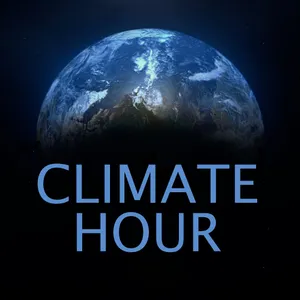
Free Daily Podcast Summary
Climate Hour: Daily Summaries Delivered
by Bob Grove
The best in climate news, technology and practices from experts in the field.
Latest Episodes
The most recent episodes — sign up to get AI-powered summaries of each one.
- Yesterday50 min
Climate Realities: The Latest Science versus Old Disinformation
There are a couple of climate realities making the rounds these days. There’s the reality of anthropomorphic greenhouse gases, creating global warming that causes climate change. Then there’s the reality of climate denialism which believes that the Earth’s climate systems are not changing. Or at least that the current changes are natural and not man made. One reality is endorsed by 98% of scientists world wide. The other reality is endorsed by the fossil fuel industry and the current U.S. government. Despite the evidence for climate change, it appears that a majority of voters continue to support the reality of climate denialism. Hence the current U.S. government. Sociologists not only point out the role of greed in determining whether someone believes in climate change or climate denialism. They also point out the role of culture in determining one’s climate reality. On the greed side, there are billionaire fossil fuel executives who’d rather make another billion dollars than save peoples’ lives. But on the cultural side, you find fossil fuel and support industry workers who are more worried about their next paycheck, than a future collapse of the Earth’s climate systems. Both choose climate denialism. The greed side is pretty clear-cut. Large corporations don’t get big by being nice. But the cultural side of climate denialism is much more ambiguous and nuanced. And then there’s a third reality. The reality of those who believe in climate science, but either think it’s too late to do anything about it, or are simply too attached to their consumer comforts to make meaningful changes. Ultimately, the world’s prevailing climate reality will be created by the voters. People selecting leaders who follow in the climate reality of scientists, or leaders who follow the reality of climate denialism. Join host, Bob Grove, and guests to discuss Climate Realities: The Latest Science versus Climate Disinformation. Guests Dr Paul Bierman is a climate scientist, author, and Distinguished Professor of Environmental Science with the Rubenstein School of the Environment and Natural Resources at the University of Vermont. His research explores the environmental impacts of people and societies on Earth’s systems. Paul has published in Science and Nature, and his findings have been covered by CNN, the New York Times, the Washington Post, the Weather Channel, and many others. He’s received both a Career award for integration of research and teaching, and a Distinguished Teaching Scholar Director’s Award from the National Science Foundation. Paul’s latest book, “When the Ice is Gone”, is an environmental history of Greenland focusing on climate change. Dr Helen Amanda Fricker is a glaciologist and Professor of Geophysics with the Cecil H and Ida M Green Institute of Geophysics and Planetary Physics at Scripps Institution of Oceanography at UC, San Diego. Helen has received the NASA Group Achievement Award for her role in the “Ice, Cloud, and Land Elevation Satellite Mission Development Team,” the Martha T. Muse Prize for Science and Policy in Antarctica, and the Seligman Crystal award from the International Glaciological Society. To learn more, visit … https://www.paulbierman.net https://hafricker.scrippsprofiles.ucsd.edu https://www.amazon.com/dp/B0C6JPDD24
- Oct 1, 202650 min
The Lost Value of Social Culture on Climate Politics
Why does climate politics play such a big role in our lives? Climate-driven weather disasters effect both conservatives and liberals equally. And global petro-wars drive up the cost of food and transportation for everyone. In a market-driven economy, the consumer should be able to determine whether fossil fuel or renewable energy is better. Instead, all of the renewable options are being taken off the market by a fossil-fuel owned government. They are forcing conservatives and liberals alike to suffer from increasingly expensive energy and food choices, growing health risks, and the loss of higher paying jobs. Climate politics may be less about conservative versus liberal than they are about billionaires versus everyone else. Only the mega-rich profit from increased prices. And it’s only the mega-rich the profit from health risks that increase medical spending. For the rest of us, a renewable economy is healthier, cleaner and more profitable for everyone. But the billionaires continue to exploit our social and cultural differences to make us lose sight of this shared value. This is nothing new. The rich have manipulated social and cultural beliefs throughout history. Perhaps it’s time to recognize that climate politics is just another tool to make the rich richer. Join host, Bob Grove, and Dr Timmons Roberts to discuss the the Lost Value of Social Culture on Climate Politics. Guests Dr Roberts is the Ittleson Professor of Environment & Society at Brown University. He leads the Climate and Development Lab, and is the Executive Director of the global Climate Social-Science Network. He holds a a Ph.D. in Comparative International Development from the Johns Hopkins University. Dr Roberts has served on the Board of the Environmental Change & Society of the National Academy of Sciences, and has received Frederick Buttel Awards for distinguished scholarship from both the American and the International Sociological Associations. To learn more, visit … https://www.climatedevlab.brown.edu https://vivo.brown.edu/display/jr17 https://cssn.org/scholar/timmons-roberts/ https://www.amazon.com/dp/B0C6JPDD24
- Sep 1, 202650 min
The Survival of the Amazon Rainforest and Brazilian Democracy
Climate rights and voting rights are growing more and more interconnected. When an elected government doesn’t care about the environment we live in, it also doesn’t care about our right to vote. Elected officials who are more interested in taking money from oil lobbies than in saving billions of peoples’ lives, are not going to let our right to vote stop them. We already see this in the United States. The elimination of all federal climate programs is the opening act to attempts to restrict our voting rights. If we vote the way they want, our vote counts. If we vote in a state that supports common-sense climate policies, our vote may be delayed, lost or disqualified. Brazil faces similar challenges where one political party wants to extract and exploit the environment, while another is more likely to preserve and sustain it. Unlike the United States, Brazil is home to one of the nine global-climate tipping points. An ecosystem so significant that it’s collapse will lead to the inevitable global change of Earth’s weather and food systems. That global climate tipping point is the Amazon rainforest. The Amazon rainforest is not only one of the Earth’s largest natural sequestration engines, but it’s natural transpiration creates rainfall thousands of miles away, including throughout the United State’s Midwestern region. Both global warming and deforestation threaten the Amazon rainforest. Brazil’s adoption of common-sense climate policies and forest management have the potential to save the Amazon. It’s continued deforestation has the potential to turn far-flung regions, including the U.S. Midwest, into deserts. Join host, Bob Grove, and Claudio Angelo to discuss the Survival of the Amazon Rainforest and Brazilian Democracy. Guests Claudio Angelo is the International Policy Coordinator at Brazil’s Climate Observatory. Angelo worked as a Science Editor and environmental journalist for over two decades. He has published in Nature magazine and Scientific American. His 2016 book titled, The Death Spiral: How Humanity Altered the Climate Machine, was the science book of the year in Brazil. His latest book is, The Silence of the Chainsaw: When Brazil Decided to Save the Amazon. To learn more, visit … https://oc.eco.br https://www.amazon.com/dp/B0C6JPDD24
- Aug 1, 202650 min
Climate Tipping Points: Devastating Events or Social Challenge
Climate tipping points are critical thresholds that, once crossed, lead to the acceleration and irreversible change of our climate systems. For example, our ongoing greenhouse gas emissions are melting the world’s ice sheets and glaciers, which reduce the Earth’s ability to reflect hot solar radiation back into space. If we cross that tipping point and the ice dissapears, then the Earth’s surface will be darker, will absorb solar heat faster and consequently accelerate global warming. Or our melting of the arctic permafrost which will release large amounts of captured methane into the atmosphere. If we cross that tipping point and the permafrost melts, then the atmosphere will be filled with methane and the Earth’s greenhouse gas effect will irreversibly change our climate systems. It’s important to take action before we reach these and other climate tipping points. But climate action is difficult when climate-denialism becomes institutionalized and begins dictating environmental policy at the highest levels of government. It’s hard to even discuss climate science openly when government-driven climate-hushing becomes the rule of the land. So let’s take this opportunity to remind ourselves what real science tells us about climate. Join host, Bob Grove, and Dr Laura Pereira to discuss Climate Tipping Points. Guests Dr Pereira is a Professor in Sustainability Transformations & Futures with the Global Change Institute at the University of the Witwatersrand in South Africa, and a researcher at the Stockholm Resilience Centre in Sweden. She holds a Doctor of Philosophy in Geography and Environmental Science from the University of Oxford. Dr Pereira is a lead author of the Transformative Change assessment report by the Intergovernmental Science-Policy Platform on Biodiversity and Ecosystem Services (IPBES) and the United Nations Environmental Program’s (UNEP) seventh Global Environmental Outlook assessment report (GEO7). To learn more, visit … https://global-tipping-points.org https://www.stockholmresilience.org/meet-our-team/staff/2019-08-26-pereira.html https://www.amazon.com/dp/B0C6JPDD24
- Jul 1, 202650 min
America’s Beautiful Epoch Of Oil Is Collapsing
Despite desperate efforts by the oil industry and its captive U.S. government, the epoch of oil is collapsing. Even if we ignore the cheaper and more sustainable power provided by wind and solar energy, the world’s oil reserves are expected to dry up by 2050, leaving us no choice but to transition to new sources of energy. But most of the world isn’t waiting. Over the past decade clean energy investment has increased ten-fold. In 2025, clean energy investment was more than double that of fossil fuels. And renewables have now exceeded coal as the world’s top provider of electricity. With the exception of the United States, Russia and a few Gulf states dependent upon oil production, the world is rushing to embrace renewable energy. And recent events are accelerating that transition. Russia’s invasion of Ukraine led the E.U. to end its dependency on Russian oil. U.S. military actions in Venezuela and Iran have destabilized oil prices, leading to major cost-shock for the consumers that make cheap, safe renewables ever more attractive. António Guterres, the United Nations secretary-general, recently stated that, “We have entered the age of clean energy.” And that, “Those who lead this transition will lead the global economy of the future.” Historians report that the British Empire ended when coal was replaced by oil, leading to the rise of the oil-rich United States. We can equally argue that the end of oil may lead to the collapse of an oil-obsessed America. Will current U.S. energy policy make America great again, or is it making America go away. Join host, Bob Grove, and Jonathan Watts, Global Environment Writer for the Guardian News and founder of Sumaúma.com, to discuss the Collapse of the American Epoch of Oil. Guest Mr Watts is the founder of the Rainforest Journalism Fund and the China Environmental Press Awards. His most recent book is The Many Lives of James Lovelock: Science, Secrets and Gaia Theory. Jonathan is a recipient of the 2018 and 2019 SEAL Environmental Journalism Awards. Read Mr Watt’s article, The American Epoch Of Oil Is Collapsing: What Comes Next Could Be Ugly, HERE. To learn more, visit … https://sumauma.com/en/quem-somos/ https://www.amazon.com/dp/B0C6JPDD24
- Jun 1, 202650 min
War and Environmental Security in a World of Climate Denial
We’re in a vicious cycle. Climate change is increasing the likelihood of war, and war is increasing climate change. Environmental security is at its lowest point in history. A recent study from Queen Mary University of London reports that the first 60 days of war in Gaza created 281 thousand metric tonnes of greenhouse gas emissions. Another study, titled Climate Damage Caused By Russia’s War In Ukraine, reports that the first 18 months of that war created 150 million metric tonnes of greenhouse gas emissions. This vicious cycle is caused by climate denialism. Climate deniers ignore environmental security. And a national defense strategy that doesn’t consider environmental security is simply more likely to go to war. If you accept climate science, you understand that we have a global problem. Something the countries of the world must work together to solve. If you deny science, then you’re simply back to dark age feudalism. And you’re willing to go to war over every scrap of the environment’s dwindling resources. It seems that climate denialism has now penetrated every aspect of the U.S. Federal Government. And this climate denialism is leading to policy and military decisions that ignore environmental security and lead to one war after another. Join host, Bob Grove, and Brigadier General Wendell Chris King, to discuss War and Environmental Security in a World of Climate Denial. Guests Dr King is a retired Brigadier General and Dean Emeritus of the U.S. Army Command and General Staff College. He holds a Ph.D. in Environmental Engineering from the University of Tennessee. And two Masters Degrees; a Master of Science in Civil Engineering and a Master of Arts in National Security & Strategic Studies from the Naval War College. Dr King is a recipient of the Distinguished Service Medal, the American Academy of Environmental Engineering Honor Award, and the Army Science Award. He is the author of Understanding International Environmental Security: A Strategic Military Perspective. Dr King has lectured at Oxford University, NATO and the technical session of the Copenhagen Climate Summit. Read Dr King’s article, The IPCC: Forty Years of Great Science in Understanding Climate Change, HERE. To learn more, visit … https://climatehour.net/the-ipcc/ https://www.amazon.com/dp/B0C6JPDD24
- May 1, 202650 min
Climate Politics: The New Plague On Survival
CLIMATE HOUR – Climate change is now the most politically divisive issue in the United States. Yet climate disasters continue to kill people regardless of their political beliefs. Regardless of whether they’re natural or anthropogenic, climate disasters continue to destroy infrastructure and food systems needed by both conservatives and liberals. Climate politics are threatening our survival. They overwhelm both parties’ agendas, even though there are marketable climate solutions that easily reduce our greenhouse gas emissions, making the world better for everyone. Climate solutions that are good for the economy, good for the consumers, and even good for the wealthy. The United States is supposed to be a market driven economy where the consumer determines which products are the best. Yet the Republican party and the Trump administration continue to undermine consumers’ basic right to choose products like solar energy and electric vehicles. Why are they so afraid that the consumer will choose these options over fossil-fuels? In the 1980s, when scientists discovered that emissions from aerosol spray-cans were destroying the atmosphere’s ozone layer, industry and government came together and solved the problem. No arguments. They just fixed it. Why haven’t we fixed the climate crisis? We know how. Climate solutions are profitable for businesses and affordable for consumers. Instead, the United States is burying the energy systems of the future, and digging their way back to the dying energy systems of the past. Join host, Bob Grove, and guests to discuss Climate Politics: The New Plague On Survival. Guests include: Dr. Heather Williams, Professor of Politics, Pomona College. Thomas McHenry, JD, Former Dean and President of Vermont Law School. To learn more, visit … https://www.pomona.edu/directory/people/heather-l-williams https://www.vermontlaw.edu/faculty/mchenry-thomas https://www.amazon.com/dp/B0C6JPDD24 View other Climate Hour episodes at www.ClimateHour.net.
- Apr 1, 202650 min
The Truth About EPA’s Repeal Of Its 2009 Endangerment Finding
CLIMATE HOUR – The Environmental Protection Agency’s 2009 Endangerment Finding is the foundation of the U.S. government’s legal authority to regulate greenhouse gas emissions and to combat climate change. This finding is why the United States has vehicle emission standards. It is why the U.S. adopted the Clean Power Plan. It is why the U.S. became a party to the Paris Climate Agreement. Columbia University reports that the second Trump Administration has implemented significant rollbacks of environmental regulations, including over 200 climate-related laws. In July of 2025, Trump’s Department of Energy released a report written by a newly-formed Climate Working Group, composed of five scientists known for their opposition to mainstream climate science. On that very same day, Trump’s EPA cited this Climate Working Group Report in their announcement that they were rescinding the 2009 Endangerment Finding and repealing all greenhouse gas emission standards for vehicles and engines. Scientists around the world, including a group of 85 scientists led by Dr. Andrew Dessler and Dr. Robert Kopp, have rallied against the Climate Working Group report and repeal of the Endangerment Finding, concluding that the CWG report contained numerous instances of cherry-picking data, overemphasis of uncertainties, misquoting peer-reviewed research, and a general dismissal of the vast majority of decades of peer-reviewed research. Join host, Bob Grove, and Dr Andrew Dessler to discuss the Environmental Protection Agency’s repeal of the 2009 Endangerment Finding. Guest Dr Dessler is a climate scientist in the Department of Atmospheric Sciences at Texas A&M University, and Director of Texas A&M’s Texas Center for Climate Studies. He holds a Bachelor degree in physics from Rice University and a Ph.D. in chemistry from Harvard University. Dr Dessler has served as a Senior Policy Analyst in the White House Office of Science and Technology Policy, and on NASA’s Earth Science Advisory Committee. Dr Dessler is a recipient of the American Geophysical Union’s Climate Communication Award, and is currently President of the AGU’s Global Environmental Change section. To learn more, visit … https://artsci.tamu.edu/atmos-science/contact/profiles/andrew-dessler.html https://www.theclimatebrink.com https://www.amazon.com/dp/B0C6JPDD24
Get Climate Hour summaries in your inbox
Free AI-powered daily recaps. Key takeaways, quotes, and mentions — in a 5-minute read.
Get Free Summaries →Free forever for up to 3 podcasts. No credit card required.
You Might Also Like
Listeners also like.
The Climate Question
BBC World Service

A Matter of Degrees
Two climate experts explore the systems driving climate change and spotlight solutions through stories of leadership and activism.
Natural Causes
Explores the intersection of outdoor access, conservation, and environmental justice in an era of climate crisis and political threat.
Unf*cking the Future
A scientist explores environmental crises and practical solutions to secure a sustainable future.
Drilled: Displaced
A journalist documents climate displacement in Latin American communities, exposing its human and systemic impacts.

Inquiring Minds
Explores the intersection of science and society through critical thinking and in-depth analysis.

Resources Radio
Experts discuss climate change, energy, ecosystems, and environmental policy research in accessible weekly episodes.

The Great Simplification with Nate Hagens
Discussions with experts on energy, ecology, economics, and human behavior to understand the systemic challenges facing civilization.
Science In Action
The BBC covers the latest weekly developments and news in science.
Biosphere 2 Podcast
Aaron Bugaj

Heroes, Action, Adventure, Extreme Sports - Profiles in Courage - The Creative Process
Interviews with adventurers, athletes, and activists exploring courage, resilience, and creativity through extreme sports, exploration, and social change.
The World, the Universe and Us
Explores big scientific questions about life, consciousness, climate, and the cosmos with expert scientists and New Scientist journalists.
About Climate Hour
The best in climate news, technology and practices from experts in the field.
Customized Recaps
AI-powered recaps with compact key takeaways, quotes, and insights.
Straight to Your Inbox
Get key takeaways from Climate Hour in a 5-minute read.
Save Hours Every Week
Stay current on your favorite podcasts without falling behind.
Frequently Asked Questions
What is Podzilla's Climate Hour daily summary?
It's a free AI-powered email that summarizes new episodes of Climate Hour as soon as they're published. You get the key takeaways, notable quotes, and links & mentions — all in a quick read.
How does the Climate Hour podcast summary work?
When a new episode drops, our AI transcribes and analyzes it, then generates a personalized summary tailored to your interests and profession. It's delivered to your inbox every morning.
Is this an official Climate Hour product?
No. Podzilla is an independent service that summarizes publicly available podcast content. We're not affiliated with or endorsed by Bob Grove.
Can I get summaries of other podcasts too?
Absolutely! The free plan covers up to 3 podcasts. Upgrade to Pro for 15, or Premium for 50. Browse our full catalog at /podcasts.
How often does Climate Hour release new episodes?
Climate Hour publishes monthly. Our AI generates a summary within hours of each new episode.
What topics does Climate Hour cover?
Climate Hour covers topics including Science, Nature, Earth Sciences. Our AI identifies the specific themes in each episode and highlights what matters most to you.
Start getting Climate Hour summaries tomorrow morning.
Free forever for up to 3 podcasts. No credit card required.
Free forever for up to 3 podcasts. No credit card required.