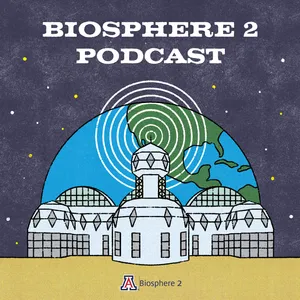
Free Daily Podcast Summary
Biosphere 2 Podcast: Daily Summaries Delivered
by Aaron Bugaj
Each episode we feature in depth interviews with scientists, authors, engineers, entrepreneurs, artists and policy makers exploring the threads between Earth, its living systems, and our place in the Universe.
Latest Episodes
The most recent episodes — sign up to get AI-powered summaries of each one.
- Dec 2, 20241h 48m
#026: The Worlds Hottest Rainforest - Dr. Joost Van Haren
We are joined by Dr. Joost Van Haren, the research director of the rainforest biome at Biosphere 2. Joost has been conducting research at Biosphere 2 since 1995, executing experiments in the rainforest related to rainforest ecosystem responses to climate change, including carbon cycling, water cycling, temperature limits, and the effects of drought. He is also an assistant research professor at the University of Arizona, where he teaches science courses and facilitates internships through the W.A. Franke Honors College. In this episode, we talk about the amazing research that's been done in the Biosphere 2 rainforest- past and present. We discuss Joosts fieldwork in Brazil and what makes Biosphere 2 complimentary to field observatories. We discuss the wonder of tropical trees and their unique responses to stress. This episode can get a bit technical, but stick with us. Whenever we got into technical points, I was sure to double back to explain terms and concepts further with Joost. Here is Joost Van Haren.
- May 23, 20241h 19m
#025: Coral Reef Arks - Dr. Forest Rhower, Dr. Breeann Kirby, and Dr. Ty Roach
Today we are joined by Dr. Forest Rhower, Dr. Breeann Kirby, and Dr. Ty Roach. Forest, Breeann, and Ty were all on site at Biosphere 2 as facilitators of the Desert Arks Meeting– a meeting where scientists and artists from institutions worldwide gather around a common experiment in coral reef ecology, known as the Coral Reef Arks project. An ark is a large geodesic structure submerged in the ocean that serves as a mesocosm for studying coral reef ecosystems. Imagine massive midwater structures colonized with luminescent corals, anemones, crabs and urchins, and circled by giant schools of fish. These are Coral Reef Arks. The Arks were conceived to address a global need for developing new technologies that will help mitigate widespread coral reef degradation. Two years ago, arks were deployed in Curacao, Puerto Rico, and San Diego. The Desert Arks Meeting served as a meeting place to check in on the progress of the Arks, to learn from failed hypothesis, and to iterate on design and technology of the Ark systems. In this episode, we talk about the success of the Desert Arks conference and how artists play a valuable role in facilitating research. Further, we discuss the arks in-depth, debriefing some of the highlights of the Arks Meeting, and asking more questions about the best way to move the research forward. About our guests: Doctor Forest Rohwer is a microbial ecologist and Professor of Biology at San Diego State University. His particular interests include coral reef microbial ecology and viruses as both evolutionary agents and opportunistic pathogens in various environments. Being a marine microbial ecologist, Dr. Forest Rohwer sees a coral reef as a finely-tuned community in which the microbes and viruses are major players. Recognizing their importance, he pioneered the use of metagenomics as a means to characterize these previously inscrutable organisms and to investigate their role in coral reef health and disease. Doctor Breeann Kyte Kirby is a research scientist turned creative writer. She works in both fields, facilitating interdisciplinary collaborations between artists, scientists, and thinkers. Dr. Kirby is a professor of creative writing and environmental studies at Point Loma Nazarene University. There she designed and heads the interdisciplinary humanities based environmental studies program. Her current books examine how to convey complex science accurately in engaging fiction. Doctor Ty Roach is a molecular biologist, freelance scientist, and a decorated competitive surfer and wrestler. Ty is a former Postdoctoral Researcher at Biosphere 2, where he split time between the Hawaii Institute of Marine Biology and living on site at Biosphere 2. He has done extensive research in the Biosphere 2 Ocean system, logging over 100 hours underwater. Today, Ty is making his way through academia as a freelance scientist with research focused on microbial and viral ecology, coral reef science, and theoretical biophysics. He is currently an Adjunct Research Professor at the Viral Information Institute at San Diego State University. Ty, Forest, and Breeann are co-authoring a book on the positive roles of viruses and bacteria in human and ecological health that will be coming out this year.
- Oct 28, 20232h 36m
#024: The Surfing Scientist - Dr. Ty Roach
In this episode, we are joined by Dr. Ty Roach. Ty is a molecular biologist, freelance scientist, and a decorated competitive surfer and wrestler. Ty is a former Postdoctoral Researcher at Biosphere 2, where he split time between the Hawaii Institute of Marine Biology and living on site at Biosphere 2. He has done extensive research in the Biosphere 2 Ocean system, logging over 100 hours underwater. Today, Ty is making his way through academia as a freelance scientist with research focused on microbial and viral ecology, coral reef science, and theoretical biophysics. He is currently an Adjunct Research Professor at the Viral Information Institute at San Diego State University. Additionally, he is co-authoring a book with Drs Forest Rohwer and Breeann Kirby on the positive roles of viruses and bacteria in human and ecological health that will be coming out next year. As a competitive surfer, Ty has won two National championships and four consecutive East Coast Longboard championships, along with numerous professional level surfing titles. As a Division 1 wrestler, Ty was named a two-time Academic All-Conference athlete, an Academic All-American, and was presented the North Carolina State Top Scholar Athlete Award four times. In this episode, Ty shares his experience at Biosphere 2 and reflects upon his journey as a molecular biologist exploring the frontiers of viruses and bacteriophages in coral reef environments all over the world. We cover many topics, including: the Biosphere 2 Ocean, coral reef resilience, viruses, Ty's unconventional career path, professional surfing, designing surfboards, biophysics, phage therapy, and coral reef restoration, among other topics. Without further ado, here is Dr. Ty Roach. Thank you for listening to the Biosphere 2 Podcast. I hope you enjoyed this conversation with Dr. Ty Roach. You can follow his surfing and science on social media @smokinroachjr This episode was co-produced by Keelin Joy Connely. As always thank you for listening to the Biosphere 2 podcast.
- Sep 18, 20231h 6m
#023: The Biosphere 2 Lung - Bill Dempster
Today we are joined by Bill Dempster. From 1985 to 1994, Bill Dempster served as the Director of Systems Engineering and chief engineer for Space Biospheres Ventures, the company responsible for designing and building Biosphere 2. As Systems Engineer, Bill was responsible for managing the integrity of Biosphere 2's atmospheric seal. This role included leading the design and development of the Biosphere 2 Lung and leading a crucial leak testing campaign required for sealing the structure. After his time at Biosphere 2, Bill went on to serve as the President of the Institute of Ecotechnics, a London-based international ecological development institute where he's continued to engage in systems engineering projects around the world. In our conversation, Bill reminisces on the construction and design phase of Biosphere 2, shedding light on his team's engineering triumphs and challenges in constructing the world's largest closed system experiment. Without further ado, here is Bill Dempster.
- Aug 15, 20231h 6m
#022: Space Analog for the Moon and Mars - Kai Staats
In this episode we are joined by Kai Staats. Kai is a veteran developer, designer, filmmaker, and scientist. Kai is the Director of SAM, Space Analog for the Moon and Mars, here at Biosphere 2. SAM is a hi-fidelity, hermetically sealed Mars habitat analog with greenhouse, living quarters, airlock, pressure suits, and a half acre Mars yard. Since 2021 Kai and his team have been constructing SAM, and just last month, SAM hosted it's first two sealed missions, Inclusion 1 and Inclusion 2. Prior to SAM, Kai was co-founder and CEO of the world-renowned Yellow Dog Linux operating system for ten years. The YDL platform was used extensively in Department of Energy, NASA, and University research across a full spectrum of sciences. Kai also designed and developed iConji, an icon-based language for international communication. Further, he wrote the machine learning algorithm Karoo GP which has been used at LIGO for classification of glitches and supernovae. Kai was principal designer of the Mt. Meru Astronomical Observatory in Tanzania, the first of its kind in East Africa. At Arizona State University Kai led the development of SIMOC, a research-grade computer simulation and educational interface hosted by National Geographic that enables citizen scientists to explore the complexity of a human habitat on Mars. In this podcast, Kai takes us on his journey to build SAM. Breaking down the inspiration for SAM's creation, and the research goals for SAM's future.
- Oct 21, 202147 min
#021: Microbial Ecology - Dr. Steve Allison
In this episode we are joined by microbial ecologist and climate scientist, Dr. Steve Allison. Dr. Allison is a Professor of Ecology in the Department of Ecology and Evolutionary Biology at University of California Irvine. He holds a PhD in Biological Sciences from Stanford University and in 2013, Dr. Allison was named an Early Career Fellow of the Ecological Society of America. His research addresses the resilience of microbial communities to drought and climate change in southern California ecosystems. His lab studies how microbes function in ecosystems by using both experiments and mathematical models to predict what might happen to microbes as the climate gets warmer and drier. Steve talks about micro-biomes, climate change, and how his lab group studies microbial communities in a variety of field sites across California with a focus on climate and drought. https://allisonlab.bio.uci.edu/
- Jul 27, 20211h 5m
#020: Clamsplaining: Giant Clams - Dr. Dan Killam
In this episode, we are joined by Dr. Dan Killam. Dan is a post- doctoral researcher in the Coral Reef Laboratory here at Biosphere 2. Dan's central research focus is the study of giant clams. His research involves growing giant clams to understand how they embed signatures in their shells that relate to the activity of symbiotic algae in the clams bodies. Prior to Biosphere 2, Dan was a Zuckerman Postdoctoral Fellow at the University of Haifa in Israel, where he studied the effects of climate change on bittersweet clams found on the Israeli coast. Dan completed his PhD in Paleobiology at UC Santa Cruz where he studied the ecological and physiological history of bivalves. In this episode, Dan takes us deep into world of Giant Clam research-- revealing a wide array of fascinating facts about these overshadowed bivalves found within Coral Reefs. Further, Dan tells us why the Biosphere 2 Ocean is a great place to study clams, he explains his past research studying Clams in the Red Sea, and he guides us through the life history and symbiosis of Giant Clams. https://dantheclamman.blog/
- May 19, 20211h 17m
#019: Coral Reefs Through Time - Dr. Stuart Sandin
In this episode we are joined by Dr. Stuart Sandin. Stuart is the Oliver Chair in Marine Biodiversity and Conservation at Scripps Institution of Oceanography, UC San Diego. He is a professor in the Marine Biology Research Division, and he serves as director of the Center for Marine Biodiversity and Conservation. Sandin has coordinated multiple ship- and land-based expeditions to the remote islands of the central and south Pacific Ocean, with much work conducted in the Line Islands archipelago. He has been using this island gradient and others to study the individual and interacting roles that local human activities and oceanographic context play in the fisheries dynamics and general functioning of coral reef ecosystems. The work in the Pacific has led to the development of the 100 Island Challenge research campaign. In this episode, Stuart and I discuss what Caribbean reefs used to look like and why they've changed. Further, we explore how Stuarts Lab is using structure from motion technology to map out reefs systems over time. We broach the topics of self organization, resilience, evolutionary succession, and technology driven ecological research. Learn more about this project at 100IslandChallenge.org. https://sandinlab.ucsd.edu/
Get Biosphere 2 Podcast summaries in your inbox
Free AI-powered daily recaps. Key takeaways, quotes, and mentions — in a 5-minute read.
Get Free Summaries →Free forever for up to 3 podcasts. No credit card required.
You Might Also Like
Listeners also like.
Planet Visionaries
Climate innovators share their work and motivations with rock climber Alex Honnold in conversations about preserving the planet.

Hostile Worlds: Exploring Space
A documentary-style podcast exploring extreme alien environments through immersive audio storytelling aboard a fictional exploration vessel.
Planetary Radio: Space Exploration, Astronomy and Science
Explores space exploration, astronomy, and science through conversations with experts and advocates shaping humanity's journey beyond Earth.

Unobtainium Podcast
A Hollywood writer-producer and an astrophysicist analyze the science behind sci-fi films, separating fact from cinematic fiction.

Inquiring Minds
Explores the intersection of science and society through critical thinking and in-depth analysis.

Cosmos in a Pod
Explores space, science, philosophy, and technology to reveal the wonders of the universe and humanity's place within it.
Nature Podcast
Covers breakthrough research from Nature journal across all scientific fields, with insights from scientists and science journalists.
The Deep-Sea Podcast
Deep-sea scientists discuss ocean mysteries, recent discoveries, and interview experts in the field.
In Defense of Plants Podcast
Explores the fascinating world of plants, from tiny duckweeds to towering redwoods, celebrating the science and wonder of botany.
The Life Scientific
A scientist discusses their research, inspirations, and career with physicist Jim Al-Khalili.
The Planet Earth Podcast
Behind-the-scenes stories and personal reflections from the creators and narrator of the Planet Earth documentary series.
Terrestrials
Nature stories that reveal surprising animal and plant behaviors through immersive, family-friendly audio adventures.
About Biosphere 2 Podcast
Each episode we feature in depth interviews with scientists, authors, engineers, entrepreneurs, artists and policy makers exploring the threads between Earth, its living systems, and our place in the Universe.
Customized Recaps
AI-powered recaps with compact key takeaways, quotes, and insights.
Straight to Your Inbox
Get key takeaways from Biosphere 2 Podcast in a 5-minute read.
Save Hours Every Week
Stay current on your favorite podcasts without falling behind.
Frequently Asked Questions
What is Podzilla's Biosphere 2 Podcast daily summary?
It's a free AI-powered email that summarizes new episodes of Biosphere 2 Podcast as soon as they're published. You get the key takeaways, notable quotes, and links & mentions — all in a quick read.
How does the Biosphere 2 Podcast podcast summary work?
When a new episode drops, our AI transcribes and analyzes it, then generates a personalized summary tailored to your interests and profession. It's delivered to your inbox every morning.
Is this an official Biosphere 2 Podcast product?
No. Podzilla is an independent service that summarizes publicly available podcast content. We're not affiliated with or endorsed by Aaron Bugaj.
Can I get summaries of other podcasts too?
Absolutely! The free plan covers up to 3 podcasts. Upgrade to Pro for 15, or Premium for 50. Browse our full catalog at /podcasts.
How often does Biosphere 2 Podcast release new episodes?
Biosphere 2 Podcast publishes monthly. Our AI generates a summary within hours of each new episode.
What topics does Biosphere 2 Podcast cover?
Biosphere 2 Podcast covers topics including Science, Nature, Earth Sciences. Our AI identifies the specific themes in each episode and highlights what matters most to you.
Start getting Biosphere 2 Podcast summaries tomorrow morning.
Free forever for up to 3 podcasts. No credit card required.
Free forever for up to 3 podcasts. No credit card required.