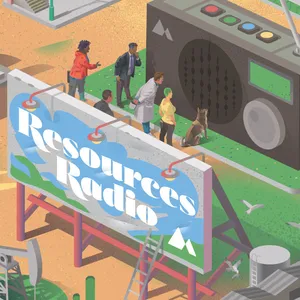
Free Daily Podcast Summary
Resources Radio: Daily Summaries Delivered
by Resources for the Future
Resources Radio is a weekly podcast by Resources for the Future. Each week we talk to leading experts about climate change, electricity, ecosystems, and more, making the latest research accessible to everyone.
Latest Episodes
The most recent episodes — sign up to get AI-powered summaries of each one.
- 4 days ago34 min
Is It Safe to Drink the Water? Turning on the Tap, with Dave Keiser and Joseph Shapiro
In this episode, host Margaret Walls speaks to Dave Keiser and Joseph Shapiro about safe drinking water in the United States. Keiser is a professor at Yale University, and Shapiro is an associate professor at the University of California, Berkeley. Together with other coauthors, they put out a research paper on clean drinking water: how US residents have access to it, what types of policies help preserve it, and the degree to which it benefits people’s health. Their paper incorporates more than 250 million readings on 1,250 different water pollutants across 48 states over several decades, links those data to maps of public water systems across the country, and connects all this information to health outcomes via Medicare data. The Safe Drinking Water Act of 1974 authorizes the US Environmental Protection Agency to set limits on contaminants in water supplied by public water systems, and the act provides financial loans to local municipalities for constructing and upgrading wastewater-treatment plants; this law led to major improvements in providing clean drinking water to US residents. Some of the questions Keiser and Shapiro address in this episode: What exactly are the benefits of access to clean water—and do those benefits justify the costs? What level of government is most effective for managing drinking water? Find out more by listening to the episode. References and recommendations: “Water Works: Causes and Consequences of Safe Drinking Water in America” by David A. Keiser, Bhashkar Mazumder, David Molitor, and Joseph S. Shapiro; https://www.nber.org/papers/w35288 “National trends in drinking water quality violations” by Maura Allaire, Haowei Wu, and Upmanu Lall; https://www.pnas.org/doi/10.1073/pnas.1719805115 “The Evolution of Water Pollution Control in the United States” by William L. Andreen; https://scholarship.law.ua.edu/fac_articles/10/ “The Lost City of the Monkey God” by Douglas Preston; https://www.hachettebookgroup.com/titles/douglas-preston/the-lost-city-of-the-monkey-god/9781455540020/ Subscribe to stay up to date on podcast episodes, news, and research from Resources for the Future: https://www.rff.org/subscribe/
- 1 weeks ago29 min
Flooded with New Information: Who Pays When Flood Risk Is Revealed?, with Jesse Gourevitch
In this episode, host Kristin Hayes talks with Jesse Gourevitch, a new Resources for the Future fellow, about how flood-risk information affects US housing markets. Discussing an upcoming report, Gourevitch outlines changes in property sale prices and buyer characteristics following revisions to federal flood maps and updates to state requirements for disclosing flood risk to homebuyers. He and his coauthor have found that property sale prices are lower when properties are mapped into a designated flood zone or become subject to disclosure requirements. For lower-income homeowners, the declines in property value are larger than high-income homeowners relative to annual income. Following these changes to flood maps, homebuyers in flood-prone areas tend to have higher incomes and are less likely to be Black or Hispanic. Gourevitch discusses what these findings could mean for disparities in flood exposure across different socioeconomic groups. References and recommendations: “Who Is Government? The Untold Story of Public Service” edited by Michael Lewis; https://www.penguinrandomhouse.com/books/788713/who-is-government-by-edited-by-michael-lewis/ Subscribe to stay up to date on podcast episodes, news, and research from Resources for the Future: https://www.rff.org/subscribe/
- 2 weeks ago33 min
Can Oil-Dependent Countries Prepare for an Energy Transition, with Andrea Furnaro and Patrick Heller
In this episode, host Daniel Raimi talks with Andrea Furnaro and Patrick Heller from the Natural Resource Governance Institute. Drawing from a recent report, Furnaro and Heller lay out a five-step framework for how national oil companies (NOCs) can navigate an impending energy transition. Together, they contend that a business-as-usual approach is not a neutral option for these companies and their respective countries. Instead, NOCs must define national policy goals, assess transition risks and opportunities, establish a strategic direction beyond oil and gas, strengthen institutional governance, and ensure a just transition and responsible exit for workers and communities. Examples from Saudi Arabia, Indonesia, and Denmark illustrate how different NOCs can weigh diversification opportunities and adapt strategies to their unique national circumstances and organizational, technical, and economic capacities. References and recommendations: “National Oil Company Transformation: Strategic Choices for an Uncertain Energy Future” by Andrea Furnaro, Giovanni Tagliani, Patrick Heller, Ana Carolina González Espinosa, Tengi George-Ikoli, Fernanda Ballesteros, Nicola Woodroffe; https://resourcegovernance.org/publications/national-oil-company-transformation “Facing the Future” by Andrea Furnaro and David Manley; https://resourcegovernance.org/publications/facing-future-what-national-oil-companies-say-about-energy-transition “Jane” documentary film; https://films.nationalgeographic.com/jane-the-movie “The Secret Agent” film; https://www.imdb.com/title/tt27847051/ Subscribe to stay up to date on podcast episodes, news, and research from Resources for the Future: https://www.rff.org/subscribe/
- 3 weeks ago31 min
Inequality in Weather Forecasts Around the World, with Jeff Shrader
This week, host Margaret Walls investigates the world of weather forecasting with Jeffrey Shrader, an associate professor at Columbia University whose recent research examines inequalities in forecast accuracy among countries across the globe. While the accuracy of weather forecasts has improved steadily over the past few decades, low-income countries experience notably less reliability in their local and regional weather predictions. Shrader explains how factors such as topography and proximity to the tropics impact the ability to get a read on the weather, while lack of investment in weather-observing infrastructure exacerbates such inequalities. In the course of breaking down his findings, Shrader gives an overview of the public-private partnership behind US weather forecasting (including how the context and outcomes may be poised to shift with recent policy proposals) as well as the changes that national and global leaders can implement to improve the complex weather forecasting system. References and recommendations: “Global Inequalities in Weather Forecasts” by Manuel Linsenmeier and Jeffrey Shrader; https://www.nature.com/articles/s41467-026-77630-w “Weather Forecasts Become More Important for Reducing Mortality as the Climate Warms” by Jeffrey G. Shrader, Stephan Thies, Laura Bakkensen, Manuel Linsenmeier, and Derek Lemoine; https://www.pnas.org/doi/10.1073/pnas.2523372123 “On the Impossibility of Informationally Efficient Markets” by Sanford J. Grossman and Joseph E. Stiglitz; https://www.jstor.org/stable/1805228 “Princess Mononoke” film; https://en.wikipedia.org/wiki/Princess_Mononoke “All the World” by Liz Garton Scanlon; https://parents.simonandschuster.com/9781481431217 “Balanced Weather” blog from Alan Gerard; https://balancedweather.com/author/wxinms1/ “Balanced Weather” substack from Alan Gerard; https://substack.com/@balancedweather Subscribe to stay up to date on podcast episodes, news, and research from Resources for the Future: https://www.rff.org/subscribe/
- Sep 8, 202635 min
Mapping Electricity Prices Across the Country, with Zehra Khan and Lauren Sidner
In this episode of the podcast, host Kristin Hayes invites Zehra Khan and Lauren Sidner to discuss their work on the Electricity Price Hub, a collaboration that involves Heatmap News, the Massachusetts Institute of Technology, and the Clean Economy Project. The Hub visualizes national, state-level, and regional electricity prices—a feat that previously has been elusive due to the fragmentation of data across many sources. By putting prices in comparison for ZIP codes across the country, Khan, Sidner, and their colleagues are able to illuminate broad nationwide trends and the differences among states and regions when it comes to changing electricity prices and key drivers of that change. They discuss the role of data centers in electricity rate increases; what’s behind the notable price spike in Washington, DC; considerations for state regulators and policymakers; and more. References and recommendations: “How to Fix the Fastest-Rising Electricity Prices in the U.S.” by Zehra Khan, Lauren Sidner, and Steven Berit; https://heatmap.news/ideas/pepco-exelon-prices Electricity Price Hub data tool from Heatmap News, MIT, and CleanEcon; https://electricity.heatmap.news/ “The Affordability and Climate Agendas Run Through State Regulators. It’s Time to Rethink Their Roles.” by Arjun Krishnaswami and Megan Husted; https://fas.org/publication/rethinking-state-regulators-climate/ The Kyoichiro Kaga series of mystery novels by Keigo Higashino; https://us.macmillan.com/series/thekyoichirokagaseries “A Bad, Bad Place” by Frances Crawford; https://www.penguinrandomhouse.com/books/803124/a-bad-bad-place-by-frances-crawford/ Subscribe to stay up to date on podcast episodes, news, and research from Resources for the Future: https://www.rff.org/subscribe/
- Aug 31, 202630 min
Does Experience with Extreme Weather Affect Views on Climate Change?, with Gabrielle Wong-Parodi
This week, host Daniel Raimi brings Gabrielle Wong-Parodi on the podcast to discuss how people connect climate change to their personal experiences with extreme weather events—and whether these experiences impact their willingness to take action. As a social scientist at Stanford University with a psychology background, Wong-Parodi offers a glimpse into the complicated, and often unpredictable, path between experiencing a consequence of climate change and deciding to contribute to solutions. Research has shown that extreme weather events can lead to increased desire to take adaptation measures (like making homes more resilient) and mitigation actions (like purchasing electric vehicles or solar panels). However, translating these cognitive responses to behavior isn’t always straightforward; Wong-Parodi explains how psychological biases and political affiliation can affect the actions that result from observed attitudinal trends. References and recommendations: “Personal experiences matter for climate action” by Gabrielle Wong-Parodi; https://www.nature.com/articles/s41558-026-02640-x “Households’ Perceived Personal Risk and Responses in a Multihazard Environment” by Michael K. Lindell and Seong Nam Hwang; https://onlinelibrary.wiley.com/doi/abs/10.1111/j.1539-6924.2008.01032.x “The effects of weather experiences on climate change attitudes and behaviors” by Matthew Ryan Sisco; https://www.sciencedirect.com/science/article/abs/pii/S1877343521001160 “Experience of extreme weather affects climate change mitigation and adaptation responses” by Christina Demski, Stuart Capstick, Nick Pidgeon, Robert Gennaro Sposato, and Alexa Spence; https://pubmed.ncbi.nlm.nih.gov/32355377/ “All That Breathes” documentary; https://www.allthatbreathes.com/ Subscribe to stay up to date on podcast episodes, news, and research from Resources for the Future: https://www.rff.org/subscribe/
- Jul 28, 202634 min
Geologic Hydrogen: Could the Smallest Molecule Power the Whole World?, with Ishan Sharma
This week, host Daniel Raimi brings Ishan Sharma on the podcast to discuss the beginnings of the geologic hydrogen industry. Sharma, director and founder of a fund at Renaissance Philanthropy that seeks to grow hydrogen into a competitive energy provider, draws upon the trajectories of sectors such as oil and gas—and newer additions, like geothermal energy—to argue that with enough investment, the abundant hydrogen gas trapped beneath the Earth’s surface could be a major player in the energy game. As hydrogen is a natural output of common chemical reactions, such as the interaction of iron and water, there’s no shortage of the resource; the issue is how to find it. While interest in geologic hydrogen is ramping up, the industry faces feasibility issues related to incomplete public information, lack of understanding about the subsurface world, and regulatory voids—however, Sharma believes this low-carbon source has a bright future. References and recommendations: Chimaera Fund; https://www.renaissancephilanthropy.org/chimaera-fund “Designing a Life That Matters” episode of the “Hidden Brain” podcast; https://www.hiddenbrain.org/podcast/designing-a-life-that-matters/ “Odd Lots” podcast from Bloomberg; https://www.bloomberg.com/oddlots “Ministry for the Future” book; https://www.hachettebookgroup.com/titles/kim-stanley-robinson/the-ministry-for-the-future/9780316300162/ Subscribe to stay up to date on podcast episodes, news, and research from Resources for the Future: https://www.rff.org/subscribe/
- Jul 21, 202633 min
From Coal to Clean: The Future of Energy in Utah, with Sara Baldwin-Griffin
In this episode, host Kristin Hayes invites Sara Baldwin-Griffin to give her perspective on Utah’s growing renewable energy sector—a product of the state’s abundant resources, increasing energy demand, and collaborative policy landscape. Baldwin-Griffin, as chief executive officer of Utah Clean Energy, is supporting the industry’s boom as solar, wind, geothermal, and battery power have grown from less than 5 percent to approximately 20 percent of Utah’s energy generation within just two decades. Not only do sustainable sources of energy offer solutions for affordability and reliability issues, which have been exacerbated by the state’s emerging data center projects, but renewable energy can inject vitality back into struggling local economies. Baldwin-Griffin elaborates on the factors that have led to Utah’s clean-energy success so far, including bipartisan support and community engagement, and speculates on next steps to increase renewable energy adoption across the Western United States. References and recommendations: Utah Clean Energy; https://utahcleanenergy.org/ Subscribe to stay up to date on podcast episodes, news, and research from Resources for the Future: https://www.rff.org/subscribe/
Get Resources Radio summaries in your inbox
Free AI-powered daily recaps. Key takeaways, quotes, and mentions — in a 5-minute read.
Get Free Summaries →Free forever for up to 3 podcasts. No credit card required.
You Might Also Like
Listeners also like.

Energy Gang
A podcast that breaks down clean energy technology, policy, and market trends shaping the global energy transition.
Unf*cking the Future
A scientist explores environmental crises and practical solutions to secure a sustainable future.
Energy Policy Now
Experts discuss current energy policy challenges and their societal and environmental impacts.

Energy Evolution
Discusses energy transition and decarbonization with experts, covering climate, emerging fuels, and commodity markets.
Power: Limits and Prospects for Human Survival
Explores how humanity's pursuit and misuse of power drives ecological and social crises, and why rethinking power is key to survival.

Inquiring Minds
Explores the intersection of science and society through critical thinking and in-depth analysis.

The Ezra Klein Show
Conversations on pressing political, social, and cultural issues with experts and thinkers.

Natural Causes
Explores the intersection of outdoor access, conservation, and environmental justice in an era of climate crisis and political threat.

Climate Magic
Explores how emotions like climate anxiety can fuel meaningful action through expert conversations on resilience and small-scale change.

Sustainable World Radio- Ecology and Permaculture Podcast
Experts discuss ecology, permaculture, organic gardening, and sustainable living through interviews and commentary.

Colorado Today
A daily news podcast covering key Colorado stories and their impact on local communities, hosted by Arlo Pérez Esquivel.

TED Radio Hour
A show that explores profound global questions through curated TED Talks and in-depth conversations with leading thinkers.
About Resources Radio
Resources Radio is a weekly podcast by Resources for the Future. Each week we talk to leading experts about climate change, electricity, ecosystems, and more, making the latest research accessible to everyone.
Customized Recaps
AI-powered recaps with compact key takeaways, quotes, and insights.
Straight to Your Inbox
Get key takeaways from Resources Radio in a 5-minute read.
Save Hours Every Week
Stay current on your favorite podcasts without falling behind.
Frequently Asked Questions
What is Podzilla's Resources Radio daily summary?
It's a free AI-powered email that summarizes new episodes of Resources Radio as soon as they're published. You get the key takeaways, notable quotes, and links & mentions — all in a quick read.
How does the Resources Radio podcast summary work?
When a new episode drops, our AI transcribes and analyzes it, then generates a personalized summary tailored to your interests and profession. It's delivered to your inbox every morning.
Is this an official Resources Radio product?
No. Podzilla is an independent service that summarizes publicly available podcast content. We're not affiliated with or endorsed by Resources for the Future.
Can I get summaries of other podcasts too?
Absolutely! The free plan covers up to 3 podcasts. Upgrade to Pro for 15, or Premium for 50. Browse our full catalog at /podcasts.
How often does Resources Radio release new episodes?
Resources Radio publishes weekly. Our AI generates a summary within hours of each new episode.
What topics does Resources Radio cover?
Resources Radio covers topics including Government. Our AI identifies the specific themes in each episode and highlights what matters most to you.
Start getting Resources Radio summaries tomorrow morning.
Free forever for up to 3 podcasts. No credit card required.
Free forever for up to 3 podcasts. No credit card required.