Free Daily Podcast Summary
Uncensored Renegades: Daily Summaries Delivered
by Jon Evans and Kory Marchisotto
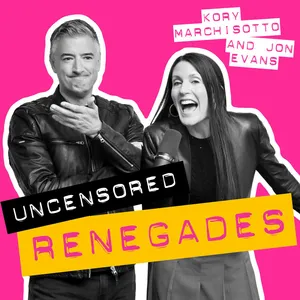
Kory Marchisotto, the trailblazing CMO of e.l.f., and Jon Evans, the perpetually fired host of the Uncensored CMO, team up to talk about the things leaders usually avoid talking about; failures, numbers, getting fired, and so on. The renegade duo fire through topics at speed, on a 20-minute time limit… ish.
Latest Episodes
The most recent episodes — sign up to get AI-powered summaries of each one.
- Yesterday23 min
The leadership framework that went viral
Jon and Kory discuss the unexpected viral success of 3, 5, 7, 9, and the psychology that made the idea resonate.They unpack where the framework came from, why repetition helps ideas stick, and how marketers can use memorable language without crossing the line from persuasion into indoctrination.Along the way, they explore why great brands have great taglines, what campaigns can learn from 3, 5, 7, 9, and how a simple idea becomes something people want to repeat.Useful links:Kellyn Smith Kenny’s 3-5-7-9 frameworkVirtuosi LeagueTimestamps00:00 - Start00:57 - The viral clip01:49 - How does the viral clip benchmark against other clips03:48 - The comments on the viral video04:54 - Where does 3, 5, 7, 9 come from?06:09 - Why 3, 5, 7, 9 works10:52 - Have any marketing campaigns adopted 3, 5, 7, 9?16:49 - Persuasion vs indoctrination20:15 - Why good brands have great taglines21:44 - 3, 5, 7, 9 - repeated
- 1 weeks ago28 min
8 traits of a renegade leader
Jon and Kory discuss the traits that separate renegade leaders from the rest.From courage and risk tolerance to persistence and a bias for action, they explore what it takes to challenge conventional thinking inside large organisations, especially when bureaucracy, short-term pressure and fear of failure make bold decisions difficult.Timestamps00:00 - Start01:16 - The core characteristics of a Renegade leader02:39 - 3 surprising facts about Renegade leaders03:49 - Why are companies so risk averse08:00 - Challenging the status quo13:47 - Why great leaders have courage15:47 - Having a high risk tolerance19:36 - Why e.l.f. want their competitors to get bigger21:03 - Why great leaders provide air cover21:49 - Renegade leaders are persistent22:56 - Beating bureaucracy24:18 - Do one thing, do it well25:46 - Bias for action26:56 - Jon does strategic distillation
- 2 weeks ago22 min
Why high-performing teams are built in person
Jon and Kory discuss why, in an increasingly online world, some of the most important work still happens when people are together in a room.From recording the podcast face-to-face to building high-performing teams, they explore what is lost when every interaction becomes a scheduled video call. Not productivity or convenience, but the trust, informal learning and unexpected opportunities that are much harder to create remotely.They examine the changing attitude towards office life, including a Gen Z counter-swing towards real-world connection, and why some investors remain wary of backing fully remote teams. Kory also shares why e.l.f. is continuing to invest in in-person experiences, and how events can create connections that genuinely change someone’s career or life.Timestamps00:00 - Start00:25 - Why we do the podcast in person01:56 - How many companies are back in offices04:46 - The Gen Z counterswing07:33 - Why investors only invest in in-person teams08:36 - The power of IRL within teams12:19 - The unexpected opportunities that happen IRL13:31 - Why e.l.f. are investing in in-person events17:04 - How in-person events can change lives18:27 - How do we use IRL in an ever online world20:03 - A question from Jon and Kory
- 3 weeks ago20 min
Why leaders are using KPIs wrong
Jon and Kory discuss why the metrics designed to improve performance can sometimes lead businesses in exactly the wrong direction.Kory explains why e.l.f. does not tie compensation directly to KPIs, and why misaligned targets can discourage creativity, distort decision-making and even put good people at risk.They also tackle a growing leadership problem: treating KPIs as instructions rather than information. How high should targets be? When do they create useful focus, and when do they become a ceiling? And what should leaders use instead when the work requires judgement, experimentation and long-term thinking?Timestamps00:00 - Start01:01 - Do KPIs kill creativity?02:56 - Goodhart’s law03:31 - Why e.l.f. do not have compensation based KPIs06:50 - Why misaligned KPIs can get you fired09:37 - Can KPIs hold you back?13:25 - People are using KPIs like AI14:19 - How high should you set KPIs16:19 - The better way to approach KPIs19:09 - Are KPIs out?
- 4 weeks ago23 min
The serious case for humour (or humor)
Jon and Kory discuss why humour is a serious advantage for brands, leaders and anyone trying to earn attention. They explore the science behind why humour makes ideas more memorable, why funny advertising has become less common, and the important difference between trying to be amusing and using humour to reveal a truth.The conversation looks at what it takes to create the conditions for humour to thrive: giving people permission to take creative risks, planning for it rather than treating it as an afterthought, and understanding why brands such as Liquid Death make it look effortless.A useful case for taking the work seriously, without always taking yourself quite so seriously.Timestamps00:00 - Start01:44 - The serious case for humour03:46 - The science behind humour04:48 - Why humour is good for brands06:28 - Why we are seeing less funny ads09:23 - Humour touches on truth11:17 - How to create the conditions for humour to thrive14:25 - Why the best brands plan humour17:38 - Why Liquid Death are so funny19:37 - Can you use humour in a business context?
- Oct 2, 202628 min
The subtle art of persuasion: how leaders get buy-in
Jon and Kory discuss why persuasion is one of the most important, and overlooked, skills in leadership.Getting an idea approved is rarely about delivering the perfect argument in a meeting. It starts earlier: asking better questions, listening closely, understanding what different people need, and finding the stories that make an idea feel relevant rather than imposed.They explore the role of verbal and non-verbal communication, why the meeting is never really just the meeting, and how to build support before a decision is formally on the table. Kory also shares practical lessons from winning over her own board, persuading an organisation to take risks, and turning advocates into people who will sell the idea when you are not in the room.A practical episode for leaders who need to influence without forcing, build alignment without endless consensus, and give their best ideas a genuine chance of happening.LinksThe Storyteller's Secret BookTimestamps00:00 - Start00:56 - Is persuasion one of the secrets to being a successful leader?02:24 - The importance of asking questions05:00 - The art of listening08:09 - Verbal and non verbal communication10:49 - The power of communicating through stories13:43 - The meeting is never actually the meeting17:26 - How Kory sold So Many Dicks to her board20:08 - Pursauding your company to take risks21:17 - Getting advocates to sell your idea26:03 - Identifying your leverage
- Sep 25, 202626 min
15 principles for building a customer-obsessed business
Jon and Kory discuss the Wiseman’s 15 building blocks of customer obsession: a practical framework for turning customer-first intentions into the way an organisation actually works, exemplified by Dutch Bros.As always, Kory brings the data behind customer-obsessed organisations before the duo discuss why internal politics so often gets in the way, and whether founder-led businesses have a natural advantage when it comes to staying close to the people they serve.From empowering frontline teams to reading every customer complaint, they unpack the behaviours that make customer obsession tangible rather than a line in a values document. They also draw on lessons from Unreasonable Hospitality, challenge the limitations of the golden rule, and consider how leaders can embed a customer-first mindset across the business.LinksFounders Mentality BookUnreasonable Hospitality BookTimestamps00:00 - Start00:40 - Are you really obsessed with your customer?01:59 - The data behind customer obsessed organisations03:08 - Why internal politics gets in the way of the customer05:15 - Are founder-led companies more customer led?06:42 - The Wiseman’s building blocks08:47 - Jon’s favourite customer first principles10:25 - Example of empowering the front lines13:11 - Kory’s favourite customer first principle14:20 - Talking through all the Wiseman building blocks17:13 - Why Kory reads all of e.l.f.’s customer complaints19:13 - Customer first lessons from Unreasonable Hospitality23:48 - Why Kory doesn’t like the golden rule24:45 - How to embed these principles into your organisation
- Sep 18, 202623 min
How to make your teams perform 38x better
Jon and Kory discuss how small, consistent improvements can transform team performance 38x in just 1 year. Using lessons from elite cycling and Team Sky’s famously obsessive approach to marginal gains, they explore why high-performing teams rarely improve through one dramatic intervention. Instead, progress comes from making incremental improvements that compound over time.LinksThe Earned Life, Marshall Goldsmith - bookTimestamps00:00 - Start00:24 - Why Jon always wears black02:45 - The compounding power of incremental gains05:16 - Lessons from high performance sport06:48 - The insane 1% improvements Team Sky made to win the Tour De France11:21 - Applying cycling lessons to leadership13:52 - Why you need to ask for feedback16:27 - Just start17:10 - How to see if you’ve actually made progress20:28 - The paradoxical data on incremental progress
Get Uncensored Renegades summaries in your inbox
Free AI-powered daily recaps. Key takeaways, quotes, and mentions — in a 5-minute read.
Get Free Summaries →Free forever for up to 3 podcasts. No credit card required.
You Might Also Like
Listeners also like.
Unbossing
Conversations with business and tech leaders about redefining leadership by unlearning outdated rules in times of change.
Leading By Example: Executives Making An Impact
Executives share pivotal moments and personal experiences that shaped their leadership and decision-making in real-world business environments.
One Part Lion - One Part Lamb with Stephen Scoggins
Leadership advice for founders balancing success, integrity, and faith through interviews with entrepreneurs.

Total Disruption Podcast
Discussions with entrepreneurs and thought leaders on how disruptions in life and business drive personal and professional transformation.

Hunters and Unicorns
Explores the strategies and journeys of top tech leaders and sales innovators shaping the software industry.

The Entrepreneur DNA
Entrepreneurs share lessons on building businesses and personal growth through real experiences and mistakes.
The Learning Leader Show With Ryan Hawk
Conversations with top leaders across industries exploring how continuous learning drives success.

HBR IdeaCast
Features leading thinkers in business and management discussing key ideas and trends.

Right About Now - Legendary Business Advice
Raw business insights from founders and industry leaders, revealing real wins, failures, and actionable strategies without the fluff.

2Bobs—with David C. Baker and Blair Enns
Discussions about creative entrepreneurship led by David C. Baker and Blair Enns.
The Curiosity Shop with Brené Brown and Adam Grant
Two researchers examine leadership, connection, and change by combining qualitative and quantitative insights.

David Senra
David Senra hosts conversations with the greatest living founders.
About Uncensored Renegades
Kory Marchisotto, the trailblazing CMO of e.l.f., and Jon Evans, the perpetually fired host of the Uncensored CMO, team up to talk about the things leaders usually avoid talking about; failures, numbers, getting fired, and so on. The renegade duo fire through topics at speed, on a 20-minute time limit… ish.
Customized Recaps
AI-powered recaps with compact key takeaways, quotes, and insights.
Straight to Your Inbox
Get key takeaways from Uncensored Renegades in a 5-minute read.
Save Hours Every Week
Stay current on your favorite podcasts without falling behind.
Frequently Asked Questions
What is Podzilla's Uncensored Renegades daily summary?
It's a free AI-powered email that summarizes new episodes of Uncensored Renegades as soon as they're published. You get the key takeaways, notable quotes, and links & mentions — all in a quick read.
How does the Uncensored Renegades podcast summary work?
When a new episode drops, our AI transcribes and analyzes it, then generates a personalized summary tailored to your interests and profession. It's delivered to your inbox every morning.
Is this an official Uncensored Renegades product?
No. Podzilla is an independent service that summarizes publicly available podcast content. We're not affiliated with or endorsed by Jon Evans and Kory Marchisotto.
Can I get summaries of other podcasts too?
Absolutely! The free plan covers up to 3 podcasts, any in the catalog. Basic raises that to 15, Pro to 40 and Max to 100. Browse our full catalog at /podcasts.
How often does Uncensored Renegades release new episodes?
Uncensored Renegades publishes weekly. Our AI generates a summary within hours of each new episode.
What topics does Uncensored Renegades cover?
Uncensored Renegades covers topics including Business, Marketing, Management. Our AI identifies the specific themes in each episode and highlights what matters most to you.
Start getting Uncensored Renegades summaries tomorrow morning.
Free forever for up to 3 podcasts. No credit card required.
Free forever for up to 3 podcasts. No credit card required.