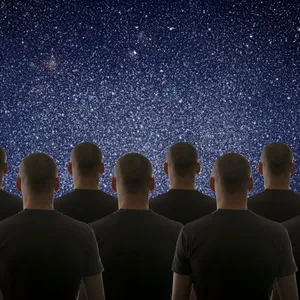
Free Daily Podcast Summary
The Universe As We Know It: Daily Summaries Delivered
by Podgo
Explore our universe in all its wonder!
Latest Episodes
The most recent episodes — sign up to get AI-powered summaries of each one.
- Sep 26, 202612 min
The Woman Who Measured the Stars with Glass Plates and Patience
In a Harvard Observatory basement in 1908, a woman earning 30 cents an hour discovered the key to measuring the entire universe. Henrietta Leavitt's discovery of the period-luminosity relationship transformed dim points of light on glass plates into cosmic yardsticks, ultimately revealing that our galaxy was just one of billions and giving us the tools to measure distances across the observable universe.
- Sep 11, 202615 min
Einstein vs. the Quantum: A Century of Physics at War with Itself
They're both right. They both work perfectly. And they absolutely hate each other. Dive into the greatest scientific rivalry that isn't between people—it's between the two most successful theories in physics, each explaining half the universe while completely contradicting the other, and why their refusal to get along might be the biggest clue we have to understanding reality itself.
- Aug 26, 202616 min
Seven Cosmic Phenomena We Completely Misunderstood for Centuries
From thinking Venus was two different stars to believing the Sun orbited Earth, humanity's cosmic blunders are as fascinating as our breakthroughs. We're counting down seven of the most epic misunderstandings in astronomical history—cases where even the brightest minds got it completely wrong. Some took centuries to correct, and one still makes astronomers wince.
- Aug 11, 202615 min
The 43 Minutes That Saved Apollo 13
On April 13, 1970, an explosion 200,000 miles from Earth turned a routine moon mission into a desperate fight for survival. We reconstruct the frantic 43 minutes when three astronauts had to abandon their dying command module and squeeze into a lunar module built for two—a spacecraft that would become humanity's smallest, most unlikely lifeboat in the vacuum of space. Every decision made in those minutes would determine whether they'd ever see home again.
- Jul 19, 202615 min
Fire and Ice: The Death Match Between Red Giants and White Dwarfs
Same starting point, wildly different endings. We pit the cosmic bloat of red giants against the diamond-hard density of white dwarfs to understand why some stars go out with a whimper of expansion while others collapse into eternal compression. It's a tale of two destinies written in the mass of a star.
- Jun 14, 202613 min
Five Cosmic Accidents That Changed Everything
What if the universe as we know it exists because of a series of lucky breaks? From the precise ratio of matter to antimatter in the first microseconds after the Big Bang, to the asteroid that cleared the way for mammals, we're counting down five cosmic flukes that shaped everything. Prepare to feel incredibly fortunate—and incredibly tiny.
- May 29, 202613 min
The Day We Caught a Neutron Star Collision
On August 17, 2017, a ripple in spacetime triggered alarms at observatories across the globe, launching the most coordinated astronomical observation ever attempted. What happened in the next 11 hours would confirm decades of theory, solve the mystery of where gold comes from, and open an entirely new way of seeing the universe. This is the story of GW170817—the cosmic collision that changed everything.
- Jan 7, 202610 min
Multi-Verse
NOT science fictionSee Privacy Policy at https://art19.com/privacy and California Privacy Notice at https://art19.com/privacy#do-not-sell-my-info.
Get The Universe As We Know It summaries in your inbox
Free AI-powered daily recaps. Key takeaways, quotes, and mentions — in a 5-minute read.
Get Free Summaries →Free forever for up to 3 podcasts. No credit card required.
You Might Also Like
Podcasts in similar categories.
Something You Should Know
Explores practical wisdom and expert insights to help listeners improve their lives, careers, and relationships.

Inside AsembleAI: DeepTech, AI & Science
Experts discuss AI's impact on business, product development, and leadership with researchers, founders, and executives.

Huberman Lab
Explores neuroscience and science-based tools for understanding and improving brain function, behavior, and health.

Big Ideas Lab
Inside Lawrence Livermore National Laboratory, uncover breakthroughs in science and technology shaping the future.
Gastropod
Explores the science and history behind food and farming, from ancient feasts to modern aquaculture and everything in between.

The Jordan B. Peterson Podcast
Explores how values, religion, and culture shape individuals and society through interviews and lectures.
The Science of Everything Podcast
Explores diverse topics in natural and social sciences through the lens of the scientific method.
The Rest Is Science
Hannah Fry and Michael Stevens explore puzzling scientific questions that challenge everyday assumptions about reality.
Plagues with Dr. Keith
A physician examines the science, history, and societal impact of major diseases and pandemics.

Somewhere in the Skies
A weekly exploration of UFO phenomena and unexplained aerial encounters hosted by an author and investigator.
Data Science With Sam
Data scientists and AI practitioners discuss real-world tools, deployments, and lessons in data science and emerging technology.
Discovery
Explores various topics in the field of science.
Customized Recaps
AI-powered recaps with compact key takeaways, quotes, and insights.
Straight to Your Inbox
Get key takeaways from The Universe As We Know It in a 5-minute read.
Save Hours Every Week
Stay current on your favorite podcasts without falling behind.
Frequently Asked Questions
What is Podzilla's The Universe As We Know It daily summary?
It's a free AI-powered email that summarizes new episodes of The Universe As We Know It as soon as they're published. You get the key takeaways, notable quotes, and links & mentions — all in a quick read.
How does the The Universe As We Know It podcast summary work?
When a new episode drops, our AI transcribes and analyzes it, then generates a personalized summary tailored to your interests and profession. It's delivered to your inbox every morning.
Is this an official The Universe As We Know It product?
No. Podzilla is an independent service that summarizes publicly available podcast content. We're not affiliated with or endorsed by Podgo.
Can I get summaries of other podcasts too?
Absolutely! The free plan covers up to 3 podcasts, any in the catalog. Basic raises that to 15, Pro to 40 and Max to 100. Browse our full catalog at /podcasts.
How often does The Universe As We Know It release new episodes?
The Universe As We Know It publishes biweekly. Our AI generates a summary within hours of each new episode.
What topics does The Universe As We Know It cover?
The Universe As We Know It covers topics including Science, Astronomy. Our AI identifies the specific themes in each episode and highlights what matters most to you.
Start getting The Universe As We Know It summaries tomorrow morning.
Free forever for up to 3 podcasts. No credit card required.
Free forever for up to 3 podcasts. No credit card required.