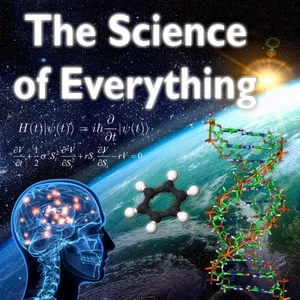
Free Daily Podcast Summary
The Science of Everything Podcast: Daily Summaries Delivered
by James Fodor
In this podcast I discuss a variety of topics in both the natural and social sciences, exploring the many fascinating insights that the scientific method yields about the world around us.
Latest Episodes
The most recent episodes — sign up to get AI-powered summaries of each one.
- 3 weeks ago1h 4m
Episode 164: Gauge Theory and the Higgs Boson
We conclude our series on the standard model with an introduction to gauge theory. We discuss how the requirement of local gauge invariance generates interaction terms in the Lagrangian, and introduce the U(1) x SU(2) x SU(3) group structure of the standard model. We also consider the problem of massive W and Z bosons, and how this was resolved by the introduction of the Higgs field and the mechanism of spontaneous symmetry breaking. Recommended pre-listening is Episode 163: The Standard Model of Particle Physics. If you enjoyed the podcast please consider supporting the show by making a PayPal donation or becoming a Patreon supporter. https://www.patreon.com/jamesfodor https://www.paypal.me/ScienceofEverything
- Aug 8, 202645 min
Episode 163: The Standard Model of Particle Physics
An introduction to the particles and forces that constitute the standard model of particle physics. After some historical background, we introduce each of the three fundamental forces that comprise the standard model - electromagnetism, the strong nuclear force, and the weak nuclear force. We then compare and contrast the different types of particles these forces interact with, including the difference between fermions and bosons, and between quarks and leptons. We consider the types of interactions experienced by these particles and the three generations of matter. Recommended pre-listening is Episodes 158 & 159: Quantum Electrodynamics Parts 1 and 2. If you enjoyed the podcast please consider supporting the show by making a PayPal donation or becoming a Patreon supporter. https://www.patreon.com/jamesfodor https://www.paypal.me/ScienceofEverything
- Jun 30, 20261h 26m
Episode 162: Human Evolution
Beginning with primitive Cynodonts in the late Permian, we our evolutionary development through Mesozoic mammaliaforms, the divergence of monotremes from marsupials and placentals, and culiminating in the emergence of primates in the early Cenozoic. Along the way we discuss the emergence of important traits such as the mammalian ear and various primate adaptations for arboreal life. We then discuss the sequence of hominin species in the lead up to to humans, including Ardipithecus, Australopithecus, Homo erectus, and Neanderthals. We conclude with an analysis of the emergence of distinctive human traits, including bipedalism, encephalisation, and extensive tool use. Recommended pre-listening is Episode 161: Dinosaurs and Other Ancient Reptiles. If you enjoyed the podcast please consider supporting the show by making a PayPal donation or becoming a Patreon supporter. https://www.patreon.com/jamesfodor https://www.paypal.me/ScienceofEverything
- Jun 1, 20261h 33m
Episode 161: Dinosaurs and Other Ancient Reptiles
A survey of extinct animal species from the Permian through the Cretaceous periods. We discuss important differences between anapsids, synapsids, and diapsids, and then review diverse species from all groups, including pelycosaurs, therapsids, parareptiles, euryapsids, pterosaurs, pseudosuchia, and dinosaurs. We also consider aspects including bipedal gait, endothermy, gigantism, and the cause of the end Cretaceous mass extinction. Recommended pre-listening is Episode 160: The Evolution of Animals. If you enjoyed the podcast please consider supporting the show by making a PayPal donation or becoming a Patreon supporter. https://www.patreon.com/jamesfodor https://www.paypal.me/ScienceofEverything
- May 1, 20261h 23m
Episode 160: The Evolution of Animals
A journey through the evolutionary history of animals, beginning with the split of the metazoans from protists about 760 million years ago and ending with the rise of the amniotes about 340 million years ago. The focus is the development of key morphological traits necessary for more complex animal forms, including the origin of true tissues, bilaterial symmetry, the complete gut, the coelom, internal skeletons, and limbs. We conclude with an analysis of key adaptions that allowed amniotes to life in a wider range of terrestrial habitats. Recommended pre-listening is Episode 155: Embryology and Development and Episode 157: The Geologic Time Scale. If you enjoyed the podcast please consider supporting the show by making a PayPal donation or becoming a Patreon supporter. https://www.patreon.com/jamesfodor https://www.paypal.me/ScienceofEverything
- Apr 1, 202645 min
Episode 159: Quantum Electrodynamics Part 2
Continuing from quantum electrodynamics part 1, here we explore the mathematical machinery used to compute interactions between particles, including propagators, Feynman diagrams, cross sections. We then walk through a simple example calculation to illustrate how these tools are applied. I conclude with an introduction to the problem of divergent loop integrals and how these can be resolved using renormalisation. Recommended pre-listening is Episode 158: Quantum Electrodynamics Part 1. If you enjoyed the podcast please consider supporting the show by making a PayPal donation or becoming a Patreon supporter. https://www.patreon.com/jamesfodor https://www.paypal.me/ScienceofEverything
- Mar 1, 202651 min
Episode 158: Quantum Electodynamics Part 1
A detailed look into the physics and mathematics of quantum electrodynamics, the theory of how light and matter interact. We discuss the generalisation of the Schrodinger equation to the Klein-Gordon and Dirac equations, and howw these describe the propogation of light and fermions respectively. We then consider the process of computing transition probabilities between quantum states, including the S matrix and perturbation theory, and Wick's theorem. Recommended pre-listening is Episode 85: Introduction to Quantum Field Theory. If you enjoyed the podcast please consider supporting the show by making a PayPal donation or becoming a Patreon supporter. https://www.patreon.com/jamesfodor https://www.paypal.me/ScienceofEverything
- Jan 17, 20261h 1m
Episode 157: The Geologic Time Scale
A survey of the Earth's history through the lens of the geologic timescale. We begin with a discussion of the terminology of geochronologic units and how they are specified using 'golden spikes'. We then review the development of Earth's atmosphere, geosphere, and biosphere through the Hadean, Archean, Proterozoic, and Phanerozoic eons. We cover many topics including the supercontinent cycle, the great oxidation event, the evolution of eukaryotes, the Cambrian explosion, and mass extinctions. Recommended pre-listening is Episode 156: Fossils and Dating Methods. If you enjoyed the podcast please consider supporting the show by making a PayPal donation or becoming a Patreon supporter. https://www.patreon.com/jamesfodor https://www.paypal.me/ScienceofEverything
Get The Science of Everything Podcast summaries in your inbox
Free AI-powered daily recaps. Key takeaways, quotes, and mentions — in a 5-minute read.
Get Free Summaries →Free forever for up to 3 podcasts. No credit card required.
You Might Also Like
Listeners also like.

Let's Learn Everything!
Three science communicators explore diverse topics, teaching each other about science and random curiosities each episode.

Theories of Everything with Curt Jaimungal
Analyzes theoretical physics, consciousness, AI, and metaphysics with rigorous, unconventional depth.
The Life Scientific
A scientist discusses their research, inspirations, and career with physicist Jim Al-Khalili.

The Rest Is Science
Two science communicators explore the strange, unanswered questions behind everyday phenomena and challenge assumptions about reality.

The World, the Universe and Us
Explores big scientific questions about life, consciousness, climate, and the cosmos with expert scientists and New Scientist journalists.
In Our Time: Science
Discusses scientific principles, theories, and influential figures in the development of science.

COMPLEXITY
Santa Fe Institute

Science Vs
A show that investigates popular topics and myths by analyzing scientific evidence to determine what’s fact, fiction, or uncertain.

Everything Everywhere Daily: History, Science, Geography & More
A daily podcast delivering concise, fact-based stories on history, science, geography, and culture from around the world.

Inquiring Minds
Explores the intersection of science and society through critical thinking and in-depth analysis.
Science In Action
The BBC covers the latest weekly developments and news in science.

The Psychology Podcast
Explores human potential and possibility through conversations with scientists, thinkers, and self-actualized individuals.
About The Science of Everything Podcast
In this podcast I discuss a variety of topics in both the natural and social sciences, exploring the many fascinating insights that the scientific method yields about the world around us.
Customized Recaps
AI-powered recaps with compact key takeaways, quotes, and insights.
Straight to Your Inbox
Get key takeaways from The Science of Everything Podcast in a 5-minute read.
Save Hours Every Week
Stay current on your favorite podcasts without falling behind.
Frequently Asked Questions
What is Podzilla's The Science of Everything Podcast daily summary?
It's a free AI-powered email that summarizes new episodes of The Science of Everything Podcast as soon as they're published. You get the key takeaways, notable quotes, and links & mentions — all in a quick read.
How does the The Science of Everything Podcast podcast summary work?
When a new episode drops, our AI transcribes and analyzes it, then generates a personalized summary tailored to your interests and profession. It's delivered to your inbox every morning.
Is this an official The Science of Everything Podcast product?
No. Podzilla is an independent service that summarizes publicly available podcast content. We're not affiliated with or endorsed by James Fodor.
Can I get summaries of other podcasts too?
Absolutely! The free plan covers up to 3 podcasts. Upgrade to Pro for 15, or Premium for 50. Browse our full catalog at /podcasts.
How often does The Science of Everything Podcast release new episodes?
The Science of Everything Podcast publishes monthly. Our AI generates a summary within hours of each new episode.
What topics does The Science of Everything Podcast cover?
The Science of Everything Podcast covers topics including Science. Our AI identifies the specific themes in each episode and highlights what matters most to you.
Start getting The Science of Everything Podcast summaries tomorrow morning.
Free forever for up to 3 podcasts. No credit card required.
Free forever for up to 3 podcasts. No credit card required.