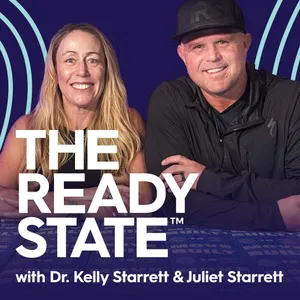
Free Daily Podcast Summary
The Ready State Podcast: Daily Summaries Delivered
by Kelly Starrett, Juliet Starrett
Welcome to The Ready State Podcast, where unlocking human potential is not a goal, but a way of life. Where becoming the healthiest and most resilient version of yourself, both physically and mentally, is not just something you work toward… but a power mindset you embody day in and day out. Turning complex topics into instantly applicable lessons, this show is a compass for those seeking excellence in every facet of life – physical health, athletic performance, work, purpose, creativity, and family life. Dr. Kelly and Juliet Starrett, the New York Times bestselling authors of ‘Built To Move’, help listeners achieve this by sitting down with some of the world’s most influential figures in health, wellness, fitness, business, and art. Every episode is infused with Dr. Kelly’s wisdom from 10+ years of training and coaching elite athletes in the NFL, MLB, the Olympics, and more. His expertise is perfectly complemented by Juliet’s profound insights as a three-time world champion paddler.
Latest Episodes
The most recent episodes — sign up to get AI-powered summaries of each one.
- 4 days ago1h 14m
From Combat Zones to the White House: The Physical Therapist Behind Two U.S. Presidents | Drew Contreras
View This Week's Show NotesStart Your 7-Day Trial to Mobility CoachJoin Our Free Weekly Newsletter: The AmbushWhat does it take to keep someone performing when their job leaves almost no room for downtime? In this episode of the Ready State Podcast, Kelly and Juliet Starrett sit down with longtime friend Dr. Drew Contreras, a retired Army physical therapist who went from supporting soldiers in combat to becoming the first full-time physical therapist embedded in the White House Medical Unit.Drew shares what he learned caring for everyone from White House staff to Presidents Barack Obama and Joe Biden – and why the fundamentals of human performance matter even more when time is your most valuable resource. From encouraging naps during relentless work schedules to introducing walking meetings at the White House, Drew explains how small changes can help people stay functional under extraordinary pressure.The conversation also explores the changing role of physical therapy, why PTs should be doing more than treating injuries one patient at a time, and how technology such as digital health and AI could reshape the profession.What You'll Learn in This EpisodeWhat working with two sitting U.S. presidents taught Drew about keeping people functional under extreme pressureWhy naps, walking meetings, and other simple interventions can make a major difference during sustained periods of high-stress workHow physical therapists became a “force multiplier” for keeping soldiers healthy and operational during deploymentWhy Drew believes physical therapists should play a bigger role in performance and musculoskeletal primary careWhy embracing new technology such as digital health and AI will be essential for the future of physical therapyKey Highlights: Intro to Dr. Drew Contreras How a Combat PT Got Handpicked for the White House The Birthday Basketball Game That Started It All Building a Wellness Culture in the White House What Actually Moved the Needle on Health Naps, Walking Meetings, & Reframing Work Deploying as One of the First Combat PTs PT as Human Performance, Not Just Rehab Treating Obama vs. Biden – Different Ages, Different Needs Leading the APTA & Scaling Physical Therapy The Money Problem in Physical Therapy PT as Musculoskeletal Primary Care AI, Digital Health, & the Future of PT What the Presidency Really Does to a Person Infinite Shelf: Legacy by James KerrHuge thanks to our sponsors, LMNT, BEDGEAR, and Momentous.
- 1 weeks ago31 min
RECESS: Ted Lasso, Women's Sports, Private Equity in Youth Sports & Aesthetic Wellness
View This Week's Show NotesJuliet and I have been saying yes to everything this fall. We're calling it the Fall Travel Junket, and it's stacked with events from Phoenix to Vail to Antarctica. Follow our Instagram or subscribe to The Ambush for details. And spoiler: you can join us in ANTARCTICA! For real!We've been watching the new season of Ted Lasso, which is putting women's sports on mainstream television in a way that's hard to ignore. We get into what that means culturally, including who we'd want to see make a cameo.Private equity is moving into youth sports with the "stay-to-play" model and it's terrible for players and parents. We dig into that, the "pay-to-play" model, what's happening at the policy level, and what parents can actually do.We close with two Instagram trends that gave us pause: men in the longevity space calling facelifts "aesthetic wellness," and a dating site for people who didn't get the COVID vaccine.New episodes of The Ready State Podcast drop every Thursday. Subscribe wherever you get your podcasts so you don't miss a thing!What You'll Learn in This EpisodeWhy Ted Lasso's new season is putting women's sports inequities on mainstream displayWhat the WNBA surge and Copa 71 reveal about the growing appetite for women's sportsHow private equity operates in youth sports through the stay-to-play modelWhat New York Magazine and the Denver Post found when they investigated the pay-to-play childhoodWhat parents can actually do right now, from supporting Senator Murphy's bill to keeping rec leagues aliveWhy calling facelifts "aesthetic wellness" is a branding problem worth namingWhat "Unjected" is, and what it says about the stranger corners of wellness cultureKey Highlights: Welcome back + Goings on in Starrett Land: our empty nest and the Fall Travel Junket PT Biz Mastermind and Brett Bartholomew's Non-Superficial Conference The Assembly in Vail, Eudaimonia, and the Antarctica expedition Ted Lasso's new season and the women's sports moment WNBA, Copa 71, and cultural momentum toward the 2027 Women's World Cup Ted Lasso cameo wishlist: Emma Hayes and Megan Rapinoe Private equity in youth sports: NYMag and Denver Post investigations The stay-to-play model and Senator Murphy's bill Free play, skate culture, and why it matters What parents can do: rec leagues, Positive Coaching Alliance, taking action "Aesthetic wellness": men calling cosmetic procedures a health practice Unjected: the dating site for the unvaccinated Outro
- 2 weeks ago1h 21m
The Science of Women’s Health: Strength, Creatine, Body Composition, & Aging | Dr. Abbie Smith-Ryan
View This Week's Show NotesStart Your 7-Day Trial to Mobility CoachJoin Our Free Weekly Newsletter: The AmbushWhat if the biggest breakthrough in women’s health isn’t a brand-new protocol… but learning how to better apply the fundamentals to the person in front of you?Kelly and Juliet Starrett sit down with Dr. Abbie Smith-Ryan, professor of exercise physiology and nutrition at UNC Chapel Hill, to explore what the latest research can teach us about training, body composition, creatine, and women’s health across the lifespan. Drawing from more than 15 years in the lab – and her experience as a collegiate runner who suffered 9 stress fractures – Abbie explains how our understanding of female physiology has evolved.They unpack how women can use body composition data without becoming ruled by the numbers, why creatine may become even more valuable as we age, whether women really need female-specific strength programs, and how to approach HIIT and recovery during perimenopause and menopause.The takeaway? Human bodies aren’t black and white. And now that we have more tools than ever, the focus should be on finding the ones that work best for you.What You'll Learn in This EpisodeHow Abbie’s experience with 9 stress fractures shaped her approach to training, fueling, and women’s healthWhy body composition data can be a valuable tool for tracking muscle, bone, fat, and long-term healthWhat the research says about creatine for women, from muscle and hydration to potential cognitive benefitsWhy women don’t necessarily need “women-specific” strength training – and when female physiology should influence how you trainHow to use high-intensity interval training, recovery, and scaling to get results without turning every workout into an all-out effortKey Highlights: Intro Meet Dr. Abbie Smith-Ryan Advocating for Women's Health Research Women's Health Research: What's Changed & What's Missing 9 Stress Fractures, Underfueling, & Low Energy Availability Body Composition & Injury Risk DEXA, Bod Pod, & Measuring Body Composition Body Composition for Midlife Women Juliet's Bone Density Loss During Menopause What the Research Says About Creatine for Women Creatine Hesitancy, Myths, & Safety Creatine Loading & the Menstrual Cycle Creatine Dosing: 5g vs 10g & Brain Benefits What's Changed in Athletic Performance Applying Elite Performance Science to Everyday Women Women-Specific Strength Training: Science vs Marketing Overcomplicating Exercise HIIT, Recovery, & the Menstrual Cycle HIIT vs Sprint Interval Training The 20-Minute HIIT Protocol: 1 Min On, 1 Min Off Abbie's Proof of Practice Podcast No Black & White Answers Have We Improved Sports Science? Infinite Shelf: '90s Rap MusicHuge thanks to our sponsors, BEDGEAR, Momentous, and LMNT.
- 3 weeks ago34 min
RECESS: Empty Nesting, Women's Pain Tolerance, a Youth Sports Myth & Two Years Inside the Starrett System
View This Week's Show NotesJuliet and I are officially empty nesters. Both girls are launched, the bathroom is clean every morning, and we're figuring out what the next phase looks like. It rhymes with dusk bike rides, protein shakes for dinner, and a cereal bar in Marin we somehow didn't know existed until now.We also revisited one of our longest-running household debates: women's pain tolerance. An Instagram infographic claiming childbirth equals breaking 20 bones made the rounds and reignited everything. We cover what the McGill pain scale actually says, why medical research has failed women on pain, and the full story of my eardrum, which ends with blood in the ER and a pain scale I have never quite recovered from.From there we got into our book Outplay and the data shaping every youth sports conversation right now. The number everyone cites is that 70% of kids drop out of sport by age 13. A researcher on LinkedIn tried to find the primary source and came up empty. So did researchers at the Aspen Institute. So did everyone else. We unpack what the CDC data actually shows and why citation drift doesn't mean youth sports is fine.The biggest chunk of this episode is something I wanted to make sure we gave real time to: what two years of running the Starrett System has actually taught us. Most people coming into the program weren't working a coherent physical practice at all. They might have been doing some weight training or riding a Peloton, but nobody was hitting all three legs of the longevity triangle: strength, conditioning, and mobility. Nobody was sprinting. And a lot of people believed that the moment they felt discomfort, they should stop.Watching that shift has been one of the most rewarding things we've done. Member Lily gained 5.4 pounds of lean mass in eight months. Cole said he's craving training every day for the first time. The fall cohort starts September 8th. Early bird: $200 off at starrettsystem.com.What You'll Learn in This EpisodeWhy the "70% of kids drop out of sports by age 13" statistic cited by the American Academy of Pediatrics and major sports governing bodies may have no verifiable primary source, and what the CDC and Aspen Institute data actually showsWhy the claim that childbirth equals breaking 20 bones is a myth, and what the McGill pain scale says is actually more painfulWhy medical research has historically underserved women on pain, and how self-reporting skews the pictureWhat two years of running the Starrett System revealed about what most people were actually missing in their physical practiceWhy having a strength practice, a conditioning practice, and mobility work are three separate things, and why most people were only doing one of themWhat the "longevity triangle" is and why most wellness and longevity conferences have almost no conversation about itHow teaching people to train around injuries and physical limitations, rather than stop, has been one of the biggest shifts for Starrett System membersWhy the program's nutrition approach centers on abundance and eliminating nothing, and what happens when people who have been chronically underfueling start eating enoughKey Highlights Welcome to RECESS / Kelly and Juliet go officially empty nest The bathroom story and Byron Katie's towel wisdom via Gabby Reese Life as empty nesters: bike rides at dusk, protein shakes, cereal for dessert Listener ask: send your best recipes for two Women vs. men pain tolerance: the debate renewed Kelly's eardrum story McGill pain scale and Juliet's finger Outplay: preparing families for youth sports Pay-to-play, private equity, and the Norwegian youth sports model The 70% dropout stat and its missing primary source Starrett System: origin story from the YPO conference Starrett System: member results and the September 8th fall cohort Cereal bar in Marin and the great Raisin Bran debate Wrap and early bird CTA
- Aug 20, 20261h 27m
Building Resilience, Finding Clarity, and Staying Calm Under Pressure | Andy Stumpf
View This Week's Show NotesStart Your 7-Day Trial to Mobility CoachJoin Our Free Weekly Newsletter: The AmbushAndy Stumpf spent years navigating some of the most extreme environments imaginable as a Navy SEAL, but he says the hardest lessons he learned had nothing to do with combat. In this episode of the Ready State Podcast, Kelly and Juliet Starrett sit down with the retired SEAL Team Six operator, pilot, skydiver, and author of Drownproof to explore the mindset that helps people stay steady when life feels anything but that.From a chaotic military skydive gone spectacularly wrong to the emotional toll of divorce, Andy shares why the ability to "chunk" overwhelming challenges into the next manageable step has become one of the most valuable skills he's ever developed. Along the way, the conversation dives into self-talk, asking for help, ownership, leadership, flow state, and why resilience isn't about being fearless – but about learning to focus on what you can control when everything else feels out of control.Whether you're navigating a personal setback, leading a team, raising kids, or simply trying to build a more resilient mindset, this episode offers practical lessons for staying grounded, making better decisions, and keeping your head above water when the inevitable storms of life arrive.What You'll Learn in This EpisodeWhy resilience is less about toughness and more about controlling what you can controlHow breaking overwhelming challenges into small, manageable steps can help you navigate almost any crisisThe surprising role that self-talk plays in performance, confidence, and decision-making under pressureWhy asking for help is one of the strongest leadership skills, not a sign of weaknessHow finding a healthy "flow state" can improve focus, reduce stress, and build long-term resilience through work, sport, or everyday lifeKey Highlights: Intro & Andy's Background Origin of "Becoming a Supple Leopard" Backstory of "Drownproof" Title Where We Learn Resilience & Life Skills Breaking Tasks Into Small Chunks Andy's Wild HAHO Jump Story Everything Goes Wrong Mid-Air Getting to Safety & Lesson From the Jump How Divorce Was Harder Than SEAL Training The Power of Self-Talk Asking for Help as a Sign of Strength After-Action Reviews, Accountability, & Leadership Why 85% Quit BUD/S The Chunking vs. Overwhelm Theory Hell Week & the Psychology of Time "It Takes Longer to Do It Wrong" Writing Drownproof BASE Jumping, Wingsuits, & Risk Flow State, Not Adrenaline The Sphere of Influence Exercise Redirecting Negative Self-Talk The Infinite Shelf: Money & MeaningHuge thanks to our sponsors, LMNT and Momentous.
- Aug 13, 202631 min
Hiking the Haute Route, Thorne Sold to P&G, Kasia Niewiadoma's Historic Climb & GLP-1 Watch
View This Week's Show NotesWe're back from one of the most bonkers trips of our lives. Juliet and I just finished hiking the Haute Route, the classic alpine traverse from Chamonix, France to Zermatt, Switzerland, roughly 90 miles over 10 days with our daughters Georgia and Caroline. Caroline's senior trip. Years of mental infiltration paid off.Neither of us trained specifically for it. I spent the spring managing a torn ACL and calf. I skipped the surgery because we had this trip on the calendar, and I wasn't willing to miss it. Somewhere around day eight or nine on the trail, my knee actually started to feel better. That's the thing about movement as medicine: there's no substitute for the reps.The trip had other highlights. We've been telling Georgia since she was three that we would someday find wild Edelweiss in the Alps. On day four, crossing one of the high passes, she spotted a patch. She actually cried. It was one of the best moments of my life.We also dig into the news that Thorne, one of the most trusted names in supplement quality, has been acquired by Procter & Gamble for $3.8 billion, and why this deal raises real questions worth watching.Then there's the Tour de France Femme and Kasia Niewiadoma's historic climb on Mont Ventoux: 5.3 watts per kilo for 55 minutes. We talk about the coverage problem, the naming problem, and why this race deserves far more than it's currently getting.We close out with GLP-1 Watch: new data on cancer risk reduction, dementia, addiction disorders, and which grocery category is taking the biggest hit. Spoiler: it's chips.New episodes of The Ready State Podcast drop every Thursday.What You'll Learn in This EpisodeWhat the Haute Route is and why it's one of the great alpine treks in the worldHow Kelly completed 10 days of hiking in Switzerland months after tearing his ACL and choosing not to have surgeryWhy going uphill is easy and the downhill will humble you, and what "tissue exposure" means for how you prepare for a big adventureThe story behind finding wild Edelweiss on a high alpine pass and why Georgia cried when she spotted itWhat Thorne's $3.8 billion acquisition by Procter & Gamble means for supplement quality, and what to actually watch forWhy Kasia Niewiadoma's 5.3 watts per kilo for 55 minutes on Mont Ventoux is one of the most extraordinary athletic performances in recent memoryWhat the current GLP-1 research shows about cancer risk, dementia, and addiction, and why all of it still needs to be taken with real cautionWhy where your GLP-1 is compounded matters and what the black market problem looks likeKey Highlights: Welcome back to RECESS, and a recap of the hippo attack episode and puppet theater Introducing the Haute Route: Chamonix to Zermatt, and how Caroline's senior trip idea came to be The scale of the Swiss Alps: glaciers, wildflower valleys, and a moonscape where a glacier used to be Meeting hikers at the mountain hut who ask "Have you been training for this?" The bonkers 8-hour day: two 10,000-foot passes, extreme terrain, and extreme views The $500 Edelweiss bounty, day four on the trail, and Georgia's emotional discovery Fit but not prepared for the downhill: what tissue exposure means and why the kneecaps paid the price Kelly's "sprain plus": tearing his ACL and calf in February and deciding to skip surgery for this trip Working the plan: movement, swelling management, and a knee that improved over 10 days of hiking The family dimension: hiking as a unit of four, bird launchers, and the mountain bike trike side trip Thorne acquired by Procter & Gamble for $3.8 billion: what it means for supplement quality Why NSF Certified for Sport matters and the precedent of P&G's 2012 New Chapter acquisition Tour de France Femme: Kasia Niewiadoma's historic climb on Mont Ventoux The coverage problem: Peacock picking up halfway, and why this race needs Phil Liggett on the mic What 5.3 watts per kilo for 55 minutes actually means (and why you should try your local bike) GLP-1 Watch: grocery data from 150,000 households, chips down 10%, and yogurt on the rise GLP-1 and cancer: Penn Medicine study, breast cancer data, and why these are still observational studies GLP-1 and dementia: 40–70% lower risk across large studies, and what the mechanisms might be The caveats: observational data, socioeconomic skew, compounding quality,
- Aug 6, 20261h 11m
Fitness Should Be FUN: Caleb Marshall on Joy, Inclusion & ACL Recovery | The Fitness Marshall
View This Week's Show NotesStart Your 7-Day Trial to Mobility CoachJoin Our Free Weekly Newsletter: The AmbushMovement doesn't have to feel like punishment to improve your health. In fact, Caleb Marshall believes the secret to staying active for life has far less to do with discipline – and far more to do with joy. In this episode of the Ready State Podcast, Kelly and Juliet Starrett sit down with the creator of The Fitness Marshall to explore why fun, play, music, and community may be some of the most overlooked ingredients for long-term health. Caleb shares how growing up feeling like he didn't fit into traditional fitness or dance spaces inspired him to build a radically inclusive movement community where people of every age, ability, body type, and experience level feel welcome. They also dive into the surprising psychology behind making fitness sustainable, why creating a judgment-free environment helps people move with more confidence, and how Caleb's devastating ACL injury reshaped his relationship with recovery, resilience, and trusting his body again. Whether you're someone who loves the gym, avoids it altogether, or simply wants to enjoy moving again, this conversation is a powerful reminder that the best exercises are often the ones you look forward to doing.What You'll Learn in This EpisodeWhy joy, play, and fun are essential ingredients for long-term consistency in fitnessHow creating an inclusive, judgment-free environment helps people fall in love with movementThe surprising mental health benefits of dance, rhythm, and being fully present in your bodyWhat Caleb's ACL recovery taught him about resilience, patience, and rebuilding trust in his bodyWhy mastering the basics – instead of chasing the latest fitness trends – is still the most effective path to lasting healthKey Highlights: Intro & Guest Bio Welcome to the Podcast Caleb's Fitness Philosophy & Origin Story Joy as a Health Strategy Building Truly Inclusive Content The Ready State Live Tour Story Disarming People Through Non-Judgment Buying Richard Simmons' Wardrobe Origins of the Booty Army How a Fitness Marshall Video Gets Made Craziest Fan Moments: Zara Larsson & Sesame Street Audience Size & Recognition Tearing His ACL on Camera The Psychology of Injury Recovery Adapting to Seated Chair Workouts Launching Active Booty Balancing the On-Camera Persona with Real Life Movement Practice & Training Routine Staying Trend-Proof Most Popular Videos Revisited Infinite Shelf Recommendation Closing ThoughtsHuge thanks to our sponsors, Momentous and LMNT.
- Jul 30, 20261h 4m
RECESS: Surviving a Zambezi Hippo Attack - Juliet Starrett's Extreme Whitewater World Championship Story
Juliet and I have told pieces of this story over the years, but we've never sat down and told the whole thing from the beginning. This episode, I'm turning the tables and interviewing Juliet, because the full arc of how she ended up getting launched twelve feet into the air by a hippo on the Zambezi River is too good to tell any other way.It starts in the late 1990s, when Juliet was a D1 rower turned wilderness river guide in California: fit, competent on Class IV water, and completely unaware that a tryout on the Kern River was about to drop her onto one of the most storied women's extreme whitewater teams in the world. We're talking Kelly Califadich, Julie Munger, Beth Rippins, Sue Norman, Brooke Winger, Rebecca Rusch: true legends of the sport. Juliet was the youngest, the least experienced, and by Rebecca's nickname for her, the MEAT in the middle of the boat. What she had was athletic horsepower, the right mindset, and no real concept yet of what she'd signed up for.Winning nationals meant an all-expenses-paid trip to the Zambezi River in Zimbabwe for the 1997 World Championships. Two weeks of daily training in the Batoka Gorge: daily flips in Class V rapids, giardia, massive crocodiles between rapids, and a hundred-degree grueling hike in and out of the canyon every single day. Followed by a race they won. Then, because they'd budgeted a full month in-country, the team tacked on a five-day canoe safari at Mana Pools, Juliet's mom Janet included. Flat water. Wildlife. A chance to decompress.Emphasis on WILDlife.What Juliet describes about the moment of the hippo attack (the sound, the air, looking down into the open mouth of a four-thousand-pound animal) is something I still think about. And what she did in the seconds after hitting the water is the reason she's here to tell it.What You'll Learn in This EpisodeWhat it actually took to make a women's extreme whitewater World Championship team in the late 1990s — and why the word "extreme" matteredHow high-volume rivers like the Zambezi differ from the Class IV whitewater most people have experienced, and why that gap is bigger than it soundsWhat two weeks of daily training in the Batoka Gorge looks like: the hike in, the carnage, the giardia, and what finally made the flipping stopWhy hippos kill more people in Africa than almost any other large animal — and what makes their attacks so difficult to surviveWhat Juliet's guide told the team in the safety talk before the canoe safari, and why the locals already knew not to be thereThe split-second decision Juliet made in the water after the attack — and why years of river guiding made the differenceWhy a lifetime of athletic competition and high-stakes environments still didn't prepare Juliet for this particular kind of fearWhat "primal terror" actually feels like, and how it's different from the adrenaline fear of running a dangerous rapidKey Highlights: Kelly sets up the episode: an interview with Juliet about a story that shaped their life together How they met at the Extreme Whitewater World Championships in Chile, including Kelly's infamous Class V swim What made this sport extreme: Camel Cigarette sponsorships, helicopter carnage footage, and Class V rivers worldwide Juliet's four World Championship venues: the Zambezi, Reventazon, Orange River, and Futaleufú The legendary women's team: Kalafatich, Munger, Rippins, Norman, and Rebecca Rusch Juliet's origin story: D1 rowing at Berkeley, chasing a tan, and becoming a wilderness river guide The tryout on the Kern River and the Monday phone call that changed her life Winning nationals means Zimbabwe: understanding high-volume rivers for the first time Two weeks in the Batoka Gorge: daily flips, giardia, crocodiles, and finding the Nyaminyami Winning the World Championship and the greatest French fries of Juliet's life The Ready State Mobility Coach The canoe safari plan: five days on the lower Zambezi at Mana Pools, with Janet, Juliet's Mom Gary's safety talk: machetes, three guns, hippos, crocs, lions, and snakes Days one and two on the river: crocodile wakes, hippo pods, and the Jumanji paddle bang Hippo City or Hippo Bronx: the democratic vote that nearly cost Juliet her life The attack: a sound like a gunshot, launched 12 feet into the air, and swimming for their lives Stranded on a Cape Buffalo island, Tupperware canoe repair, and three silent days to the takeout Juliet can't be beat at the "share an interesting fact" ice-breaker game Primal fear and why Juliet will never do a canoe safari again Reacting under extreme pres
Get The Ready State Podcast summaries in your inbox
Free AI-powered daily recaps. Key takeaways, quotes, and mentions — in a 5-minute read.
Get Free Summaries →Free forever for up to 3 podcasts. No credit card required.
You Might Also Like
Listeners also like.
TRAINED
Discusses fitness and wellness through interviews with athletes, scientists, and health experts on mindset, nutrition, movement, recovery, and sleep.

The Model Health Show
Shawn Stevenson explores health and fitness topics including nutrition, sleep, hormones, and exercise with expert guests.
Peak Performance Life Podcast
Covers health, energy, and mental performance optimization through biohacking, nutrition, and lifestyle strategies.

The Rich Roll Podcast
Rich Roll interviews thought leaders in wellness, personal development, and performance to inspire authentic living.
FoundMyFitness
A podcast exploring health, science, nutrition, aging, and fitness.
The Nick Bare Podcast
Nick Bare discusses nutrition, performance, and habits for consistent personal growth through disciplined, principle-driven conversations.

Red Pill Your Healthcast
Two healthcare providers discuss overlooked health issues and empower listeners to make informed decisions for their families.
Treated with Dr. Sara Szal
Dr. Sara Szal explores holistic health solutions through conversations with experts and patients seeking mind, body, and soul healing.

Cleared Hot - Powered By BRCC
A former military pilot shares stories of adventure, fitness, and leadership to explore resilience and personal growth.
The Balanced, Beautiful and Abundant Show - Rebecca Whitman
A coach helps high-achieving women overcome burnout using a framework centered on spiritual, emotional, physical, and financial well-being.

We're Out of Time
Discusses the fentanyl crisis, mental health, and resilience through interviews with recovery experts, survivors, and public figures.
The Dan Buettner Podcast
Shares practical habits and insights from the world’s longest-lived populations to improve longevity and well-being.
About The Ready State Podcast
Welcome to The Ready State Podcast, where unlocking human potential is not a goal, but a way of life. Where becoming the healthiest and most resilient version of yourself, both physically and mentally, is not just something you work toward… but a power mindset you embody day in and day out. Turning complex topics into instantly applicable lessons, this show is a compass for those seeking excellence in every facet of life – physical health, athletic performance, work, purpose, creativity, and family life. Dr. Kelly and Juliet Starrett, the New York Times bestselling authors of ‘Built To Move’, help listeners achieve this by sitting down with some of the world’s most influential figures in health, wellness, fitness, business, and art. Every episode is infused with Dr. Kelly’s wisdom from 10+ years of training and coaching elite athletes in the NFL, MLB, the Olympics, and more. His expertise is perfectly complemented by Juliet’s profound insights as a three-time world champion paddler.
Customized Recaps
AI-powered recaps with compact key takeaways, quotes, and insights.
Straight to Your Inbox
Get key takeaways from The Ready State Podcast in a 5-minute read.
Save Hours Every Week
Stay current on your favorite podcasts without falling behind.
Frequently Asked Questions
What is Podzilla's The Ready State Podcast daily summary?
It's a free AI-powered email that summarizes new episodes of The Ready State Podcast as soon as they're published. You get the key takeaways, notable quotes, and links & mentions — all in a quick read.
How does the The Ready State Podcast podcast summary work?
When a new episode drops, our AI transcribes and analyzes it, then generates a personalized summary tailored to your interests and profession. It's delivered to your inbox every morning.
Is this an official The Ready State Podcast product?
No. Podzilla is an independent service that summarizes publicly available podcast content. We're not affiliated with or endorsed by Kelly Starrett, Juliet Starrett.
Can I get summaries of other podcasts too?
Absolutely! The free plan covers up to 3 podcasts. Upgrade to Pro for 15, or Premium for 50. Browse our full catalog at /podcasts.
How often does The Ready State Podcast release new episodes?
The Ready State Podcast publishes weekly. Our AI generates a summary within hours of each new episode.
What topics does The Ready State Podcast cover?
The Ready State Podcast covers topics including Fitness, Health & Fitness. Our AI identifies the specific themes in each episode and highlights what matters most to you.
Start getting The Ready State Podcast summaries tomorrow morning.
Free forever for up to 3 podcasts. No credit card required.
Free forever for up to 3 podcasts. No credit card required.