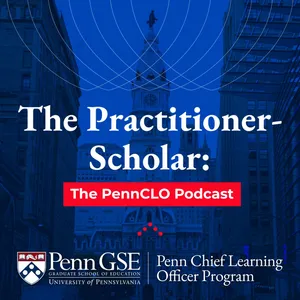
Free Daily Podcast Summary
The Practitioner-Scholar: The PennCLO Podcast: Daily Summaries Delivered
by Penn Graduate School of Education, University of Pennsylvania
Welcome to "The Practitioner-Scholar: The PennCLO Podcast," the flagship production of the renowned Penn Chief Learning Officer Executive Doctoral Program at the University of Pennsylvania. Immerse yourself in a curated blend of scholarly insights and industry expertise, offering a profound exploration of organizational learning and leadership. Unveiling strategies and success indicators crucial in today's dynamic landscape, this podcast is a testament to the distinctive approach fostered by our program.Join us on a transformative journey through the multifaceted world of leadership, where practitioner-scholar approaches shine as a beacon of excellence. As we spotlight luminaries within our esteemed student, faculty, and alumni circles, "The Practitioner-Scholar" podcast becomes a unique channel for intellectual engagement and actionable takeaways. For prospective students, seasoned executives, and dedicated scholar-practitioners alike, this platform is your exclusive access to the e
Latest Episodes
The most recent episodes — sign up to get AI-powered summaries of each one.
- 1 weeks ago30 min
The Hidden Curriculum of Leadership: How Life Experiences Shape Who We Become as Leaders
In this episode of The Practitioner Scholar, host Dr. Jess Jones welcomes Dr. Megan Yoo Schneider, a strategy and transformation leader, executive coach, and University of Pennsylvania Chief Learning Officer doctoral graduate, to explore an often-overlooked dimension of leadership development: the experiences that shape us outside the workplace.Organizations invest significantly in developing leaders through formal training, assessments, and professional experiences. Yet some of our most formative experiences happen outside the workplace, influencing how we see ourselves, navigate complexity, make decisions, and lead others.Drawing on over two decades of experience in strategy, organizational transformation, and leadership development, Megan introduces the concept of the hidden curriculum of leadership—the significant life experiences that shape leader identity, perspective, and adult development. She shares insights from her doctoral research, including how leaders often draw upon non-work experiences to inform their leadership, even when they may not initially recognize their influence.Megan also reflects on how her research became deeply personal when she received an unexpected ovarian cancer diagnosis and subsequently underwent major spinal surgery. These experiences deepened her appreciation for a central insight from her work: experience alone does not necessarily lead to development. Intentional reflection and meaning-making can help us learn, grow, and evolve through what we've lived.Through her Learn, Create, Share framework, developed through reflection following her doctoral research, Megan offers a practical approach to translating lived experiences into greater self-awareness, intentional leadership, and meaningful impact. She and Jess also explore the growing importance of empathy, contextual judgment, and adaptive leadership as artificial intelligence continues to reshape how we work and lead.Ultimately, this conversation invites us to consider how integrating our lived experiences into leadership development can help cultivate more thoughtful, adaptable leaders and strengthen the organizations and communities they serve.Key TopicsThe hidden curriculum of leadership: How experiences beyond the workplace contribute to leader identity and development.Insights from doctoral research: Exploring the relationship between significant life experiences, leadership perspectives, and decision-making.From experience to development: The role of intentional reflection, meaning-making, and adaptability in navigating change and uncertainty.The Learn, Create, Share framework: A practical approach to integrating lived experiences into personal growth and leadership practice.Authenticity and human-centered leadership: Bringing greater self-awareness and empathy into leadership while maintaining thoughtful professional boundaries.Leadership in the age of AI: The importance of empathy, contextual judgment, and values-based decision-making as technology transforms organizations.
- Oct 14, 202636 min
Designing Virtual Trust: Micro-Moments, Team Norms, and Healthy Conflict in Remote Work
In this episode of The Practitioner Scholar: The Penn CLO Podcast, Dr. Sharon Ravitch explores the practicalities of remote team leadership with Dr. Karen Bicking, Head of Talent Management at CompoSecure and Penn CLO graduate. Grounded in her research chapter in Leaders as Architects of Change: Designing Organizations for Connection and Resilience in Times of Uncertainty (co-edited by Dr. Ravitch and Dr. Raghu Krishnamoorthy), Dr. Bicking offers actionable guidance for managers navigating hybrid and virtual team friction.Highlighting her chapter, "The Emotionally Intelligent Organization: Trust, Conflict, and Connection in Virtual Teams," Dr. Bicking walks listeners through real-world examples of how virtual teams navigate non-verbal cue deficits, sarcastic chat misunderstandings, and time-zone delays. From establishing transparent group chat protocols to implementing lighthearted team accountability mechanisms (like "swear jars" or coffee bets), Dr. Bicking demonstrates how small, daily micro-interactions build lasting trust and prevent team burnout.Key Topics:Dr. Bicking’s Real-World Research: What sets high-performing virtual teams apart from struggling, low-trust groups.Decoding Digital Silence: How Dr. Bicking advises leaders to step in when virtual meetings turn silent or sidebar conversations take over.Micro-Moments of Connection: Utilizing quick check-ins, personal milestone celebrations, and informal touchpoints to strengthen relationships.Practical Accountability: Creative, lighthearted methods Dr. Bicking has seen teams use to enforce agreed-upon communication norms.Mid-Year Resets: How leaders can facilitate quick "stop, start, continue" sessions to continuously fine-tune virtual team dynamics.
- Sep 9, 202637 min
Leading Through the BANI World: Psychological Stability, Trust, and Pre-Mortems
Dr. Sharon Ravitch is joined by HR executive and scholar-practitioner Dr. TJ Lintz. Reflecting on his doctoral research at the University of Pennsylvania, Dr. Lintz explores how leaders transform moments of extreme disruption into catalysts for long-term organizational evolution.This episode explores the intersection of crisis management, artificial intelligence, and human-centered leadership. Dr. Lintz explains why artificial intelligence will never replace the human touch required for emotional support, but emphasizes how AI can serve as a vital sparring partner during risk assessment. He leaves listeners with actionable frameworks for creating safe conditions where employees at all levels can contribute transformative ideas. As a contributing author to the book Leaders as Architects of Change, co-edited by Dr. Ravitch and Dr. Raghu Krishnamoorthy, Dr. Lintz draws on his chapter to explore these ideas.Key topics:How effective leaders act as a stabilizing presence during high-anxiety organizational stormsThe role of artificial intelligence as a strategic sparring partner for strategic scenario planningWhy psychological stability forms the foundation for cross-functional collaboration and rapid decision-makingTransforming talent management frameworks to evaluate resilience before crises occurPractical steps for executive leaders to encourage intelligent risk-taking and "failing forward"Redefining executive leadership in a brittle, anxious, non-linear, and incomprehensible (BANI) environmentHow concise, frequent communication builds emotional infrastructure and reduces organizational anxiety
- Aug 5, 202632 min
The Gift of Constructive Critique: Designing Brave Corporate Cultures
In this episode of the PennCLO podcast, Dr. Sharon Ravitch is joined by Dr. Marikay Forst, a distinguished leadership expert and author of the groundbreaking chapter, Architecting Dissent by Design: Psychological Safety, Diverse Thinking, and Brave Cultures, featured in the new book Leaders as Architects of Change.Dr. Forst’s work tackles a critical paradigm shift in modern organizational design: transforming how leaders perceive, encourage, and process constructive disagreement. Moving past traditional views that equate critique with disloyalty, she shares qualitative research proving that inviting dissenting voices is a leadership team's best defense against catastrophic errors. Through a collection of organizational practices and tools, this conversation provides a practical roadmap for top executives to build strategic, psychologically safe environments where multiple viewpoints are intentionally surfaced and acted upon.Alongside the technical strategies, Dr. Forst explores the human dynamics behind corporate decision-making—including the intersection of Carol Dweck’s growth mindset, the invisible costs of ignoring feedback, and the value of maintaining procedural discipline when facing intense time and budget constraints.Key topics:Why dissent is a strategic mechanism for risk prevention and corporate innovationThe blueprint for aligning stated organizational core values with actions.Managing power dynamics and neutralizing the unconscious consequences of speaking upPractical tools for leaders: Designing effective pre-mortems and structured brainstorming sessionsCultivating a growth mindset to enhance constructive critique
- Jun 30, 202637 min
Architects of Change: A Six-Part Leadership Roadmap for the AI Era
In this episode of The Practitioner Scholar, Dr. Sharon Ravitch sits down with Dr. Bridie Fanning, Managing Director at Accenture and former Chief HR Officer, to discuss her critical contributing chapter to the ground-breaking new book, Leaders as Architects of Change (edited by Dr. Sharon Ravitch and Dr. Raghu Krishnamoorthy). While modern headlines focus heavily on what artificial intelligence can automate, Dr. Bridie Fanning argues that the future of work will not be dictated by technology, but by leadership choices. This conversation dives deep into her chapter's core ethos: that AI is fundamentally a human learning story, that leaders must build psychological safety for continuous experimentation, and that traditional, linear change management models must be entirely rewritten to align with the framework of the book.Key Takeaways:Amara’s Law in Action: Why we are currently overestimating AI's short-term hype while drastically underestimating its massive, long-term societal and operational impact.The Death of Traditional Change Management: Moving away from traditional "Point A to Point B" transition models and adopting dynamic, continuous, and iterative organizational capabilities.The "Inverted" Problem-Solving Approach: Why leaders must stop asking "What can AI do?" and instead start with their biggest organizational pain points, working backward to find technical solutions.
- May 28, 202643 min
Leaders as Architects of Collaboration
Great collaboration doesn't happen. It's designed. So why do so many leadership teams still treat it as something that should just emerge naturally?In this episode of the PennCLO Podcast, The Practitioner Scholar, Dr. Sharon M. Ravitch speaks with PennCLO mentor and lecturer Dr. Phillip Ellis about designing organizations for collaboration, resilience, and adaptive leadership.Based on Phillip’s chapter in Leaders as Architects of Change: Designing Organizations for Connection and Resilience in Times of Uncertainty, this conversation explores why many teams struggle to collaborate in a world of uncertainty,and how leaders can create the conditions for deeper trust, innovation, and collective problem-solving.Together, they unpack:Why collaboration is a leadership design challengeHow “systems of knowing” shape teams and organizationsWhy traditional leadership models struggle in uncertain environmentsHow leaders can foster more adaptive and resilient culturesLeaders who treat collaboration as a soft skill keep getting stuck results. This conversation makes the case for designing it instead.In the book, The Seeing Gap, co-written by Dr. Phillips and Dr. Ravitch, they turn the lens on AI. Phillip and Sharon are writing it in the open on Substack, inviting readers to help shape it as it takes form. When he’s not writing or teaching, he’s on stages and in rooms with leadership teams, designing communities and immersive workshops that help organizations stop talking about adaptability and start practicing it.
- Apr 29, 202629 min
Designing for Uncertainty: Rethinking Leadership Beyond Control
What if uncertainty isn’t the problem—but the point?In this episode of the PennCLO Podcast, Dr. Jennifer Neumaier sits down with Penn CLO doctoral alum Dr. Lucrecia Grandolini about her chapter on leading through uncertainty from the book Leaders as Architects: Designing Organizations for Connection and Resilience, co-edited by Dr. Sharon Ravitch (University of Pennsylvania Graduate School of Education) and Dr. Ragu Krishnamoorthy, Director of the Penn CLO program. Drawing on her global experience across financial services, consulting, and clinical psychology, Lucrecia challenges the traditional “plan–predict–control” model of leadership—and offers a compelling alternative.Together, they unpack:Why uncertainty is both deeply human—and deeply misunderstoodThe hidden cost of control: how it erodes trust and psychological safetyThe “living iceberg” metaphor—and what leaders miss beneath the surfaceWhat uncertainty-friendly organizations actually look like in practiceFour essential leadership practices for thriving in complexityThis conversation is a powerful invitation to stop trying to eliminate uncertainty—and start designing for it.Dr. Lucrecia Grandolini is also a co-author of several books on human skills, leadership and organizational change.Leaders as Architects of Change: Designing Organizations for Connection and Resilience in Times of Uncertainty, 2026, RoutledgeLeading with Human Skills: Thriving in the Age of AI, 2026, Lulu The Best Version of Me: Boosting Your Wellbeing, 2024, Lulu
- Apr 2, 202637 min
When the Map Disappears: Architecting Adaptability in a World That Won’t Slow Down
Dr. Sharon Ravitch (University of Pennsylvania Graduate School of Education) interviews Penn CLO doctoral alum Oscar Arias about his chapter, “Leading in Flux,” from the book Leaders as Architects: Designing Organizations for Connection and Resilience, co-edited by Ravitch and Dr. Ragu Krishnamoorthy. Arias explains “flux” as leading when conditions constantly shift, and describes a move from VUCA to a BANI world where systems are brittle, anxiety rises, and change is non-linear and hard to comprehend. He argues many organizations are still built for stability, while disruptions like AI, low barriers to entry, and shifting customer behaviors erode old “moats.” Warning signs of brittleness include slow sharing of bad news, coverups, and inability to detect signals. Arias emphasizes trust, recovery, cultural intelligence, and leaders as architects who design rituals, structures, and decision rules for adaptability. He contrasts resilience (returning to baseline) with anti-fragility (getting stronger), highlighting learning agility through reflection, feedback seeking, experimentation, and diverse dissenting networks.
Get The Practitioner-Scholar: The PennCLO Podcast summaries in your inbox
Free AI-powered daily recaps. Key takeaways, quotes, and mentions — in a 5-minute read.
Get Free Summaries →Free forever for up to 3 podcasts. No credit card required.
You Might Also Like
Listeners also like.

Building Champions for Life
Examines how elite performers in sports, business, and education develop character and mindset for lasting success.
The Curiosity Shop with Brené Brown and Adam Grant
Two researchers examine leadership, connection, and change by combining qualitative and quantitative insights.
Leading By Example: Executives Making An Impact
Executives share pivotal moments and personal experiences that shaped their leadership and decision-making in real-world business environments.
The Learning Leader Show With Ryan Hawk
Conversations with top leaders across industries exploring how continuous learning drives success.
Servant Leadership Institute Podcast
Servant Leadership Institute
Leading Outward
Leaders tackle culture, accountability, and conflict with real-time coaching and insights from global executives.

The Cult of Pedagogy Podcast
Discusses teaching strategies, classroom dynamics, and education reform through interviews with educators and school community members.

Amplify Speakers Podcast
Discusses mindset, leadership, and resilience with top speakers, athletes, and change-makers about their personal journeys and impact.

The Carey Nieuwhof Leadership Podcast: Lead Like Never Before
A podcast about leadership, change, and personal growth to help you thrive in life and leadership.
Bred To Lead
Leadership is developed through real-world turnarounds, early warning signs, and people-first habits that prevent organizational decline.

The CopDoc Podcast: Aiming for Excellence in Leadership
Examines police leadership and innovation through interviews with experts focused on improving law enforcement and community relationships.

The Jedburgh Podcast
Leaders and high performers from military, business, and athletics share strategies for elite performance, leadership, and personal growth.
About The Practitioner-Scholar: The PennCLO Podcast
Welcome to "The Practitioner-Scholar: The PennCLO Podcast," the flagship production of the renowned Penn Chief Learning Officer Executive Doctoral Program at the University of Pennsylvania. Immerse yourself in a curated blend of scholarly insights and industry expertise, offering a profound exploration of organizational learning and leadership. Unveiling strategies and success indicators crucial in today's dynamic landscape, this podcast is a testament to the distinctive approach fostered by our program.Join us on a transformative journey through the multifaceted world of leadership, where practitioner-scholar approaches shine as a beacon of excellence. As we spotlight luminaries within our esteemed student, faculty, and alumni circles, "The Practitioner-Scholar" podcast becomes a unique channel for intellectual engagement and actionable takeaways. For prospective students, seasoned executives, and dedicated scholar-practitioners alike, this platform is your exclusive access to the e
Customized Recaps
AI-powered recaps with compact key takeaways, quotes, and insights.
Straight to Your Inbox
Get key takeaways from The Practitioner-Scholar: The PennCLO Podcast in a 5-minute read.
Save Hours Every Week
Stay current on your favorite podcasts without falling behind.
Frequently Asked Questions
What is Podzilla's The Practitioner-Scholar: The PennCLO Podcast daily summary?
It's a free AI-powered email that summarizes new episodes of The Practitioner-Scholar: The PennCLO Podcast as soon as they're published. You get the key takeaways, notable quotes, and links & mentions — all in a quick read.
How does the The Practitioner-Scholar: The PennCLO Podcast podcast summary work?
When a new episode drops, our AI transcribes and analyzes it, then generates a personalized summary tailored to your interests and profession. It's delivered to your inbox every morning.
Is this an official The Practitioner-Scholar: The PennCLO Podcast product?
No. Podzilla is an independent service that summarizes publicly available podcast content. We're not affiliated with or endorsed by Penn Graduate School of Education, University of Pennsylvania.
Can I get summaries of other podcasts too?
Absolutely! The free plan covers up to 3 podcasts, any in the catalog. Basic raises that to 15, Pro to 40 and Max to 100. Browse our full catalog at /podcasts.
How often does The Practitioner-Scholar: The PennCLO Podcast release new episodes?
The Practitioner-Scholar: The PennCLO Podcast publishes monthly. Our AI generates a summary within hours of each new episode.
What topics does The Practitioner-Scholar: The PennCLO Podcast cover?
The Practitioner-Scholar: The PennCLO Podcast covers topics including Education, Courses. Our AI identifies the specific themes in each episode and highlights what matters most to you.
Start getting The Practitioner-Scholar: The PennCLO Podcast summaries tomorrow morning.
Free forever for up to 3 podcasts. No credit card required.
Free forever for up to 3 podcasts. No credit card required.