Free Daily Podcast Summary
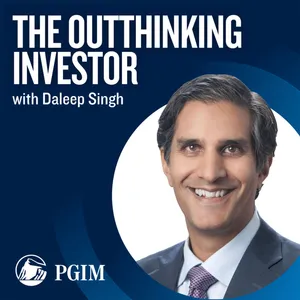
The Outthinking Investor with Daleep Singh: Daily Summaries Delivered
by PGIM
In today's ever-changing world, investors should challenge old assumptions and think outside the box. Markets trade on more than just economic data. They trade on geopolitics, technology, policy, and elections. In a world searching for a new equilibrium, old assumptions are expensive mistakes. Daleep Singh, Vice Chair and Chief Global Economist at PGIM, has spent his career at the intersection of markets and policy, from the U.S. Treasury and Federal Reserve to the White House. Now, Daleep is sharing his perspectives with you. On The Outthinking Investor, Daleep sits down with prominent economists, technologists, policymakers, and market veterans to map out the full distribution of what comes next—and why it matters.
Latest Episodes
The most recent episodes — sign up to get AI-powered summaries of each one.
- 1 weeks ago28 min
Barry Eichengreen on the Dollar's Privilege: Eroding or Enduring?
Despite speculation over its demise, the U.S. dollar remains the operating system of global finance. No alternative — whether a sovereign currency, cryptocurrency, or gold — offers the same depth or liquidity. However, the dollar's primacy is not a light switch to be turned on or off. It can be understood more as a light dimmer. If the dollar dims, it could lead to higher borrowing costs, less fiscal space, less capacity to absorb shocks, and less capacity to deliver effective measures of economic statecraft. Could the dollar slowly lose its dominance over time, creating a world of currency multipolarity? Barry Eichengreen, Professor of Economics and Political Science at the University of California, Berkeley, joins Daleep Singh in this episode to explore how currency dominance is built, sustained, and lost—and how we can apply this historical view to today's global monetary system. They discuss: Potential signs of the dollar's gradual erosion as the dominant currency The technological, geopolitical, and economic forces that could alter the dollar's status as the world's reserve currency The role that digital payment rails, from blockchains to stablecoins, might play in shaping the future of global finance
- Oct 21, 202648 min
Prediction Markets vs. Political Reality: Henrietta Treyz on the Midterm Elections
From the polls to prediction markets, market participants must look beyond conventional wisdom to identify investable signals across elections, fiscal policy, trade, and regulation. Market implications from the U.S. midterm elections could be profound for the pace of America's data center buildout, the intensity of risk from foreign policy and tariffs, and the possibility of a debt ceiling impasse in 2027. PGIM's Daleep Singh is joined by Henrietta Treyz, Co-Founder and Director of Economic Policy at Veda Partners, to take a closer look at the chain reaction for markets and the economy that could follow the U.S. midterms. Listen for analysis on: The impact of potential U.S. tariffs The politics of data centers and AI Budget negotiations and the fiscal outlook Foreign policy and geopolitical considerations Any forward-looking statements, including projections or forecasts, are subject to change without notice and are not guarantees of future results. References to specific companies are for illustrative purposes only and should not be interpreted as recommendations to purchase or sell securities. PGIM and its affiliates may hold positions in the securities of companies referenced herein.
- Sep 11, 202651 min
When Nobody's in Control: AI, Cyber Risk, and the Economics of Digital Trust
AI has the potential to bring a host of benefits to society and the global economy. It has fueled optimism around productivity, disinflation, and debt sustainability. But like many innovations that came before it, AI also brings a new set of challenges. The same technology that might boost economic growth and lift people out of poverty could also serve as a tool for cyberwarfare and fraud. Using AI, digital crimes could become faster, cheaper, and more scalable. AI is also becoming a new chokepoint in geopolitical competition: The discussion explores whether control of digital verification layers may create strategic leverage. Shuman Ghosemajumder, co-founder of the AI and cybersecurity company Reken and former Global Head of Product for Trust & Safety at Google, joins PGIM's Daleep Singh to discuss how AI has expanded the field for cybercrime and why technology itself could be part of the solution. The conversation also covers: How the public and private sectors can manage cyber risks and develop defenses against AI-powered fraud Why AI could make infrastructure and organizations more secure using proprietary tools How public sentiment toward AI has evolved
- Aug 26, 202639 min
The Visible Hand: Marketcrafting from AI to the Price of Money
Adam Smith introduced his concept of the "invisible hand" in the 18th century, offering a metaphor for how self-interest and competition guide a free-market economy. The case could be made that government policy is an increasingly crucial force in shaping markets today, particularly amid heightened geoeconomic competition and a resurgence in industrial policy. In this way, individuals and entities in both the private and public sectors can be "marketcrafters." PGIM's Daleep Singh is joined by Chris Hughes (Facebook co-founder, Chair of the Economic Security Project, and author of "Marketcrafters: The 100-Year Struggle to Shape the American Economy") for a discussion about government policy's role in driving markets and investment outcomes. They cover topics including: How the U.S. government has shaped markets through history Marketcrafting agendas that could address inflation and cost of living challenges An industrial policy framework targeting housing affordability and emerging solutions like modular homes The AI investment cycle and potential policy levers The Federal Reserve's influence on financial markets through its ample reserves regime
- Aug 11, 202637 min
Chip Craze: Framing Industrial Policy for the AI Era
The AI-driven capex cycle might be the biggest investment story of the past century. The five largest hyperscalers were on track to spend around $800 billion on AI infrastructure in 2025, and as a share of U.S. GDP, AI capex has already eclipsed the dot-com boom of the 1990s. Chips are at the center of the AI frenzy – the same chips that also guide precision munitions and power satellite communications. In pursuit of a strategic advantage, nations are racing to shore up critical supply chains and achieve dominance in the economic arena. How will industrial policy's reemergence influence investment opportunities and global capital flows? For a closer examination of industrial policy's risks and rewards, PGIM's Daleep Singh talks to Mike Schmidt, Distinguished Visitor at Princeton University's Griswold Center for Economic Policy and former Director of the CHIPS Program Office (CPO) at the U.S. Department of Commerce. The discussion covers topics including: A framework for employing industrial policy effectively Economic resilience and strategic dominance Opportunities and challenges in ramping up U.S. chip production Recent industrial policy actions and their market impact How to prepare supply chains to withstand geopolitical weaponization or unexpected shocks
- Jul 20, 202623 min
The Power Play: Is Fusion Nearing a Kitty Hawk Moment?
In an era of AI, data centers and electrification, rising power demand presents a range of challenges and investment opportunities across the energy sector. Bottlenecks in the supply chain, such as the backlog in gas turbine production, have grabbed headlines while the power-hungry digital infrastructure buildout lifts energy consumption. With the grid increasingly strained, commercial-grade fusion power is one innovative solution emerging in a rapidly evolving energy landscape. PGIM's Daleep Singh visits Commonwealth Fusion Systems CEO Bob Mumgaard for a conversation inside the facility that houses SPARC, the company's prototype for what could be the first commercially produced machine that generates net energy from fusion. This milestone – expected in 2027 – would be significant, paving the way for the first generation of fusion power plants. Like geothermal energy and small modular reactors, commercially viable fusion power could make the national grid better equipped to meet forecasts for intense electricity demand – using dispatchable, zero-carbon power that could be more resilient through periods of geopolitical strife. Institutional investors will continue to play a role in deploying the long-term capital needed to scale new technologies, expand the power grid, and fortify energy supply chains. Listen for an inside look at the future of fusion power. This episode explores: CFS's plans to establish the first ARC plant in the early 2030s – and its ambitions to build thousands more The engineering and capital hurdles to create grid-scale fusion power plants Industrial policy actions and public-private partnerships that could accelerate the fusion buildout Why fusion energy's supply chain is less vulnerable to geopolitical chokepoints than traditional fuel sources
- Jul 7, 202623 min
Warsh's Opening Act: Inside the Fed's Regime Shift with James Bullard
The arrival of Kevin Warsh as Chair of the Federal Reserve marked a regime shift. At its June meeting, the Federal Open Market Committee (FOMC) dropped its easing bias, opening the door to interest rate hikes as supply shocks collide with hotter demand. The Fed also announced five new task forces to evaluate key priorities, from inflation frameworks to AI's impact on productivity and the labor market. Under Warsh, the central bank sent an unmistakable message: This is just the opening act for a very different Fed. James Bullard, former President and CEO of the Federal Reserve Bank of St. Louis and current Dean of the Mitch Daniels School of Business at Purdue University, joins PGIM's Daleep Singh to analyze the start of the Warsh era at the Fed. They discuss policy challenges from inflation's resurgence, the case for lower rates over the long run, and potential market implications if the Fed changes how it conducts monetary policy. The conversation also covers: The Fed's reaction function amid policy shifts and economic transformation Emerging similarities to the Fed's Greenspan era How changes to Fed communications and forward guidance could influence markets Economic outcomes from the AI boom – and why fears of job destruction might be overblown
- Jun 8, 202637 min
Strategic Stalemate: What Investors Miss About U.S.-China Competition
The military concept of escalation dominance posits that the side controlling the pace and pain of a conflict determines the outcome. For most of the Cold War era, the U.S. had escalation dominance—militarily, technologically, and economically—but the use of economic statecraft was limited. That era is over. As great power competition intensifies, the relationship between the U.S. and China offers a view into where competition is headed and what it means for global stability. While the U.S.-China summit resulted in an effective truce, there are deeper takeaways that investors and other observers should consider. PGIM's Daleep Singh welcomes Julian Gewirtz, former Senior Director for China and Taiwan Affairs at the National Security Council, to discuss the U.S.-China stalemate and the economic long game. The conversation covers topics including: Geopolitical and economic takeaways from the summit China's efforts to buy time—and potential U.S. policy responses Technological competition, including AI, chips and related minerals Strategies aimed at achieving AI superiority in pursuit of national interests
Get The Outthinking Investor with Daleep Singh summaries in your inbox
Free AI-powered daily recaps. Key takeaways, quotes, and mentions — in a 5-minute read.
Get Free Summaries →Free forever for up to 3 podcasts. No credit card required.
You Might Also Like
Listeners also like.

Excess Returns
Discusses long-term investing strategies with finance experts, focusing on macroeconomics, value investing, and factor-based approaches.

The Real Eisman Playbook
Legendary investor Steve Eisman analyzes markets, the global economy, and investment trends with candid, no-nonsense insight.

All-In with Chamath, Jason, Sacks & Friedberg
Four tech investors discuss technology, markets, politics, and poker with candid, in-depth analysis.
Thoughtful Money with Adam Taggart
Expert advice on wealth-building and financial markets, hosted by Adam Taggart.

How I Invest with David Weisburd
Interviews with top institutional investors about their strategies and decision-making.
Thoughts on the Market
Analysis of current market events from Morgan Stanley experts.
Invest Like the Best with Patrick O'Shaughnessy
Interviews with top investors and business leaders exploring their strategies, decisions, and insights on investing and leadership.

Prof G Markets
Daily market news and analysis on earnings, geopolitics, Big Tech, and AI with clear, no-jargon insights.
Exchanges
Experts from a firm discuss global economic trends, market shifts, and industry developments in each episode.

No Priors: Artificial Intelligence | Technology | Startups
Discusses AI advancements and implications with researchers, engineers, and founders shaping the future of artificial intelligence.

The Investor's Podcast (We Study Billionaires) - The Investor’s Podcast Network
Analyzes the investment strategies of billionaire investors and explores lessons from legendary financiers on wealth, wisdom, and life.

The Markets
Goldman Sachs traders analyze recent market movements and identify potential investment opportunities.
About The Outthinking Investor with Daleep Singh
In today's ever-changing world, investors should challenge old assumptions and think outside the box. Markets trade on more than just economic data. They trade on geopolitics, technology, policy, and elections. In a world searching for a new equilibrium, old assumptions are expensive mistakes. Daleep Singh, Vice Chair and Chief Global Economist at PGIM, has spent his career at the intersection of markets and policy, from the U.S. Treasury and Federal Reserve to the White House. Now, Daleep is sharing his perspectives with you. On The Outthinking Investor, Daleep sits down with prominent economists, technologists, policymakers, and market veterans to map out the full distribution of what comes next—and why it matters.
Customized Recaps
AI-powered recaps with compact key takeaways, quotes, and insights.
Straight to Your Inbox
Get key takeaways from The Outthinking Investor with Daleep Singh in a 5-minute read.
Save Hours Every Week
Stay current on your favorite podcasts without falling behind.
Frequently Asked Questions
What is Podzilla's The Outthinking Investor with Daleep Singh daily summary?
It's a free AI-powered email that summarizes new episodes of The Outthinking Investor with Daleep Singh as soon as they're published. You get the key takeaways, notable quotes, and links & mentions — all in a quick read.
How does the The Outthinking Investor with Daleep Singh podcast summary work?
When a new episode drops, our AI transcribes and analyzes it, then generates a personalized summary tailored to your interests and profession. It's delivered to your inbox every morning.
Is this an official The Outthinking Investor with Daleep Singh product?
No. Podzilla is an independent service that summarizes publicly available podcast content. We're not affiliated with or endorsed by PGIM.
Can I get summaries of other podcasts too?
Absolutely! The free plan covers up to 3 podcasts, any in the catalog. Basic raises that to 15, Pro to 40 and Max to 100. Browse our full catalog at /podcasts.
How often does The Outthinking Investor with Daleep Singh release new episodes?
The Outthinking Investor with Daleep Singh publishes monthly. Our AI generates a summary within hours of each new episode.
What topics does The Outthinking Investor with Daleep Singh cover?
The Outthinking Investor with Daleep Singh covers topics including Business, Investing. Our AI identifies the specific themes in each episode and highlights what matters most to you.
Start getting The Outthinking Investor with Daleep Singh summaries tomorrow morning.
Free forever for up to 3 podcasts. No credit card required.
Free forever for up to 3 podcasts. No credit card required.