Free Daily Podcast Summary
The Michael Shermer Show: Daily Summaries Delivered
by Michael Shermer
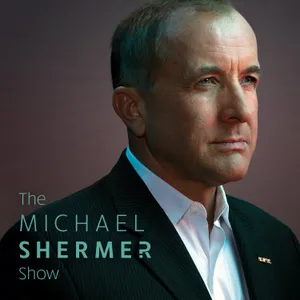
The Michael Shermer Show is a series of long-form conversations between Dr. Michael Shermer and leading scientists, philosophers, historians, scholars, writers and thinkers about the most important issues of our time.
Latest Episodes
The most recent episodes — sign up to get AI-powered summaries of each one.
- 5 days ago1h 29m
Jared Diamond: How Much Can One Person Change History?
Would World War II have happened without Hitler? Would someone else have built Apple without Steve Jobs? Jared Diamond joins Michael Shermer to ask how much history depends on particular people. From Darwin's discoveries to the rise of Christianity, Diamond considers when someone is truly irreplaceable, when someone else would have done much the same thing, and how we can tell the difference. Jared Diamond is the Pulitzer Prize-winning author of the seminal million-copy-bestseller Guns, Germs, and Steel, which was named one of Time magazine's best non-fiction books of all time, Collapse, a No. 1 international bestseller, and The World Until Yesterday, among other books. A professor of geography at UCLA and noted polymath, Diamond's work has been influential in the fields of anthropology, biology, ornithology, ecology and history, among others. His new book is Profits, Prophets, Coaches, and Kings: (When) Do Leaders Matter?
- 1 weeks ago42 min
Why America Failed to Stop 9/11 | Gerald Posner & Michael Shermer
How did 19 hijackers evade the world's most advanced intelligence apparatus despite years of warnings? Twenty-five years after 9/11, journalist Gerald Posner joins Michael Shermer to explain the security failures that left America vulnerable. Those failures, compounded by government secrecy, have helped sustain suspicions that officials orchestrated the attacks or deliberately allowed them to happen. What does the evidence show, and have we learned the right lessons?
- 1 weeks ago1h 45m
Why Be Honest When Cheating Pays?
Most of us think of ourselves as honest. But would we still tell the truth if lying got us what we wanted—and nobody would ever find out? Philosopher Christian Miller joins Michael Shermer to discuss his new book The Honesty Crisis and the uncomfortable gap between having a reputation for honesty and actually being honest. Christian B. Miller is the A.C. Reid Professor of Philosophy at Wake Forest University. He is the author of over 130 articles as well as several books. Thanks to a $4.4 million grant from the John Templeton Foundation, he directed The Honesty Project, one of the largest research initiatives ever undertaken on honesty. His new book is The Honesty Crisis: Preserving Our Most Treasured Virtue in an Increasingly Dishonest World.
- 2 weeks ago1h 23m
Is the Future Unknowable? Uncertainty, Free Will, and the Limits of Science
What if uncertainty isn't a temporary problem science will eventually solve, but a fundamental feature of reality? Neuroscientist Stuart Firestein joins Michael Shermer to make the case that the universe may be far less deterministic—and the future far less predictable—than we like to imagine. Firestein and Shermer discuss chaos and complexity, Darwin and randomness, free will, scientific progress, the replication crisis, COVID and the problem of communicating uncertainty, why humans are so bad at probability, and why even enormous amounts of data can fail to predict individual people or events. Stuart Firestein is a professor of neuroscience at Columbia University and a member of the Santa Fe Institute. He has published over one hundred scientific papers in journals such as Nature, Science, Cell, and Neuron. He is a Guggenheim fellow, a member of the advisory committee for the Alfred P. Sloan Foundation, and an elected fellow of the American Association for the Advancement of Science. His new book is It Could Be Otherwise: Science in the Age of Uncertainty.
- 3 weeks ago1h 13m
Why We Want to Believe in Aliens and Why We Still Haven't Found Them
UFOs were once the stuff of tabloids and conspiracy theories. Today they're the subject of congressional hearings, Pentagon investigations, mainstream news coverage, and a new wave of claims about government cover-ups and alien technology. Adam Kirsch, senior editor at The Atlantic and author of We Want to Believe: How Aliens Went Mainstream and Why It Matters, joins Michael Shermer to ask what changed—and why the idea of extraterrestrial visitors has such a powerful hold on us. They discuss Roswell, UFO "disclosure," eyewitness testimony, government secrecy, alien abductions, Carl Sagan and Contact, the religious impulse behind UFO belief, and the difference between testimony and scientific evidence. The conversation also turns to the serious scientific search for extraterrestrial intelligence: the Fermi paradox, why decades of SETI have found nothing, how rare intelligent life might be, and whether our ideas about aliens ultimately tell us more about ourselves than about anything actually out there. Adam Kirsch is the author of several books of poetry and criticism and a senior editor at The Atlantic. A 2016 Guggenheim Fellow, Kirsch has written for publications including The New Yorker, Slate, The Times Literary Supplement, The New York Times Book Review, Poetry, and Tablet. His new book is We Want to Believe: How Aliens Went Mainstream and Why It Matters.
- Aug 18, 20261h 18m
Is There a Second Arrow of Time? A New Law of Evolution, Information, and Complexity
Why does the universe produce ever more elaborate forms, from atoms and minerals to cells, organisms, brains, technology, and civilization? The familiar laws of physics can explain much of what happens in nature, but Robert Hazen and Michael Wong argue that something important has been missing: a law describing how evolving systems generate and select new forms over time. Michael Shermer speaks with Hazen and Wong about their proposed law of increasing functional information, the central idea behind their new book Time's Second Arrow. They discuss entropy and the second law of thermodynamics, the origin of life, the Cambrian explosion, emergence and complexity, Stephen Jay Gould and evolutionary contingency, whether evolution has a direction, and why the same basic process of variation and selection may apply far beyond biology. Shermer also presses them on what evidence could falsify their theory, whether AI could evolve far faster than biological organisms, and the biggest question of all: Does any of this imply that the universe has a purpose? Robert M. Hazen, a geoscientist at the Carnegie Institution for Science, is the author of Symphony in C, among other titles. Michael L. Wong is a planetary scientist and astrobiologist at the Carnegie Institution for Science.
- Aug 11, 20261h 57m
Why Good People Disagree About Right and Wrong
Why do reasonable people disagree so strongly about right and wrong? And why are we so quick to assume that people on the other side of a moral or political issue are irrational, selfish, ignorant, or simply bad? Michael Shermer speaks with Cornell psychologist Audun Dahl, author of Between Fixed and Fickle: Why Our Moral Views Keep Changing, about how human morality develops and why many familiar explanations fall short. They discuss whether babies are born with a moral sense, what children and other primates can really tell us about the origins of morality, how parents shape their children's values, classic experiments in moral psychology, and whether science can tell us what is right and wrong. The conversation also turns to abortion, competing rights, immigration, religion, and the growing tendency to misunderstand and demonize people who reach different moral conclusions. Audun Dahl is a professor of psychology at Cornell University, where he directs the Developmental Moral Psychology Lab. His research examines how people develop ideas about right and wrong across the lifespan, from infancy through adulthood, and how moral judgments are shaped by everyday social interactions. He is the author of Between Fixed and Fickle: Why Our Moral Views Keep Changing.
- Aug 5, 20261h 22m
Are We Building a God? AI, Superintelligence, and the Coming Singularity
Robert Wright joins Michael Shermer to discuss his new book, The God Test: Artificial Intelligence and Our Coming Cosmic Reckoning, and why he thinks the AI revolution may be moving much faster than most people realize. Wright argues that deep learning is not just a new way of programming computers. In an important sense, it resembles evolution: neural networks discover solutions for themselves, sometimes recreating cognitive functions that natural selection built into human brains. That helps explain why AI capabilities have advanced so quickly, and why increasingly autonomous systems and recursive self-improvement could accelerate the process even further. Shermer presses Wright on what all of this actually means. Does an AI understand what it says? Could it be conscious? Why would a superintelligence ever seek power? Is human extinction a realistic possibility, or science-fiction doomerism? They discuss AI deception and theory of mind, John Searle's Chinese Room, bioweapons and cyberattacks, the risk of a U.S.-China AI arms race, regulation, surveillance, and the growing concentration of power in governments and tech companies. The conversation ends with Wright's larger philosophical question: if humanity really is building something with godlike power, what kind of god are we going to build, and are we mature enough to survive it? Robert Wright is the New York Times bestselling author of The Evolution of God (a finalist for the Pulitzer Prize), Nonzero, The Moral Animal, and Three Scientists and their Gods (a finalist for the National Book Critics Circle Award). He has taught at the University of Pennsylvania and at Princeton University, where he also created the popular online course "Buddhism and Modern Psychology." He is currently Visiting Professor of Science and Religion at Union Theological Seminary in New York.
Get The Michael Shermer Show summaries in your inbox
Free AI-powered daily recaps. Key takeaways, quotes, and mentions — in a 5-minute read.
Get Free Summaries →Free forever for up to 3 podcasts. No credit card required.
You Might Also Like
Listeners also like.

The Jordan Harbinger Show
Conversations with top performers across fields, distilling actionable insights on success, relationships, and personal growth.
Inquiring Minds
Explores the intersection of science and society through critical thinking and in-depth analysis.

TED Tech
Experts examine how technology reshapes society, science, design, and business through ethical, cultural, and human lenses.
The World, the Universe and Us
Explores big scientific questions about life, consciousness, climate, and the cosmos with expert scientists and New Scientist journalists.

Intelligence Squared
Live debates and in-depth discussions on pressing global issues featuring leading experts and thinkers.
Into the Impossible With Brian Keating
Brian Keating explores profound scientific and philosophical questions with leading thinkers in physics, technology, and beyond.

CSPI Podcast
Conversations with CSPI scholars and experts on topics in science, technology, and politics.

The Great Simplification with Nate Hagens
Discussions with experts on energy, ecology, economics, and human behavior to understand the systemic challenges facing civilization.

Something You Should Know
Explores practical wisdom and expert insights to help listeners improve their lives, careers, and relationships.

Science Friday
Explores diverse science and technology topics, from space to microscopic life, with engaging educational stories.

EconTalk
Long-form conversations on economics, philosophy, history, and human behavior with experts from diverse fields.
Inner Cosmos with David Eagleman
Neuroscientist David Eagleman examines how the brain interprets reality through science, stories, and interviews.
About The Michael Shermer Show
The Michael Shermer Show is a series of long-form conversations between Dr. Michael Shermer and leading scientists, philosophers, historians, scholars, writers and thinkers about the most important issues of our time.
Customized Recaps
AI-powered recaps with compact key takeaways, quotes, and insights.
Straight to Your Inbox
Get key takeaways from The Michael Shermer Show in a 5-minute read.
Save Hours Every Week
Stay current on your favorite podcasts without falling behind.
Frequently Asked Questions
What is Podzilla's The Michael Shermer Show daily summary?
It's a free AI-powered email that summarizes new episodes of The Michael Shermer Show as soon as they're published. You get the key takeaways, notable quotes, and links & mentions — all in a quick read.
How does the The Michael Shermer Show podcast summary work?
When a new episode drops, our AI transcribes and analyzes it, then generates a personalized summary tailored to your interests and profession. It's delivered to your inbox every morning.
Is this an official The Michael Shermer Show product?
No. Podzilla is an independent service that summarizes publicly available podcast content. We're not affiliated with or endorsed by Michael Shermer.
Can I get summaries of other podcasts too?
Absolutely! The free plan covers up to 3 podcasts. Upgrade to Pro for 15, or Premium for 50. Browse our full catalog at /podcasts.
How often does The Michael Shermer Show release new episodes?
The Michael Shermer Show publishes weekly. Our AI generates a summary within hours of each new episode.
What topics does The Michael Shermer Show cover?
The Michael Shermer Show covers topics including Science, Natural Sciences. Our AI identifies the specific themes in each episode and highlights what matters most to you.
Start getting The Michael Shermer Show summaries tomorrow morning.
Free forever for up to 3 podcasts. No credit card required.
Free forever for up to 3 podcasts. No credit card required.