Free Daily Podcast Summary
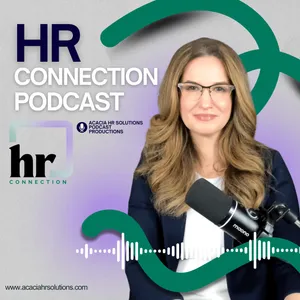
The HR Connection Podcast with Sabrina Baker: Daily Summaries Delivered
by Sabrina Baker
The HR Connection Podcast with Sabrina Baker and Marie Rolston is your go-to resource for all things HR in the small business world. This podcast is designed especially for those wearing multiple hats—whether you’re the only HR person at your company, a business owner figuring out HR as you go, or someone who just got handed the HR file and a wish for good luck. Typically designed for those managing HR in a 1-500 headcount firm, although we often talk about navigating life in the less than 100 space because we know that is the space where the most nuance, and most chaos, exists. Each episode will bring real talk (no corporate fluff), practical advice, and helpful insights from Sabrina and Marie, and occasionally other members of the Acacia team who truly understand the ups and downs of HR in companies with 1 to 500 employees because they are doing the work every single day.Think of it as your HR support system. One that actually gets what it’s like to do this
Latest Episodes
The most recent episodes — sign up to get AI-powered summaries of each one.
- 3 weeks ago13 min
The Next Chapter: Moving HR Connection to the HR Happy Hour Network
In this brief transition episode, Sabrina announces a major milestone for The HR Connection. Effective today, our weekly podcast release schedule is wrapping up as we prepare to launch exclusively as a monthly spotlight show on the HR Happy Hour Network. Listen in to discover why we are shifting to a monthly cadence, what this means for our content depth and strategic frameworks, and how to stay connected with our bi-weekly YouTube teardowns and LinkedIn case studies. Key Takeaways The Big Transition: The HR Connection is moving from a weekly self-published podcast to a featured monthly show on the HR Happy Hour Network. Why the Shift? Moving to the longest-running, most listened-to network in HR tech allows us to prioritize high-impact executive interviews, deep-dive teardowns, and strategic alignment frameworks over weekly noise. Mark Your Calendar: Our next episodes on the HR Happy Hour Network drop August 28th and September 26th. Continuous Content: Even with a monthly podcast schedule, weekly frameworks and deep-dive video teardowns will continue bi-weekly on YouTube and personal LinkedIn feeds. Links & Resources Mentioned Subscribe to the HR Happy Hour Network: https://www.hrhappyhour.net/ Connect on LinkedIn: https://www.linkedin/in/sabrinabaker Subscribe on YouTube: https://www.youtube.com/@AcaciaHRSolutions Executive Resources & Diagnostic Tools: https://www.acaciahrsolutions.com/resources
- Aug 5, 202627 min
The Exit Interview No One's Reading
Sabrina compares two clients with identical size (25-40 employees) and identical turnover (1-3 departures per quarter). One has a climbing engagement score. The other has been flat or dropping for two years. Same exit interview process, same data collected. The difference is what happens to the data after it's gathered. Three questions determine whether an exit interview process functions or is just a habit: Are people telling you the truth? Format drives honesty — face-to-face over forms, matched to the right interviewer, in an environment where past honesty was treated as safe rather than punished. Is the data reaching decision makers in a way that lands? Written reports get skimmed. Face-to-face delivery forces a reaction in the room and surfaces the defensiveness that kills follow-through before it starts. Has anything ever changed? The single diagnostic question: when's the last time something was changed because of exit interview data? Cumulative patterns drive real change — one person's feedback is an anecdote, three people saying the same thing is a finding. Sabrina closes with a real example: six of seven exit interviews at one client cited the same PTO approval friction. The company fixed the process. The complaint stopped showing up in exit interviews. Run the three-question audit on your last five exit interviews in under ten minutes.
- Jul 29, 202623 min
3 Reasons I Stopped Going to HR Conferences
Sabrina Baker, founder and CEO of Acacia HR Solutions, breaks down why she stepped back from major HR conferences after years attending as an attendee, speaker, blogger, and conference organizer, and what she recommends instead for HR practitioners in the 1-500 employee range. Segments: Sabrina's conference background: attendee, blogger/"blog squad," speaker, and multi-year co-chair of the Illinois SHRM conference Reason 1: Content mismatch. Enterprise-level frameworks assume budget and headcount most small businesses don't have. "HR department of one" tracks often don't reflect day-to-day small business realities. Reason 2: Networking mismatch. High cost of major conferences prices out small business peers, leaving attendees without like-minded practitioners to connect with. Reason 3: ROI mismatch. Time out of office and unpaid travel costs weighed against content that isn't immediately usable. What Sabrina uses instead: content curated for small business, local HR groups, law firm and Chamber of Commerce content, and peer podcasts Close: a filter to run conference budget through before committing, and alternatives (webinars, one-on-one coaching, local HR group memberships) worth considering instead Questions or topic ideas for the show: hello@acaciahrsolutions.com
- Jul 22, 202626 min
The Tool Often Dismissed That Changed How My Teams Communicate
Most organizations hire, manage, and develop based on skill set alone and ignore the other half of every person: personality. In a team of five hundred, that gap gets absorbed. In a team of twelve, it becomes the culture. Sabrina is certified in Myers-Briggs and Hogan. In this episode she addresses the science objection directly, then walks through the four ways ignoring personality damages small teams and the one shift that fixes all four. What's covered: The objection — Personality typing isn't backed by strong validity research, and Sabrina doesn't use it for scientific purposes. She uses it because of what she's watched happen in fifteen years of workshops: people understanding why they do what they do, and why the person next to them does too. Leaders manage from their own type — The default operating mode of whoever's in charge becomes the entire system in a small business. Employees who don't match it aren't underperforming. They're working uphill against a bias nobody has named. Preference gets misread as performance — The employee who says "let me think about that" isn't unprepared. They're an introvert doing exactly what they need to do to give a good answer. Missed pairings — A real example from Sabrina's own leadership team: two directors, exact personality opposites, now one of her strongest duos once they understood how to cover each other's blind spots. Forced-preference burnout — Every person has a way of working that costs the least energy and produces the best output. Default to one operating mode for everyone, and the people who don't match it burn out — not from the work, from working against their wiring all day. The fix — Common language. A shared vocabulary that lets people explain themselves instead of getting managed as a mystery. Includes the Sheldon Cooper / Andy Dwyer framework Sabrina uses in live workshops to make the stakes concrete.
- Jul 15, 202624 min
The Termination I Handled Correctly That Still Ended in a Lawsuit.
Sabrina walks through a real case: a role elimination executed while the employee was on paternity leave. Every step was legally defensible. He sued anyway. The client settled, not because they were wrong, but because trial risk on a paternity-leave termination isn't worth the exposure regardless of the underlying facts. What this episode covers: The timing decision: execute during leave or wait for return, and the reasoning behind choosing to act during leave The documentation gap: redundancy analysis completed before the leave, elimination decision finalized after it began, and why that gap is exactly where plaintiff's attorneys plant their flag Aligning internal and external narrative: why what you tell the team has to match what you can defend legally Severance negotiation as signal: what it means when someone negotiates terms up, then doesn't sign or take the money Why the client settled despite strong documentation, and what "settlement isn't an admission" actually means in practice Three real lessons: separate analysis timeline from decision timeline in writing, document decisions in real time rather than after the process wraps, and treat any leave-adjacent termination as litigation-probable from day one Not legal advice. Consult employment counsel before executing any termination involving protected leave.
- Jul 8, 202631 min
Onboarding in a Small Business: How to Make It Work When Nobody Has Time
Onboarding fails in small businesses not because no one cares but because no one owns it. This episode walks through a complete onboarding framework built for the 1–500 environment: fewer systems, less redundancy, managers executing on instinct rather than process. Covers every phase from offer acceptance through the first 30 days, and closes on the distinction that matters most, what the manager executes versus what HR owns. What's Covered Why onboarding breaks differently in small business and the ROI framing to use with leadership The three jobs of onboarding: productivity, clarity, and reducing avoidable early exits Pre-boarding: the window between offer acceptance and day one that most organizations waste Equipment and access provisioning: the most common first-day failure and how to prevent it The manager welcome email and buddy introduction that should arrive before day one First day structure: the 30-minute conversation that sets the tone for everything that follows The buddy role: what it is, what it is not, and why an open-door policy does not replace it First 30 days: role clarity, scheduled check-ins, relevant training, and early correction The skills framework: knowing by role what gets trained at 30, 60, and 90 days What HR owns in the onboarding process: consistency, compliance, documentation, repeatability Resources Mentioned Companion YouTube video: The First Week — for founders and CEOs HR Connection documentation episode
- Jul 1, 202639 min
What Happens to HR When the Owner Is the Problem
This episode started with a LinkedIn message. A practitioner at a 75-person firm, HR department of one, had been listening to episodes on toxic employees and sacred cows, and she asked the question nobody wants to ask out loud: what do you do when the toxic person is the founder? That question is what this episode is built around. Not how to manage up. Not how to influence without authority. What to actually do when the person creating the problem is the person at the top, with no one above them to escalate to. Referenced Episodes HR Happy Hour Network: Sacred Cows CEO vs. founder framing and language "HR Can't Fix What Leadership Won't Own" Connect Questions, topic ideas, or your own experience navigating this situation: DM Sabrina on LinkedIn or leave a comment when the episode is posted. hello@acaciahrsolutions.com
- Jun 24, 202644 min
Running HR Without Backup - What Actually Works
If you're managing HR alone for 100, 150, or more employees, you already know the standard advice about time management doesn't apply to you. The problem isn't how you manage your hours. It's how you classify the work coming at you. In this episode, Sabrina breaks down the operating system Acacia uses to run high-volume HR work without burning out; a triage framework, a method for separating templatable work from judgment work, and a structural approach to time that protects capacity for what actually matters.
About The HR Connection Podcast with Sabrina Baker
The HR Connection Podcast with Sabrina Baker and Marie Rolston is your go-to resource for all things HR in the small business world. This podcast is designed especially for those wearing multiple hats—whether you’re the only HR person at your company, a business owner figuring out HR as you go, or someone who just got handed the HR file and a wish for good luck. Typically designed for those managing HR in a 1-500 headcount firm, although we often talk about navigating life in the less than 100 space because we know that is the space where the most nuance, and most chaos, exists. Each episode will bring real talk (no corporate fluff), practical advice, and helpful insights from Sabrina and Marie, and occasionally other members of the Acacia team who truly understand the ups and downs of HR in companies with 1 to 500 employees because they are doing the work every single day.Think of it as your HR support system. One that actually gets what it’s like to do this
Customized Recaps
AI-powered recaps with compact key takeaways, quotes, and insights.
Straight to Your Inbox
Get key takeaways from The HR Connection Podcast with Sabrina Baker in a 5-minute read.
Save Hours Every Week
Stay current on your favorite podcasts without falling behind.
Frequently Asked Questions
What is Podzilla's The HR Connection Podcast with Sabrina Baker daily summary?
It's a free AI-powered email that summarizes new episodes of The HR Connection Podcast with Sabrina Baker as soon as they're published. You get the key takeaways, notable quotes, and links & mentions — all in a quick read.
How does the The HR Connection Podcast with Sabrina Baker podcast summary work?
When a new episode drops, our AI transcribes and analyzes it, then generates a personalized summary tailored to your interests and profession. It's delivered to your inbox every morning.
Is this an official The HR Connection Podcast with Sabrina Baker product?
No. Podzilla is an independent service that summarizes publicly available podcast content. We're not affiliated with or endorsed by Sabrina Baker.
Can I get summaries of other podcasts too?
Absolutely! The free plan covers up to 3 podcasts. Upgrade to Pro for 15, or Premium for 50. Browse our full catalog at /podcasts.
How often does The HR Connection Podcast with Sabrina Baker release new episodes?
The HR Connection Podcast with Sabrina Baker publishes weekly. Our AI generates a summary within hours of each new episode.
What topics does The HR Connection Podcast with Sabrina Baker cover?
The HR Connection Podcast with Sabrina Baker covers topics including Business, Careers. Our AI identifies the specific themes in each episode and highlights what matters most to you.
Start getting The HR Connection Podcast with Sabrina Baker summaries tomorrow morning.
Free forever for up to 3 podcasts. No credit card required.
Free forever for up to 3 podcasts. No credit card required.