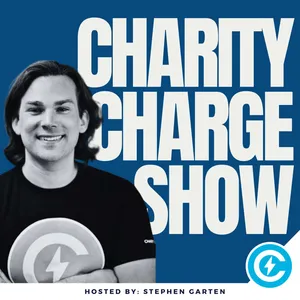
Free Daily Podcast Summary
The Charity Charge Show - Nonprofit Podcast: Daily Summaries Delivered
by Charity Charge
The Charity Charge Show features candid conversations with nonprofit executives, founders, and social impact leaders about what it actually takes to run a mission-driven organization: funding, operations, leadership, and the lessons nobody puts in the annual report. The show is hosted by Stephen Garten, founder and CEO of Charity Charge, a Public Benefit Corporation founded in 2015 in Austin, Texas. Charity Charge provides financial tools built exclusively for nonprofits, including a credit card underwritten to the organization's EIN with no personal guarantee and no annual fee. More than 3,000 nonprofits have used Charity Charge to manage their spending.
Latest Episodes
The most recent episodes — sign up to get AI-powered summaries of each one.
- 6 days ago29 min
Project Sanctuary, Why Collaboration Beats Competition in the Nonprofit World
Most nonprofits are taught to think of every other organization in their space as competition for the same limited pool of donors. Heather Ray, founder and CEO of Project Sanctuary, and her colleague Catherine Ganley say that mindset is exactly backwards, and it may be one reason so many organizations struggle to grow past their first few years. On a recent episode of the Charity Charge Show, they explained how a collaboration-first approach, paired with a genuinely specific niche, has kept Project Sanctuary operating for close to 20 years.Project Sanctuary provides therapeutic retreats and up to two years of follow-on support for military, veteran, and first responder families, treating the whole family unit rather than just the service member. Ray started the organization after recognizing that veterans returning home were getting help while their families were not, leaving a gap that no other organization at the time was filling.
- 1 weeks ago41 min
HawkWatch International, 40 Years of Raptor Data, Diversified Revenue, and Donor Loyalty
Most nonprofits that fold don't fail because the mission stopped mattering. They fail because 80% of the budget sat on top of one grant, one donor, or one contract, and that one thing disappeared. HawkWatch International has avoided that trap for 40 years, and CEO Nikki Wayment says the fix is not complicated: stop putting all your eggs in one basket, and start treating every donor relationship like it's worth building for a decade, not a campaign.HawkWatch is a Utah-based raptor conservation nonprofit built on migration research. It has weathered four decades of funding cycles, a pandemic, and the kind of donor fatigue that hits every cause-based organization eventually. On a recent episode of the Charity Charge Show, Wayment walked through exactly how the organization has stayed financially sound long enough to reach its 40th anniversary, and the lessons apply well beyond conservation work.Quick SummaryHawkWatch International has operated for 40 years by continually adding new, uncorrelated revenue sources instead of depending on one.Personal donor stewardship (handwritten notes, thank you calls with no ask attached) converted a $50 a year donor into a $250,000 estate gift.Only about 5% of most people's net worth sits in cash, which means nonprofits that only ask for checks are missing the other 95% of what donors could give.A 16 acre property gift and a corporate card built for nonprofit cash flow both show up in the episode as the kind of unplanned, unconventional support that keeps a mission-driven organization solvent.
- 2 weeks ago36 min
Roughly 697 million people worldwide lack basic access to safe water - Dave LeVan, CEO of Water for Good
On this episode of the Charity Charge Show, host Stephen Garten sits down with Dave LeVan, CEO of Water for Good, to talk about how a faith-based water nonprofit doubled its reach without doubling its budget. The conversation covers mergers, decentralization, technology, fundraising, and a mindset shift that most nonprofit leaders never make. Charity Charge builds financial tools for the 501(c)(3) organizations doing exactly this kind of work, which is why these operator-to-operator conversations sit at the center of the show.Quick SummaryWater for Good delivers water, sanitation, and hygiene (WASH) programs in some of the hardest-to-reach communities in sub-Saharan Africa and Cambodia.Its three-year "Healthy Village" model has kept 92% of water points flowing and cut childhood diarrhea by 90% over the past decade, per LeVan.The organization moved roughly 90% of its 280 staff in-country and gave frontline teams live data, which flattened the hierarchy and reduced burnout.Water for Good was formed by merging two healthy nonprofits, a rare move that let each contribute its strengths instead of hiring to fill gaps.LeVan's north star: solve the problem and put the organization out of business, not protect it.Who is Dave LeVan?Dave LeVan is the CEO of Water for Good, a faith-based nonprofit that transforms lives through access to safe water, improved sanitation, and hygiene. The organization works in difficult places, including the Central African Republic, Ethiopia, Tanzania, Uganda, and Cambodia. LeVan spent most of his career in the for-profit world, including a transformation role at Walmart, before joining the organization first as a donor, then a board member, then chief executive.How big is the global water access problem?Roughly 697 million people worldwide lack basic access to safe water, meaning they cannot collect it and get home within 30 minutes, the World Health Organization's threshold for basic access. LeVan's figure aligns with the WHO/UNICEF Joint Monitoring Programme's 2025 estimates, which show more than two billion people without safely managed drinking water and hundreds of millions still relying on unsafe or unimproved sources.Beyond the raw count, LeVan describes a second, hidden cost: women and children spend an estimated 100 million hours a day walking for water. The problem is twofold, he explains: the time it consumes and the fact that the source at the end of the walk is usually unsafe.
- 3 weeks ago22 min
How the National Basketball Players Association Foundation Rethinks Player Giving - Erika Swilley Executive Director - NBPA Foundation
On this episode of the Charity Charge Show, host Grayson Harris sits down with Erika Swilley, Executive Director of the NBPA Foundation, the philanthropic arm of the National Basketball Players Association. Swilley explains how the foundation turns NBA player fines into matching grants. Her core message applies to any nonprofit leader: intent is not enough, and lasting impact comes from focus, not volume.About the guest. Erika Swilley has spent more than two decades in sports philanthropy, including senior community and social responsibility roles with the Detroit Pistons, Golden State Warriors, and Chicago Sky. She now leads the NBPA Foundation, where she created the Fined and Philanthropic campaign and advises active and retired players on building genuine, durable community impact.Quick SummaryThe NBPA Foundation funds much of its work through pooled player fines, then matches player donations up to $25,000 a year for active players and $15,000 for many retired players.The Fined and Philanthropic campaign educates players, agents, and families on where fine money goes and how to tap the match.Swilley pushes players away from one-off events like turkey drives and toward year-round, focused giving that builds a legacy.Most young players are steered away from starting their own foundation and toward donor-advised funds, fiscal sponsors, or established nonprofits.Nonprofits can connect with the foundation through its website or LinkedIn to be considered for player partnerships.Inside the NBPA Foundation: how player fines fund community workThe NBPA Foundation is a nonprofit that channels NBA player fine money into community programming led by the players themselves. When players receive technical fouls or ejections, those fines are pooled and, at the end of the season, split between NBA Cares and the foundation.The foundation then reinvests those dollars through a matching grant program that has existed since 2015. Engagement has climbed sharply under Swilley, who describes the model as non-traditional because so much of the funding starts as penalties. In the 2025 offseason, the NBPA reported distributing roughly $1.6 million in matching grants from fine money.Player statusAnnual matching grant capActive players | Up to $25,000 per yearEligible retired players | Up to $15,000 per yearFined and Philanthropic: turning penalties into purposeFined and Philanthropic is the campaign Swilley created to show players exactly where their fine money goes and how to put it to work. Many players assumed their fines vanished into a black hole with no idea the money funded community programs they could tap.The campaign uses simple, memorable touches, including hats that tell players where their fine dollars land. The goal is awareness across the full circle around a player, meaning agents, family members, and team staff. Swilley spent 19 years on the team side without knowing these resources existed, so she built the campaign to close that exact gap.
- Jul 30, 202639 min
How to Combat Drunk Driving: Insights from Mothers Against Drunk Driving
In this episode, nonprofit leader Stacey Davis Stewart discusses the impactful work of Mothers Against Drunk Driving (MAD), its history, legislative successes, and future initiatives to prevent impaired driving and save lives.
- Jul 15, 202642 min
Innovating Food Security: Inside the Regional Food Bank of NE NY with Tom Nardacci
Food insecurity is rising even as household budgets stretch thinner, and food banks have become core infrastructure for hundreds of thousands of families. On this episode of the Charity Charge Show, Tom Nardacci, CEO of the Regional Food Bank of Northeastern New York, breaks down how his organization feeds roughly 350,000 people each month across 23 counties, and what nonprofit executives can learn from how he runs it. The conversation covers local food sourcing, leadership lessons from the for-profit world, and how to build funding resilience when federal support is unpredictable.Quick SummaryThe Regional Food Bank of Northeastern New York distributes about 50 million pounds of food annually through nearly 1,000 partner agencies across 23 counties.Its Agricultural Hub initiative connects local farms directly to food pantries, with a goal of growing farm and produce distribution to 30 million pounds per year.Nardacci applies for-profit team-building and accountability practices to nonprofit operations, treating the food bank like a logistics company.Funding volatility, especially around SNAP, makes diversified revenue and strong funder relationships essential for any nonprofit.About the Guest: Tom NardacciTom Nardacci has served as CEO of the Regional Food Bank of Northeastern New York since August 2023. Before moving into nonprofit leadership, he founded and ran Gramercy Communications, a public relations firm he led for more than 15 years, and launched the Troy Innovation Garage, a business incubator in the Capital Region.His connection to food access runs deep. His grandparents operated Nardacci's Broadway Food Mart in Rensselaer, New York for 50 years, and he grew up watching them quietly feed neighbors who could not always pay. Today he leads one of the oldest food banks in the country, an organization that operates like a major grocery wholesaler with a fleet of trucks, warehouse operations, and thousands of volunteers.
- Jun 4, 202620 min
Unlocking Play: How Volo Kids is Bringing Youth Sports to Thousands of Kids w/Jen Rifkin
In the social impact sector, scaling an organization nationally while maintaining deep community trust is one of the hardest balancing acts to pull off. It requires an unshakeable operational foundation, a clear mission, and creative revenue models that move beyond traditional grant dependency.In this episode of the Charity Charge Show, host Grayson Harris sits down with Jen Rifkin, Executive Director of the Volo Kids Foundation, an organization dedicated to removing economic, gender, and racial barriers to youth sports. Jen shares her inspiring journey from volunteer coach to national executive leader, breaking down the operational "special sauce" behind their 12-state expansion. She also reveals how their unique, symbiotic partnership with a for-profit adult sports league offers a brilliant blueprint for sustainable nonprofit funding.Show Notes: Key TakeawaysBuild a Replicable Operational Formula: Rapidly scaling a national footprint requires a standardized core program structure—what Jen calls a "cookie-cutter" framework—that can be easily deployed anywhere while leaving room for local market adaptation.Leverage Hybrid Corporate Partnerships: Volo Kids sustains its growth through a powerful relationship with Volo Sports, a for-profit adult leagues provider. Guided by the slogan "We play so the kids play free," a portion of adult registration revenue offsets the foundation's core operational costs, allowing donor and grant funds to go directly to youth programming.Move at the Speed of Community Trust: Entering a new city shouldn't involve a prescriptive "we know what's best" mentality. Lasting impact is built by attending local neighborhood meetings, listening to schools, and collaborating with local municipalities to fill genuine gaps.Prioritize Relational Fundraising over Transactional Grants: In a hyper-competitive funding climate where grant dollars are stretched thin, organic word-of-mouth advocacy from volunteers, coaches, and corporate partners remains the most effective tool for unlocking new donor relationships.
- May 20, 202627 min
From Acquisition to Adoption: How TechSoup and GTIA Are Empowering Nonprofits Through AI
In the social impact sector, being "scrappy" is often badge of honor. Nonprofits routinely stretch every dollar to ensure maximum funding goes directly to their programs. However, when it comes to technology, this efficiency-first mindset can accidentally lead to underinvestment, disjointed tools, and missed opportunities.On a recent episode of the Charity Charge Show, host Grayson Harris sat down with Adam Eads, Director at TechSoup, and Kelly Ricker, Chief Operating Officer at the Global Technology Association for IT Channel Leaders (GTIA). They discussed a powerful new grant collaboration designed to change the narrative around nonprofit technology. By funding the enrollment of 100 new organizations into the TechSoup Plus platform, GTIA and TechSoup are helping social entrepreneurs bridge the gap between simply having access to software and truly adopting it—with a specific focus on navigating the rapidly changing landscape of Artificial Intelligence (AI).Key TakeawaysAcquisition vs. Adoption: Securing a software discount is only step one. True digital transformation requires ongoing education to help staff effectively integrate and use those tools to advance their mission.The 1% Philanthropy Gap: Less than 1% of global philanthropic funding is currently directed toward technology. Foundations must begin viewing operational tech investments as essential infrastructure rather than compliance-heavy "overhead."AI is a Mindset Shift, Not an IT Problem: Successfully implementing AI isn't about transforming nonprofit leaders into computer scientists. It is a change-management exercise focused on small, daily operational wins that free up time for community work.Choose-Your-Own-Adventure Learning: Because every nonprofit operates at a different stage of digital maturity, technology training cannot be one-size-fits-all. It must be modular, bite-sized, and meted out exactly where the organization stands.
Get The Charity Charge Show - Nonprofit Podcast summaries in your inbox
Free AI-powered daily recaps. Key takeaways, quotes, and mentions — in a 5-minute read.
Get Free Summaries →Free forever for up to 3 podcasts. No credit card required.
You Might Also Like
Listeners also like.
Nonprofit Hub Radio
Interviews with nonprofit leaders and experts offering practical insights to help organizations improve and grow.
Nonprofit Everything
A bi-weekly Q&A podcast covering topics related to nonprofits.

Proven Podcast
Charles Schwartz

Impact Podcast, Mentorship with Eddie Wilson
A seasoned entrepreneur shares insights on building businesses, leadership, and living with purpose to create meaningful impact.

Founder's Story
Real founders share raw stories of building, scaling, and leading companies, revealing the grit and purpose behind entrepreneurial success.
How Leaders Lead with David Novak
Conversations with top leaders in business, sports, and entertainment reveal actionable insights on leadership and decision-making.

Hacks and Hobbies with Junaid Ahmed
Creators and entrepreneurs discuss turning hobbies into income through podcasting, content, and personal branding.
Mick Unplugged
A leadership podcast exploring the deep personal motivations behind high achievers’ success by asking what drives them at their core.

Walk-In Talk Podcast
Raw conversations with food industry professionals about restaurant operations, culinary leadership, and the business of hospitality.

American Potential
Stories of ordinary Americans driving change in their communities through grassroots action and policy advocacy.

The Entrepreneur DNA
Entrepreneurs share lessons on building businesses and personal growth through real experiences and mistakes.
The Curiosity Shop with Brené Brown and Adam Grant
Brené Brown and Adam Grant explore boldness amid uncertainty through research, debate, and dialogue in a six-episode series.
About The Charity Charge Show - Nonprofit Podcast
The Charity Charge Show features candid conversations with nonprofit executives, founders, and social impact leaders about what it actually takes to run a mission-driven organization: funding, operations, leadership, and the lessons nobody puts in the annual report. The show is hosted by Stephen Garten, founder and CEO of Charity Charge, a Public Benefit Corporation founded in 2015 in Austin, Texas. Charity Charge provides financial tools built exclusively for nonprofits, including a credit card underwritten to the organization's EIN with no personal guarantee and no annual fee. More than 3,000 nonprofits have used Charity Charge to manage their spending.
Customized Recaps
AI-powered recaps with compact key takeaways, quotes, and insights.
Straight to Your Inbox
Get key takeaways from The Charity Charge Show - Nonprofit Podcast in a 5-minute read.
Save Hours Every Week
Stay current on your favorite podcasts without falling behind.
Frequently Asked Questions
What is Podzilla's The Charity Charge Show - Nonprofit Podcast daily summary?
It's a free AI-powered email that summarizes new episodes of The Charity Charge Show - Nonprofit Podcast as soon as they're published. You get the key takeaways, notable quotes, and links & mentions — all in a quick read.
How does the The Charity Charge Show - Nonprofit Podcast podcast summary work?
When a new episode drops, our AI transcribes and analyzes it, then generates a personalized summary tailored to your interests and profession. It's delivered to your inbox every morning.
Is this an official The Charity Charge Show - Nonprofit Podcast product?
No. Podzilla is an independent service that summarizes publicly available podcast content. We're not affiliated with or endorsed by Charity Charge.
Can I get summaries of other podcasts too?
Absolutely! The free plan covers up to 3 podcasts. Upgrade to Pro for 15, or Premium for 50. Browse our full catalog at /podcasts.
How often does The Charity Charge Show - Nonprofit Podcast release new episodes?
The Charity Charge Show - Nonprofit Podcast publishes weekly. Our AI generates a summary within hours of each new episode.
What topics does The Charity Charge Show - Nonprofit Podcast cover?
The Charity Charge Show - Nonprofit Podcast covers topics including Business, Non-Profit. Our AI identifies the specific themes in each episode and highlights what matters most to you.
Start getting The Charity Charge Show - Nonprofit Podcast summaries tomorrow morning.
Free forever for up to 3 podcasts. No credit card required.
Free forever for up to 3 podcasts. No credit card required.