Free Daily Podcast Summary
The AI Concepts Podcast: Daily Summaries Delivered
by Sheetal ’Shay’ Dhar
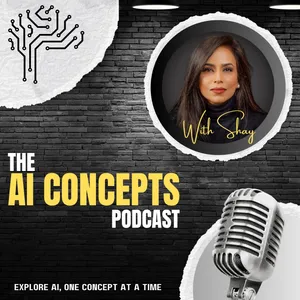
The AI Concepts Podcast is my attempt to turn the complex world of artificial intelligence into bite-sized, easy-to-digest episodes. Imagine a space where you can pick any AI topic and immediately grasp it, like flipping through an Audio Lexicon - but even better! Using vivid analogies and storytelling, I guide you through intricate ideas, helping you create mental images that stick. Whether you’re a tech enthusiast, business leader, technologist or just curious, my episodes bridge the gap between cutting-edge AI and everyday understanding. Dive in and let your imagination bring these concepts to life!
Latest Episodes
The most recent episodes — sign up to get AI-powered summaries of each one.
- 1 weeks ago13 min
Module 7: Building an LLM Application End to End
In this episode, we bring everything together by following one LLM application from the user's first request to the final response. We see retrieval, context, tools, model calls, state, memory and orchestration working as one system, revealing the bigger lesson of the module: building with LLMs is not just about what the model can do, but deciding what the model should do and what the rest of the application should handle.
- 1 weeks ago7 min
Module 7: Building LLM Applications | LangChain, LangGraph, LlamaIndex and the LLM Application Stack
In this episode, we map the modern LLM application stack and explore where frameworks, SDKs, runtimes and protocols actually fit. We look at how tools like LangChain, LangGraph, LlamaIndex, provider SDKs, durable workflows and MCP solve different problems, and why understanding the architecture matters more than memorizing product names.
- 2 weeks ago13 min
Module 7: Building LLM Applications | State and Memory: How Does an LLM Application Remember?
This episode separates two concepts that are often confused: state, which keeps track of what is happening now, and memory, which allows information from the past to become useful later. We explore how applications create continuity around a model, and why good memory is not about remembering everything, but remembering the right things at the right time.
- 2 weeks ago12 min
Module 7: Building LLM Applications | What Does Orchestration Actually Mean?
This episode breaks down what orchestration actually means, from sequencing and routing to retries, parallel execution and human approvals, and explores the different ways those flows can be managed. Most importantly, we separate orchestration from the model itself and show why it is really about controlling how work moves through an application.
- Aug 21, 202610 min
Module 7: The LLM Application Loop
Who actually decides what happens next inside an LLM application? This episode explores the difference between decisions made by code and decisions made by the model, and why real applications often use both. We follow the loop that emerges when a model can request information or actions, receive the results and decide what to do next, revealing what developers mean when they talk about “owning the loop” and setting the stage for orchestration.
- Aug 19, 202610 min
Module 7: Why Do We Need LLM Frameworks?
If LLM applications can be built with regular code and APIs, why do frameworks exist at all? This episode explores what happens as a simple application grows and starts needing retrieval, memory, routing, multiple models, retries and tracing. We look at what frameworks actually take off the developer’s plate, when those abstractions become useful, and why sometimes plain code is still the better choice.
- Aug 19, 202610 min
Module 7: Building LLM Applications | What Is an LLM Application, Really?
What actually sits behind an LLM application? This episode takes one simple request and follows it beneath the surface, revealing how the model, application code, APIs, external data and context work together to produce something genuinely useful. As the request gets more complex, we begin to see why concepts like memory, tools and orchestration enter the picture. It is a practical look at what we are really building when we say we are building with LLMs.
- Jun 12, 20268 min
Module 6: RAG | Long Context vs RAG - Do You Still Need Retrieval at All
This episode closes out Module 6 by tackling the question that has been getting louder since large context windows arrived. If a model can hold hundreds of thousands or even millions of tokens at once, do we still need all the architecture we just spent this module building? We explore why RAG was never just about fitting text into a small prompt, what retrieval is actually doing that a large context window cannot, and how the shift from compression to curation changes what good RAG looks like today. We cover when long context is genuinely the better tool, when retrieval still matters deeply, and why in most real enterprise systems the best answer is both working together. The episode closes with the argument that RAG is not disappearing. It is maturing. And everything we built in this module is part of that stronger foundation. By the end you will have a clear and honest picture of where these two approaches fit, and why understanding both puts you well ahead of most people working in this space.
About The AI Concepts Podcast
The AI Concepts Podcast is my attempt to turn the complex world of artificial intelligence into bite-sized, easy-to-digest episodes. Imagine a space where you can pick any AI topic and immediately grasp it, like flipping through an Audio Lexicon - but even better! Using vivid analogies and storytelling, I guide you through intricate ideas, helping you create mental images that stick. Whether you’re a tech enthusiast, business leader, technologist or just curious, my episodes bridge the gap between cutting-edge AI and everyday understanding. Dive in and let your imagination bring these concepts to life!
Customized Recaps
AI-powered recaps with compact key takeaways, quotes, and insights.
Straight to Your Inbox
Get key takeaways from The AI Concepts Podcast in a 5-minute read.
Save Hours Every Week
Stay current on your favorite podcasts without falling behind.
Frequently Asked Questions
What is Podzilla's The AI Concepts Podcast daily summary?
It's a free AI-powered email that summarizes new episodes of The AI Concepts Podcast as soon as they're published. You get the key takeaways, notable quotes, and links & mentions — all in a quick read.
How does the The AI Concepts Podcast podcast summary work?
When a new episode drops, our AI transcribes and analyzes it, then generates a personalized summary tailored to your interests and profession. It's delivered to your inbox every morning.
Is this an official The AI Concepts Podcast product?
No. Podzilla is an independent service that summarizes publicly available podcast content. We're not affiliated with or endorsed by Sheetal ’Shay’ Dhar.
Can I get summaries of other podcasts too?
Absolutely! The free plan covers up to 3 podcasts. Upgrade to Pro for 15, or Premium for 50. Browse our full catalog at /podcasts.
How often does The AI Concepts Podcast release new episodes?
The AI Concepts Podcast publishes daily. Our AI generates a summary within hours of each new episode.
What topics does The AI Concepts Podcast cover?
The AI Concepts Podcast covers topics including Science, Technology, Education, Courses. Our AI identifies the specific themes in each episode and highlights what matters most to you.
Start getting The AI Concepts Podcast summaries tomorrow morning.
Free forever for up to 3 podcasts. No credit card required.
Free forever for up to 3 podcasts. No credit card required.