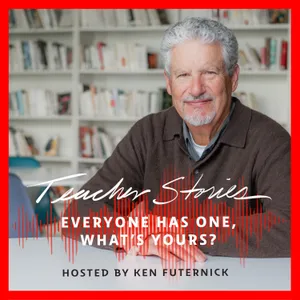
Free Daily Podcast Summary
Teacher Stories: Daily Summaries Delivered
by Teacher Stories
Get key takeaways, quotes, and insights from Teacher Stories in a 5-minute read. Delivered straight to your inbox.
Latest Episodes
The most recent episodes — sign up to get AI-powered summaries of each one.
- Mar 23, 20261h 11m
From Strangers to Connection: A Day That Changes Everything (Ep. 51)
What if just 6 hours could transform how students see each other—and themselves? In this powerful episode, we take you inside Breaking Down the Walls, a high school workshop where simple conversations evolve into moments of deep vulnerability, empathy, and connection. At a Northern California high school, students move from awkward introductions to sharing personal stories of loneliness, bullying, and resilience. Through activities like “Cross the Line,” they discover something many didn’t expect: they are not alone. Walls built by fear, stereotypes, and silence begin to fall. This episode, featuring voices from students, educators, and a social-emotional learning expert, reveals why connection is essential for learning—and how schools can foster it. The result? A powerful reminder that when students feel seen and understood, everything changes—relationships, school culture, and, for many, a renewed eagerness to learn.
- Oct 7, 202514 min
From Shy Student to Children's Author: How One Teacher's Story Inspired 'Elephant Beach'
What happens when a shy, young girl who hated being called on in class grows up to become a teacher—and then writes a children's book that helps kids face their fears? This episode of Teacher Stories features Christine Devane, a former educator who transformed her childhood struggles with shyness into a powerful tool for connecting with students and young readers. You'll hear how Christine's own experience with shyness led her to give students choices and help them find their voice. You’ll hear how an 8-year-old reader immediately related Christine's book to her own experiences at a waterpark and arts camp. Whether you're a parent, educator, or simply someone who believes in the power of storytelling, this conversation will remind you how the right book at the right moment can help children—and adults— gain important insights about themselves and the world around them. Plus, you'll get a simple suggestion at the end to reconnect with a childhood book that made a difference in your own life.
- Jul 8, 202556 min
Bending the Moral Arc: How One Teacher's Conscience Changed Lives
In this episode, host Ken Futernick sits down with Bruce Wasser, a former history teacher whose life story is as inspiring as his teaching career. Bruce shares his poignant journey from being a conscientious objector during the Vietnam War to becoming a beloved educator who had a profound impact on his students. Listen as Bruce recounts the pivotal moments that shaped his life, including the influence of his high school basketball coach and the challenges he faced in standing up for his beliefs. The episode also features Julia Damer, a former student of Bruce's, who shares her experiences in his classroom and the lasting impact he had on her life. The conversation highlights the reciprocal influence between teachers and students, as well as the enduring power of education to inspire change. The conversation also raises an important question about the kind of influence one would want teachers to have on their students. Bruce says, “I am in the business [of teaching] so I can help young men and women become proud, strong citizens, loving their country when it's right and earnestly trying to change it when it's wrong.” Might such an approach to teaching lead to indoctrination? Do we want history teachers taking on such a role, or should they stick to historical facts? “If that's indoctrination,” Bruce says, “I'll plead guilty to it, but I don't think you can teach any subject blandly or without any kind of conviction.” Later, Bruce explains that he wants his students to find their voice, to stand up for principle, whether or not it aligns with their teachers’ or classmates’ perspectives. “I would always try to find my way to stand next to the minority opinion, always stand close to that man or woman who's standing up and arguing for principle, and I would tell 'em you might be one person facing a hurricane, but you've got to have strong roots. You have to have the courage of your convictions. These are your friends. Don't worry about being in the minority.” Discover how Bruce's experiences as a young man shaped his teaching philosophy and the lasting legacy he left in the classroom. This episode is a testament to the power of education and the importance of nurturing young minds to challenge the status quo and strive for a better world.
- Jun 13, 202525 min
Controlled Chaos: How One Award-Winning Teacher Connects With Students Before Teaching the Curriculum
Eric Hall, an award-winning elementary school teacher from Northern Michigan, shares a touching story about a fishing trip he took in the dark of night with one of his students. “That night,” he writes, “we didn't catch a single smelt, but we caught something better, a connection. And honestly, I'd wear that ridiculous headlamp again in a heartbeat, just maybe not next weekend." “Jerky, Headlamps, and One Loyal Teacher” is a story that reminds us of the importance of building connections with students and being present for them, even in unconventional or unexpected situations. In his conversation with host Ken Futernick, Mr. Hall says he encourages his students to take risks, step out of their comfort zones, and not be afraid of failure. He says cultivating curiosity and a willingness to try new things is crucial for students to become engaged and successful learners. Eric Hall and his students have been featured on several national outlets, including The Ellen DeGeneres Show. While the accolades are nice, Eric will tell you his greatest rewards come in the form of high-fives in the hallway, students who finally “get it,” and the joy of watching kids realize they are capable of more than they imagined.
- May 12, 202529 min
“You Can’t Take Monica from Monica”
“You can take all of my belongings. You can make me carry my life in a trash bag. I can be homeless. You can even take my family from me if that's what you must do, but you can't take Monica from Monica.” Those are the words of Monica Juliana, a high school student from West Virginia who endured an especially challenging upbringing, the kind that would have prevented most children from succeeding in school. “A lot of my childhood was bouncing around, living in cars, panhandling for money while my dad was in jail. We lived in a U-Haul for a little bit. I would say I was a backwards child. I mean, I didn't speak for the first couple of years of my life,” Monica recalled. But a veteran math teacher named Susan McMichael took notice of an intriguing new 8th-grade student at her middle school. “Even though it was less than a minute encounter with Monica, the way she held herself, the way she walked across the room, I felt something special there,” Susan said. Soon, she would take Monica in as a foster child and eventually adopt her. “I always worked especially hard with the girls,” Susan said. She would tell them, “You are important, but you need an education to get you through life.” Noting that many girls don’t want to appear smarter than their male counterparts, Susan would say, “‘You're just as good as the boys. Don't dumb down'…I challenged them to be shining…I always looked toward those girls who had that special quality.” When asked if she worried about being smarter than the boys, Monica replied, “Oh, I don't mind at all. I take quite a lot of pleasure in it, actually.” Monica didn’t just excel in math, but in all of her subjects. With unwavering support from Susan and an insatiable desire to learn, Monica exceeded most everyone’s academic expectations. Except perhaps her own and Susan’s. She was named valedictorian of her graduating class of 2025 and received a full-ride scholarship to Georgetown University in Washington, D.C., where she will major in Government and minor in Economics. “My identity very early on just happened to be with learning,” Monica said. “I was curious, sometimes too curious. People would be like, ‘Monica, shut up. You're asking too many questions.’ I loved to read…that, very early on, was something that was really special. It was really my way of escaping, my way of preserving who I was and asserting myself in the world.” The world is lucky to have Monica. The world is also lucky to have teachers like Susan McMichael.
- Apr 18, 202541 min
The Shoe Club: Walking Towards Empathy and Connection in a Michigan School
This story starts with a bag of shoes that helped a school community heal after the tragic deaths of two students. That story blossomed into a unique project called the “Shoe Club” that fosters empathy and breaks barriers in a Michigan middle school. The founder of the club and guest on this episode is Matt Hamilton, a 2025 Horace Mann and NEA Award-winning teacher from East Jordan Public Schools in Michigan. The Club has gotten national attention with inscribed shoe donations from the likes of Jane Goodall, Michael Jordan, moon-walking astronaut Chalie Duke, Dolly Parton, and a Nobel Peace Prize recipient. Hear about the unique requirements for joining the Shoe Club, which now include reading the book Value Up, co-authored by Hamilton. Students also donate one of their own shoes with a meaningful inscription. Matt explains how the club evolved to include community service and the creation of dream boards, all designed to empower students with a sense of purpose. Joining Matt are two student Club members from East Jordan: Hannah Wyman, an eighth-grader active in theater, and Rylan McVannel, an eleventh-grader with a passion for disc golf. Both are integral to the Shoe Club's story and offer firsthand perspectives on its significance within their school community. A central theme of the conversation is the concept of students wearing "masks" and the pain that can lie hidden beneath the surface. Matt, Hannah, and Rylan discuss the Shoe Club's role in encouraging students to see beyond these facades and creating a safe space for understanding and connection. They share powerful insights into how the club promotes listening, appreciating diverse perspectives, and bridging the powerful forces that often divide students. For educators intrigued by the Shoe Club, Matt generously offers guidance on how educators and students elsewhere can start something similar in their own schools. This episode is a testament to the power of a teacher's vision and the remarkable capacity of students to create positive change. Through the simple yet profound act of sharing stories and "walking in each other's shoes," the Shoe Club in East Jordan is a powerful antidote to division and a beacon of hope for building more empathetic and connected school communities.
- Apr 15, 202537 min
From Classroom to Grammy Stage - Adrian Maclin’s Teacher Story
Meet Adrian Maclin, the Tennessee high school music teacher honored as Music Educator of the Year at the 2025 Grammys. In this episode, you’ll hear the extraordinary music from his students that earned him this prestigious award. Co-hosted by arts education advocate Emili Danz, this episode explores Adrian's inspiring journey, his unique approach to building a thriving "choir family," and the profound impact he has on his students' lives. You’ll learn how Adrian fosters a caring and creative environment where students flourish, both musically and personally. You’ll also hear Adrian describe his methods for connecting with students, empowering student leadership, and tapping into the emotional core of the words they sing. Hear touching reflections from one of Adrian's students who attests to his dedication. Beyond the music, Adrian shares moving stories of individual students, illustrating his commitment to nurturing their full potential and helping them become the "best version" of themselves. For aspiring educators, Adrian offers heartfelt advice, highlighting the challenges and immense joys of the profession. He encourages future teachers to discover their "why" and to focus on the lasting impact they can have on young lives. This inspiring episode of Teacher Stories reminds us of the transformative power of dedicated educators.
- Feb 3, 202541 min
What Students Learn Thousands of Miles from Home in the Alaska Wilderness
This teacher story is about two high school students who learned life-changing lessons, not in a classroom with four walls, desks, and chairs, but in a much bigger classroom - the Alaska wilderness. Keisha Orozco and Chris Flores spent three weeks hiking and kayaking with other students as part of STEP, a college-access and leadership program for low-income students in Arizona. Also joining this conversation is Tracy Baynes, the founder of the STEP program, which she started in 2004 after working as an oceanographer and instructor for Outward Bound and the National Outdoor Leadership School (NOLS). Chris, Keisha, and their fellow students had experienced guides, but they served periodically as leaders during these expeditions. This story is a reminder that deep, transformative learning can happen in the absence of teachers standing up in front of a class explaining subjects to their students. It can happen away from school, without one’s electronic devices, when students have an opportunity to work together and figure things out on their own. Chris said that he had never internalized a lesson his mother had impressed upon him - that he is his best advocate. “Being able to trust myself…that I know myself best to make those decisions and that I will make sure I will take myself wherever I need to go…That was the biggest takeaway I had from the Alaska expedition. You need to trust yourself because any risk or danger that you have in urban Arizona is amplified exponentially in Alaska.” For Keisha — who described the experience as “brutal, but in a good way” — one of the most rewarding parts of the trip, something she attributes to being disconnected from technology, was the connections she made with other students. “I couldn't imagine not talking to them if I were glued to my phone.” A key lesson Keisha learned from this experience was confidence. “Beforehand, I was not super timid, but I would be really hesitant with myself. I didn't really think that what I had to say would make a big contribution…Now, I am definitely not afraid to make decisions, big or small,” she said. Episode notes at www.teacherstories.org include links to the STEP program, Outward Bound, and the National Outdoor Leadership School (NOLS).
Get Teacher Stories summaries in your inbox
Free AI-powered daily recaps. Key takeaways, quotes, and mentions — in a 5-minute read.
Get Free Summaries →Free forever for up to 3 podcasts. No credit card required.
You Might Also Like
Listeners also like.

Educator Forever
Lily Jones, Teacher Advocate
Shared Teaching Podcast
Shared Teaching
Classroom Narratives: Healing in Education
Joseph Weisler
Two Writing Teachers Podcast
Two Writing Teachers
Teachers on Fire
voicEd Radio
Inspiring Stories
Michael Clogs
Teacher Self-Care and Life Balance: Personal Growth to Empower Educators & Avoid Burnout
Grace Stevens
Brave New Teaching: A Podcast for High School and Middle School Teachers
Marie Morris & Amanda Cardenas, Secondary ELA Teachers
Parrish The Thought
Brian Keith Parrish
From Student To Teacher: A Podcast for Beginning Educators
Erin Scholes and Josh Chlebowski
Teachers in Transition: Career Change and Real Talk for Burned-Out Teachers
Vanessa Jackson

SEL in EDU
Powered by Resonance Education
About Teacher Stories
TeacherStories.org celebrates teachers and the important role they play in our lives and communities. Do you have a teacher story that you would like to share? https://teacherstories.org/submit-story
Customized Recaps
AI-powered recaps with compact key takeaways, quotes, and insights.
Straight to Your Inbox
Get key takeaways from Teacher Stories in a 5-minute read.
Save Hours Every Week
Stay current on your favorite podcasts without falling behind.
Frequently Asked Questions
What is Podzilla's Teacher Stories daily summary?
It's a free AI-powered email that summarizes new episodes of Teacher Stories as soon as they're published. You get the key takeaways, notable quotes, and links & mentions — all in a quick read.
How does the Teacher Stories podcast summary work?
When a new episode drops, our AI transcribes and analyzes it, then generates a personalized summary tailored to your interests and profession. It's delivered to your inbox every morning.
Is this an official Teacher Stories product?
No. Podzilla is an independent service that summarizes publicly available podcast content. We're not affiliated with or endorsed by Teacher Stories.
Can I get summaries of other podcasts too?
Absolutely! The free plan covers up to 3 podcasts. Upgrade to Pro for 15, or Premium for 50. Browse our full catalog at /podcasts.
What topics does Teacher Stories cover?
Teacher Stories covers topics including Education. Our AI identifies the specific themes in each episode and highlights what matters most to you.
Start getting Teacher Stories summaries tomorrow morning.
Free forever for up to 3 podcasts. No credit card required.
Free forever for up to 3 podcasts. No credit card required.