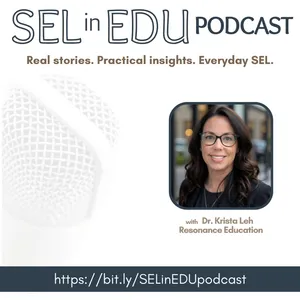
Free Daily Podcast Summary
SEL in EDU: Daily Summaries Delivered
by Powered by Resonance Education
Get key takeaways, quotes, and insights from SEL in EDU in a 5-minute read. Delivered straight to your inbox.
Latest Episodes
The most recent episodes — sign up to get AI-powered summaries of each one.
- 5 days ago41 min
096: The Soft Life: Humanizing Math and Learning with Dr. Natalie Odom Pough
In this episode of SELinEDU, Dr. Krista Leh sits down with Dr. Natalie Odom Pough, a mathematics educator and advocate for joyful, justice-centered learning, to explore what she calls the soft life. Together, they unpack the idea that learning environments do not have to be rooted in pressure, comparison, and compliance—but can instead be spaces where students feel seen, respected, and capable of growth.Through stories from her work in middle school math classrooms and her own experiences as a parent and educator, Natalie shares how identity, culture, and personal experience shape how students engage with learning. She challenges the notion that math exists in isolation, offering powerful examples of how relevance, real-world context, and student-centered design can transform both engagement and understanding. From rethinking word problems to connecting math with history and community, she reminds us that meaningful learning happens when students can see themselves in the work.The conversation also highlights the deeply human side of teaching. Natalie reflects on what it means to truly see each student—even in large classrooms—and how relationships, consistency, and communication with families create the foundation for both academic and social-emotional growth. She shares practical ways educators can support productive struggle, build classroom culture over time, and shift from comparison-driven environments to ones that honor each student’s unique abilities.At its core, this episode is a reminder that social emotional learning is not separate from content—it is how learning comes to life. When we center students as individuals, treat learning as a conversation, and create spaces grounded in respect and belonging, we open the door for both rigor and humanity to coexist.Chapters00:00 The Soft Life in Education05:43 Empowering Students in Math13:01 Seeing Students as Individuals18:02 Social Emotional Learning and Teaching37:22 Productive Struggle and Discourse in the Classroom
- 1 weeks ago42 min
095: Possibility as a Practice with Thom Stecher
What helps young people and adults see beyond what is into what could be? In this episode, I’m joined again by educator, author, and lifelong champion for young people, Thom Stecher, for a conversation about possibility... a powerful mindset that invites hope, stretches imagination, and opens doors where others see walls.Together, we explore possibilities not as wishful thinking, but as a way of seeing, teaching, and living that helps people move beyond limitation into growth, agency, and purpose.Throughout this conversation, Thom shares wisdom about nurturing possibility in schools and in life: how educators can become cultivators of potential, why belief often precedes achievement, and how creating conditions for curiosity, courage, and imagination can transform learning.We also reflect on how possibility connects to SEL, fueling hope, resilience, perspective-taking, and self-discovery. If you’ve ever wondered how we help students envision futures they may not yet be able to name, or how we keep possibility alive in ourselves, this conversation offers both inspiration and practical wisdom that will stay with you.
- Apr 15, 202631 min
094: The Resilience Loop: How Facing Discomfort Builds Inner Strength with Josephine Hunt
Discover practical strategies for fostering resilience and emotional wealth in students and educators alike. This episode features insights from Josephine Hunt, a seasoned special education teacher and media voice, who shares how natural consequences, intrinsic motivation, and mindful coaching cultivate resilient learners.Main topics:The resilience loop: understanding how overcoming challenges builds long-term strengthDifferentiating resilience as a skill versus a fixed traitThe impact of social media and technology on youth mental health and resiliencePractical classroom strategies: choice, autonomy, and reflective questioningThe importance of self-regulation and co-regulation for adults working with youthThe role of physical strength and movement in emotional well-beingResources & Links:Josephine Hunt’s WebsiteThe Four Agreements by don Miguel RuizDealing with Feelings by Dr. Mark BrackettBrené Brown on VulnerabilityConnect with Josephine Hunt:WebsiteYouTube ChannelEmailThank you for joining this conversation about resilience, growth, and emotional health in education. Remember to notice one small way SEL showed up in your day and keep nurturing meaningful, connected learning.
- Mar 18, 202637 min
092: The Psychological Safety Gradient with Chase Mielke
A single hand raised can fool us into thinking a class feels safe, while most students are silently calculating the social cost of being wrong. We sit down with award-winning educator and burnout expert Chase Mielke to make psychological safety practical through a Goldilocks Gradient lens: low, mid, and high-risk moments that shape student participation, academic risk-taking, and real engagement.We talk through why “one student in the spotlight” instantly creates a high-gradient situation, even when the question is simple. Then we map out how to sequence learning so students warm up before you ask for courage: quick partner exchanges, brief opinion prompts, and fast confidence checks that serve as formative assessments. We also get honest about the harm of cold calling when it spikes threat responses, and how “lukewarm calls” preserve rigor while protecting dignity.The conversation moves beyond talk into the environment itself. Classroom layout, teacher movement, lighting, and visual cues can quietly broadcast safety or threat. Chase shares ways to use anchor spots in the room, class agreements, and displays that celebrate progress and courage so students see mistakes as part of learning. If you’re building SEL, classroom culture, and equitable participation, these strategies are designed to be usable tomorrow. Subscribe, share this with a colleague, and leave a review with the one small change you’re going to test next.EPISODE RESOURCES:Connect with Chase via his website, LinkedIn, and Instagram.Purchase Chase's book and read his articles.
- Feb 11, 202641 min
091: How Shifts In Perspective Can Transform Learning And Leadership with Thom Stecher
What if the biggest lever for healthier schools is how we view people and problems? I sit down with veteran educator and consultant Thom Stecher to unpack how a shift in perspective can transform classroom climate, leadership choices, and our well-being. From the first moments, we trace a clear arc: perception shapes understanding, understanding unlocks empathy, and empathy fuels compassionate action. And that sequence lives inside every SEL competency.Thom shares personal stories that bring both-and thinking to life, showing how grief and gratitude can coexist and how that nuance matters for students and staff navigating complex emotions. We dig into responsible decision-making as the cumulative outcome of self-awareness, self-management, social awareness, and relationship skills, then get practical: using a mindful pause to interrupt reactivity, spotting absolutist language that signals stuck thinking, and replacing it with I-statements that restore agency. We also explore cognitive empathy versus affective empathy and why honoring different truths in a classroom builds respect without demanding conversion.Curiosity gets its due as the engine of empathy and innovation, raising a tough question for schools: Do we actually want curiosity if it refuses to be compliant? Drawing on the original meaning of educare (to draw out), we offer strategies to elevate student voice, invite multiple perspectives, and design learning that values people over mere performance.If you’re ready to trade either-or for both-and, to ground big goals in human connection, and to build a culture where perspective leads to wiser choices, this conversation will give you language, tools, and courage to start. If it resonates, follow the show, share it with a colleague, and leave a quick review to help others find it. What’s one place you’ll add a mindful pause this week?EPISODE RESOURCES:Connect with Thom Stecher via his website or Facebook.Order his book, Social Emotional Learning - One Day at a Time
- Feb 4, 202631 min
089: Designing Uncheatable Learning With Story, Agency, And Real Audiences with Michael Hernandez
What if students did work they couldn’t fake and didn’t want to? We sit down with award-winning educator and author Michael Hernandez to rethink assessment, culture, and the role of technology by anchoring learning in agency, responsibility, and authentic audiences. Instead of building classrooms around compliance and bans, we explore how trust and clear boundaries create a sandbox where creativity thrives, and cheating loses its appeal.Michael walks us through a step-by-step PSA project that turns SEL from a talking point into a daily practice. Along the way, we dig into assessing for impact, originality, and courage; teaching ethical research and credibility; and using phones, mics, and cameras as microscopes and telescopes for inquiry. We also talk about oral histories as a powerful listening-first approach that builds digital literacy, empathy, and real communication skills.The conversation widens to film festivals, cross-school collaboration, and policy shifts away from standardized tests toward portfolios and a portrait of a graduate. We frame the classroom as a think tank with real deadlines and audiences, where feedback and iteration are the norm, responsibility has consequences, and students learn to navigate ambiguity with confidence. If you want practical, human-centered strategies that make learning relevant, rigorous, and public, this one will spark ideas you can use tomorrow.EPISODE RESOURCES: Connect with Michael via his website, LinkedIn, and Instagram.Check out Michasel's books and online courses!
- Jan 21, 202636 min
088: Why School Meetings Stall and How Simple Shifts Get Them Moving with Chris Fenning
What if staff meetings ended with real decisions and classes felt like energizing workshops? We sit down with communication expert and author Chris Fenning to rebuild school time around clarity and outcomes using one simple framework: Topic, Purpose, Output. From IEPs and MTSS to department huddles and professional learning workshops, we show how to set relevance, choose the right activities, and leave each session with a tangible result you can print, share, or ship.We unpack the difference between meetings and workshops and why that distinction matters for educators. You’ll learn how to write agendas as questions so anyone can lead with confidence, use the inverse time rule to handle niche items without holding everyone hostage, and stop “admiring the problem” by validating voices and shifting to solutions. Chris shares fast, inclusive techniques such as silent writing, quick polls, sticky-note clustering, and time-boxed sprints that surface ideas from the quiet, curb overtalkers, and keep momentum strong.This conversation connects directly to SEL. Clear purposes lower stress. Named outputs build agency. Validation increases belonging. When we frame lessons as purposeful meetings - opening with a question, selecting activities that align with the goal, and closing with a visible product - students practice collaboration, focus, and reflective decision-making. EPISODE RESOURCES:Connect with Chris via his website and LinkedIn.Check out Chris' books:The First MinutesEffective EmailsEffective Meetings 39 Ways to Make Training Stick
- Dec 3, 202537 min
085: Compassionate Coaching with Kathy Perret and Kenny McKee
Coaching should feel like a partnership where educators bring their expertise, name the barriers they face, and co-create next steps that actually fit their classrooms. We sit down with Kenny McKee and Kathy Perrett, co-authors of Compassionate Coaching, to explore a humane, practical framework for helping teachers move forward without judgment or gimmicks.In this episode, we unpack six recurring barriers: lack of confidence, failure, overload, disruption, isolation, and tough school culture. Kenny shares how reframing "failure" with design thinking and action research turns data into direction, not blame. Kathy explains how to introduce coaching so it's not "come fix me," but truly collaborative. You'll hear how to offer options without overwhelming, ask for permission before advising, and attribute ideas in ways that build trust rather than hierarchy. We also highlight a simple data routine that changes conversations quickly: ask students two questions: "What helped you learn today?" What got in the way? Then use those insights to plan the next lesson together.Across stories from elementary to high school, single-site to multi-school roles, we show how compassionate coaching strengthens teacher agency, elevates student voice, and adapts to wildly different cultures. You'll leave with practical tools for gathering meaningful, in-the-moment data, strategies for starting with willing partners, and a mindset shift: be the most coachable person in the building, model reflection, and celebrate small wins that compound. If this resonates, follow the show, share with a colleague, and leave a review telling us which barrier you're tackling next.EPISODE RESOURCES:Connect with Kenny via his website, LinkedIn, and Instagram.Connect with Kathy via her website, LinkedIn, and Instagram.Purchase their book - Compassionate Coaching: How to help educators navigate barriers to professional growth
Get SEL in EDU summaries in your inbox
Free AI-powered daily recaps. Key takeaways, quotes, and mentions — in a 5-minute read.
Get Free Summaries →Free forever for up to 3 podcasts. No credit card required.
You Might Also Like
Listeners also like.
Teachers on Fire
voicEd Radio
Neuroscience Meets Social and Emotional Learning
Andrea Samadi

edWebcasts
edWeb
Teach Better Talk
Teach Better Team
Aspire to Lead
Joshua Stamper
A Slice of Empathy
Valerie J Kelly

Education Perspectives
Liza Holland
Empowered Educator: Leadership in Motion | Educational Leadership, Principal Leadership, Teachers as Leaders
Dr. Mel Vandevort - Educational Leadership, Educational Consultancy, Teacher Transition Coach, Educational Administration, Educational Entrepreneurship

The Learning Scientists Podcast
Learning Scientists

Coaching the Whole Educator
Becca Silver

Trending In Ed with Mike Palmer
Palmer Media
School Success Podcast
Mitchell Slater
About SEL in EDU
Real stories. Practical insights. Everyday Social Emotional Learning (SEL).
Customized Recaps
AI-powered recaps with compact key takeaways, quotes, and insights.
Straight to Your Inbox
Get key takeaways from SEL in EDU in a 5-minute read.
Save Hours Every Week
Stay current on your favorite podcasts without falling behind.
Frequently Asked Questions
What is Podzilla's SEL in EDU daily summary?
It's a free AI-powered email that summarizes new episodes of SEL in EDU as soon as they're published. You get the key takeaways, notable quotes, and links & mentions — all in a quick read.
How does the SEL in EDU podcast summary work?
When a new episode drops, our AI transcribes and analyzes it, then generates a personalized summary tailored to your interests and profession. It's delivered to your inbox every morning.
Is this an official SEL in EDU product?
No. Podzilla is an independent service that summarizes publicly available podcast content. We're not affiliated with or endorsed by Powered by Resonance Education.
Can I get summaries of other podcasts too?
Absolutely! The free plan covers up to 3 podcasts. Upgrade to Pro for 15, or Premium for 50. Browse our full catalog at /podcasts.
How often does SEL in EDU release new episodes?
SEL in EDU publishes biweekly. Our AI generates a summary within hours of each new episode.
What topics does SEL in EDU cover?
SEL in EDU covers topics including Education. Our AI identifies the specific themes in each episode and highlights what matters most to you.
Start getting SEL in EDU summaries tomorrow morning.
Free forever for up to 3 podcasts. No credit card required.
Free forever for up to 3 podcasts. No credit card required.