Free Daily Podcast Summary
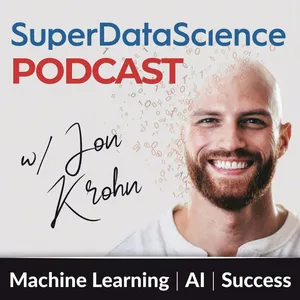
Super Data Science: ML & AI Podcast with Jon Krohn: Daily Summaries Delivered
by Jon Krohn
Get key takeaways, quotes, and insights from Super Data Science: ML & AI Podcast with Jon Krohn in a 5-minute read. Delivered straight to your inbox.
Latest Episodes
The most recent episodes — sign up to get AI-powered summaries of each one.
- Today1h 10m
993: How to Build AI-First Organizations, with Jacob Miller and Jeremy Mumford
For years, AI content has come in the form of “use this library, use this tool” tutorials that age out within months. Jacob Miller and Jeremy Mumford, co-authors of the brand new Wiley book Architected Intelligence, wanted to write something different, a guide to the higher-level principles of building AI products and AI-first organizations that will still be relevant in five or ten years. In this episode, the two Pattern engineers walk Jon Krohn through the core ideas of their book: why you should design products and processes so they can be executed by a human, an AI agent, or any hybrid combination; why most companies are still treating hallucinations as a model problem when they’re actually a data curation problem; why the natural progression of AI development goes skills, workflows, agents, not straight to agents; and why velocity, not models or data, is the only durable competitive advantage left. Additional materials: https://www.superdatascience.com/993 Interested in sponsoring a SuperDataScience Podcast episode? Email natalie@superdatascience.com for sponsorship information. In this episode you will learn: The User Agnosticism Tenet The Zillow Offers parable Why workflows should come before agents Why data engineering is the bedrock of AI Why velocity is the only durable moat
- 4 days ago14 min
992: Tokenmaxxing vs AI Hardware Bottlenecks
While “tokenmaxxing”, the social media trend of maximizing AI token consumption as a vanity metric, takes off online, the physical infrastructure behind AI is slamming into serious bottlenecks. In this Five-Minute Friday, Jon Krohn maps out the four overlapping supply-chain constraints choking AI compute: GPUs (with NVIDIA Blackwell sold out through mid-2026), high-bandwidth memory (quintupled demand since 2023, only three manufacturers worldwide), CPUs (agentic AI requires 12x more CPUs per GPU than chatbots), and electricity (Gartner projects power shortages will restrict 40% of AI data centres by 2027). Find out why the five biggest hyperscalers are on track to spend $725 billion on AI infrastructure in 2026, where the reasons for optimism lie, and why Jon says you should definitely not tokenmaxx. Additional materials: www.superdatascience.com/992 Interested in sponsoring a SuperDataScience Podcast episode? Email natalie@superdatascience.com for sponsorship information.
- 1 weeks ago1h 8m
991: Pair Programming with AI in Your Python Notebook, with Dr. Trevor Manz
Dr. Trevor Manz of Marimo talks to Jon Krohn about Marimo Pair, an open-source agent skill that teaches coding agents like Claude Code how to drive a reactive Python notebook, reading cell state, running Python in the kernel, taking screenshots of cells, and iterating on data tasks the way agents iterate on traditional software. Trevor also unpacks recursive language models, his AnyWidget project that bridges Python and the web, and his journey from a Wisconsin small town and Harvard bioinformatics research to founding-engineer life at Marimo. Listen to the episode to hear why no matter where AI takes us, curiosity and going deep on a topic will always be valuable. Additional materials: www.superdatascience.com/991 Interested in sponsoring a SuperDataScience Podcast episode? Email natalie@superdatascience.com for sponsorship information. In this episode you will learn: What Marimo Pair is and how it teaches agents to use notebooks as a tool How agent skills work as folders of markdown files Trevor's day-to-day workflow combining Claude Code and Marimo Pair Recursive language models and why they could be the future of agentic reasoning Career advice on curiosity, going deep, and becoming a domain expert
- 1 weeks ago10 min
990: Inside Mythos: Anthropic's Locked-Down Frontier Model
Anthropic has built a frontier AI model so capable at finding software vulnerabilities that it has decided not to release it to the general public. In this Five-Minute Friday, Jon Krohn breaks down Claude Mythos Preview, a general-purpose model whose hacking abilities emerged as a side effect of broad improvements in code understanding and reasoning. Find out how Mythos achieved a nearly 100x improvement over Opus 4.6 on Firefox exploit generation, why Mozilla patched 271 vulnerabilities in a single release using an early version of the model, and what Project Glasswing Anthropic’s gated industry consortium means for the future of cybersecurity. Jon also shares practical tips for securing the code you’re generating with AI tools. Additional materials: www.superdatascience.com/990 Interested in sponsoring a SuperDataScience Podcast episode? Email natalie@superdatascience.com for sponsorship information.
- 2 weeks ago1h 4m
989: Security for Mythos-Era Agentic Risks, with Rubrik’s Anneka Gupta and Cal Al-Dhubaib
Rubrik’s Anneka Gupta and Cal Al-Dhubaib speak to Jon Krohn about cybersecurity measures, the risks AI in business might pose for malicious attacks, and why AI should be kept “boring.” Find out how Rubrik safeguards client data, what zero trust is in the context of cybersecurity, and why cyber-resilience needs to be a top priority for companies looking to adopt AI. Additional materials: www.superdatascience.com/989 Interested in sponsoring a SuperDataScience Podcast episode? Email natalie@superdatascience.com for sponsorship information. In this episode you will learn: All about Rubrik The announcement of Claude Mythos Utilizing zero trust About the Rubrik agent cloud
- 2 weeks ago35 min
988: In Case You Missed It in April 2026
In this month’s episode of In Case You Missed It, Jon Krohn talks to guests about memory and education, and how artificial intelligence is continuing to help lower the barriers to access. Hear from Matt Glickman, Traci Walker-Griffith, Richmond Alake, and Linda Haviv, discussing the foundations of AI agent memory, how engineers can develop at scale, and why they believe AI could be your child’s perfect tutor in the classroom. Additional materials: www.superdatascience.com/988 Interested in sponsoring a SuperDataScience Podcast episode? Email natalie@superdatascience.com for sponsorship information.
- 3 weeks ago1h 17m
987: AI Infrastructure, Ray, and Why Nonlinear Careers Win, with Linda Haviv
Linda Haviv talks to Jon Krohn about staying current on AI matters, why open-source technology is narrowing the gap in its race with proprietary models, and how being a content creator in tech is key to career growth and longevity. She emphasizes that non-linear pathways to a career in tech can give applicants an edge, and stresses the importance of continuous upskilling to “stay relevant.” In her view, systems thinking is becoming more important than coding skills. Hear why in this episode. Additional materials: www.superdatascience.com/987 Interested in sponsoring a SuperDataScience Podcast episode? Email natalie@superdatascience.com for sponsorship information. In this episode you will learn: Linda Haviv on AI education The future of coding Having a side hustle in today’s economy On becoming a content creator for tech How open source could disrupt the AI landscape
- 3 weeks ago29 min
986: Building Hardware is Hard but AI Agents Help, with Kishore Subramanian
CTO of Propel Software Kishore Subramanian talks to Jon Krohn about how product lifecycle management (PLM) software and quality management systems (QMS) help ensure compliance, record management, and quality assurance. Listen to the episode to hear Kishore Subramanian talk about best practices for getting started with Agentforce 360, his top tips for deploying AI projects, and why yoga and meditation could make you better at building AI products! Additional materials: www.superdatascience.com/984 Interested in sponsoring a SuperDataScience Podcast episode? Email natalie@superdatascience.com for sponsorship information. In this episode you will learn: How Propel Software meets its customers’ demands About Propel One AI A case study for Salesforce’s Agentforce 360 Platform How to build an enterprise-ready agent with Agentforce 360 How to get your AI tool into production
Get Super Data Science: ML & AI Podcast with Jon Krohn summaries in your inbox
Free AI-powered daily recaps. Key takeaways, quotes, and mentions — in a 5-minute read.
Get Free Summaries →Free forever for up to 3 podcasts. No credit card required.
You Might Also Like
Listeners also like.
AGI - Advance, Grow, Innovate with AI
AGI Podcasters
Superhuman AI: Decoding the Future
Superhuman AI
The Artificial Intelligence Show
Paul Roetzer and Mike Kaput
AI Engineering Podcast
Tobias Macey
The AI in Business Podcast
Daniel Faggella
OpenAI Podcast
OpenAI

NVIDIA AI Podcast
NVIDIA
Towards Data Science
The TDS team
Unsupervised Learning with Jacob Effron
by Redpoint Ventures
Data Science at Home
Francesco Gadaleta
Artificial Intelligence: Real Talk
Eli Davis

BigCheese AI Podcast
🧀 Big Cheese AI
About Super Data Science: ML & AI Podcast with Jon Krohn
The latest machine learning, A.I., and data career topics from across both academia and industry are brought to you by host Dr. Jon Krohn on the Super Data Science Podcast. As the quantity of data on our planet doubles every couple of years and with this trend set to continue for decades to come, there's an unprecedented opportunity for you to make a meaningful impact in your lifetime. In conversation with the biggest names in the data science industry, Jon cuts through hype to fuel that professional impact.Whether you're curious about getting started in a data career or you're a deep technical expert, whether you'd like to understand what A.I. is or you'd like to integrate more data-driven processes into your business, we have inspiring guests and lighthearted conversation for you to enjoy.We cover tools, techniques, and implementation tricks across data collection, databases, analytics, predictive modeling, visualization, software engineering, r
Customized Recaps
AI-powered recaps with compact key takeaways, quotes, and insights.
Straight to Your Inbox
Get key takeaways from Super Data Science: ML & AI Podcast with Jon Krohn in a 5-minute read.
Save Hours Every Week
Stay current on your favorite podcasts without falling behind.
Frequently Asked Questions
What is Podzilla's Super Data Science: ML & AI Podcast with Jon Krohn daily summary?
It's a free AI-powered email that summarizes new episodes of Super Data Science: ML & AI Podcast with Jon Krohn as soon as they're published. You get the key takeaways, notable quotes, and links & mentions — all in a quick read.
How does the Super Data Science: ML & AI Podcast with Jon Krohn podcast summary work?
When a new episode drops, our AI transcribes and analyzes it, then generates a personalized summary tailored to your interests and profession. It's delivered to your inbox every morning.
Is this an official Super Data Science: ML & AI Podcast with Jon Krohn product?
No. Podzilla is an independent service that summarizes publicly available podcast content. We're not affiliated with or endorsed by Jon Krohn.
Can I get summaries of other podcasts too?
Absolutely! The free plan covers up to 3 podcasts. Upgrade to Pro for 15, or Premium for 50. Browse our full catalog at /podcasts.
What topics does Super Data Science: ML & AI Podcast with Jon Krohn cover?
Super Data Science: ML & AI Podcast with Jon Krohn covers topics including Science, Technology. Our AI identifies the specific themes in each episode and highlights what matters most to you.
Start getting Super Data Science: ML & AI Podcast with Jon Krohn summaries tomorrow morning.
Free forever for up to 3 podcasts. No credit card required.
Free forever for up to 3 podcasts. No credit card required.