Free Daily Podcast Summary
The TWIML AI Podcast (formerly This Week in Machine Learning & Artificial Intelligence): Daily Summaries Delivered
by Sam Charrington
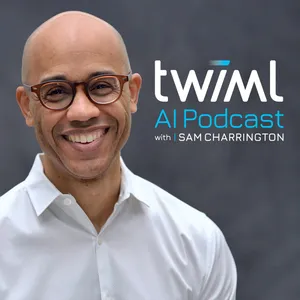
Machine learning and artificial intelligence are dramatically changing the way businesses operate and people live. The TWIML AI Podcast brings the top minds and ideas from the world of ML and AI to a broad and influential community of ML/AI researchers, data scientists, engineers and tech-savvy business and IT leaders. Hosted by Sam Charrington, a sought after industry analyst, speaker, commentator and thought leader. Technologies covered include machine learning, artificial intelligence, deep learning, natural language processing, neural networks, analytics, computer science, data science and more.
Latest Episodes
The most recent episodes — sign up to get AI-powered summaries of each one.
- 3 days ago1h 5m
From Voice Agents to AI Avatars with Alexander Smola - #777
Voice AI has gotten remarkably good, but natural conversation remains a high bar. Small delays, awkward interruptions, or the wrong tone can quickly break the illusion—and adding vision and visual presence only raises the stakes. In this episode, Alex Smola, co-founder and CEO of Boson AI, explores the path from today’s voice agents to audiovisual agents and AI avatars. We discuss the technical tradeoffs behind real-time voice, including audio tokenization, latency, model size, and inference cost, as well as what changes when these systems can both see and be seen. We also explore the role of emotional intelligence in AI, how agents can learn from human interactions, and what it will take to move beyond impressive demos toward interactions that actually feel natural. 🗒️ Full show notes: https://twimlai.com/go/777.
- 1 weeks ago59 min
Do AI Tokenomics Matter More Than Model Benchmarks? with Chris Potts - #776
As reasoning models consume more tokens and AI systems become more expensive to run, understanding what those tokens actually buy is becoming increasingly important. In this episode, Stanford professor and Big Spin co-founder Chris Potts joins us to discuss AI tokenomics and his research into “tokenflation”—the possibility that token usage is growing faster than the measurable value those tokens produce. We explore how to measure the return on AI spending, why benchmarks alone provide an incomplete picture of model progress, and what inference-time scaling means for the economics of increasingly capable models. Chris also explains why expert AI users tend to get better results by challenging and iterating with models, how AI fluency affects outcomes, and why more efficient architectures could change the underlying economics. We also discuss DSPy, interpretability, the limits of today’s transformer architectures, and where Chris sees opportunities for more fundamental innovation in AI. 🗒️ Full show notes: https://twimlai.com/go/776.
- 2 weeks ago1h 6m
World Models and the Future of Spatial AI with Justin Johnson - #775
In this episode, Justin Johnson, co-founder of World Labs, joins us to discuss world models and the emerging field of spatial AI. We explore why many researchers see capabilities beyond language as an important frontier for AI, and what it means to build models that can understand, generate, and simulate the environments around them. Justin explains the different approaches to world modeling, including explicit 3D representations and generative models, and why there is still no established recipe for building these systems. We also discuss World Labs’ Marble system, which can generate navigable 3D worlds from images and other inputs, the challenges of evaluating world models, and the role of simulation, planning, and action. Finally, Justin shares his vision for models that bring these capabilities together, supporting everything from interactive virtual environments to agents and robots that can operate in the physical world. 🗒️ Full show notes: https://twimlai.com/go/775.
- 3 weeks ago55 min
Why the Next AI Breakthrough May Come from Physics with Max Welling - #774
The conventional wisdom in AI is that the next breakthrough will come from more compute, more data, and larger models. But what if the next leap comes from somewhere else? In this episode, Max Welling—co-founder and CTO of CuspAI and professor at the University of Amsterdam—argues that physics may provide some of the ideas behind the next generation of AI systems. We begin with CuspAI’s work using generative AI to design entirely new materials for semiconductors, batteries, carbon capture, and clean energy. Max explains how foundation models for chemistry, agentic workflows, simulation, and automated experimentation are dramatically accelerating the search for new materials and reshaping scientific discovery. The conversation then broadens into a deeper question. Beyond giving AI new scientific problems to solve, can physics also teach us how to build better AI? Max explores surprising connections between machine learning and thermodynamics, why waves may become a new computational primitive for neural networks, and how concepts like symmetry breaking and statistical physics could inspire AI architectures beyond today’s scaling paradigm. 🗒️ Full show notes: https://twimlai.com/go/774.
- Aug 12, 202656 min
Why Image Generation Needs More Than Bigger Models with Fatih Porikli - #773
Text-to-image models have become remarkably good at producing realistic images. But realism isn’t the same as correctness. Ask for several distinct people, a specific composition, or a high-resolution image generated locally, and today’s models still struggle in surprising ways. In this episode, Fatih Porikli, Vice President of Technology at Qualcomm, joins me to discuss what remains unsolved in image generation and several approaches his team presented at CVPR to address those challenges. We explore why better training objectives can improve controllability, how separating scene planning from rendering may lead to more reliable image generation, techniques for generating 16-megapixel images efficiently on edge devices, and new methods for eliminating the visible artifacts that often appear in AI-powered image editing. Along the way, we discuss reinforcement learning for image generation, agentic image generation pipelines, on-device AI, and what the next phase of progress in generative vision systems is likely to look like. 🗒️ Full show notes: https://twimlai.com/go/773
- Jul 27, 202647 min
Why Models Are AI’s Next Training Dataset with Damian Borth - #772
For more than a decade, AI has advanced by training ever-larger models on ever-larger datasets. But as high-quality training data becomes harder to find and pretraining grows increasingly expensive, researchers are looking for new ways to keep foundation models improving. In this episode, Damian Borth, professor of AI and machine learning at the University of St. Gallen, argues we’ve been overlooking an important source of knowledge: the models we’ve already trained. His group’s work on weight space learning treats trained neural networks themselves as data, learning from the distilled results of millions of GPU hours of optimization rather than starting from raw data each time. We explore what it means to build foundation models of neural networks, how knowledge can be transferred across architectures and domains, why this approach could dramatically reduce the cost of developing specialized models, and whether future AI systems may be trained on collections of existing models instead of ever-growing datasets. 🗒️ Full show notes: https://twimlai.com/go/772.
- Jul 8, 202659 min
How AI Learns to Smell with Alex Wiltschko - #771
In this episode, Alex Wiltschko, founder and CEO of Osmo, joins the show to discuss his goal of giving computers a sense of smell and what it takes to build olfactory intelligence. We explore the science behind smell, from the hundreds of olfactory receptors in the human nose to the challenge of mapping the relationship between molecular structure and odor, ensuring safety regulations are met, and building foundation models for smell. Alex explains how graph neural networks and advanced embedding spaces allow AI to capture the multi-dimensional structure of scents, grouping them into perceptual neighborhoods, and creating a machine learning representation that predicts how molecules smell. We also cover how Osmo built the largest proprietary olfactory dataset from scratch to train a fleet of predictive models, and how olfactory intelligence could eventually power applications far beyond fragrance, including disease detection, emotion sensing, and consumer devices. 🗒️ Full show notes: https://twimlai.com/go/771.
- Jun 16, 202656 min
Why AI Agents Break the GenAI Security Model with Devvret Rishi - #770
In this episode, Sam talks with Dev Rishi, GM of AI at Rubrik, about what happens when agents move beyond answering questions and start taking action across tools, systems, and business processes. We explore why the enterprise playbook of static guardrails plus human approval starts to break down in the agent era. Agents are useful because they can plan, call tools, update systems, write code, send messages, and operate across workflows at machine speed, but those same capabilities make them difficult to govern with rules written in advance or approval prompts reviewed one at a time. Dev explains why tool access increases blast radius, why agents can route around controls in surprising ways, and why human-in-the-loop review can become security theater when agents operate at scale. We also discuss what enterprises need instead: better visibility, runtime enforcement, policy-aware governance, agent observability, and recovery mechanisms for when something goes wrong. Along the way, we dig into MCP and tool sprawl, small language models for policy enforcement, defense in depth, agent rewind, and why AI may be needed to help secure AI. 🗒️ Full show notes: https://twimlai.com/go/770.
Get The TWIML AI Podcast (formerly This Week in Machine Learning & Artificial Intelligence) summaries in your inbox
Free AI-powered daily recaps. Key takeaways, quotes, and mentions — in a 5-minute read.
Get Free Summaries →Free forever for up to 3 podcasts. No credit card required.
You Might Also Like
Listeners also like.

Intelligent Machines (Audio)
Explores the impact of artificial intelligence through conversations with pioneers shaping the future of intelligent technology.

Machine Learning Street Talk (MLST)
Discussions with leading AI researchers and thinkers exploring machine learning, cognitive science, and philosophy of mind without hype.

The AI Daily Brief: Artificial Intelligence News and Analysis
A daily analysis of artificial intelligence news, exploring its creative potential, industry impacts, and ethical challenges.

The Most Interesting Thing in AI
Conversations with leading thinkers exploring the ethical, economic, and social impact of artificial intelligence.

AI and I
Interviews with professionals who use AI tools in their work, exploring how AI affects creativity, thinking, and daily life through live demonstrations.

OpenAI Podcast
Conversations with OpenAI researchers and builders exploring how frontier AI models are developed and used in practice.

Everyday AI Podcast – An AI and ChatGPT Podcast
Practical AI and ChatGPT tips for professionals to improve productivity and grow their careers.

The AI XR Podcast.
Industry insiders interview top founders and executives on AI, spatial computing, VR/AR, and synthetic media.

This Week in Tech (Audio)
A weekly roundtable of tech insiders discusses the latest developments in AI, robotics, computing, and digital privacy.

Latent Space: The AI Engineer Podcast
Explores AI engineering breakthroughs in foundation models, code generation, and AI agents through interviews with researchers and developers.
"The Cognitive Revolution"
Interviews with AI developers and researchers exploring the transformative impact of artificial intelligence on society and technology.

AI For Humans: Weekly AI News, Tools & Trends
A weekly breakdown of major AI news, tools, and breakthroughs for both newcomers and seasoned enthusiasts.
About The TWIML AI Podcast (formerly This Week in Machine Learning & Artificial Intelligence)
Machine learning and artificial intelligence are dramatically changing the way businesses operate and people live. The TWIML AI Podcast brings the top minds and ideas from the world of ML and AI to a broad and influential community of ML/AI researchers, data scientists, engineers and tech-savvy business and IT leaders. Hosted by Sam Charrington, a sought after industry analyst, speaker, commentator and thought leader. Technologies covered include machine learning, artificial intelligence, deep learning, natural language processing, neural networks, analytics, computer science, data science and more.
Customized Recaps
AI-powered recaps with compact key takeaways, quotes, and insights.
Straight to Your Inbox
Get key takeaways from The TWIML AI Podcast (formerly This Week in Machine Learning & Artificial Intelligence) in a 5-minute read.
Save Hours Every Week
Stay current on your favorite podcasts without falling behind.
Frequently Asked Questions
What is Podzilla's The TWIML AI Podcast (formerly This Week in Machine Learning & Artificial Intelligence) daily summary?
It's a free AI-powered email that summarizes new episodes of The TWIML AI Podcast (formerly This Week in Machine Learning & Artificial Intelligence) as soon as they're published. You get the key takeaways, notable quotes, and links & mentions — all in a quick read.
How does the The TWIML AI Podcast (formerly This Week in Machine Learning & Artificial Intelligence) podcast summary work?
When a new episode drops, our AI transcribes and analyzes it, then generates a personalized summary tailored to your interests and profession. It's delivered to your inbox every morning.
Is this an official The TWIML AI Podcast (formerly This Week in Machine Learning & Artificial Intelligence) product?
No. Podzilla is an independent service that summarizes publicly available podcast content. We're not affiliated with or endorsed by Sam Charrington.
Can I get summaries of other podcasts too?
Absolutely! The free plan covers up to 3 podcasts. Upgrade to Pro for 15, or Premium for 50. Browse our full catalog at /podcasts.
How often does The TWIML AI Podcast (formerly This Week in Machine Learning & Artificial Intelligence) release new episodes?
The TWIML AI Podcast (formerly This Week in Machine Learning & Artificial Intelligence) publishes biweekly. Our AI generates a summary within hours of each new episode.
What topics does The TWIML AI Podcast (formerly This Week in Machine Learning & Artificial Intelligence) cover?
The TWIML AI Podcast (formerly This Week in Machine Learning & Artificial Intelligence) covers topics including Science, News, Technology. Our AI identifies the specific themes in each episode and highlights what matters most to you.
Start getting The TWIML AI Podcast (formerly This Week in Machine Learning & Artificial Intelligence) summaries tomorrow morning.
Free forever for up to 3 podcasts. No credit card required.
Free forever for up to 3 podcasts. No credit card required.