Free Daily Podcast Summary
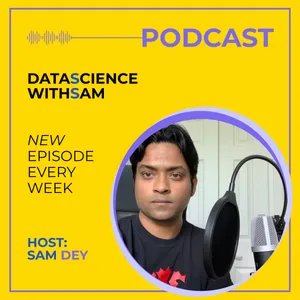
Data Science With Sam: Daily Summaries Delivered
by Soumava Dey
Data Science with Sam brings together data scientists, AI practitioners, engineers, and industry leaders for honest, practitioner-first conversations about what's actually working in AI and data — and what isn't. Hosted by Soumava "Sam" Dey, each episode covers real tools, real deployments, and real lessons from the people building at the frontier of data science, artificial intelligence, and emerging technology. The views expressed are those of the host and guests and do not reflect the position of any organization. This podcast is for educational and informational purposes only.
Latest Episodes
The most recent episodes — sign up to get AI-powered summaries of each one.
- Yesterday32 min
EP 54: Guardrails Don't Slow You Down - A CTO/CISO's Case for AI Security as a Speed Advantage | Ben Wilcox
Most conversations about AI in the enterprise focus on what it can do. This one is about what it can do to you. Ben Wilcox is CTO and CISO at Proarch, a global IT services and consulting firm — and he holds both titles at the same time. That combination means he's asking the innovation question and the security question simultaneously, which turns out to produce a very different kind of AI risk thinking than most executives ever develop. Ben has 30 years in technology, started building websites in the early days of the internet, and today is responsible for both driving AI adoption and securing it against a threat landscape that has fundamentally changed in the past 18 months. In this conversation, Sam and Ben cover what AI has done to attacker behavior, why identity is now a first-order problem in enterprise AI deployments, what Ben actually found when Shadow AI monitoring went live inside his 500-person firm, and why he's simultaneously an AI optimist and deeply cautious about high-autonomy agents with broad permission sets. They also discuss MCP server security — a topic Ben is tracking in real time — and close with a conversation about race car instruction that maps more precisely to AI risk management than it has any right to. WHAT YOU'LL HEAR - The dual CTO/CISO role: what it unlocks and why it never stops creating tension - How AI changed the attacker toolkit: faster reconnaissance, automated social engineering, chained exploits - Why identity is now a first-order AI security challenge — human identity, agent identity, tool identity, destination - Shadow AI at a 500-person tech firm: what visibility revealed, why the fragmentation was the real surprise - MCP security: over-permissioned toolsets, tool drift in open-source servers, and supply chain risk - Secure by design for AI agents: a simple email-processing agent broken into its control opportunities - Why security controls cannot live inside the model — and what has to live outside it - AI optimism: what Ben believes and what would make him change his mind - Racing cars as an AI risk management framework: traction, tire degradation, track variables, and guardrails GUEST Ben Wilcox — CTO & CISO, Proarch 30 years in technology. Race car instructor, Northeast Audi Club. LinkedIn: linkedin.com/in/ben-wilcox Company: proarch.com Newsletter: published weekly on LinkedIn / Proarch blog HOST Sam (Soumava Dey) — DataScienceWithSam Associate Director of Data Analytics at CMI Media Group | Co-Founder, AsembleAI | Co-Chair, Denver AI FOLLOW DATASCIENCEWITHSAM YouTube: https://youtu.be/sDWaat1Rjeg Spotify, Apple Podcasts, Amazon Music, iHeart Radio: search DataScienceWithSam LinkedIn: https://www.linkedin.com/in/sam-dey-441294ab/
- 2 weeks ago53 min
EP 53: Cognitive Surrender: The AI Engineering Mistake That Kills Projects
Sam sits down with Ethan Lyon — principal AI engineer, Denver-based, MIT professional education background — for one of the most technically honest conversations on the show. Ethan has built AI systems, thrown them away, and learned more from the failures than the wins. He coined the term "cognitive surrender" to describe the mistake most AI builders make: handing everything to the AI without understanding it, and wondering why the project falls apart. This episode is a practitioner's guide to building AI systems that actually hold up — data trust, MCP architecture, knowledge graphs, self-improving skills, and the planning-first workflow that changes everything.WHAT YOU'LL LEARN▪ The verification tax — why AI that needs constant fact-checking adds work instead of saving it, and how to fix it at the data layer▪ Cognitive offloading vs. cognitive surrender — the distinction that determines whether AI makes you better or just faster at being wrong▪ The two architectures Ethan threw away — a linked-document knowledge graph and a Neo4j personal knowledge graph — and what he rebuilt▪ The 100% accurate conversational analytics architecture: LookML agents + custom MCP server + semantic layer▪ The voice-to-design-to-code planning process: 30-40% upfront thinking before any code gets written▪ How to build a skill that heals other skills: automated trials, golden datasets, and recursive self-improvement▪ The dreaming simulation: a scheduled Claude Cowork job that reviews sessions and proposes CLAUDE.md improvementsGUEST BIOEthan Lyon is an AI Architect based in Denver, Colorado, with a background in MIT professional education. He has spent years building and scaling data and AI infrastructure, and writes publicly about what AI is actually doing to engineering teams — including the honest reality that some of the most elegant-sounding architectures don't survive contact with production. He built systems, threw them away, and learned more from the failures than the wins.GUEST LINKSEthan Lyon on LinkedInSUBSCRIBEEnjoying the show? Subscribe on YouTube, Spotify, Apple Podcasts, Amazon Music, iHeartRadio, and Podbean. Leave a rating and review — it helps more practitioners and engineers find the show.
- 4 weeks ago23 min
EP 52: The AI CEO: Leadership, Governance & the AI Gold Rush
Sam sits down with Dr. Zahra Timsah — co-founder and CEO of Igentic AI and author of The AI CEO — for a direct conversation about what AI is actually doing to leadership. Dr. Timsah holds a PhD in biochemistry and an MBA in strategy, has led AI transformation at IQBia, Mass Mutual, and GSK, and has advised the FDA and US Senate on AI policy. She's also one of the clearest voices making the case that the AI era is a particular opportunity for women who know how to seize it.WHAT YOU'LL LEARN▪ What "The AI CEO" actually means — leadership when AI becomes part of every decision▪ How the experience advantage has shifted: from knowing answers to asking the right questions▪ Why the most experienced leaders often resist AI the most — and how to move past that▪ AI as an equalizer for women: building ownership, visibility, and income — not just saving time▪ The three human qualities companies are hiring executives for now: judgment, courage, and accountability▪ One practical action for any leader who feels behind on AI — something you can do this week▪ The next leadership frontier: AI that acts, not just advises — and what "collective intelligence" means in practiceGUEST BIODr. Zahra Timsah is co-founder and CEO of Igentic AI and author of The AI CEO. She holds a PhD in biochemistry, an MBA in strategy, and an MSc, and has led AI transformation at IQVIA, Mass Mutual, and GSK. She has advised the FDA and the US Senate on AI policy, contributes to the World Economic Forum's AI governance work, and is an executive member of Chief. Igentic AI's Gini platform turns compliance from a brake into a business accelerator.BOOK & GUEST LINKSDr. Zahra Timsah on LinkedInIgentic AI — igentic.aiThe AI CEO — https://www.amazon.com/dp/B0HBXGXT16?lv=shuf&channelId=500&plpRedirect=mhFallbackSUBSCRIBEEnjoying the show? Subscribe on YouTube, Spotify, Apple Podcasts, Amazon Music, and iHeartRadio. Leave a rating and review - it helps more practitioners and leaders find the show.
- Oct 12, 202621 min
EP 51: Building AI Agents That Actually Work in Production | Shawn Kercher, CEO @HummingAgent.ai
Sam sits down with Shawn Kercher — Co-Founder & CEO of HummingAgent.ai — to cut through the noise around AI agents. Shawn built his company on a simple but powerful observation: most AI products are just ChatGPT wrappers. HummingAgent is his answer — a full-custom software shop that builds private, in-environment AI workflows for companies that run on real data, messy CRMs, and processes that only exist in someone's head.WHAT YOU'LL LEARN IN THIS EPISODE▪ Why generic AI tools fail in real business environments — and what full-custom actually means▪ The wrapper test: if Anthropic adds this next quarter, does your product still exist?▪ HummingAgent's Private GPT — lives in your environment, zero data sent for external training▪ Humcrew.com — voice AI, texting, proposals, and full company command centre in one product▪ Real client story: 44 years of PDF data, research time cut from hours to minutes▪ Why discovery-first, paid-scope engagements beat "move fast and ship demos"▪ The baby steps rule for agent permissions: one task, one sandbox — expand only after validationGUEST BIOShawn Kercher is Co-Founder and CEO of HummingAgent.ai, based in Lone Tree, Colorado. With over a decade of engineering leadership experience, Shawn has built HummingAgent as a full-custom software shop — not a generic AI tool vendor. HummingAgent builds private, in-environment AI workflows and agents for small and mid-sized businesses, including the Private GPT product and Humcrew.com command centre. Shawn writes publicly about the risk of AI startups becoming ChatGPT wrappers — and what it actually takes to build AI systems with real domain expertise and data integration.GUEST LINKSShawn Kercher on LinkedInSUBSCRIBEEnjoying the show? Subscribe on YouTube, Spotify, Apple Podcasts, Amazon Music, iHeartRadio, and Podbean. Leave a rating and review — it helps more builders and data professionals find the show.
- Sep 21, 202623 min
EP 50: Evolution of Enterprise Data Engineering in Gen AI Era
Shashank Akinapalli is a Senior Data Engineer at TCS where he leads cloud data lakehouse initiatives and real-time streaming architectures for supply chain intelligence. With 14 years of experience across IBM DataStage, Databricks, Snowflake, dbt, AWS, and Spark-based ecosystems, he has previously worked with USAA in banking and Blue Cross Blue Shield in healthcare. IN THIS EPISODE:▪ The biggest architectural shift when migrating from IBM DataStage to a modern cloud lakehouse — and why the technical migration is the easier half, while reconstructing encoded business knowledge is the real challenge▪ How to choose between Snowflake and Databricks: Databricks for heavy transformation and Python workloads, Snowflake for structured SQL and BI, and where dbt fits as the layer that eliminates repetitive SQL code▪ The real UNFI example: how batch processing caused inventory misrepresentation (800 units sold, system still showing 1,000 available), and how real-time Databricks pipelines eliminated that problem and unlocked fraud detection on top▪ Data governance across three regulated domains: the four pillars — data quality, redundancy, least-privilege access, and lineage — and the three questions every framework must answer first▪ Why CI/CD transformed data engineering: from manual, multi-team deployments with risky rollbacks to automated quality checks, Git version control, and the specific silent failure that finally convinces a team to invest▪ How the data engineer role shifts over the next three years: from pipeline development to data product engineering, from reactive operations to AI-predicted failure prevention, and from human dashboards to AI agents making autonomous predictions▪ Practical advice for data engineers who want to stay relevant: Python, PySpark, cloud architecture, and understanding the full data lifecycle from ingestion to consumption FIND SHASHANK:LinkedIn: https://www.linkedin.com/in/shashank-a-2aa629119/Twitter / Instagram: @shashi001gitHappy to answer questions on enterprise data warehouse, data engineering, and cloud architecture modernisation — reach out directly via LinkedIn or email.DATASCIENCEWITHSAM:If you work in data engineering and are navigating a legacy modernisation right now — this is the episode to send your team. Subscribe on Apple Podcasts, Spotify, Amazon Music, iHeartRadio, Podbean, and YouTube. If you enjoyed this episode, please share it with your network. DataScienceWithSam is always looking for new guests for captivating discussions — if you have a topic you'd like to discuss on a 30–45 minute podcast, feel free to reach out.
- Sep 13, 202633 min
EP 49: The Human Side of AI in Media: Speed, Trust & What's Really Changing | Karima Sharif-Ali, Media & Marketing Leader
Karima Sharif-Ali — known affectionately in the industry as the Fresh Princess of Media — is the SVP of Strategic Accounts at Doceree, a platform transforming point-of-care communications for healthcare brands. Over her career, Karima has shaped the marketing journeys of more than 100 pharmaceutical and medical device brands across agencies including WPP, Publicis, and IPG MediaBrands. She is a thought leader featured in AdWeek and MM+M, co-founder of the Women of Color Affinity Group (now the Mosaic Collective Leadership), and a global board member of the Healthcare Businesswomen's Association. She holds an MBA from Rosemont College and a BA in Communications from Temple University. IN THIS EPISODE:▪ Karima's one word for AI's biggest impact on healthcare media: SPEED — media plans down from two months to two weeks, data available daily instead of monthly, and media planners freed to focus on strategy rather than back-office operations▪ The difference between AI pilots and real AI adoption: asking 'how does this make what I'm doing better?' rather than experimenting theoretically — and the meeting notes example: two hours reduced to 15 minutes, giving planners 90 minutes back for strategy▪ Why creative strategy must remain human-led: the concept, the vision, the cultural intelligence. AI reformats and scales what humans create — it cannot originate the strategy itself▪ The deep fake crisis in healthcare: why AI-generated misinformation targeted at vulnerable audiences (patients, elderly populations) is Karima's biggest concern, and why authenticity and trust are non-negotiable in healthcare media▪ The copyright and IP question: should AI companies establish partnerships before inheriting creative work — especially in healthcare patient journey content?▪ The three things that keep Karima up at night: deep fakes, data privacy, and the erosion of trust and authenticity▪ The five-year vision: AI embedded in daily operations, more regulation, more nimble media companies — and Karima's call for more women and Black executives at the table where AI decisions are made, not just using the tools FIND KARIMA:LinkedIn: https://www.linkedin.com/in/karima-sharif-ali-mba-9520727/HBA Global Board: hbanet.org DATASCIENCEWITHSAM:If this episode resonated — share it with someone in media or healthcare who is navigating the AI conversation right now. Subscribe on Apple Podcasts, Spotify, Amazon Music, iHeartRadio, Podbean, and YouTube. If you enjoyed this episode, please don't forget to share it with your network. DataScienceWithSam is always looking for new guests for captivating discussions. If you have a topic you'd like to discuss on a 30–45 minute podcast, feel free to reach out.
- Aug 20, 202632 min
EP 48: From Pilots to Productivity: What It Actually Takes to Make AI Work in the Enterprise
Jim Spignardo is the Director of Cloud Strategy and AI Enablement at ProArch, a global IT services and consulting firm. With 25 years in IT spanning network engineering, cloud, cybersecurity, and strategic consulting, Jim advises executive teams on modernisation, operational resilience, and AI-enabled transformation that delivers measurable business value. He is the architect behind ProArch's Microsoft 365 Copilot adoption playbook, which has been deployed with clients across financial services, credit unions, and enterprise organisations. Jim is also the author of The AI Turning Point, available on Amazon, and publishes the Control All Innovate newsletter on LinkedIn, where he writes approximately three articles per week on AI strategy and adoption. IN THIS EPISODE: ▪ Why the through-line of Jim's 25-year career isn't the technology — it's the discipline of making technology actually work for the organisation and justifying that investment to leadership ▪ The real reasons 95% of enterprise AI pilots fail: weak use cases selected before the problem is clearly defined, and jumping to exciting initiatives without asking whether AI is actually the right solution ▪ Shadow AI — the hidden ROI nobody measures: employees quietly using AI tools on their own often deliver real productivity gains that never appear in official metrics, causing organisations to underestimate what AI is already doing ▪ What a successful Microsoft 365 Copilot rollout looks like in 90 days: a strong business case, a targeted pilot with the right stakeholders, measurable use cases, and no broad rollout before value is proven in a contained environment ▪ Why data governance should be an accelerator, not a blocker — good governance tells people what they CAN do, enables faster experimentation, and prioritises use cases so organisations operationalise value sooner ▪ AI amplifies broken processes and can't fix culture — if work processes were broken before AI arrived, AI will expose that faster than anything else ▪ What organisational readiness for AI actually requires: an AI governance council, internal champion programmes, and — critically — someone in the organisation with AI transformation as their primary job description, not a side project FIND JIM SPIGNARDO: LinkedIn: https://www.linkedin.com/in/spignardo/?skipRedirect=trueBook: The AI Turning Point — available on Amazon ProArch: https://www.linkedin.com/company/proarch-it-solutions-pvt-ltd/Website: https://www.proarch.com/DATASCIENCEWITHSAM: If your organisation is staring at an AI pilot that stalled, or a Copilot licence nobody is using, this is the conversation to share with your leadership team. Subscribe on Apple Podcasts, Spotify, Amazon Music, iHeartRadio, Podbean, and YouTube. If you enjoyed this episode, please share it with your network. DataScienceWithSam is always looking for new guests for captivating discussions — if you have a topic you'd like to discuss on a 30–45 minute podcast, feel free to reach out.
- Aug 3, 202650 min
EP 47: The AI Pioneer Who Decided Privacy Matters More Than Hype
If you ever had a document you wished you could just ask questions to - without it leaving your computer, wouldn't be pretty good from data privacy perspective? In this episode, Sam sits down with Dr. Jonathan Schaeffer - Distinguished Professor Emeritus at the University of Alberta, co-founder of the Alberta Machine Intelligence Institute, and founder and CEO of Synsira, creator of KIND — for one of the most historically grounded AI conversations we've had on this show.He holds two Guinness World Records: his program Chinook became the first computer to beat a human world champion in any game (Checkers, 1994), and in 2007 his team mathematically solved the game of Checkers - proving perfect play always ends in a draw across 500 billion billion positions. He is a Fellow of the Royal Society of Canada and the AAAI. In February 2026 he launched KIND, a desktop AI application built by his company Synsira Software Solutions, with one founding thesis: your data should work for you and only you.IN THIS EPISODE:▪ The 40-year arc of AI through the eyes of someone who lived every wave - expert systems, search scaling with computing, deep learning removing human knowledge bottlenecks, and being stunned on November 30, 2022 when ChatGPT launched▪ Why nondeterminism is built into LLMs and why the 'hallucination' band-aids being applied don't fix the fundamental flaw - the answer today may be different from the answer tomorrow▪ Why Jonathan renamed AI as 'augmented intelligence' - and what that reframe means for how leaders should govern and oversee these tools▪ KIND unpacked: a private, local, hallucination-free desktop AI that answers questions about your own files - with no internet access, no data leaving your device, and a clear answer of 'I don't know' when the answer isn't in your data▪ Real-world use cases from Jonathan himself: personal medical records, family history, book research, and intellectual property - things he uses ChatGPT and Claude for daily, but would never put near KIND's use cases▪ The data resale story: searching for a niche collectible online, then receiving a cold email from an unknown company selling exactly that product within 24 hours▪ Digital sovereignty: why Canada, Europe, and much of the non-US world is dangerously dependent on a small number of large US companies - and why user agreements, when you read them, reveal more than most people expect.FIND DR. SCHAEFFER & KIND:LinkedIn: linkedin.com/in/jonathan-schaeffer-phd-frsc-aaai-fellow-3318015KIND download: kind.synsira.comAmii: amii.caDATASCIENCEWITHSAM:If you enjoyed this episode, please share it with your network. DataScienceWithSam is always looking for new guests for captivating discussions. If you have a topic you'd like to discuss on a 30–45 minute podcast, feel free to reach out. Subscribe on Apple Podcasts, Spotify, Amazon Music, iHeartRadio, RSS, and YouTube.
Get Data Science With Sam summaries in your inbox
Free AI-powered daily recaps. Key takeaways, quotes, and mentions — in a 5-minute read.
Get Free Summaries →Free forever for up to 3 podcasts. No credit card required.
You Might Also Like
Listeners also like.

Super Data Science: ML & AI Podcast with Jon Krohn
Conversations with data science experts exploring machine learning, AI, and real-world applications to advance technical skills and careers.
The TWIML AI Podcast (formerly This Week in Machine Learning & Artificial Intelligence)
Explores machine learning and artificial intelligence through interviews with leading researchers, engineers, and industry experts.

What Comes Next with Arun
Explores how data and AI strategy create competitive advantage in business, based on real-world enterprise experience.

The AI in Business Podcast
Interviews with AI executives reveal practical applications and strategic insights for business leaders adopting AI.

CISO Series Podcast
Security professionals and vendors share insights on improving collaboration to strengthen cybersecurity.
Me, Myself, and AI
Leaders from top companies share real-world strategies for turning artificial intelligence into measurable business results.
Training Data
Discussions with AI researchers and builders exploring the technological, business, and societal impacts of artificial intelligence.

This Week in AI
Four AI experts analyze the latest news and trends in artificial intelligence each week.

Intentional AI
Two productivity experts explore practical applications of artificial intelligence to improve work efficiency and daily workflows.

NVIDIA AI Podcast
Explores how artificial intelligence and emerging technologies are driving innovation across science, sustainability, and industry.

Google DeepMind: The Podcast
A mathematician explores AI's real-world impact through behind-the-scenes insights from a leading research lab.

TED Tech
Experts examine how technology reshapes society, science, design, and business through TED Talks hosted by Sherrell Dorsey.
About Data Science With Sam
Data Science with Sam brings together data scientists, AI practitioners, engineers, and industry leaders for honest, practitioner-first conversations about what's actually working in AI and data — and what isn't. Hosted by Soumava "Sam" Dey, each episode covers real tools, real deployments, and real lessons from the people building at the frontier of data science, artificial intelligence, and emerging technology. The views expressed are those of the host and guests and do not reflect the position of any organization. This podcast is for educational and informational purposes only.
Customized Recaps
AI-powered recaps with compact key takeaways, quotes, and insights.
Straight to Your Inbox
Get key takeaways from Data Science With Sam in a 5-minute read.
Save Hours Every Week
Stay current on your favorite podcasts without falling behind.
Frequently Asked Questions
What is Podzilla's Data Science With Sam daily summary?
It's a free AI-powered email that summarizes new episodes of Data Science With Sam as soon as they're published. You get the key takeaways, notable quotes, and links & mentions — all in a quick read.
How does the Data Science With Sam podcast summary work?
When a new episode drops, our AI transcribes and analyzes it, then generates a personalized summary tailored to your interests and profession. It's delivered to your inbox every morning.
Is this an official Data Science With Sam product?
No. Podzilla is an independent service that summarizes publicly available podcast content. We're not affiliated with or endorsed by Soumava Dey.
Can I get summaries of other podcasts too?
Absolutely! The free plan covers up to 3 podcasts, any in the catalog. Basic raises that to 15, Pro to 40 and Max to 100. Browse our full catalog at /podcasts.
How often does Data Science With Sam release new episodes?
Data Science With Sam publishes biweekly. Our AI generates a summary within hours of each new episode.
What topics does Data Science With Sam cover?
Data Science With Sam covers topics including Technology. Our AI identifies the specific themes in each episode and highlights what matters most to you.
Start getting Data Science With Sam summaries tomorrow morning.
Free forever for up to 3 podcasts. No credit card required.
Free forever for up to 3 podcasts. No credit card required.