Free Daily Podcast Summary
Simply Science: Daily Summaries Delivered
by EnolaSays
Get key takeaways, quotes, and insights from Simply Science in a 5-minute read. Delivered straight to your inbox.
Latest Episodes
The most recent episodes — sign up to get AI-powered summaries of each one.
- Dec 8, 20247 min
Open Problem in Physics Explained - Reinforcement and Laws of Physics
Can machines learn the laws of physics? Sounds cool, but it’s not as easy as it seems! In this episode of Simply Science, we dive into the wild world of AI trying to grasp the universe's rules. From transfer learning giving machines a head start, to multi-task learning making them multitask like pros (sometimes), to reinforcement learning teaching them through trial and error—it’s a rollercoaster of breakthroughs and roadblocks. But physics is no pushover, and blending AI with nature’s laws comes with plenty of challenges. Tune in for a fun, mind-bending journey through the intersection of AI and the ultimate rulebook: the laws of physics!
- Dec 4, 20247 min
Open Problem in Physics Explained - Data Driven Optimization
In this episode of Simply Science, we explore how data-driven evolutionary optimization is reshaping the way we solve complex problems. Unlike traditional methods relying on straightforward objective functions, this cutting-edge approach uses data from simulations, experiments, and real-world observations to evaluate solutions.However, real-world data often comes with challenges like noise and heterogeneity, making optimization more complicated. Enter physics-informed models—AI-inspired frameworks that integrate physical knowledge to reduce computational costs and improve generalization. Coupled with knowledge-driven AI, which condenses and interprets data for greater efficiency, these advancements are driving a shift toward smarter, more interpretable optimization methods.We discuss the exciting potential of combining knowledge- and data-driven optimization strategies to tackle some of AI’s toughest challenges. If you’re curious about the future of AI in solving real-world problems with efficiency and precision, this episode is a must-listen!
- Dec 4, 20244 min
Open Problem in Physics Explained - Catastrophic Forgetting
In this episode of Simply Science, we explore the fascinating parallels between the brain's memory system and artificial intelligence. The brain acts as an information filter, much like a computer clearing disk space—it deletes outdated or irrelevant data to make room for new insights. This process, known as “catastrophic forgetting” in neuroscience, involves the weakening or resetting of neural connections, allowing the brain to rewire itself and adapt. While this may seem like a flaw, it’s a feature that enhances flexibility, helps us let go of negative experiences, and improves decision-making in dynamic environments.For artificial intelligence, forgetting is just as essential. To achieve artificial general intelligence, AI systems must learn, adapt, and selectively forget outdated information. This ability prevents overfitting, enhances algorithm generalization, and enables AI to tackle real-world problems effectively.Join us as we dive into how selective forgetting, both in humans and machines, holds the key to adaptability, better learning, and the pursuit of artificial general intelligence. If you’ve ever wondered why forgetting is just as important as remembering, this episode is for you!
- Dec 4, 20246 min
Open Problem in Physics Explained - Causation
Join us in this thought-provoking episode of Simply Science as we unravel the ambitious goal of artificial intelligence: enabling machines to “think” and “decide” like the human brain. While AI has made incredible strides, it still lags behind the brain's unmatched ability to process incomplete information, navigate complex scenarios, and solve time-sensitive problems.We dive into the critical distinction between correlation and causation in AI models, highlighting why most current systems excel at recognizing patterns but falter in understanding the why. Drawing on pioneering works in time-series causality, we explore how integrating causal reasoning, principles of statistical physics, and brain-inspired cognitive activities could transform AI, enhancing its ability to generalize in unpredictable environments.This episode sheds light on the exciting challenges and breakthroughs at the intersection of neuroscience, physics, and artificial intelligence. Whether you’re an AI enthusiast, a science lover, or just curious about the future of machine learning, this is an episode you won’t want to miss!
- Dec 4, 20244 min
Open Problem in Physics Explained - Interpretability
Welcome to Simply Science, the podcast where we break down the complex mysteries of the universe into ideas we can all understand. We are Max and Enola, and today, we’re diving into an intriguing open problem in physics and artificial intelligence: the mystery of neural networks and the challenge of making them explainable.Neural networks, the AI systems that mimic how our brains work, are revolutionizing physics. From predicting complex systems to analyzing massive datasets, these networks are becoming indispensable. But there’s a catch. They’re often called "black boxes" because, while they produce results, we don’t always know how they get there. Join us this Season 4, as we explore these open problems, why they matter, and how researchers are working to crack the code of these mysterious AI systems.
- Dec 3, 20247 min
Speech Recognition and Noise Explained
In this episode of Simply Science, we delve into groundbreaking research that tackles the challenge of making speech recognition systems work better in noisy environments. Ever tried talking to your virtual assistant in a crowded room? This innovative approach could be the solution!The study introduces a clever technique: adding "well-behaved" masking noise to both training and test data. By doing so, it effectively masks the bad noise and creates consistency between training and testing conditions, leading to remarkable improvements in speech recognition accuracy—especially for tricky noises like cross-talk.But it doesn’t stop there! We also explore how combining multiple recognizers with different masking noises and using a ROVER strategy can push accuracy even further. Tune in for an engaging discussion on the science, the math, and what this could mean for the future of AI-powered communication.Whether you're a tech enthusiast or just curious about how machines are learning to understand us better, this episode is packed with insights and innovation!
- Nov 19, 20244 min
Noise Driven Computations Explained
In this episode of Simply Science, we explore a fascinating new approach to machine learning inspired by how our brain works. Imagine using a system of elements that can switch between two states, like light switches being on or off. These elements are influenced by random noise, just like neurons firing unpredictably. Instead of relying on exact values, this system stores information in patterns of probabilities.The researchers show how this method can solve the XOR problem, which is important for creating complex machine-learning systems. Their findings suggest this approach could be useful for applications that need to be both energy-efficient and resilient to noise.If you're interested in learning more about this cutting-edge research, please send us an article at maxpsandiego@gmail.com!
- Nov 19, 20246 min
Science of Cooling Explained
In this episode of Simply Science, we dive into the fascinating (and often misunderstood) world of home cooling techniques. Ever thought about opening your refrigerator to cool off your house? Spoiler alert: It doesn’t work! We explain simple physics demonstrations, like rubber bands and a Peltier device, to show why this technique is a no-go.We also take a closer look at electric fans. While they feel great on a hot day, Allain explains why fans actually raise the room's temperature slightly due to the motor’s heat output. It’s a surprising revelation that might make you think twice about cranking up the fan to beat the heat.Tune in for a fun, myth-busting episode where physics meets everyday life, and learn why your best bet to stay cool might be a bit different than you think!
Get Simply Science summaries in your inbox
Free AI-powered daily recaps. Key takeaways, quotes, and mentions — in a 5-minute read.
Get Free Summaries →Free forever for up to 3 podcasts. No credit card required.
You Might Also Like
Listeners also like.
Science Society
Catarina Cunha

The Rest Is Science
Goalhanger
The Sound of Science
Northern Public Radio
Let's Science
SQPN, Inc.
The DemystifySci Podcast
DemystifySci

Let's Find Out
Let's Find Out
The Science of Everything Podcast
James Fodor
Understand All
Aaron Barlow

Buzz Blossom & Squeak
Jill McKinley
Reason with Science
Jitender Kumar
Science is all around us
AG
Science Quickly
Scientific American
About Simply Science
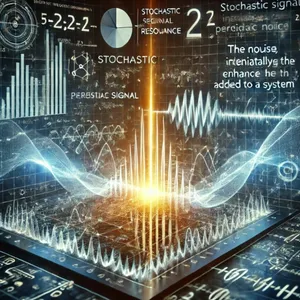
In Simply Science, we break down complex ideas into something you can easily understand. In this episode, we explore the fascinating concept of stochastic resonance—a surprising phenomenon where a little bit of noise can actually help make weak signals clearer! Whether it's helping animals hear better in noisy environments or improving medical devices, you'll learn how randomness can sometimes be a good thing. No complicated math or jargon, just clear explanations and fun examples that show how this quirky part of science plays a role in our everyday lives.Tune in, and discover how something as simple as noise can actually boost clarity!
Customized Recaps
AI-powered recaps with compact key takeaways, quotes, and insights.
Straight to Your Inbox
Get key takeaways from Simply Science in a 5-minute read.
Save Hours Every Week
Stay current on your favorite podcasts without falling behind.
Frequently Asked Questions
What is Podzilla's Simply Science daily summary?
It's a free AI-powered email that summarizes new episodes of Simply Science as soon as they're published. You get the key takeaways, notable quotes, and links & mentions — all in a quick read.
How does the Simply Science podcast summary work?
When a new episode drops, our AI transcribes and analyzes it, then generates a personalized summary tailored to your interests and profession. It's delivered to your inbox every morning.
Is this an official Simply Science product?
No. Podzilla is an independent service that summarizes publicly available podcast content. We're not affiliated with or endorsed by EnolaSays.
Can I get summaries of other podcasts too?
Absolutely! The free plan covers up to 3 podcasts. Upgrade to Pro for 15, or Premium for 50. Browse our full catalog at /podcasts.
How often does Simply Science release new episodes?
Simply Science publishes daily. Our AI generates a summary within hours of each new episode.
What topics does Simply Science cover?
Simply Science covers topics including Science. Our AI identifies the specific themes in each episode and highlights what matters most to you.
Start getting Simply Science summaries tomorrow morning.
Free forever for up to 3 podcasts. No credit card required.
Free forever for up to 3 podcasts. No credit card required.