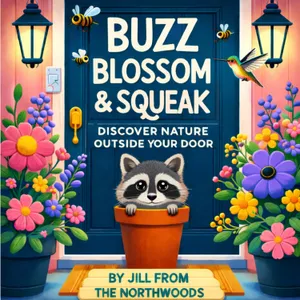
Free Daily Podcast Summary
Buzz Blossom & Squeak — Be a Neighborhood Naturalist: Daily Summaries Delivered
by Jill McKinley
Buzz, Blossom & Squeak is a quiet, curious walk into the natural world right outside your door. You don’t need to be a scientist, a hardcore birder, or someone who hikes miles into the wilderness. This podcast is for anyone who has ever paused to notice a bird call, wondered about a plant growing along a sidewalk, watched insects move through a garden, or felt the seasons shifting without quite knowing why. Each episode focuses on small, approachable pieces of nature—birds, bugs, plants, weather, ecosystems, and natural patterns—explained in a way that’s calm, curious, and grounded in observation. Instead of rushing toward big conclusions, Buzz, Blossom & Squeak invites you to slow down and really notice what’s happening in the living world around you. You’ll hear about things like: How birds use different layers of trees and sky, Why certain plants grow where they do, What insects are actually doing when they buzz past, How seasons quietly reshape landscapes, The hidden systems that connect living things.
Latest Episodes
The most recent episodes — sign up to get AI-powered summaries of each one.
- Aug 13, 202615 min
126 - Reading a Bird’s Strategy By Where It Stands
I promised you a twist at the end of this one, and I’m going to make you wait for it, just like I made myself wait when I first noticed it. Because once you understand why a bird chooses the perch it chooses, you can’t unsee it — every fence wire, dead snag, and mudflat starts telling you a story. This episode grew out of a simple observation from a walk Em and I took a few summers ago, when we spotted two Say’s Phoebes doing two completely different things with two completely different perches. That question — why? — is the whole episode.The Hunting BlindEastern Phoebes perch low and exposed near water or woodland edges, pumping their tails like little metronomes. That perch isn’t decoration — it’s a launch pad for short, fast bursts after flying insects, and the bird returns to the same twig again and again.The StageDickcissels take the tallest available perch in a treeless prairie — a fence, a shrub, a sign post — for a totally different reason. It’s not about hunting at all. It’s about being seen and heard, broadcasting territory and courtship to everything around them.Safety in NumbersSwallows lined up on a wire are doing the same job as a Phoebe — catching insects — but they’ve traded a solo hunting blind for a shared perch, more eyes watching for hawks in exchange for a little competition.No Perch at AllGreat blue herons skip elevation entirely and just stand motionless in the water, waiting the fish out. Killdeer skip perching altogether, running open ground and relying on a broken-wing act instead of height or cover.Built for the JobWoodpeckers cling vertically to tree trunks using stiff tail feathers as a brace — anatomy built for a completely different kind of perch than a songbird’s branch-grip. Red-tailed hawks use height on power poles and dead trees the opposite way a Dickcissel does: to see without being seen.The Catbird Seat, Debunked“Sitting in the catbird seat” conjures a bird perched high and commanding, but gray catbirds are actually skulkers — they sing from deep inside dense thickets, barely visible. The phrase (popularized in the 1940s through baseball broadcaster Red Barber and later James Thurber’s short story) paints a picture the real bird doesn’t match at all.The next time you’re outside, before you even try to identify a bird, just look at where it’s sitting. Low and exposed near water? Probably hunting. Standing tall and singing? Probably staging. In a loose group? Probably managing risk together. Motionless at the water’s edge? Definitely hunting, just patiently. The perch tells you the story before the field guide does.Appreciate you being out there — see you next week.You can reach me at northwoodsjill@fastmail.com or find every way to connect at jillfromthenorthwoods.com.Jill’s Linkshttps://jillfromthenorthwoods.com/ - Find my podcasts, videos, downloads and ways to contact mehttps://www.buymeacoffee.com/smallstepspodhttps://x.com/NorthWoodsJillEmail the podcast at NorthwoodsJill@fastmail.comYouTube @BuzzBlossomSqueakBy choosing to watch this video or listen to this podcast, you acknowledge that you are doing so of your own free will. The content shared here reflects personal experiences and opinions and is intended for informational and educational purposes only. I am not a licensed biologist, ecologist, or wildlife professional. Any nature observations, identifications, or suggestions offered should not be considered a substitute for professional scientific or environmental guidance. Always follow local regulations when observing or interacting with wildlife and natural spaces. You are solely responsible for any decisions or actions you take based on this content.
- Aug 7, 202610 min
125 - Summer Stars and The Best Perseid Meteor Shower in Years (Aug 12–13)
Finding Your Way Around the Summer SkyStep outside tonight and look up — it's not the same sky we talked about in winter. Orion and his belt have slipped below the horizon, and in their place is a whole new cast of characters: a swan flying down a river of stars, a scorpion with a glowing red heart, and a teapot pointed straight at the center of our galaxy. Same backyard, completely different view. Here's how to find your way around it.Start with the Summer TriangleJust like Orion's Belt anchors the winter sky, the Summer Triangle anchors summer. Look for three bright stars spread wide across the sky: Vega (the brightest, part of Lyra the Harp), Deneb (marking the tail of Cygnus the Swan, also called the Northern Cross), and Altair (part of Aquila the Eagle). Find these three and everything else branches off from there.Scorpius and the TeapotLow in the south is one of the few constellations that genuinely looks like its name — Scorpius, complete with a curling tail and a hook. Its glowing red heart is Antares, a red giant so vivid it visibly rivals Mars in color (its name literally means "rival of Ares/Mars"). Right next door, Sagittarius's teapot shape points almost exactly at the center of the Milky Way — meaning when you look that direction, you're looking straight through the crowded core of our own galaxy.Chasing True DarknessIn winter we face the galaxy's sparse outer edge; in summer we face the crowded core, and under real darkness — no streetlights, no porch lights — the Milky Way stops being a faint smudge and becomes a thick, wide band running from Cygnus down through Scorpius and Sagittarius. Scouting a dark spot during daylight (open sky, no trees, minimal light pollution) makes it much easier to know exactly where to go once the sun sets.Two More LandmarksFollow the arc of the Big Dipper's handle and it leads you to Arcturus, the brightest star in the northern sky — "arc to Arcturus" is the phrase to remember. Overhead, Hercules forms a lopsided box; a pair of binoculars pointed at it reveals a faint smudge that's actually the M13 star cluster, hundreds of thousands of stars packed together.The Perseids: Mark Your CalendarThe Perseid meteor shower peaks the night of August 12–13, 2026, and the timing this year is about as good as it gets — a new moon means zero moonlight washing out the sky, with 50–100 meteors an hour possible from a dark site. Look northeast after midnight, give your eyes about 20 minutes to adjust, and you don't need any equipment beyond your own eyes.Your AssignmentStep outside one clear night this week and find the Summer Triangle. That's it. From there, everything else — Scorpius, the Milky Way, Arcturus, the Perseids — is just a matter of branching out.Getting to true darkness takes a little effort — scouting a spot in daylight, maybe driving out of town or finding a campground — but it's worth doing at least once a season. The stars really do look different when there's nothing between you and them.Stargazing apps to help you find your way:Stellarium — iOS / Android — free, point-your-phone sky map, available on both platformsNight Sky — iOS only — the app mentioned in the episodeJill’s Linkshttps://jillfromthenorthwoods.com/ - Find my podcasts, videos, downloads and ways to contact mehttps://www.buymeacoffee.com/smallstepspodhttps://x.com/NorthWoodsJillEmail the podcast at NorthwoodsJill@fastmail.comYouTube @BuzzBlossomSqueakBy choosing to watch this video or listen to this podcast, you acknowledge that you are doing so of your own free will. The content shared here reflects personal experiences and opinions and is intended for informational and educational purposes only. I am not a licensed biologist, ecologist, or wildlife professional. Any
- Jul 30, 202619 min
124 - The Birds We’ve Wrongly Decided Are Villains
A hawk at the feeder gets hate comments. A crow doing something clever gets called creepy. A circling vulture gets treated like an omen. In this episode, I make the case that none of these birds are villains — they’re doing jobs the ecosystem genuinely needs, and the “enemy bird” story we tell ourselves says a lot more about us than it does about them.Cooper’s Hawks: Quality Control, Not CrueltyBuilt for tight turns through backyard clutter, Cooper’s hawks aren’t wiping out songbird populations — they’re mostly catching the sick, slow, and distracted ones, which keeps the rest of the population sharper and healthier.Owls and Their Undeserved ReputationCenturies of folklore call owls omens of death, mostly because they’re silent and nocturnal. Meanwhile, a single barn owl family can work through an enormous number of rodents in a nesting season — which is exactly why farmers put up owl boxes instead of poison.Turkey Vultures: Nature’s Cleanup CrewBald heads, corrosive stomach acid, a habit of circling — every visual cue reads as menace. But vultures neutralize pathogens like botulism, anthrax, and rabies before they can spread, and regions that lost their vulture populations saw real public health consequences.Shrikes: The “Butcher Bird” Solving an Engineering ProblemToo small to have talons, shrikes impale prey on thorns to store it for later — dramatic to look at, but functionally no different than filling your chest freezer in the fall.Crows and Ravens: Smart, Not SinisterFacial recognition that lasts generations, tool use once thought exclusive to primates — the “creepy” reputation crows and ravens carry is really just discomfort with how intelligent they are.Why Removing These Birds Would Collapse the EcosystemPull every hawk, owl, shrike, and corvid out of the picture, and you don’t get a songbird paradise — you get unchecked rodent and insect populations and faster-spreading disease. These birds aren’t flaws in the system; they’re carrying a load the whole environment depends on.The next time you see a “scary” bird on a list, remember: it’s doing exactly what it’s supposed to be doing, and the whole yard is healthier for it.Find every show I do at jillfromthenorthwoods.com, and if you want to go deeper, Cornell’s All About Birds has an excellent page on every species mentioned here.Jill’s Linkshttps://jillfromthenorthwoods.com/ - Find my podcasts, videos, downloads and ways to contact mehttps://www.buymeacoffee.com/smallstepspodhttps://x.com/NorthWoodsJillEmail the podcast at NorthwoodsJill@fastmail.comYouTube @BuzzBlossomSqueakBy choosing to watch this video or listen to this podcast, you acknowledge that you are doing so of your own free will. The content shared here reflects personal experiences and opinions and is intended for informational and educational purposes only. I am not a licensed biologist, ecologist, or wildlife professional. Any nature observations, identifications, or suggestions offered should not be considered a substitute for professional scientific or environmental guidance. Always follow local regulations when observing or interacting with wildlife and natural spaces. You are solely responsible for any decisions or actions you take based on this content.
- Jul 23, 202612 min
123 - How Wildfire Smoke Affects Birds, Insects, and Water
This week’s episode started with something small and annoying: my air purifier kept kicking on every time I walked across my living room. Turns out my floor wasn’t dirty — it was covered in wildfire smoke particles from Canadian and Boundary Waters fires, and every footstep was stirring them back into the air. That one observation turned into a much bigger question I couldn’t shake all week: where does all this smoke actually go, and what happens to everything living outside that doesn’t have an air purifier of its own?What Wildfire Smoke Actually IsThese particles are smaller than 2.5 microns — about a thirtieth the width of a human hair — small enough to stay suspended in the atmosphere for days or weeks and travel thousands of miles on the wind. It doesn’t even smell like a campfire anymore by the time it reaches us; the wood smell burns away, leaving a chemical smell behind.Nature’s Own Cleaning CrewSome smoke particles simply settle out under gravity, sticking to leaves, rooftops, and fences. But the real workhorse is rain — every raindrop acts like a tiny vacuum cleaner, hauling particles down as it falls. I watched our local air quality index drop from 453 to the 70s after one short rain shower.Nothing Goes to WasteThe particles that come down don’t disappear — they mix into soil, wash into streams and lakes, and become nutrients for the next generation of plants. Carbon locked inside a tree that burned continents away eventually feeds something else, somewhere else.Why Birds Feel This Differently Than We DoBird respiratory systems are far more efficient than ours — air flows through their lungs in one direction instead of in and out, which is exactly why canaries were historically used in coal mines. That same efficiency means smoke can hit them harder, and researchers have observed birds shortening migration flights, changing altitude, or grounding entirely during heavy smoke events — sometimes right in the middle of already-started migrations.Beyond BirdsPollinators and insects are affected too, since dimmed sunlight disrupts temperature and the light cues many species depend on for reproduction. Aquatic life isn’t spared either — ash settling into lakes and streams changes the water chemistry.The Encouraging PartWildfires and the smoke that follows them have been part of this world since the world existed — the same way Saharan dust crosses the Atlantic to fertilize the Amazon rainforest, or pollen and seeds ride the wind across continents. The atmosphere isn’t empty space above us — it’s a river that never stops moving, and everything outside has been living inside that system all along.Next time the sky looks hazy, it’s worth pausing to ask what’s actually causing it — and remembering that the animals outside have been dealing with this, in one form or another, for a very long time.You can find everything I do at jillfromthenorthwoods.com. My email is jill@startwithsmallsteps.com.Jill’s Linkshttp://jillfromthenorthwoods.comhttps://www.buymeacoffee.com/smallstepspodTwitter - https://twitter.com/schmernYouTube @BuzzBlossomSqueakBy choosing to watch this video or listen to this podcast, you acknowledge that you are doing so of your own free will. The content shared here reflects personal experiences and opinions and is intended for informational and educational purposes only. I am not a licensed biologist, ecologist, or wildlife professional. Any nature observations, identifications, or suggestions offered should not be considered a substitute for professional scientific or environmental guidance. Always follow local regulations when observing or interacting with wildlife and natural spaces. You are solely responsible for any decisions or actions you take based on this content.
- Jul 16, 202619 min
122 - The Hidden Logic of Beaks, Snouts, and Faces
Can you identify a critter without ever opening a field guide? I think you can — if you just look at its face first. I stumbled on a chart lineup of bird beaks recently, and it hit me: sometimes the whole story of an animal is sitting right there in its face, before you even check the color or the size.Seed Eaters: A Nutcracker Built Into the FaceCardinals, finches, and sparrows have short, thick, conical beaks that work like a pair of pliers, not tweezers. The shorter the beak, the more crushing force it generates — like a short wrench giving you more torque. Many even have a “tomial tooth,” a hard ridge that wedges into a seed and peels the shell right off.Precision Probers: Hummingbirds and ShorebirdsLong, thin beaks aren’t about reach so much as sensing. A hummingbird’s beak isn’t a straw — it houses a grooved tongue flicking in and out dozens of times a second. Shorebirds like dowitchers use the nerve-loaded tips of their bills as living metal detectors for worms and clams hidden in wet sand.Hooked Predators, Filter Feeders, and ChiselsHawks, eagles, and vultures carry a sharp downward hook built for tearing, not killing — that’s the talons’ job. Ducks and spoonbills filter-feed with combed ridges, straining out anything edible. And woodpeckers get their own category entirely: a shock-absorbing skull structure, with a tongue that wraps around the back of their head, built to survive thousands of impacts a day.Spears and the “Murder Bird”Herons and kingfishers strike with dagger-sharp, straight beaks after standing motionless for what feels like forever. And then there’s the shrike — a small songbird with a hooked beak nearly identical to a raptor’s, despite being an entirely different family. It impales prey on thorns and barbed wire, which is exactly how it earned the nickname “butcher bird.”Beyond Birds: Turtles, Alligators, and AnteatersThe same rules apply outside the bird world. A snapping turtle’s hooked jaw works just like a raptor’s beak. A pelican hunts by volume (scooping) while an alligator hunts by clamping force (and has surprisingly weak jaw-opening muscles). And an anteater’s tubular snout exists purely to house a tongue that can be over two feet long.The underlying rule ties it all together: form follows food. Before you reach for a field guide or an app, just ask three questions — is it short and thick, long and thin, straight or hooked? That’s usually enough to land you in the right neighborhood of what you’re looking at.Jill’s Linkshttp://jillfromthenorthwoods.comhttps://www.buymeacoffee.com/smallstepspodTwitter - https://twitter.com/schmernYouTube @BuzzBlossomSqueakBy choosing to watch this video or listen to this podcast, you acknowledge that you are doing so of your own free will. The content shared here reflects personal experiences and opinions and is intended for informational and educational purposes only. I am not a licensed biologist, ecologist, or wildlife professional. Any nature observations, identifications, or suggestions offered should not be considered a substitute for professional scientific or environmental guidance. Always follow local regulations when observing or interacting with wildlife and natural spaces. You are solely responsible for any decisions or actions you take based on this content.
- Jul 9, 202612 min
121 - Yard Work Is a Dinner Bell for Birds
The second I start mowing, trimming, or dragging branches around my yard, I get company — robins, sparrows, cardinals, all showing up like they’ve been waiting for me to start. There’s a genuinely fun explanation for why, and it turns out I’ve been running a temporary buffet this whole time without fully realizing it.Disturb the Ground, Feed the Birds. Mowing, raking, and digging expose the hidden world living just under the grass — earthworms, beetles, grubs, spiders, ants — turning what was tucked away into an easy meal. Different birds cash in differently: robins are visual ground hunters who trail right behind anyone disturbing soil, sparrows go after newly exposed seeds, and cardinals — who eat plenty of insects but are also just deeply curious birds — show up to check out whatever’s happening.You’re an Ecosystem Engineer. Beavers build dams, woodpeckers excavate cavities other species reuse for years — and when you’re out there dragging branches and flipping logs, you’re running a small, temporary version of the exact same thing.This Pattern Is Ancient. Long before lawnmowers, birds followed bison, elk, deer, and rooting pigs moving through grasslands, snapping up whatever got exposed in their wake. The behavior is ancient even if the tool driving it now is a lawnmower — and there’s real evidence that birds learn to associate specific human routines with food showing up.It’s Not Just Birds. Toads and frogs hop out looking for the same exposed insects. Garter snakes do the same. Rabbits like the shorter sightlines after mowing (plus easier access to clover). Squirrels find it easier to dig for buried nuts once the grass is trimmed.Not All Yard Work Is Equal. Mowing down clover and dandelions can temporarily cut food supply for bees and pollinators, even while it benefits ground-feeding birds — but clearing overgrown areas also opens up sunny patches that some ground-nesting bees and beetles actually prefer. Underground, mowing stimulates denser grass growth, clippings add natural nitrogen back into the soil, and raking aerates compacted ground, which benefits earthworms — who, in the short term, mostly end up serving robins. Circle of life.So the next time a bird shows up the second you start yard work, you’ll know exactly why — and it’s a connection that stretches all the way back to bison herds on the ancient grasslands.Jill’s Linkshttp://jillfromthenorthwoods.comhttps://www.buymeacoffee.com/smallstepspodTwitter - https://twitter.com/schmernYouTube @BuzzBlossomSqueakBy choosing to watch this video or listen to this podcast, you acknowledge that you are doing so of your own free will. The content shared here reflects personal experiences and opinions and is intended for informational and educational purposes only. I am not a licensed biologist, ecologist, or wildlife professional. Any nature observations, identifications, or suggestions offered should not be considered a substitute for professional scientific or environmental guidance. Always follow local regulations when observing or interacting with wildlife and natural spaces. You are solely responsible for any decisions or actions you take based on this content.
- Jul 2, 202611 min
120 - Let Somebody Else Raise Your Kids — A Bird Strategy
My friend and I were out at our local federal marsh when we spotted brown-headed cowbirds, a black-billed cuckoo, and a yellow-billed cuckoo — all in the same outing. Three birds with three very different levels of commitment to the same strategy: letting someone else raise your kids. That’s the whole episode right there.The Spectrum of Commitment. Not all brood parasites operate the same way. The brown-headed cowbird is all-in — she never builds a nest, never incubates an egg, never raises a chick. Her entire reproductive strategy is to find other birds’ nests, drop an egg, and leave. Cowbirds are what’s called obligate brood parasites. Our cuckoos (black-billed and yellow-billed) are facultative parasites — they mostly do the normal bird thing and raise their own young, but they’ll occasionally slip an egg into another nest as a side bet when the opportunity is right.Why Bother? Building a nest, incubating eggs, and feeding chicks for weeks is expensive — in energy, time, and exposure to predators. A cowbird skips every one of those costs and spreads her eggs across multiple nests in a single season instead of betting everything on one. Some European cuckoo species take it further with egg mimicry, producing eggs that look remarkably similar to the host’s own so they aren’t detected.The Hard Part to Watch. When a parasite egg shows up in a host’s nest, it’s rarely a neutral addition. The parasitic chick often hatches earlier, grows bigger, and out-competes the host’s own chicks for food — and in some cases physically pushes host eggs or chicks out of the nest entirely. The host bird — a warbler, a vireo — raises a chick that isn’t hers, sometimes at the direct cost of her own.The Host Fights Back. This isn’t a one-sided story. Species like the American Robin and Gray Catbird can recognize a foreign egg and eject it. Others abandon the parasitized nest entirely and start fresh. Some aggressively mob cowbirds they spot near their territory. And yellow warblers have been known to nest near red-winged blackbirds — who are so loud and aggressive in their own defense that they effectively provide an early warning system for the whole neighborhood.Where I Land. I’ll admit I’ve groaned at cowbirds before — standing around like teenagers with nothing to do. But a cowbird didn’t choose this strategy any more than the warbler chose to be the host. Two different survival patterns, shaped over a very long time, colliding in our local marsh. It’s uncomfortable to watch sometimes, and that’s okay. But it’s not a villain story.Jill’s Linkshttp://jillfromthenorthwoods.comhttps://www.buymeacoffee.com/smallstepspodTwitter - https://twitter.com/schmernYouTube @BuzzBlossomSqueakBy choosing to watch this video or listen to this podcast, you acknowledge that you are doing so of your own free will. The content shared here reflects personal experiences and opinions and is intended for informational and educational purposes only. I am not a licensed biologist, ecologist, or wildlife professional. Any nature observations, identifications, or suggestions offered should not be considered a substitute for professional scientific or environmental guidance. Always follow local regulations when observing or interacting with wildlife and natural spaces. You are solely responsible for any decisions or actions you take based on this content.
- Jun 25, 202619 min
119 - What Are Birds Actually Fighting About?
That bird that acts like it owns your entire backyard? It probably does — and it has good reasons for the attitude. While camping last month, I watched a string of bird fights break out around my campsite, and it got me wondering: what are they actually fighting about? It turns out bird aggression isn’t random at all. It follows rules, and once you know what to look for, you’ll start seeing the logic everywhere.Fighting is expensive, so it’s never random. Conflict costs energy and risks injury, and an injured bird doesn’t survive as well. That means when birds do fight, it’s almost always over one of four things: territory, mates, food, or protecting eggs and chicks.Territory drives the most conflict, especially in spring. A male robin singing from your rooftop at 5 a.m. isn’t celebrating the morning — he’s broadcasting a warning. Song is a substitute for physical combat. When song fails, things escalate fast: robins are known for genuinely brutal territorial fights, rolling and pecking on the ground.Mates create a second layer of competition. In most songbirds, males compete for choosy females, and a good territory often wins a good mate — which is exactly why territory and mate competition tend to overlap. But it isn’t always males competing: house wrens and spotted sandpipers flip the script, with females holding territory and competing aggressively for males.Nest and egg defense is its own category. This is where the famous red-winged blackbird dive-bomb comes from — small, furious, and completely unbothered by your size. It’s also why an eagle resting with a fish in its claws can suddenly find itself mobbed by shorebirds defending their own nests nearby.Feeders reveal a stable dominance hierarchy. A dominant chickadee displacing everyone else at the sunflower seeds isn’t bullying — it’s a pecking order doing exactly what it’s supposed to do. Real fights mostly break out when that hierarchy gets disrupted: a new bird arrives, breeding season shifts the balance, or resources get scarce.How a fight actually unfolds. It usually starts with a display — puffed feathers, spread wings, an “arrow” body posture — that lets one bird back down before anything physical happens. Birds also practice the “dear enemy effect,” responding far more aggressively to an unfamiliar male’s song than to an established neighbor’s, because the neighbor already understands the boundaries.Hummingbirds are the extreme case. Pound for pound, they may be the most aggressive birds in North America — chasing at speeds near 30 mph, spiraling in aerial combat, and one dominant male often controlling an entire feeder or flower patch.Next time a cardinal displaces a junco at your feeder, or a red-winged blackbird goes after your bike helmet, you’re watching a survival calculation play out in real time. It’s not bad behavior — it’s a bird telling the world exactly what it’s protecting.If you’ve got a backyard bird drama of your own, I’d love to hear about it. Email me at jill@startwithsmallsteps.com, and find all my podcasts at jillfromthenorthwoods.com.Jill’s Linkshttp://jillfromthenorthwoods.comhttps://www.buymeacoffee.com/smallstepspodTwitter - https://twitter.com/schmernYouTube @BuzzBlossomSqueakBy choosing to watch this video or listen to this podcast, you acknowledge that you are doing so of your own free will. The content shared here reflects personal experiences and opinions and is intended for informational and educational purposes only. I am not a licensed biologist, ecologist, or wildlife professional. Any nature observations, identifications, or suggestions offered should not be considered a substitute for professional scientific or environmental guidance. Always follow local regulations when observing or interacting with wildlife and natural spaces. You are solely responsible for any decisions or actions you take based on this content.
Get Buzz Blossom & Squeak — Be a Neighborhood Naturalist summaries in your inbox
Free AI-powered daily recaps. Key takeaways, quotes, and mentions — in a 5-minute read.
Get Free Summaries →Free forever for up to 3 podcasts. No credit card required.
You Might Also Like
Listeners also like.
Terrestrials
A nature podcast exploring surprising animal and plant behaviors through immersive storytelling and original songs.
Get Birding
A birder and actor guides listeners through the basics of birdwatching and nature connection.
BirdNote Daily
Short audio stories about birds and nature that highlight animal behavior, sounds, and conservation.

The Zooquarium Podcast
A biologist and an artist answer listener questions about animals and ecosystems, blending science and creativity for all ages.

Life List: A Birding Podcast
Conversations about birding, conservation, and birding culture with expert hosts.

The Beginner's Garden with Jill McSheehy
A practical guide for new gardeners, breaking down gardening basics and terminology to help beginners grow confidently.
The American Birding Podcast
Discusses birds, birding, conservation, and birding-related travel with experts and enthusiasts across North America and beyond.
Sleep Tight Science - A Bedtime Science Podcast For Kids
A bedtime science podcast for kids that answers their big questions about the natural world in a calming, family-friendly way.
Nat Theo Nature Lessons Rooted in the Bible
Children learn biblical lessons by exploring nature and discovering spiritual truths in the natural world.
In Defense of Plants Podcast
Explores the fascinating world of plants, from tiny duckweeds to towering redwoods, celebrating the science and wonder of botany.

Wild Edible World: A Foraging Podcast
Explores wild edible plants and mushrooms, sharing global foraging knowledge and ways to identify and use them safely.
Songbirding
Guided field recordings explore North American songbird habitats and their calls across diverse regions.
About Buzz Blossom & Squeak — Be a Neighborhood Naturalist
Buzz, Blossom & Squeak is a quiet, curious walk into the natural world right outside your door. You don’t need to be a scientist, a hardcore birder, or someone who hikes miles into the wilderness. This podcast is for anyone who has ever paused to notice a bird call, wondered about a plant growing along a sidewalk, watched insects move through a garden, or felt the seasons shifting without quite knowing why. Each episode focuses on small, approachable pieces of nature—birds, bugs, plants, weather, ecosystems, and natural patterns—explained in a way that’s calm, curious, and grounded in observation. Instead of rushing toward big conclusions, Buzz, Blossom & Squeak invites you to slow down and really notice what’s happening in the living world around you. You’ll hear about things like: How birds use different layers of trees and sky, Why certain plants grow where they do, What insects are actually doing when they buzz past, How seasons quietly reshape landscapes, The hidden systems that connect living things.
Customized Recaps
AI-powered recaps with compact key takeaways, quotes, and insights.
Straight to Your Inbox
Get key takeaways from Buzz Blossom & Squeak — Be a Neighborhood Naturalist in a 5-minute read.
Save Hours Every Week
Stay current on your favorite podcasts without falling behind.
Frequently Asked Questions
What is Podzilla's Buzz Blossom & Squeak — Be a Neighborhood Naturalist daily summary?
It's a free AI-powered email that summarizes new episodes of Buzz Blossom & Squeak — Be a Neighborhood Naturalist as soon as they're published. You get the key takeaways, notable quotes, and links & mentions — all in a quick read.
How does the Buzz Blossom & Squeak — Be a Neighborhood Naturalist podcast summary work?
When a new episode drops, our AI transcribes and analyzes it, then generates a personalized summary tailored to your interests and profession. It's delivered to your inbox every morning.
Is this an official Buzz Blossom & Squeak — Be a Neighborhood Naturalist product?
No. Podzilla is an independent service that summarizes publicly available podcast content. We're not affiliated with or endorsed by Jill McKinley.
Can I get summaries of other podcasts too?
Absolutely! The free plan covers up to 3 podcasts. Upgrade to Pro for 15, or Premium for 50. Browse our full catalog at /podcasts.
How often does Buzz Blossom & Squeak — Be a Neighborhood Naturalist release new episodes?
Buzz Blossom & Squeak — Be a Neighborhood Naturalist publishes weekly. Our AI generates a summary within hours of each new episode.
What topics does Buzz Blossom & Squeak — Be a Neighborhood Naturalist cover?
Buzz Blossom & Squeak — Be a Neighborhood Naturalist covers topics including Science, Nature. Our AI identifies the specific themes in each episode and highlights what matters most to you.
Start getting Buzz Blossom & Squeak — Be a Neighborhood Naturalist summaries tomorrow morning.
Free forever for up to 3 podcasts. No credit card required.
Free forever for up to 3 podcasts. No credit card required.