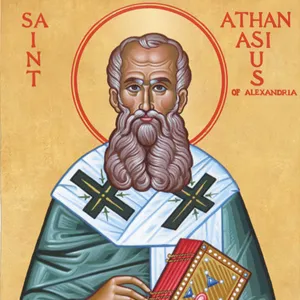
Free Daily Podcast Summary
Scripture with the Fathers: Daily Summaries Delivered
by Son of Athanasius
This podcast is a Scripture Study based on the interpretation of the Church Fathers
Latest Episodes
The most recent episodes — sign up to get AI-powered summaries of each one.
- 3 days ago23 min
Matthew 18.4 Repeated Forgiveness 490
Jesus continues his fourth discourse in instructing the disciples (Apostles) on the authority He is bestowing to them to bind and loose sins. Then Peter, in what he believes is a statement of forgiveness greater than the law requires, suggests to Jesus that seven times would be the limit. Jesus then, referencing the prophecy of Daniel explains to Peter that their mercy must be equal to His, which is unlimited. At the same time, Jesus is confirming Peter's confession that Jesus is in fact the Son of the Living God. We hear from the Fathers and Dr. Hahn, Dr. Pitre and Dr. Bergsma for further insight.
- 6 days ago21 min
Exodus 20.10 Thou Shalt Not Covet Thy Neighbor's Goods
In this episode we cover the tenth commandment and what it entails. We here from St. Thomas Aquinas to discuss the operations of the soul. We continue to look at the Catechism, St. Paul's letter to the Galatians, St. Chrysostom and St. Augustine to gain a handle what it means to "covet".
- 1 weeks ago23 min
Matthew 18.3 Binding and Loosing Sins
We discuss briefly the lost sheep and then go into our discussion about binding and loosing sins. Jesus gives us the process by which to correct a brother who has done us ill or caused injury, or sinned against us. We hear from St. Jerome, Pope St. Gregory the Great, St. Augustine, St. Hilary and Venerable Bede.
- 1 weeks ago21 min
Exodus 20.9 Thou Shalt Not Covet Thy Neighbor's Wife
We explore the ninth commandment, thou shalt not covet thy neighbor's wife. What does this mean to covet? Who is my neighbor's wife? What about coveting thy neighbor's husband? Is that covered too? The previous eight commandments dealt with the actions of the body, while this and the next deal with the dispositions of the soul. We explore the operations of the soul, how they were affected by original sin and the answer for those disordered affections.
- 2 weeks ago21 min
Matthew 18.2 Matthew 18.2 Cutting Off Stubling Blocks
We continue our discussion about Temptations to Sin which is a far worse fate for those who would temp others than to fall into sin. The Fathers reiterate Jesus in saying that whomever it is in one's life that may cause one to sin or who is not one who "does the will of my Father," should be cut off from us. While it is painful to remove people from our lives, if they are leading us to sin, we cannot have them in our close circles. Jerome tells us it is better to be alone than to have many people around us and fall into hell.
- 2 weeks ago21 min
Exodus 20.8 Thou Shalt Not Bear False Witness
The eighth commandment: Thou shalt not bear false witness against thy neighbor. We look to the Catechism as well as Fr. Heribert Jone's Moral Theology, to discuss what this means and what areas of our life it covers. Lying, while always immoral, has different levels of seriousness depending on the nature of the falsehood, who it is spoken to and for what reason. A distinction is rendered as to being a venial or mortal sin. The most serious types of bearing false witness is calumny and detraction. What is that and why are these types of speech so seriously disordered? Finally we look to St. Augustine to have a rule of speech to govern our tongue.
- 3 weeks ago22 min
Matthew 18.1 True Greatness; Temptations to Sin
We begin Chapter 18 and the fourth discourse of Jesus within the Gospel According to Matthew. We turn to the Catechism of the Catholic Church and St. Jerome to look into what Jesus means by being childlike and what it means for causing scandal to a little one who are the very ones who are great in the kingdom of Heaven.
- 3 weeks ago20 min
Exodus 20.7 Thou Shalt Not Steal
The Seventh Commandment forbids the taking of someone else's property and the right of one to possess property. But the commandment covers many other areas of our lives as it relates to our neighbor's property, including his own life. If one has property and the right to own it, does this automatically preclude systems of government that do away with private property? Are these systems of government evil? What about the poor, the wage earner, the employee and employer?
About Scripture with the Fathers
This podcast is a Scripture Study based on the interpretation of the Church Fathers
Customized Recaps
AI-powered recaps with compact key takeaways, quotes, and insights.
Straight to Your Inbox
Get key takeaways from Scripture with the Fathers in a 5-minute read.
Save Hours Every Week
Stay current on your favorite podcasts without falling behind.
Frequently Asked Questions
What is Podzilla's Scripture with the Fathers daily summary?
It's a free AI-powered email that summarizes new episodes of Scripture with the Fathers as soon as they're published. You get the key takeaways, notable quotes, and links & mentions — all in a quick read.
How does the Scripture with the Fathers podcast summary work?
When a new episode drops, our AI transcribes and analyzes it, then generates a personalized summary tailored to your interests and profession. It's delivered to your inbox every morning.
Is this an official Scripture with the Fathers product?
No. Podzilla is an independent service that summarizes publicly available podcast content. We're not affiliated with or endorsed by Son of Athanasius.
Can I get summaries of other podcasts too?
Absolutely! The free plan covers up to 3 podcasts. Upgrade to Pro for 15, or Premium for 50. Browse our full catalog at /podcasts.
How often does Scripture with the Fathers release new episodes?
Scripture with the Fathers publishes every few days. Our AI generates a summary within hours of each new episode.
What topics does Scripture with the Fathers cover?
Scripture with the Fathers covers topics including Religion & Spirituality, Spirituality. Our AI identifies the specific themes in each episode and highlights what matters most to you.
Start getting Scripture with the Fathers summaries tomorrow morning.
Free forever for up to 3 podcasts. No credit card required.
Free forever for up to 3 podcasts. No credit card required.