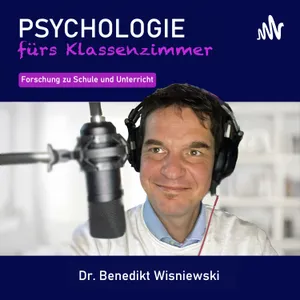
Free Daily Podcast Summary
Psychologie fürs Klassenzimmer: Daily Summaries Delivered
by Dr. Benedikt Wisniewski
Get key takeaways, quotes, and insights from Psychologie fürs Klassenzimmer in a 5-minute read. Delivered straight to your inbox.
Latest Episodes
The most recent episodes — sign up to get AI-powered summaries of each one.
- 1 weeks ago20 min
Dweck et al. (1995) | Growth Mindset
Thema: Growth MindsetUm diese Studie geht es: Dweck, C. S., Chiu, C.-y., & Hong, Y.-y. (1995). Implicit theories and their role in judgments and reactions: A world from two perspectives. Psychological Inquiry, 6(4), 267–285.Weitere Forschung:Sisk, V. F., Burgoyne, A. P., Sun, J., Butler, J. L., & Macnamara, B. N. (2018). To what extent and under which circumstances are growth mind-sets important to academic achievement? Two meta-analyses. Psychological Science, 29(4), 549–571.Macnamara, B. N., & Burgoyne, A. P. (2023). Do growth mindset interventions impact students’ academic achievement? A systematic review and meta-analysis. Educational Research Review, 38, 100503.
- Apr 13, 202634 min
Spezial: Die Bildungsweltmeister | Gespräch mit Alexander Brand
In dieser Spezialfolge unterhalte ich mich mit dem Bildungsjournalisten Alexander Brand über seine Reise in die erfolgreichsten Bildungssysteme der Welt, sein Buch „Die Bildungsweltmeister“ und die Frage, was wir aus Ländern wie Finnland oder Singapur für unser eigenes Bildungssystem lernen können.im Online-Buchhandel:"Die Bildungsweltmeister" von Alexander Brandab 16.07.2026: "Psychologie fürs Klassenzimmer": Das Buch zum Podcast
- Apr 6, 202622 min
Roberts et al. (2006) | Persönlichkeitsentwicklung
Thema: PersönlichkeitsentwicklungUm diese Studie geht es: Roberts, B. W., Walton, K. E., & Viechtbauer, W. (2006).Patterns of mean-level change in personality traits across the life course: A meta-analysis of longitudinal studies. Psychological Bulletin, 32(1), 1–25.Weitere Forschung:Hudson, N. W., & Fraley, R. C. (2015). Volitional personality trait change: Can people choose to change their personality traits?Journal of Personality and Social Psychology, 109(3), 490–507.Magidson, J. F., Roberts, B. W., Collado-Rodriguez, A., & Lejuez, C. W. (2014). Theory-driven intervention for changing personality: Expectancy value theory, behavioral activation, and conscientiousness. Developmental Psychology, 50(5), 1442–1450.
- Mar 25, 202621 min
Rozenblit & Keil (2002) | Methodenvielfalt
Thema: MethodenvielfaltUm diese Studie geht es:Rozenblit, L., & Keil, F. C. (2002). The misunderstood limits of folk science: An illusion of explanatory depth. Journal of Cognition, 7(1), 1–15. Erwähnt:Helmke, A., & Jäger, R. (2002). Das Projekt MARKUS. Mathematik-Gesamterhebung Rheinland-Pfalz: Kompetenzen, Unterrichtsmerkmale, Schulkontext. Landau: Verlag Empirische Pädagogik.Krammer, K. (2021). Methodenvielfalt im Unterricht und ihre Wirkung auf Lernerfolg (Masterarbeit). Universität Graz. https://unipub.uni-graz.at/obvugrhs/content/titleinfo/6802188/full.pdfMeyer, H. (2004). Was ist guter Unterricht? Berlin: Cornelsen.Huber, S. G., & Hader-Popp, S. (2008). Unterrichtsentwicklung durch Methodenvielfalt im Unterricht fördern. http://schulegestalten.net/pdf/Huber-HaderPopp-2008-UnterrichtsentwicklungDurchMethodenvielfaltImUnterrichtF%C3%B6rdern.pdfWeitere Forschung:Mills, C. M., & Keil, F. C. (2004). Knowing the limits of one’s understanding: The development of an illusion of explanatory depth. Journal of Experimental Child Psychology, 87(1), 1–32. Zemla, J. C., Sloman, S. A., Bechlivanidis, C., & Lagnado, D. A. (2024). Subjective understanding is reduced by mechanistic explanation. Journal of Cognition, 7(1), 1–15.
- Feb 18, 202622 min
Harp & Mayer (1998) | Anschaulichkeit
Thema: AnschaulichkeitUm diese Studie geht es:Harp, S. F., & Mayer, R. E. (1998). How seductive details do their damage: A theory of cognitive interest in science learning. Journal of Educational Psychology, 90(3), 414–434.Weitere Forschung: Alter, A. L., & Oppenheimer, D. M. (2009). Uniting the tribes of fluency to form a metacognitive nation. Personality and Social Psychology Review, 13(3), 219–235. Kaminski, J. A., Sloutsky, V. M., & Heckler, A. F. (2008). The advantage of abstract examples in learning math. Science, 320(5875), 454–455. Rey, G. D. (2012). A review of research and a meta-analysis of the seductive detail effect. Educational Research Review, 7(3), 216–237.
- Nov 23, 202522 min
Schmidt et al. (2022) | Vertrauen in Wissenschaft
Thema: Vertrauen in WissenschaftUm diese Studie geht es:Schmidt, K., Rosman, T., Cramer, C., Besa, K. S., & Merk, S. (2022). Teachers trust educational science – Especially if it confirms their beliefs. Frontiers in Education, 976556.Intro:Whitaker, T. (2009). Was erfolgreiche Lehrer anders machen. Weinheim: Beltz.Zum Confirmation Bias:Wason, P. C. (1960). On the failure to eliminate hypotheses in a conceptual task. Quarterly Journal of Experimental Psychology, 12, 129-140. Weitere Forschung:Carnine, D. (2000). Why education experts resist effective practices (And what it would take to make education more like medicine). Thomas B. Fordham Foundation.Rosman, T., & Merk, S. (2021). Teacher’s Reasons for Trust and Distrust in Scientific Evidence: Reflecting a “Smart But Evil” Stereotype?. AERA Open, 7, 23328584211028599.
- Oct 9, 202520 min
Luo et al. (2018) | Mitschriften
Um diese Studie geht es:Luo, L., Kiewra, K. A., Flanigan, A. E., & Peteranetz, M. S. (2018). Laptop versus longhand note taking: Effects on lecture notes and achievement. Instructional Science, 46, 947–971.Erwähnt:Mueller, P. A., & Oppenheimer, D. M. (2014). The pen is mightier than the keyboard: Advantages of longhand over laptop note taking. Psychological science, 25(6), 1159-1168.Weitere Forschung:Allen, M., LeFebvre, L., LeFebvre, L., & Bourhis, J. (2020). Is the pencil mightier than the keyboard? A meta-analysis comparing the method of notetaking outcomes. Southern Communication Journal, 85(3), 143-154.Horbury, S. R., & Edmonds, C. J. (2021). Taking class notes by hand compared to typing: Effects on children’s recall and understanding. Journal of research in childhood education, 35(1), 55-67.
- Sep 29, 202520 min
Bennewitz & Wegner (2017) | Elterngespräche
Um diese Studie geht es:Bennewitz, H., & Wegner, L. (2017). Empirische Arbeit: " Er tut sich einfach schwer.". Psychologie in Erziehung und Unterricht, 64(4), 270-281. Wahrnehmung von Elterngesprächen auf beiden Seiten:Lawrence-Lightfoot, S. (2003). The essential conversation: What parents and teachers can learn from each other. New York: Ballantine Books.Baker, C. & Keogh, J. (1995). Accounting for achievement in parent-teacher interviews. Human Studies, 18(2-3), 263-300.Cheatham, G. A. & Ostrosky, M. M. (2013). Goal setting during early childhood parent-teacher conferences: A comparison of three groups of parents. Journal of Research in Childhood Education, 27(2), 166-189Weitere Forschung:Gartmeier, M., Gebhardt, M., Dotger, B., & Schratz, M. (2016).Teachers’ communication competence: A latent class analysis of 677 German mathematics teachers. Teaching and Teacher Education, 54, 56–67. Munthe, E., & Westergård, E. (2023).Parents’, teachers’, and students’ roles in parent-teacher conferences: A systematic review and meta-synthesis. Teaching and Teacher Education, 136, 104355.
Get Psychologie fürs Klassenzimmer summaries in your inbox
Free AI-powered daily recaps. Key takeaways, quotes, and mentions — in a 5-minute read.
Get Free Summaries →Free forever for up to 3 podcasts. No credit card required.
You Might Also Like
Listeners also like.
Psychology in the Classroom
Lucinda Powell

Human Elevation Podcast - Der Podcast für innere Wissenschaft.
Patrick Reiser

Herzschlag Schule - Alles was die Schulwelt bewegt
Saskia Niechzial
Kritisches Denken Podcast
Kritisches Denken Podcast
Beziehungskosmos
Sabine Meyer & Felizitas Ambauen

glücklich verkopft - der Psychologie Podcast
Jessi & Wiebke (M. Sc. Psych. & Psychotherapeutinnen), Nora (M. Sc. Psych. & Psychotherapeutin i. A.)
Der Kita Podcast für bedürfnisorientierte Pädagogik
Lea Wedewardt

Herr Fechner lädt zum Gespräch - Der Bildungspodcast
Marco Fechner

Psychologie @work. Mental gesunde Arbeit, Führung und Vereinbarkeit
Dr. Silke Rusch

Der 6-Minuten-Podcast – Persönlichkeitsentwicklung to go!
Dominik Spenst
Die Psychologie der Selbstbeeinflussung
Marian Zefferer
Innerlich frei
Dr. Manuela Sekler
About Psychologie fürs Klassenzimmer
In diesem Podcast geht es um Forschung zu Schule und Unterricht, die jede Lehrerin und jeder Lehrer kennen sollte.In jeder Folge stelle ich Ihnen eine Studie, ein Review oder eine Metaanalyse vor, die für didaktische und pädagogische Erwägungen von Praktikerinnen und Praktikern relevant ist. Dabei gehe ich sowohl auf 'Klassiker' als auch auf aktuelle Forschung ein.Ich bin Schulpsychologe, nebenbei seit vielen Jahren in der Forschung tätig und habe früher zwölf Jahre lang selbst unterrichtet.https://bsky.app/profile/benwisniewski.bsky.social
Customized Recaps
AI-powered recaps with compact key takeaways, quotes, and insights.
Straight to Your Inbox
Get key takeaways from Psychologie fürs Klassenzimmer in a 5-minute read.
Save Hours Every Week
Stay current on your favorite podcasts without falling behind.
Frequently Asked Questions
What is Podzilla's Psychologie fürs Klassenzimmer daily summary?
It's a free AI-powered email that summarizes new episodes of Psychologie fürs Klassenzimmer as soon as they're published. You get the key takeaways, notable quotes, and links & mentions — all in a quick read.
How does the Psychologie fürs Klassenzimmer podcast summary work?
When a new episode drops, our AI transcribes and analyzes it, then generates a personalized summary tailored to your interests and profession. It's delivered to your inbox every morning.
Is this an official Psychologie fürs Klassenzimmer product?
No. Podzilla is an independent service that summarizes publicly available podcast content. We're not affiliated with or endorsed by Dr. Benedikt Wisniewski.
Can I get summaries of other podcasts too?
Absolutely! The free plan covers up to 3 podcasts. Upgrade to Pro for 15, or Premium for 50. Browse our full catalog at /podcasts.
How often does Psychologie fürs Klassenzimmer release new episodes?
Psychologie fürs Klassenzimmer publishes monthly. Our AI generates a summary within hours of each new episode.
What topics does Psychologie fürs Klassenzimmer cover?
Psychologie fürs Klassenzimmer covers topics including Science. Our AI identifies the specific themes in each episode and highlights what matters most to you.
Start getting Psychologie fürs Klassenzimmer summaries tomorrow morning.
Free forever for up to 3 podcasts. No credit card required.
Free forever for up to 3 podcasts. No credit card required.