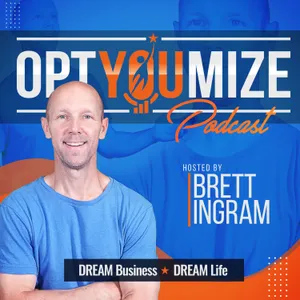
Free Daily Podcast Summary
optYOUmize: Daily Summaries Delivered
by Brett Ingram
Most self-improvement tells you that a better life is a more productive life — more output, more achievement, more optimized routines in service of bigger goals. optYOUmize begins from a different premise.You are not a machine to be tuned. You are a whole person — with competing needs, deep relationships, finite time, and an interior life that deserves as much care as your calendar.The optYOUmize podcast, hosted by entrepreneur, coach, and speaker Brett Ingram, is built around one question: what does a genuinely good life actually look like for you? Not the generic answer. Not the socially acceptable one. The honest one.Every episode — whether a guest conversation or a solo exploration — is organized around the seven pillars of a well-lived life: Mind & Inner Life, Body & Vitality, Purpose & Meaningful Work, Relationships & Connection, Money & Financial Wellbeing, Time, Rhythm & Rest, and Growth & Self-Becoming. These aren't isolated categories. They're domains of a whole life, alwa
Latest Episodes
The most recent episodes — sign up to get AI-powered summaries of each one.
- Today23 min
How to Find Meaning in a Job You Don't Love
You can find meaning in a job you don't love by letting it be one part of a meaningful life, then looking for the craft, contribution, and security already inside it. The usual advice gives you two options: love your job or leave it. This episode rejects that binary. A job doesn't have to be your calling for your life to be full, and even a job that never becomes your passion usually holds more meaning than the flatness lets you see. The work is to stop asking one job to carry your whole identity, then change your relationship to the work in front of you. What you'll discover: - Why the ache of a fine-but-flat job is so common, and why the guilt layered on top of it is a cultural leftover, not a personal failure - Why asking one job to be your paycheck, purpose, and identity all at once almost guarantees disappointment - Why "follow your passion" is often backwards, and how passion usually grows out of mastery and contribution - What the research on jobs, careers, and callings shows about how people with the same job title relate to the work differently - The three places meaning lives at work: craft, contribution, and container - What hospital cleaners reveal about finding the person on the other end of your work - Job crafting: the small task, relational, and cognitive changes anyone can make to reshape a role - How to tell a job that is flat and worth mining from a job that is wrong and worth leaving Q: How do I find meaning in a job I don't love? A: Stop asking your job to be your whole purpose. Let it be the container that funds and protects the parts of life that matter most, then look for the meaning already in the work: craft (doing it well), contribution (who it serves), and container (what it makes possible). Small job crafting changes can add more. Q: Do you have to love your job to be happy? A: No. For most of human history work was how people ate, while meaning came from family, community, and craft. A job that funds and protects a life you love is doing something meaningful, even if it never becomes your passion. Q: How do I know if I should find meaning in my job or leave it? A: Finding meaning is for a job that is fundamentally okay but feels flat. Leaving is for a job that is fundamentally wrong: underpaying, disrespecting, or harming you. Reframing should never be a way to tolerate the intolerable. This episode is part of the optYOUmize Purpose & Meaningful Work series, exploring how to build work that matters without making work your whole identity. Subscribe on Apple Podcasts, Spotify, Amazon Music, or YouTube. If this episode was useful, a quick review helps more people find the show: ratethispodcast.com/optyoumize If you've been searching for how to find purpose at work, wondering what to do when your job isn't your passion, or curious about job crafting and how to feel fulfilled without quitting, this conversation is worth your time. You can have a life you love without loving every part of how you fund it.
- 4 days ago19 min
Why Do I Avoid Looking at My Bank Account?
You avoid looking at your bank account because you're not avoiding a number, you're avoiding a feeling, and for many people that feeling is shame. Here's why it happens and how to start looking again. Financial avoidance isn't laziness and it isn't a discipline problem. Brett Ingram explains the ostrich effect, why "just check it every day" usually backfires, and the reframe the episode turns on: you're not avoiding a number, you're avoiding a verdict. The balance is a fact about your circumstances. It was never a fact about your worth. What you'll discover: Why closing the banking app before the balance loads is your mind being efficient, not irrational, and how short-term relief trains the habit The ostrich effect: what a Vanguard study of more than a million investors reveals about who stops looking when the news might be bad (and why real ostriches are innocent) Why the feeling underneath financial avoidance is often shame, not fear of the number itself Why "just check it every day" asks you to walk further into the cold ocean without changing the feeling, and why willpower is the wrong tool How money scripts, the unconscious beliefs about money you absorbed young, can make looking at your own account feel shameful The four shifts of looking without a verdict: separate looking from fixing, change the conditions, change the question, name the feeling before the number The honest glance: a ten-minute, once-this-week practice to look at one number, change nothing, and close it Q: Why do I avoid looking at my bank account? A: Because your brain has learned that not looking makes a painful feeling stop. The relief of closing the app is real, and it trains the habit. For many people the feeling underneath is shame, which turns the balance into a verdict on their worth instead of a piece of information. Q: What is the ostrich effect in money? A: It's the tendency to avoid financial information when you expect bad news. In a study of Vanguard investors, account logins dropped by about nine and a half percent after a down day in the market. Even people who chose to invest quietly turn away when the news might sting. Q: How do I stop avoiding my finances? A: Make looking safe before you try to make it a habit. Separate looking from fixing, set a ten-minute timer, name the feeling out loud, and ask one question: what's actually true right now? Then change nothing and close it. This episode is part of the optYOUmize Money & Financial Wellbeing series, exploring money as a tool for a good life rather than a scoreboard. Subscribe on Apple Podcasts, Spotify, Amazon Music, or YouTube. If this episode was useful, a quick review helps more people find the show: https://ratethispodcast.com/optyoumize If you've been searching for why you're scared to check your bank account, how to stop avoiding your finances, or what to do about money shame and financial anxiety, this conversation is worth your time.
- 1 weeks ago19 min
Why Do I Feel Anxious When Things Are Finally Going Well?
You feel anxious when things are going well because a mind wired to guard what matters suddenly has more to protect. It's called foreboding joy, and you can learn to let the good in. Anxiety in the middle of a good life isn't ingratitude and it isn't self-sabotage. Brett Ingram explains the three forces behind it, why "just be grateful" quietly makes it worse, and the reframe the episode turns on: this is a capacity problem, not an anxiety problem. You got good at building a good life. Nobody taught you how to live in one. What you'll discover: Why a good life doesn't switch off your threat-detection system, it just gives the system more to guard (negativity bias, from the "Bad Is Stronger Than Good" research) The strange math of loss aversion: why having little means little to fear, and why a full life comes with stakes How your nervous system can learn to treat calm as the quiet before something hard, and why excitement and anxiety feel almost identical in the body Why "just be grateful" and "just relax and enjoy it" backfire by adding guilt on top of the original feeling Brene Brown's concept of foreboding joy, and why joy may be the most vulnerable emotion of all The three-move framework: name it, separate the signal from the weather, and let it land A ten-second daily practice for letting one good moment register, plus an honest line on when to talk to a professional Q: Why do I feel anxious when things are going well? A: Because your mind is built to track threats, and a good life gives it more to protect. Negativity bias makes bad experiences stick harder than good ones, and loss aversion makes the fear of losing something feel bigger than the joy of having it. The anxiety is often a sign your life got good enough to be afraid of losing. Q: What is foreboding joy? A: Foreboding joy is Brene Brown's name for the moment you feel something wonderful and your mind instantly jumps to the worst-case scenario. It's a flinch that protects you from the vulnerability of fully feeling joy. It's not a flaw, and it can be worked with. Q: Does bracing for the worst protect me? A: Not really. If a loss comes, grief arrives at full size either way. Bracing mostly taxes the good time you do have, so you pay for a loss in advance, every day, for something that may never happen. This episode is part of the optYOUmize Mind & Inner Life series, exploring how to build a healthier relationship with your own mind and emotions. Subscribe on Apple Podcasts, Spotify, Amazon Music, or YouTube. If this episode was useful, a quick review helps more people find the show: https://ratethispodcast.com/optyoumize If you've been searching for why you can't enjoy good things, how to stop waiting for the other shoe to drop, or why you feel scared to be happy, this conversation is worth your time.
- 1 weeks ago21 min
Why Do I Feel Like I'm Wasting My Potential?
Why do you feel like you're wasting your potential? Because you're measuring your real life against an imaginary version of you who paid no price. Here's how to read the feeling instead. You're doing fine, maybe better than fine, and still a quiet voice says you should be doing more. Brett Ingram explains the psychology behind that ache, why both the hustle script and the comfort script make it worse, and a different way to hold the word: potential isn't a debt you owe, it's a direction you move in. What you'll discover: Why "wasting my potential" is a comparison to a fantasy self who never made a tradeoff, never got tired, and never paid a bill Self-discrepancy theory: how the gap between your actual, ideal, and ought selves produces sadness and guilt at the same time Why the hustle script ("grind harder") and the comfort script ("you're enough, let it go") both treat the feeling as a verdict What Daniel Pink's regret research says about chances not taken, and why it matters here Potential as a debt versus potential as a direction, and why more output does not always produce more of you The Honest Yardstick: a ten-minute, three-step practice to name the person you're comparing yourself to, price out their life, and turn guilt into one honest step How to tell a true nudge from the inner critic, and how coasting differs from shame Q: Why do I feel like I'm wasting my potential? A: Usually because you're comparing your real life, with real limits and tradeoffs, to an imagined version of you who made every right call and paid no costs. That person can't exist, so you always come up short. The feeling is a signal to read, not a verdict to obey. Q: How do I know if I'm wasting my potential or just being hard on myself? A: Listen to the tone. A true nudge is specific, forward-looking, and calm: I'd like to be closer to this, here's a step. The inner critic delivers global verdicts about your worth. If the voice is grading your soul, it's the critic; if it's pointing at a path, it's worth a listen. Q: How do I stop feeling guilty about unrealized potential? A: Stop treating potential as a debt and start treating it as a direction. Name the person you're comparing yourself to, price out what their life would actually cost, then choose one small, honest step this month toward what's left. This episode is part of the optYOUmize Purpose & Meaningful Work series, exploring how to build work and a life that fit who you are. Subscribe on Apple Podcasts, Spotify, Amazon Music, or YouTube. If this episode was useful, a quick review helps more people find the show: ratethispodcast.com/optyoumize If you've been asking am I wasting my potential, how to stop feeling like you should be doing more with your life, or how to live up to your potential without burning out, this conversation is worth your time.
- 2 weeks ago28 min
Why Can't I Celebrate My Own Wins?
Why can't you celebrate your wins? Three forces erase them: a resetting baseline, a negativity bias, and a moving goalpost. The fix is letting a win change you, not celebrating harder. You hit the goal and felt almost nothing, then asked "what's next?" That isn't ingratitude or modesty. Brett Ingram explains the mechanism behind it and offers a different idea of what a win is for: achieving adds to a pile, becoming changes who you are. What you'll discover: Why the same accomplishment you'd throw a friend a party for gets a curt "fine" when it's yours The hedonic treadmill: why the promotion, the raise, and the new house reset to "normal" so fast The negativity bias ("Bad Is Stronger Than Good"): why one flaw is louder in your nervous system than a 95 percent success The high-achiever reflex that moves the goalpost the instant you cross the line Why "just celebrate your wins" backfires: it turns celebration into a chore wearing a party hat Achieving versus becoming: why you can't feel a win you only added to the pile The arrival fallacy, and the squash champion who felt empty the night he won Three questions that let a win land: What did this take? Who did I have to become? What will I let it change? The done list: a five-minute weekly practice to give your wins a place to live Q: Why can't I celebrate my own accomplishments? A: Usually it's three forces, not a flaw. Your baseline resets quickly after a win, the one imperfection feels louder than the whole success, and the high-achiever reflex moves the goalpost the moment you cross it. Letting a win change how you see yourself, not just your to-do list, is what makes it land. Q: Why do I feel nothing after reaching a goal? A: The moment of crossing the line is tiny and can't hold the weight of years of expectation. This is what Tal Ben-Shahar calls the arrival fallacy. Worth tied to achieving rather than becoming leaves the finish line feeling oversold. Q: How do I actually let myself enjoy my wins? A: Keep a done list alongside your to-do list, pick one entry a week, and ask what it took, who you had to become, and what you will let it change. Then pause for sixty seconds before the next goal. That pause is the celebration. This episode is part of the optYOUmize Growth & Self-Becoming series, exploring how to grow toward who you're becoming, not just forward. Subscribe on Apple Podcasts, Spotify, Amazon Music, or YouTube. If this episode was useful, a quick review helps more people find the show: https://ratethispodcast.com/optyoumize If you've been searching for why you don't feel proud of your accomplishments, why you always move the goalposts, or how to enjoy your own success without burning out, this conversation is worth your time.
- 2 weeks ago20 min
Why Do I Stay Up Late When I'm Exhausted?
Why do you stay up late when you're exhausted? It's often revenge bedtime procrastination: you're reclaiming free time your day never gave you. The fix isn't a stricter bedtime. Staying up late when you're wiped out usually isn't a willpower failure or a sleep problem. Brett Ingram makes the case that it's a quiet protest against a day with no freedom in it, which is why sleep-hygiene rules keep failing, and why the real fix lives in the daylight, not at midnight. What you'll discover: Why midnight feels like relief, not a problem: it's often the only unclaimed time in your whole day What researchers call "bedtime procrastination" (Floor Kroese, 2014) and why it isn't a sign you're lazy Why your self-control is spent by nightfall, and why the moment you need it most is when you have the least How "revenge bedtime procrastination" went viral in 2020, and what the word "revenge" gets exactly right Why the late night isn't the disease, it's the fever, and why "just go to bed" treats the wrong thing The freedom debt: why your late night is a bill, and your day ran up the charge A three-move framework: name what you're reaching for, build a protected pocket of daylight, and end the night on purpose The difference between rest that refills you and rest that just sedates you The Midnight Audit: a ten-minute, one-time exercise to find out what you're really staying up for Q: Why do I stay up late even when I'm exhausted? A: Often it's revenge bedtime procrastination: delaying sleep to take back free time your day didn't give you. After hours of meeting other people's demands, your self-control is spent and the quiet night feels like the only time that's truly yours. Q: Is staying up late a sign I'm lazy or undisciplined? A: No. Research on bedtime procrastination links it to lower self-regulation, but that is a tired mental muscle, not a character flaw. You spend your self-control all day being responsible, so little is left by bedtime. Q: How do I stop staying up so late? A: Go upstream. Instead of forcing an earlier bedtime, put a small protected pocket of genuine free time, around twenty minutes, into your daylight hours, and give the night a deliberate closing ritual. When the day has some freedom in it, midnight stops carrying all of it. This episode is part of the optYOUmize Time, Rhythm & Rest series, exploring how to build days with real room in them, and a better relationship with your own time. Subscribe on Apple Podcasts, Spotify, Amazon Music, or YouTube. If this episode was useful, a quick review helps more people find the show: https://ratethispodcast.com/optyoumize If you've been searching for why you can't go to bed even when you're tired, how to stop staying up too late, or why you stay up late for "me time," this conversation reframes the problem: you don't need to be sent to bed like a kid, you need a day worth going to bed from.
- 3 weeks ago22 min
Why Don't I Feel Wonder Anymore?
Why don't you feel wonder anymore? Your brain habituates to the familiar, and an optimized life treats every moment as useful, which crowds out awe. Wonder isn't gone. Your attention got reallocated. The flatness isn't a verdict on your life. Brett Ingram makes the case that it's the predictable result of an efficient mind in a life built for control, and that awe is far more available, in far more ordinary places, than most of us think. What you'll discover: Why life can feel flat even when nothing is wrong, and why it isn't a sign you've gotten jaded or old What awe actually is, according to Dacher Keltner: the emotion we feel in response to vast and mysterious things we don't understand Why people feel awe two to three times a week on average, and what that says about where it's hiding Why the most common source of awe worldwide isn't nature. It's other people being quietly, remarkably good (moral beauty) Habituation: why your brain files the familiar under "handled" and stops looking Why an optimized life is almost built to kill wonder: awe requires what optimization removes, the willingness to meet something you can't control or use What awe does for you: more felt time, less impatience, a quieter inner critic, and the awe walk study "Look as if you'll never see this again": one light practice that is not another item on your to-do list Q: Why don't I feel wonder or awe anymore? A: Two things usually work together. Your brain habituates, paying less attention to anything familiar to save energy, and a busy, optimized life trains you to treat every moment as something to get through or get something from. Awe needs the opposite: encountering something you can't control or use. Q: How do I feel awe again as an adult? A: Stop trying to manufacture it and lower the barriers instead. Go somewhere ordinary, put the phone away, and look as if you'll never see it again. Awe also shows up reliably when you watch for other people being kind, brave, or good. Q: Is feeling flat and unamazed a sign something is wrong with me? A: Usually not. It's common, and it tends to reflect habituation and over-efficiency, not a defect. If the flatness is heavy and persistent, steals your sleep or appetite, or pulls you away from people, that deserves real support, not just a better walk. This episode is part of the optYOUmize Mind & Inner Life series, exploring attention, presence, and the quality of your inner experience. Subscribe on Apple Podcasts, Spotify, Amazon Music, or YouTube. If this episode was useful, a quick review helps more people find the show: https://ratethispodcast.com/optyoumize If you've been searching for how to feel awe again, why life feels flat and boring, or how to bring back a sense of wonder as an adult, this conversation offers a hopeful frame: the capacity for wonder is a muscle, and muscles come back.
- 3 weeks ago24 min
Why Does One Bad Moment Ruin My Whole Day?
Why does one bad moment ruin your whole day? Because your brain weighs bad more than good. The fix isn't positivity. It's separating the event from the spill. A thirty-second email can cost you nine good hours, and the problem is rarely the size of the moment. It's the disproportion. Brett Ingram explains the negativity bias behind it, why "stay positive" and "just let it go" backfire, and a 60-second practice called right-sizing the ripple. What you'll discover: Why a bad moment and a bad day are two different things: the event is over in seconds, the spill is what you do with it afterward The negativity bias: why bad events hit harder and linger longer than good ones of the same size (Baumeister's "Bad Is Stronger Than Good") Negativity dominance: why one drop of sewage ruins a barrel of wine, but one drop of wine doesn't fix a barrel of sewage Why your alarm system was built for lions but keeps getting pointed at emails Why "stay positive" and "just let it go" fail, and why suppressing a feeling tends to make it louder Right-sizing the ripple: let the first wave move, then name what actually happened in one sentence with no forecast The one question to carry out: is this a today problem or a life problem? The peak-end rule, and why the last thing you touch before bed changes how the whole day gets filed Q: Why does one bad thing ruin my whole day? A: Because of the negativity bias: bad events hit harder and linger longer than good events of the same size, and the brain tilts a mixed day toward bad. The moment itself is usually brief. What lasts is the spill: the replay, the story about what it means, and how it leaks into everything after. Q: How do I stop a small bad moment from taking over my day? A: Let the first wave of feeling pass without narrating it, then state what actually happened in one sentence with no prediction attached. Ask whether it's a today problem or a life problem. Most are today problems, and they get this hour, not the whole day. Q: Is it normal to dwell on one bad moment more than many good ones? A: Yes. Everyone with a working nervous system does it, and the more sensitive and conscientious you are, the more it happens. It's an ancient threat-detection system, not a character flaw. If a day-wrecking moment shows up every single day, though, the source may need changing, not just the spill. This episode is part of the optYOUmize Mind & Inner Life series, exploring how your mind actually works and how to work with it instead of fighting it. Subscribe on Apple Podcasts, Spotify, Amazon Music, or YouTube. If this episode was useful, a quick review helps more people find the show: https://ratethispodcast.com/optyoumize If you've been searching for why one bad moment ruins your day, how to stop dwelling on small things, or how to shake a bad mood without pretending it isn't there, this conversation offers a different frame: you can't stop the first wave, but you have far more say over the spill than you think.
Get optYOUmize summaries in your inbox
Free AI-powered daily recaps. Key takeaways, quotes, and mentions — in a 5-minute read.
Get Free Summaries →Free forever for up to 3 podcasts. No credit card required.
You Might Also Like
Listeners also like.
A Bit of Optimism
Conversations with thinkers and doers exploring what drives purpose, growth, and meaning in life.

The One You Feed | Personal Growth, Emotional Resilience & Purpose
Conversations with thought leaders explore personal growth, emotional resilience, and living with purpose through small, consistent actions.

Life is an Inside Job with Coach Mike Basevic
Explores subconscious emotional patterns affecting high achievers who struggle with self-doubt despite external success.

Becoming You with Suzy Welch
A podcast exploring personal growth, career choices, and life decisions with candid conversations and practical insights.
The PURPOSEFUL LIFE Podcast
Examines intentional living through mindset shifts, habits, and personal growth to help find purpose and balance.
Working Hard with Grace Beverley
Real people share hard-won lessons on success, resilience, and life balance across diverse fields, from activism to business and beyond.

Growth Mindset Psychology: The Science of Self-Improvement
Explores the science behind lasting self-improvement through psychology, neuroscience, and timeless wisdom traditions.

Quest for Success
A clinical psychologist helps leaders strengthen mindset, morals, body, spirit, and finances to overcome self-doubt and achieve personal success.

Almost 30
Best friends explore personal growth, wellness, and life transitions through candid conversations and expert interviews.

Modern Body Modern Life
A body and life coach guides women in midlife to build strength, confidence, and intention through mindset, habits, and self-trust.

The Health Continuum
High-performing professionals learn science-based health strategies to sustain energy, focus, and resilience in demanding careers.

Know Thyself
Examines self-awareness, consciousness, and personal growth through interviews with experts in spirituality, science, and creativity.
About optYOUmize
Most self-improvement tells you that a better life is a more productive life — more output, more achievement, more optimized routines in service of bigger goals. optYOUmize begins from a different premise.You are not a machine to be tuned. You are a whole person — with competing needs, deep relationships, finite time, and an interior life that deserves as much care as your calendar.The optYOUmize podcast, hosted by entrepreneur, coach, and speaker Brett Ingram, is built around one question: what does a genuinely good life actually look like for you? Not the generic answer. Not the socially acceptable one. The honest one.Every episode — whether a guest conversation or a solo exploration — is organized around the seven pillars of a well-lived life: Mind & Inner Life, Body & Vitality, Purpose & Meaningful Work, Relationships & Connection, Money & Financial Wellbeing, Time, Rhythm & Rest, and Growth & Self-Becoming. These aren't isolated categories. They're domains of a whole life, alwa
Customized Recaps
AI-powered recaps with compact key takeaways, quotes, and insights.
Straight to Your Inbox
Get key takeaways from optYOUmize in a 5-minute read.
Save Hours Every Week
Stay current on your favorite podcasts without falling behind.
Frequently Asked Questions
What is Podzilla's optYOUmize daily summary?
It's a free AI-powered email that summarizes new episodes of optYOUmize as soon as they're published. You get the key takeaways, notable quotes, and links & mentions — all in a quick read.
How does the optYOUmize podcast summary work?
When a new episode drops, our AI transcribes and analyzes it, then generates a personalized summary tailored to your interests and profession. It's delivered to your inbox every morning.
Is this an official optYOUmize product?
No. Podzilla is an independent service that summarizes publicly available podcast content. We're not affiliated with or endorsed by Brett Ingram.
Can I get summaries of other podcasts too?
Absolutely! The free plan covers up to 3 podcasts, any in the catalog. Basic raises that to 15, Pro to 40 and Max to 100. Browse our full catalog at /podcasts.
How often does optYOUmize release new episodes?
optYOUmize publishes weekly. Our AI generates a summary within hours of each new episode.
What topics does optYOUmize cover?
optYOUmize covers topics including Education, Business, Entrepreneurship, Self-Improvement. Our AI identifies the specific themes in each episode and highlights what matters most to you.
Start getting optYOUmize summaries tomorrow morning.
Free forever for up to 3 podcasts. No credit card required.
Free forever for up to 3 podcasts. No credit card required.