Free Daily Podcast Summary
Mysteries of the Universe: Daily Summaries Delivered
by TheTuringApp.Com
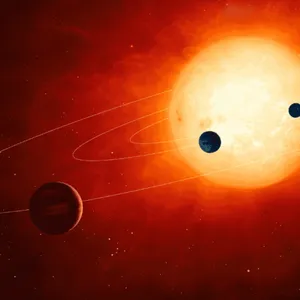
Journey into the most mind-boggling mysteries of the cosmos. Uncover the blinding power of quasars, brighter than a trillion suns, that outshine entire galaxies. Explore the coldest reaches of the universe, where temperatures plummet to near absolute zero, defying the very essence of life. And venture into the tantalizing question of life beyond Earth—could it thrive on distant exoplanets, under alien suns, or in oceans hidden beneath icy worlds? Each episode takes you deeper into the unknown, unraveling secrets that challenge the boundaries of science and ignite the imagination. Are you ready to explore the impossible?
Latest Episodes
The most recent episodes — sign up to get AI-powered summaries of each one.
- 3 weeks ago25 min
What Has JWST Found So Far
n this episode, we celebrate the third anniversary of the James Webb Space Telescope (JWST). Since its launch on a pillar of fire in 2021, this "house-sized" observatory has moved beyond the limits of visible light to capture the universe in the infrared. From the chemical signatures of alien worlds to the "impossible" maturity of the first galaxies, Webb is not just taking pictures—it is rewriting the textbooks of cosmology.As we look to the next few years, the mission turns toward even deeper mysteries. Can Webb find the first Population III stars—the very first stars made of pure hydrogen and helium? Will it witness a "Direct Collapse" black hole in the act of forming? The golden eye remains our most powerful tool for turning the "unseeable" into the "immeasurable."
- Aug 18, 202624 min
Quest for Alien Moons
In this episode, we venture into the frontier of a new astronomical chase: the hunt for the first "exomoon." We trace the story back to a strange eclipse 433 light-years away in the Centaurus constellation, where a "super-Saturn" planet named J1407b left observers puzzled until they realized a massive gap in its 37-ring system might be hiding an unseen, Earth-sized moon. We look at why finding these alien satellites is so critical, exploring how our own Moon acts as a vital planetary gyroscope that stabilizes Earth's tilt, creates coastal tide pools, and secures the long-term climate stability necessary for life to thrive. But how do you spot a small, dark moon across thousands of light-years of space? We break down the precise forensic methods astronomers use to analyze starlight—from searching for secondary shadows in the transit method to tracking a planet's microscopic gravitational "wobble" via Transit Timing Variations (TTV). Finally, we dive into the premier cosmic suspects: the jaw-dropping candidate Kepler-1625b, which appears to host a gas moon the size of Neptune, and the 2022 discovery of Kepler-1708b i. It’s a high-stakes scientific detective story filled with data replications, astronomical skepticism, and stellar "impostors" like giant rotating starspots that threaten to derail the entire race.
- Aug 11, 202620 min
How To Deal With An Explosion In Space Junk
In this episode, we confront a tragedy of the commons playing out right above our heads. For six decades, humanity has launched rockets with a completely permissive attitude toward the mess left behind, and that carefree expansion has effectively walled us in. We begin with a harrowing, high-stakes red alert on the International Space Station, where the seven-person crew was forced to lock down modules and retreat into their docked lifeboats as a massive cloud of military shrapnel hurtled toward them at 28,000 kilometers per hour. We pull apart the unforgiving kinetic equations of space travel, where mass becomes entirely irrelevant compared to speed. You'll learn why a tiny, one-gram chip of paint, completely invisible to ground radar, can strike a spacecraft with the devastating momentum of a sedan moving at 60 kilometers per hour, shattering satellites into thousands of new, untrackable bullets. We dive into Donald Kessler’s terrifying 1978 "Kessler Syndrome" prediction, exploring why scientists fear we have already crossed the tipping point into a self-sustaining, cascading chain reaction of orbital collisions. Finally, we look at how private mega-constellations are breaking our space defense systems, leaving human operators entirely overwhelmed by thousands of automated close-approach panics every single week.
- Aug 4, 202627 min
Molecular Origins of Planetary Systems
In this episode, we peer into the deep cosmic past to explore the molecular origins of planetary systems. We highlight the young star HOPS-315 in the Orion Molecular Cloud, where astronomers are watching crystalline silicate minerals condense from hot gas in real time, mirroring what our own Sun looked like 4.5 billion years ago. We dive into how space-based tools are cracking the secrets of these planetary nurseries, turning invisible infrared light into precise molecular barcodes that index water, carbon dioxide, and methane without ever physically touching them.We follow these microscopic dust grains as they transform into cosmic laboratories. Trapped inside interstellar ice layers, simple molecules collide to synthesize complex organic compounds—like methanol and acetic acid—long before a planet even exists. Finally, we explore the chemical geography of protoplanetary disks, mapping out the invisible boundaries called "snow lines" that sort raw materials into distinct thermal zones. We look at groundbreaking discoveries from the James Webb Space Telescope that show how drifting icy pebbles can deliver a local water reservoir to newborn rocky worlds, proving that planets don't have to wait for comets to bring them life-giving water.
- Jul 28, 202625 min
Black and Hot, Universe's Most Common Ice
In this episode, we venture into the extreme target chambers of modern physics to explore superionic ice, or Ice XVIII. We begin in 2019 at the Laboratory for Laser Energetics, where scientists used gem-quality diamonds and one of the world's most powerful lasers to mimic the interior of alien worlds. By blasting a trapped water droplet with an intense shockwave, they subjected it to millions of atmospheres of pressure and temperatures hitting 5,000°C—uncovering the first direct evidence of a material that defies classical thermodynamics.We pull apart the mind-bending atomic architecture of this "ice zoo" phase. Under extreme planetary compression, water molecules completely break apart. The heavy oxygen atoms freeze into a rigid, solid crystal lattice, while the hydrogen atoms turn into a soup of positively charged protons that flow freely through the gaps like a liquid.We trace this discovery from its early 1988 roots as a doubted "supercomputer mirage" to its status today as a proven cosmic reality. It turns out this dark crystal isn't a rare anomaly—it is likely the most common form of water in the universe, filling the deep interiors of ice giants across the galaxy.
- Jul 21, 202627 min
Why And When Will the Sun Stop Burning
In this episode, we step inside the thermonuclear furnace of our closest star to explore the delicate physics keeping it alive and the hidden countdown to its ultimate demise. Powered by a relentless gravitational weight that crushes its core into a plasma furnace of tens of millions of degrees, the sun survives on a strict balance between inward gravity and the outward push of nuclear fusion. But calculating the sun's precise lifespan has been plunged into a fascinating scientific mystery. It turns out that a tiny detail, the exact "recipe" of the sun's heavy chemical ingredients, or its metallicity, acts like a thick winter coat, trapping core radiation and dictating how fast the star burns through its finite hydrogen fuel.For decades, this recipe was considered a settled cornerstone of astronomy. Now, two of science's most trusted methods of "reading" the sun are locked in a major contradiction, threatening to alter our standard solar model and force a massive 10 to 15 percent recalculation of the age of the entire cosmos.
- Jul 14, 202621 min
How Did The Moon Form?
In this episode, we tackle one of the greatest enduring paradoxes in planetary science: the mystery of how the moon was born. We begin in December 1972 with Apollo 17 astronaut Harrison Schmitt—the first and only trained geologist to walk on the lunar surface. The off-white rock he collected, troctolite 76536, would become a message from the solar system's childhood, preserved like a pristine fossil on a geologically quiet world.We break down the three classic origin theories, capture, fission, and co-accretion, to reveal why the physical math behind them simply doesn't add up. Then, we look at the reigning champion of lunar history: the Giant Impact Hypothesis, which suggests a Mars-sized planet named Theia smashed into the proto-Earth 4.5 billion years ago. But when advanced mass spectrometers checked the isotopic "fingerprints" of lunar samples, they uncovered a stunning crisis. The moon doesn't look like an outsider; its chemical signature is identical to Earth's down to a tiny fraction. To resolve this cosmic paradox, we explore the radical new "Synestia" model—a theory of a collision so violently extreme that it melted both worlds into a searing, spinning, donut-shaped cloud of vaporized rock.
- Jul 7, 202626 min
Alien Plants: Hunt for Photosynthesis on Exoplanets
For most of human history, stars were just points of light. Today, we know of over 6,000 planets orbiting those stars—but what do they actually look like? In this episode, we explore the incredible forensic science of exoplanet discovery.We dive into the physics of "direct imaging," where astronomers attempt to catch just a few photons of light from a planet while being blinded by the glare of its host star. Learn about the "red edge"—a telltale signal of vegetation—and how the "glint" of distant oceans could reveal liquid water millions of miles away. Join us as we journey from unresolved dots of light to the next generation of telescopes that will show us the physical stage upon which alien life might be acting.
Get Mysteries of the Universe summaries in your inbox
Free AI-powered daily recaps. Key takeaways, quotes, and mentions — in a 5-minute read.
Get Free Summaries →Free forever for up to 3 podcasts. No credit card required.
You Might Also Like
Listeners also like.
Bedtime Astronomy
A calming exploration of cosmic wonders, sharing stories about stars, planets, and celestial phenomena to inspire curiosity before sleep.

Astrum Space
Explores the planets and wonders of the Solar System through images and videos from space missions.

Mysterious Universe
Explores fringe science, UFOs, cryptozoology, and alternative history with a mix of curiosity and humor.
Cosmos in a Pod
Explores space, science, philosophy, and technology to reveal the wonders of the universe and humanity's place within it.

The Quanta Podcast
A deep dive into fundamental questions in science and math through conversations with researchers and Quanta Magazine editors.
Daniel and Kelly’s Extraordinary Universe
Two scientists explore diverse topics across the universe, from particles to ecosystems, with accessible and engaging explanations.

The World, the Universe and Us
Explores big scientific questions about life, consciousness, climate, and the cosmos with expert scientists and New Scientist journalists.
NASA's Curious Universe
Mind-blowing stories from inside NASA’s space exploration, revealing the people and science behind cosmic discoveries.

Into the Impossible With Brian Keating
Brian Keating explores profound scientific and philosophical questions with leading thinkers in physics, technology, and beyond.
Crash Course Pods: The Universe
A theoretical astrophysicist and a bestselling author explore the history and future of the universe.

Hostile Worlds: Exploring Space
A documentary-style podcast exploring extreme alien environments through immersive audio storytelling aboard a fictional exploration vessel.

Ask a Spaceman!
An astrophysicist answers listener questions about space, time, and the universe.
About Mysteries of the Universe
Journey into the most mind-boggling mysteries of the cosmos. Uncover the blinding power of quasars, brighter than a trillion suns, that outshine entire galaxies. Explore the coldest reaches of the universe, where temperatures plummet to near absolute zero, defying the very essence of life. And venture into the tantalizing question of life beyond Earth—could it thrive on distant exoplanets, under alien suns, or in oceans hidden beneath icy worlds? Each episode takes you deeper into the unknown, unraveling secrets that challenge the boundaries of science and ignite the imagination. Are you ready to explore the impossible?
Customized Recaps
AI-powered recaps with compact key takeaways, quotes, and insights.
Straight to Your Inbox
Get key takeaways from Mysteries of the Universe in a 5-minute read.
Save Hours Every Week
Stay current on your favorite podcasts without falling behind.
Frequently Asked Questions
What is Podzilla's Mysteries of the Universe daily summary?
It's a free AI-powered email that summarizes new episodes of Mysteries of the Universe as soon as they're published. You get the key takeaways, notable quotes, and links & mentions — all in a quick read.
How does the Mysteries of the Universe podcast summary work?
When a new episode drops, our AI transcribes and analyzes it, then generates a personalized summary tailored to your interests and profession. It's delivered to your inbox every morning.
Is this an official Mysteries of the Universe product?
No. Podzilla is an independent service that summarizes publicly available podcast content. We're not affiliated with or endorsed by TheTuringApp.Com.
Can I get summaries of other podcasts too?
Absolutely! The free plan covers up to 3 podcasts. Upgrade to Pro for 15, or Premium for 50. Browse our full catalog at /podcasts.
How often does Mysteries of the Universe release new episodes?
Mysteries of the Universe publishes weekly. Our AI generates a summary within hours of each new episode.
What topics does Mysteries of the Universe cover?
Mysteries of the Universe covers topics including Science, Astronomy. Our AI identifies the specific themes in each episode and highlights what matters most to you.
Start getting Mysteries of the Universe summaries tomorrow morning.
Free forever for up to 3 podcasts. No credit card required.
Free forever for up to 3 podcasts. No credit card required.