Free Daily Podcast Summary
Bedtime Astronomy: Daily Summaries Delivered
by Synthetic Universe
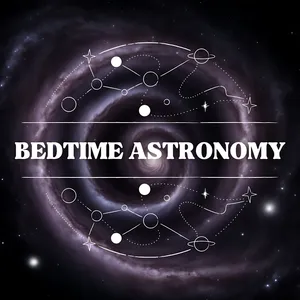
Welcome Bedtime Astronomy Podcast. We invite you to unwind and explore the wonders of the universe before drifting off into a peaceful slumber. Join us as we take you on a soothing journey through the cosmos, sharing captivating stories about stars, planets, galaxies, and celestial phenomena. AI-narrated, human-researched. We use synthetic voices to deliver deeply researched scientific content without compromise. The tech just lets us focus on what matters: bringing you mind-expanding content. Let's go through the mysteries of the night sky, whether you're a seasoned stargazer or simply curious about the cosmos, our bedtime astronomy podcast promises to inspire wonder, spark imagination.
Latest Episodes
The most recent episodes — sign up to get AI-powered summaries of each one.
- Today34 min
The Search for Alien Moons Just Got Much More Promising
Could the James Webb Space Telescope finally detect small moons orbiting distant planets? New research shows that combining observations from multiple planetary transits can reduce noise and reveal much weaker signals.Although no exomoon was found around LP 890-9 c, the study suggests that the search for the first confirmed exomoon may be more promising than previously thought.Thank you for listening to Bedtime Astronomy — your guide to the cosmos. New episodes on space exploration, NASA missions & the latest astronomy breakthroughs.This episode includes AI-generated content.
- Today45 min
How Did Young Stars Form So Close to the Milky Way’s Black Hole?
How can young stars exist so close to the Milky Way’s supermassive black hole?New simulations suggest they may have formed right where we see them, despite the extreme environment around Sagittarius A*. The findings offer a new explanation for their unusually low number of stellar companions—and a surprising glimpse into star formation near a cosmic powerhouse.Thank you for listening to Bedtime Astronomy — your guide to the cosmos. New episodes on space exploration, NASA missions & the latest astronomy breakthroughs.This episode includes AI-generated content.
- Yesterday38 min
Scientists Map Phobos to Prepare for a Historic Mars Moon Mission
A new atlas of Phobos reveals how dust and rocks migrate across Mars’s mysterious moon, helping scientists choose and interpret sampling sites for JAXA’s MMX mission.By tracing the movement of surface material, researchers hope to uncover clues about Phobos’s puzzling origin—and whether it is a captured asteroid or the remnant of a massive impact.Thank you for listening to Bedtime Astronomy — your guide to the cosmos. New episodes on space exploration, NASA missions & the latest astronomy breakthroughs.This episode includes AI-generated content.
- Yesterday19 min
The Strange Ice Inside Neptune and Uranus May Explain Their Magnetic Fields
Deep inside Neptune and Uranus, an exotic form of ice may behave nothing like ordinary ice.Researchers have created a new superionic phase under extreme conditions, where hydrogen can flow freely through a rigid oxygen structure, potentially helping explain the ice giants’ unusual magnetic fields. The discovery could reshape our understanding of what lies beneath their atmospheres.Thank you for listening to Bedtime Astronomy — your guide to the cosmos. New episodes on space exploration, NASA missions & the latest astronomy breakthroughs.This episode includes AI-generated content.
- Yesterday44 min
Could James Webb Finally Detect the Universe’s First Stars?
Could some of the universe’s first stars have formed much later than expected?New research suggests rare bursts of pristine Population III stars may have emerged under unusual conditions, creating enormous clouds that could still leave detectable traces. With gravitational lensing and the James Webb Space Telescope, astronomers may finally have a way to search for these elusive ancient stars.Thank you for listening to Bedtime Astronomy — your guide to the cosmos. New episodes on space exploration, NASA missions & the latest astronomy breakthroughs.This episode includes AI-generated content.
- Yesterday21 min
A Massive Asteroid Just Reshaped the Moon
NASA’s Lunar Reconnaissance Orbiter has identified a massive new impact crater on the Moon, created by a collision in early 2024. Measuring about 728 feet across, it is the largest modern lunar impact ever recorded.The blast scattered lunar soil across a wide area and left a striking thermal signature. The rare event gives scientists new insight into how asteroids reshape the Moon—and what future lunar bases may face.Thank you for listening to Bedtime Astronomy — your guide to the cosmos. New episodes on space exploration, NASA missions & the latest astronomy breakthroughs.This episode includes AI-generated content.
- 2 days ago37 min
eROSITA Maps Nearly 2 Million Sources Across the X-Ray Universe
The eROSITA space telescope has released its second major X-ray catalog, offering one of the most detailed views yet of the high-energy universe.With nearly two million sources, including stars, supernova remnants, and supermassive black holes, the dataset is helping astronomers build three-dimensional maps of cosmic evolution and uncover new clues about the early universe.Thank you for listening to Bedtime Astronomy — your guide to the cosmos. New episodes on space exploration, NASA missions & the latest astronomy breakthroughs.This episode includes AI-generated content.
- 2 days ago39 min
How 3D Printing and Living Organisms Could Build the Future on Mars
What if future Mars habitats could be 3D-printed using materials grown and gathered on the planet itself?Researchers have developed a bio-based construction material combining Martian regolith, gelatin, and genetically engineered yeast that could form structures as strong as concrete. Still tested only in simulated conditions, the technology could point toward a more sustainable and recyclable way to build future colonies on Mars.Thank you for listening to Bedtime Astronomy — your guide to the cosmos. New episodes on space exploration, NASA missions & the latest astronomy breakthroughs.This episode includes AI-generated content.
Get Bedtime Astronomy summaries in your inbox
Free AI-powered daily recaps. Key takeaways, quotes, and mentions — in a 5-minute read.
Get Free Summaries →Free forever for up to 3 podcasts. No credit card required.
You Might Also Like
Listeners also like.
Cosmos in a Pod
Explores space, science, philosophy, and technology to reveal the wonders of the universe and humanity's place within it.
Sleep Tight Science - A Bedtime Science Podcast For Kids
A bedtime science podcast for kids that answers their big questions about the natural world in a calming, family-friendly way.

Hostile Worlds: Exploring Space
A documentary-style podcast exploring extreme alien environments through immersive audio storytelling aboard a fictional exploration vessel.
Through the Telescope
Two hosts explore key astronomy topics in digestible episodes, making the cosmos accessible and engaging for all knowledge levels.
SpaceTime with Stuart Gary
Weekly explorations of astronomy, space, and science news with insights from a veteran science journalist and industry experts.

The World, the Universe and Us
Explores big scientific questions about life, consciousness, climate, and the cosmos with expert scientists and New Scientist journalists.
Daniel and Kelly’s Extraordinary Universe
Two scientists explore diverse topics across the universe, from particles to ecosystems, with accessible and engaging explanations.
Planetary Radio: Space Exploration, Astronomy and Science
Explores space exploration, astronomy, and science through conversations with experts and advocates shaping humanity's journey beyond Earth.
Astrum Space
Explores the planets and wonders of the Solar System through images and videos from space missions.
NASA's Curious Universe
Mind-blowing stories from inside NASA’s space exploration, revealing the people and science behind cosmic discoveries.
StarTalk with Neil deGrasse Tyson
Astrophysicist Neil deGrasse Tyson discusses space, physics, and science with comedians and experts in a blend of humor and education.
Astronomy Cast
Weekly discussions on astronomy topics from planets to cosmology, exploring what’s known and being discovered about the universe.
About Bedtime Astronomy
Welcome Bedtime Astronomy Podcast. We invite you to unwind and explore the wonders of the universe before drifting off into a peaceful slumber. Join us as we take you on a soothing journey through the cosmos, sharing captivating stories about stars, planets, galaxies, and celestial phenomena. AI-narrated, human-researched. We use synthetic voices to deliver deeply researched scientific content without compromise. The tech just lets us focus on what matters: bringing you mind-expanding content. Let's go through the mysteries of the night sky, whether you're a seasoned stargazer or simply curious about the cosmos, our bedtime astronomy podcast promises to inspire wonder, spark imagination.
Customized Recaps
AI-powered recaps with compact key takeaways, quotes, and insights.
Straight to Your Inbox
Get key takeaways from Bedtime Astronomy in a 5-minute read.
Save Hours Every Week
Stay current on your favorite podcasts without falling behind.
Frequently Asked Questions
What is Podzilla's Bedtime Astronomy daily summary?
It's a free AI-powered email that summarizes new episodes of Bedtime Astronomy as soon as they're published. You get the key takeaways, notable quotes, and links & mentions — all in a quick read.
How does the Bedtime Astronomy podcast summary work?
When a new episode drops, our AI transcribes and analyzes it, then generates a personalized summary tailored to your interests and profession. It's delivered to your inbox every morning.
Is this an official Bedtime Astronomy product?
No. Podzilla is an independent service that summarizes publicly available podcast content. We're not affiliated with or endorsed by Synthetic Universe.
Can I get summaries of other podcasts too?
Absolutely! The free plan covers up to 3 podcasts. Upgrade to Pro for 15, or Premium for 50. Browse our full catalog at /podcasts.
How often does Bedtime Astronomy release new episodes?
Bedtime Astronomy publishes daily. Our AI generates a summary within hours of each new episode.
What topics does Bedtime Astronomy cover?
Bedtime Astronomy covers topics including Science, Astronomy, Physics. Our AI identifies the specific themes in each episode and highlights what matters most to you.
Start getting Bedtime Astronomy summaries tomorrow morning.
Free forever for up to 3 podcasts. No credit card required.
Free forever for up to 3 podcasts. No credit card required.