Free Daily Podcast Summary
Ministry At Scale: Daily Summaries Delivered
by Chad Williams - Five Q
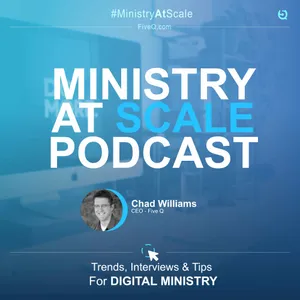
The Ministry at Scale Podcast brings you the latest trends, interviews with experts and practical tips to help your ministry multiply its impact. If you want to know how to grow your ministry in the digital space this podcast is for you.
Latest Episodes
The most recent episodes — sign up to get AI-powered summaries of each one.
- 1 weeks ago43 min
#105 - Scaling Adrian Rogers Without Ever Faking Him | Bobby Lewis
Love Worth Finding holds nearly 2,000 sermon transcripts from Adrian Rogers, and the ministry is now using AI to carry that teaching into places he never had the chance to reach. Bobby Lewis, President of Love Worth Finding, returns to Ministry at Scale to share how his team adopted AI under one rule that never bends: Adrian Rogers will never be made to say, do, or appear anywhere he actually didn't.Key TakeawaysHuman First, AI Assisted, Human Last: Bobby built on Five Q's Human-First approach by adding a final step. Nothing goes out unless someone on the Love Worth Finding staff has reviewed and vetted it.Protect the core, adapt everything else: Love Worth Finding sorts its content into three tiers. Core content (Rogers' own sermons, books, and interviews) is never altered. Derivative content and gateway content (ads and promotions) each have their own guardrails.Faithful voices, not fake ones: The team trained AI on Rogers' core content to capture five distinct voices, including his preaching, instructional, and devotional styles. One result is a summary of about 500 words for each sermon, used as website metadata and never presented as Rogers himself.One sermon, a week of discipleship: Bobby's advice to pastors is to turn Sunday's sermon into three to five devotionals and a small group Bible study. The AI draws only from the sermon itself and pulls in no outside sources.Build architects, not operators: A new three-person Ministry Solutions and Technology team meets with Bobby every other week. They design better workflows for program teams, then hand day-to-day operation back to those teams.Earn trust through transparency: A board working group reviewed and approved the ministry's AI governance policies. Love Worth Finding then published a public AI commitment on its website and added governance requirements to its employee manual.Green, yellow, or red: Bobby calls himself an idea factory, so his team grades every idea as green (go), yellow (still in discussion), or red (not ready yet). The team, not the president, decides how much moves forward.If you lead a ministry built on a founder's legacy, or you're weighing how to bring AI into your organization without losing what makes it unique, this conversation gives you a tested path forward. Bobby shares how Love Worth Finding protects its core message while multiplying its reach, plus simple first steps any pastor can take this week. Listen to the full episode now.ResourcesConnect with BobbyLinkedIn: https://www.linkedin.com/in/ralewis1002/Email: blewis@lwf.orgLove Worth Finding: https://www.lwf.org/LWF Learning Library: https://learning.lwf.org/Unlocking the Power of Prayer (Bobby's recommended course): https://www.lwf.org/upopThe Incredible Power of Kingdom Authority by Adrian Rogers: Buy Book What Every Christian Ought to Know by Adrian Rogers: Buy BookMonday.com: https://monday.com/Slack: https://slack.com/NRB (National Religious Broadcasters): https://nrb.org/Digital Ministry Conference: https://digitalministryconference.com/Launch AI: https://fiveq.com/launch/Five Q: https://fiveq.com/
- 1 weeks ago37 min
#104 - 50,000 Questions Answered | Ryan Armstrong
What do people ask when no one is watching? In just 70 days, the users of My Shepherd have asked more than 50,000 questions. The AI Bible app answers each one from Scripture and shows the user where every answer comes from. Host Chad Williams sits down with founder Ryan Armstrong to find out how he built a tool that meets people where they are and gives churches a new window into what their people are wrestling with.Key TakeawaysA closed system grounded in Scripture. Ryan built My Shepherd on Claude Sonnet as its foundation, then added a closed, custom layer trained on the King James Version. Every answer links back to the passages it draws from, so users can dig deeper into the Word themselves.Real users shaped a simpler experience. Early testers, including pastors, found the original category-first design cluttered. Ryan cut it down to a single question box, and users now say they can type a question and get a Scripture-based answer within seconds.A pulse on the congregation, without names attached. On the back end, churches see anonymized questions grouped by category, so pastors and leaders can learn what their people are struggling with. Individuals still have a safe space to bring hard questions about marriage, infidelity and more.Crisis care built in from day one. When a question involves suicide or self-harm, My Shepherd bypasses the AI, connects the user with the 988 suicide prevention helpline and encourages them to talk with a trusted adult or friend. Ryan believes it is the first AI with this feature.Customizable for each church. My Shepherd is built as a white-label platform that churches can tailor to their congregation. Ryan is learning alongside a local church's Monday night faith group to discover what churches need most.A commitment to long-term ownership. Chad asks the tough question every ministry leader should ask about a new tool: what happens if it gets acquired? Ryan shares lessons from taking on investors at his first startup and why he plans to keep 100% ownership of My Shepherd.Organic growth that points to real value. More than 3,000 people joined in 70 days with no marketing spend, mostly through word of mouth. One user told Ryan the app has become his way to connect with God "between Sundays."What Does It Look Like to Build AI With Care?If your ministry is weighing where AI fits in your mission, this conversation is an honest look at what it takes to build with care, from privacy and crisis safeguards to holding plans with an open hand. Listen to the full episode to hear Chad and Ryan work through the hard questions, and stay for the story of a chess painting that reminds us the King always has one more move.RESOURCESMy Shepherd: myshepherdapp.churchConnect with Ryan Armstrong: ryan@myshepherdapp.churchRyan's Recommendations:The Book of RomansWes Huff, for listening on the historical evidence behind ScriptureMentioned by Chad: Don't Make Me Think by Steve KrugThe "King Has One More Move" Chess Painting Clip: Watch ClipThoughts and Scripture Video: Watch Video Your First Step Video: Watch Video My Shepherd App Waitlist: <a href="https://app.myshe
- Jun 25, 202645 min
#103 - How Ministries Are Using AI Effectively| Nathan Chappell
Most nonprofits are using AI — but only 7% are seeing real strategic benefit from it. Nathan Chappell, Chief AI Officer at Virtuous and founder of Fundraising AI, has spent years studying what separates the organizations that thrive with AI from those that stall. In this episode, he shares the six-step framework drawn from the 2026 Nonprofit AI Adoption Report — and it's more practical than you might expect.Key TakeawaysThe 7% aren't spending more — they're doing things differently. Out of 346 nonprofits surveyed in Virtuous's 2026 Nonprofit AI Adoption Report, 92% are using AI, but only 7% are seeing major strategic benefit. The difference comes down to six specific, disciplined steps — none of which require a large budget.AI governance isn't a legal document — it's a values document. Nathan makes the case that a lightweight, one-page governance policy is the foundation on which everything else is built. It doesn't constrain your team — it actually frees them to experiment with confidence, knowing where the guardrails are.The human-first framework isn't optional for ministries. Nathan draws a sharp distinction between the "AI first" posture of the private sector (like Shopify) and why that model doesn't work for mission-driven organizations operating in the currency of trust and generosity. Humanity must always be greater than utility."Human at the helm" replaces "human in the loop." As agentic AI moves autonomously by design, the traditional idea of human review at every step is no longer realistic. Nathan reframes accountability: someone must always be at the helm — responsible for what the AI is doing, even if they aren't approving each action.The biggest mistake leaders are making right now? Treating AI as a line-item tool expense rather than a horizontal enabling layer that reshapes how the entire organization operates. Nathan draws a compelling parallel to the early days of the internet — and where that thinking eventually leads.The AI Olympics experiment at Virtuous. Nathan shares how Virtuous challenged every single employee — not just the engineering team — to build an agentic workflow that would meaningfully improve their job or a customer's. The results? The top submission came from the podcast and marketing team, who automated a full day's worth of post-production work. The lesson: transformation often comes from the most unexpected places.As AI accelerates, the church's moment is coming. As everything becomes faster and more synthetic, Nathan believes people will increasingly ask the deepest human questions — Who am I? Why am I here? What happens when I die? He sees this as a profound opportunity for the church to be exactly what it was built to be: a community rooted in truth.Ready to Move from Experimenting to Thriving?If your ministry is still in the "experimenting with tools" phase of AI, this conversation is your permission — and your roadmap — to go further. Nathan's framework is practical, proven, and built for organizations that lead with mission, not margin. Listen to the full episode and start asking what it would look like to move from experimentation to transformation.RESOURCESNathan Chappell on LinkedIn: https://www.linkedin.com/in/nathanchappell/Nathan's Books:- The Generosity Crisis: The Case for Radical Connection to Solve Humanity's Greatest Challenges- Nonprofit AI: A Comprehensive Guide to Implementing Artificial Intelligence for Social GoodNathan's Website: https://nathanchappell.com/Virtuous:</st
- Jun 19, 202645 min
#101 - 115,000 Beliefs Tracked | Matthew Ward
Most Christians know that they believe — but far fewer can clearly articulate why. Matt Ward, founder and CEO of BeliefTrack, built a free web-based platform to change that — and what started as a personal faith inventory has grown into a powerful discipleship and leadership vetting tool for churches. In this episode of Ministry at Scale, Chad Williams sits down with Matt to explore how a simple question — "What do I actually believe?" — became a tool that has tracked over 115,000 individual Christian beliefs.Key TakeawaysA personal faith journey sparked a ministry-sized tool. Nearly 10 years ago, Matt began wrestling with his own beliefs as a young adult — not what he was taught, but what he could confidently own. That process of honest self-reflection became the foundation for BeliefTrack's nearly 300 theological questions, spanning beginner to advanced doctrine.The confidence rating is one of BeliefTrack's most disarming features. Rather than simply asking "do you believe this?", users rate their confidence on a scale from 1 to 10. It's a simple mechanism that creates honest self-awareness — and opens the door to deeper study, better conversations, and more confident outreach.BeliefTrack has nearly 800 registered users and has tracked approximately 115,000–116,000 individual Christian beliefs — a number Matt says far exceeded his expectations, driven by people's genuine hunger to go deeper with their theology.Churches are using BeliefTrack as a leadership vetting and discipleship tool. The recommended church rollout starts with the pastor crafting their core beliefs, then having leadership go through the same process — creating a transparent, side-by-side comparison that surfaces theological alignment and gaps before someone steps into a teaching role.The platform reveals a surprising reality: congregations aren't as theologically aligned as pastors assume. Matt's experience with users from across denominations shows that even within a single church, meaningful doctrinal diversity exists — particularly on topics like eschatology and inerrancy. BeliefTrack helps pastors see those gaps clearly and respond with targeted discipleship rather than assumptions.AI played a supporting role in refining the platform's questions. As a software engineer, Matt used AI tools to help audit his question bank for unintentional bias — ensuring that users are genuinely guided toward reflection rather than nudged toward a predetermined answer.BeliefTrack is free — and Matt wants to keep it that way for small churches. Church accounts are available now, and the long-term vision is for small churches to always have free access to the platform as a discipleship resource.Does Your Church Know What It Believes?If you've ever wished you had a window into what your congregation actually believes — or if you're a ministry leader wanting to equip your people with tools for deeper theological engagement — this episode is for you. BeliefTrack is the kind of simple, mission-aligned tool that could transform the way your church approaches discipleship. Listen now, then head over to BeliefTrack.com to set up your church account and see it for yourself.RESOURCESConnect with Matthew — matt.ward@belieftrack.comMatthew Ward, Founder and CEO — BeliefTrackBeliefTrack YouTube Channel — https://www.youtube.com/@BeliefTrackBook Recommendation: Living on Target — a discipleship book Matt's church is currently using; focuses on prioritizing relationship with Christ, family, church, and the world.Online Resource: Gavin Ortlund / Truth Unites YouTube channel — accessible theological discussions on a wide range of topicsFive Q Launch AI — Ready to turn AI experimentation
- Jun 19, 202615 min
#102 - Better Text Marketing With AI | Aaron Dolton
What if the content your ministry already has — sitting untouched on a shelf — could reach more people, deepen engagement, and activate brand-new donors, all through a channel with a 98% open rate?In this DMC 2026 session, Aaron Dolton of Powered by Text shares a real-world case study with Jack Graham's PowerPoint Ministries that proves ministry-first strategy doesn't just honor the mission — it funds it.Key Takeaways"Money follows mission" is more than a ministry philosophy — it's a proven fundraising strategy. PowerPoint Ministries built their entire SMS strategy on a 90/10 rule: 90% ministry content, 10% fundraising. The results speak for themselves.Text has an open rate of approximately 98% compared to 20% for email. Aaron unpacks why SMS is one of the most underleveraged channels in ministry today and how delivering existing content through text dramatically changes engagement numbers.Repurposing content you already have is a game-changer for under-resourced teams. PowerPoint Ministries had 30 years of devotional content on the shelf. Powered by Text helped them repackage it for daily SMS delivery — no new content creation required.The results were remarkable. After launching a daily devotional text series, PowerPoint Ministries saw their monthly video views jump from approximately 4,000 to nearly 70,000 — driven solely by a change in delivery channel. Additionally, their average donation via text rose from approximately $80 to approximately $202, and they activated 89 brand-new first-time donors.Their subscriber file grew 27% organically. Without any paid acquisition, the file grew from 60,000 to 76,000 contacts — driven by subscribers sharing devotional content with others.AI-powered sentiment analysis is helping ministries respond to their audiences with greater care and stewardship. Powered by Text is using AI to surface prayer requests, flag urgent responses (including crisis situations), and cleanse subscriber lists — ensuring every dollar spent on outreach is stewarded wisely.Teaching your audience to text — especially older donors — is worth the effort. Aaron shares how a simple video tutorial for PowerPoint Ministries' "Last Seven Words from the Cross" Easter campaign helped even first-time texters engage with confidence.Your Content Is Already Written — Are You Sending It?If your ministry is sitting on years of great content while struggling to reach and retain donors, this episode will show you a better way forward. Aaron's session is a practical, data-grounded reminder that when you lead with mission, the resources follow. Listen now and start thinking differently about the channels you already have access to.RESOURCESConnect with Aaron — https://www.linkedin.com/in/aarondolton/Aaron Dolton — Powered by TextPowerPoint Ministries — jackgraham.orgText WISDOM to 59789 to experience a sample monthly devotional seriesFive Q Launch AI — Ready to turn AI experimentation into real ministry impact? Learn more at fiveq.com/launch
- Jun 12, 202625 min
#100 - Solving Problems With AI Innovation| Don Barger
What does a hotel key card have to do with 400,000 people hearing the gospel? Don Barger, Director of Innovation and Artificial Intelligence at the International Mission Board (IMB), shares the unexpected story of how one small, tangible idea helped one of the world's largest missions organizations go from AI skepticism to full-scale adoption — in just a few years.Key TakeawaysEasy wins change everything. The IMB's first AI pilots were deliberately small — translation of internal communications, a digital responder, and donor processing — and those quick wins gave skeptics something real to believe in before any large-scale rollout began.A few hundred NFC cards sparked 25,000 chatbot conversations. Don distributed programmed NFC cards at a single event, and within days, 25,000 people had tapped in and engaged with the IMB's AI chatbot — a result that came from one simple, low-cost idea.FaithBot was built for triage — and became a global evangelism tool. Originally designed to protect digital responders from high-volume, low-quality traffic, FaithBot now has over 400,000 users worldwide across multiple languages, spreading largely through organic, word-of-mouth sharing.Leadership sponsorship is the non-negotiable. Don invested significant time early on helping the IMB's President and EVP understand AI deeply enough to champion it. The entire senior leadership team completed an MIT Sloan course on AI business applications — and their buy-in made everything else possible.Your AI belief statement must come before your AI tools. The IMB established clear ethical guardrails before building anything, including a firm line: AI will not provide soul care. Defining what you won't do with AI is just as important as knowing what you will.Yesterday's skeptics make tomorrow's best advocates. Some of the IMB's loudest AI champions today were among the most resistant voices a year ago. Making innovation accessible and irresistible is what turns doubters into champions.Ready to Move from "Should We?" to "Here's How We Start?"If your ministry is still stuck in the "should we?" conversation around AI, this episode will help you move to "here's how we start." Don's framework is practical, proven, and deeply mission-focused — and it's exactly the kind of real-world perspective ministry leaders need right now. Listen to the full episode and then ask yourself: what's your hotel key card moment?ResourcesDon Barger — Director of Innovation and Artificial Intelligence, International Mission Board (IMB)FaithBot — AI evangelism chatbot: https://chat.faithbot.io/Don Barger's Substack — AI, Innovation, and Faith: donbarger.comInternational Mission Board (IMB): imb.orgDigital Ministry Conference 2026: digitalministryconference.comLaunch AI by Five Q — Ready to move from AI experimentation to measurable ministry impact? Learn more at fiveq.com/launch
- Jun 5, 20261h 8m
#99 - Why 95% of AI Projects Fail | Gregory Richardson
95% of AI projects are failing — and your ministry can't afford to be part of that statistic. Gregory Richardson, founder of Six Levers Consulting and a 35-year veteran of cybersecurity and technology leadership, brings a rare combination of deep tech expertise and unashamed Christian faith to one of the most important conversations in ministry today. This episode will challenge the way you think about AI, risk, and what it means to be a faithful steward of technology.Key TakeawaysGregory has sat in the boardrooms of companies like Blackberry and McAfee, served ministries like Global Media Outreach, and spent decades wrestling with what it looks like to be a faithful Christian in the middle of a secular tech world. In this conversation, he brings that hard-won wisdom directly to ministry leaders navigating the pressure to adopt AI responsibly. Here's what stood out most:95% of AI projects fail — and the reason may surprise you. Gregory references a study conducted in partnership with the MIT Media Lab (confirmed Q4 of the previous year) showing the vast majority of AI initiatives collapse not because of bad tools, but because of poor strategy, misaligned leadership, and a lack of governance before deployment.Christians belong in the tech space — on purpose. Gregory shares vulnerably about spending decades feeling torn between his corporate identity and his Christian calling, only to discover that his presence in secular tech environments may have been the only "on-ramp to Jesus" many of his colleagues ever encountered.AI governance isn't optional — it's stewardship. Gregory walks through why ministries and organizations must establish AI policies before they begin experimenting with tools, drawing on his background as a former CISO to explain the cybersecurity and ethical risks that come with ungoverned AI adoption.Your team is your biggest AI risk and your greatest AI asset. The conversation digs into how staff behavior, shadow AI usage, and a lack of training create real vulnerabilities — and how intentional, human-first implementation changes everything.Faith and technology aren't competing callings — they're complementary ones. Gregory's framework of "Six Levers" offers a practical lens for leaders navigating how to steward AI in a way that honors mission, protects people, and advances the Kingdom.Deep Bible literacy matters more than ever in an AI age. Gregory delivers a powerful challenge around discernment, theological grounding, and the danger of applying Scripture out of context — drawing a direct line between how we read the Bible and how we evaluate the promises AI vendors make.Community is a competitive advantage. Gregory describes "The Table," a free monthly gathering he hosts for business and ministry leaders to share what's working, what's failing, and how to move forward — together.Ready to Stop Experimenting and Start Multiplying?If your ministry is feeling the pressure to "do something with AI" but isn't sure where to start, this episode is your roadmap. Gregory's experience spans Fortune 500 companies, global ministries, and educational institutions — and his perspective will give you both the clarity and the confidence to move forward wisely. Don't miss this one. Listen to the full episode now.ResourcesSix Levers Consulting — sixleversconsulting.comGregory Richardson (Personal Site) — gregoryrichardson.aiConnect with Gregory on LinkedIn — https://www.linkedin.com/in/gregorypkrichardson/Harvard Business Review Article (with link to MIP Report) — https://hbr.org/2025/08/beware-the-ai-experimentation-trapLord of Spirits Podcast — Referenced by Gregory as a resource for Christians who want to develop deeper Bible literacy and hermeneutical understanding. https://www.ancientfaith.com/podcasts/lordofspirits/Launch AI by Five Q — Ready to move from AI experimentation to measurable ministry impact? Learn more a
- Jun 4, 202617 min
#98 - From Siloed Data to 25% Donor Growth | Nathan Hill
Your ministry is stretched thin, your data is scattered across disconnected tools, and your donor acquisition budget may be reaching the wrong people. In this session from the Digital Ministry Conference, Nathan Hill of AVID walks through a real-world case study showing how Bible League Canada decreased their cost to acquire a new donor by 20% — and grew new donors by 25% — by unifying their tech stack and adding AI-powered automation.Key TakeawaysNew donors are worth far more than year one. Based on data from 43 ministries representing approximately $1.4 billion in annual revenue, the average first-year donor gives $81 — but that number jumps to $214 in year two and $322 in year three and beyond.Siloed data is silently costing you. Most ministries rely on their CRM as their primary donor data source, but critical giving history, engagement data, and transaction records live in disconnected tools — leading to stale prospecting lists and wasted ad spend.A unified tech stack changes everything. Bible League Canada brought all of their donor data under one roof using AVID as their fundraising operating system, enabling a more complete "golden record" of their donors — and dramatically improving the accuracy of their lookalike audience targeting on Meta.Automation is the multiplier. It's not enough to unify data once — the speed at which audiences are refreshed directly impacts how effective your acquisition campaigns are. Nathan explains how automated suppression (removing existing donors from acquisition targeting) alone eliminates significant waste.The long-term kingdom impact is the real number. A sample organization Nathan shared was on pace for $7.4 million in donor revenue this year. By investing in an acquisition growth strategy, their three-year revenue outlook jumped from $7.1 million to $10.5 million — a 47% increase over three years.AVID vs. an Enterprise CRM. Nathan noted that when compared to one of the most sophisticated marketing CRMs available for this use case, AVID led to a 143% increase in donor acquisition by comparison.If you're ready to stop wasting acquisition budget on the wrong audiences and start building a donor pipeline that compounds over time, this episode is your starting point. Nathan breaks down a practical, proven framework that any ministry fundraising team can begin applying today — no massive tech overhaul required.ResourcesNathan Hill – Vice President of Marketing, AVID | avidai.comConnect With Nathan – https://www.linkedin.com/in/nathan-peter-hill/Bible League Canada Case Study – Referenced throughout the session | https://bibleleague.ca/AVID Fundraising Scorecard – Predictive analytics tool | https://avidai.com/components/scorecard/Digital Ministry Conference – digitalministryconference.comFive Q | Launch AI – https://aiofferings.fiveq.com/
Get Ministry At Scale summaries in your inbox
Free AI-powered daily recaps. Key takeaways, quotes, and mentions — in a 5-minute read.
Get Free Summaries →Free forever for up to 3 podcasts. No credit card required.
You Might Also Like
Listeners also like.
FundraisingAI
Examines the ethical and practical use of AI in fundraising, including trends, data privacy, and social impact.

The Daily Blade: Joby Martin & Kyle Thompson
A daily devotional podcast helping Christians apply biblical teachings to everyday life.

Your Brand Amplified
Explores the strategies and mindsets of successful entrepreneurs in business growth, marketing, and personal branding.

The Social Impact Solutions Podcast
Practical strategies for measuring and promoting social impact to attract support and drive change.

King Dems Podcast | Growth Mindset, Leadership, AI and Business Insights
Discusses leadership, AI, and business growth with CEOs and entrepreneurs through practical insights on strategy, innovation, and mindset.

Coaching Inc with Tom Krol
Teaches coaches and consultants how to generate consistent leads and increase income using proven, efficient marketing strategies.

Lenny's Podcast: Product | Career | Growth
Conversations with top product and growth leaders offering practical strategies for building, launching, and scaling successful products.

Growth Triggers: Content Marketing & AI
A marketing podcast teaching business owners how to use podcasting to generate leads, sales, and authority across competitive niches.

Built 4 More
Conversations with elite performers and leaders exploring the intersection of high performance, discipline, and faith.
Life.Church with Craig Groeschel
Teachings from Craig Groeschel and Life.Church pastors on practical, biblical topics for everyday life.
Meeting of Minds Podcast
Conversations with leading thinkers across history, theology, finance, economics, math, and science exploring truth with clarity and depth.

Intentional AI
Two productivity experts explore practical applications of artificial intelligence to improve work efficiency and daily workflows.
About Ministry At Scale
The Ministry at Scale Podcast brings you the latest trends, interviews with experts and practical tips to help your ministry multiply its impact. If you want to know how to grow your ministry in the digital space this podcast is for you.
Customized Recaps
AI-powered recaps with compact key takeaways, quotes, and insights.
Straight to Your Inbox
Get key takeaways from Ministry At Scale in a 5-minute read.
Save Hours Every Week
Stay current on your favorite podcasts without falling behind.
Frequently Asked Questions
What is Podzilla's Ministry At Scale daily summary?
It's a free AI-powered email that summarizes new episodes of Ministry At Scale as soon as they're published. You get the key takeaways, notable quotes, and links & mentions — all in a quick read.
How does the Ministry At Scale podcast summary work?
When a new episode drops, our AI transcribes and analyzes it, then generates a personalized summary tailored to your interests and profession. It's delivered to your inbox every morning.
Is this an official Ministry At Scale product?
No. Podzilla is an independent service that summarizes publicly available podcast content. We're not affiliated with or endorsed by Chad Williams - Five Q.
Can I get summaries of other podcasts too?
Absolutely! The free plan covers up to 3 podcasts, any in the catalog. Basic raises that to 15, Pro to 40 and Max to 100. Browse our full catalog at /podcasts.
What topics does Ministry At Scale cover?
Ministry At Scale covers topics including Technology, Business, Religion & Spirituality, Spirituality, Christianity, Non-Profit. Our AI identifies the specific themes in each episode and highlights what matters most to you.
Start getting Ministry At Scale summaries tomorrow morning.
Free forever for up to 3 podcasts. No credit card required.
Free forever for up to 3 podcasts. No credit card required.