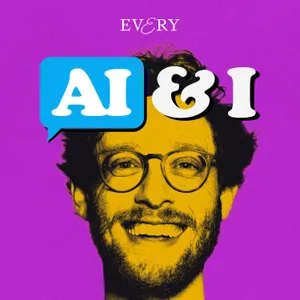
Free Daily Podcast Summary
AI and I: Daily Summaries Delivered
by Dan Shipper
Learn how the smartest people in the world are using AI to think, create, and relate. Each week I interview founders, filmmakers, writers, investors, and others about how they use AI tools like ChatGPT, Claude, and Midjourney in their work and in their lives. We screen-share through their historical chats and then experiment with AI live on the show. Join us to discover how AI is changing how we think about our world—and ourselves.
Latest Episodes
The most recent episodes — sign up to get AI-powered summaries of each one.
- 2 weeks ago47 min
How a Professional Writer Writes With AI
Two years ago, Katie Parrott was laid off from a crypto firm and couldn’t afford a career coach — so she turned to a $20-a-month ChatGPT subscription instead.The Every staff writer’s habit of feeding AI good context eventually became compound writing, a codified system for brainstorming, drafting, and editing with AI. Today, that system is a plugin any writer can use.On this week’s AI & I, Natalia Quintero talks with Katie about turning good ingredients into good writing, borrowing the taste of writers she admires, and why AI helped her fall back in love with the page.If you found this episode interesting, please like, subscribe, comment, and share!To hear more from Natalia Quintero:Subscribe to Every: https://every.to/subscribeFollow her on X: @NataliaZarinaTimestamps for YouTube:0:00 Start0:49 Introduction1:21 How Katie went from being laid off to using ChatGPT as a career coach8:06 Turning AI into a “content agency of one”10:59 Building the context files and style guides that make AI outputs useful14:15 What makes a Claude project actually work21:18 How AI helped with a mental health crisis and “computer errands”27:03 Katie’s career coach, now a fully autonomous Codex project32:27 What compounding means, and building the Compound Writing plugin38:00 Borrowing Vonnegut, Hitchcock, and Sorkin as AI editing skills44:49 Katie’s thesis: education and access will matter more than everLinks to resources mentioned in the episode:Katie Parrott on X: @kplikethebirdCompound writing plugin: [LINK COMING SOON]Compound engineering plugin (Kieran Klassen): github.com/EveryInc/compound-engineering-pluginParrott’s companion piece on compound writing: [LINK COMING SOON]Parrott, “I Hired ChatGPT as My Career Coach”: every.to/working-overtime/i-hired-chatgpt-as-my-career-coachParrott, “AI Turned Me Into a Content Agency of One”: every.to/working-overtime/ai-turned-me-into-a-content-agency-of-one
- 3 weeks ago1h 7m
A $10B Hedge Fund’s AI Playbook (Best of the Pod)
Will England is the CEO of Walleye Capital, a hedge fund managing nearly $10 billion in assets. An engineer by training with a math background from Oxford, he has spent his career at the intersection of machines and markets—and has made AI fluency mandatory for all 400 employees.England believes refusing to use AI is like refusing to use the internet in 1995 because it wasn’t perfect. His use of AI is public and effusive, including in a firm-wide email that opened with “I used ChatGPT to write this email. You should be using it, too, and be proud of it.” AI informs how Walleye drafts memos and selects stocks.On Every’s AI & I, Dan Shipper spoke with England about why he’s betting his entire organization on AI, why “results are what matter” more than blood, sweat, and tears, and what the American frontier can teach us about leading through technological change.Like, subscribe, comment, and share!To hear more from Dan Shipper:Subscribe to Every: https://every.to/subscribeFollow Dan Shipper on X: https://twitter.com/danshipperGo to https://attio.com/every and get 15% off your first year. Timestamps:0:00 Start0:51 Introduction3:25 What pushed Will to go all in on AI15:15 Inside the ‘AI-first’ memo Will shared at Walleye17:02 Why you shouldn’t be afraid of using AI for work31:25 How Will uses LLMs to sharpen his thinking35:57 Walleye’s approach to using AI to reduce risk39:35 What history can teach us about leading through change57:10 Will’s first principles for making better decisions59:23 Why Will journals every day—and how AI makes it easierLinks to resources mentioned in the episode:Will England/Walleye Capital: https://walleyecapital.com/bio/will-englandEvery’s AI tools—Monologue, Cora, Spiral, and Sparkle: https://every.to/studioEvery’s AI consulting: https://every.to/consulting
- Aug 19, 20261h 22m
The AI Alien Companion App That's Bringing In $4M a Year (Best of the Pod)
LLMs are a new medium for storytelling.That’s according to the creators of Portola, the company behind Tolan: an embodied AI companion that lives on its own planet and chats to you with a distinct personality. In 2025, Portola's founder and CEO Quinten Farmer and Head of Story Eliot Peper joined Dan Shipper to explain how they’re building this new medium from scratch. Their aim is to help users go from overwhelmed to grounded through conversations with Tolan that feel personal and spontaneous, not scripted. On this week’s AI & I, Dan revisits his conversation with Quinten and Eliot. They discuss why response time is everything for voice-based AI interfaces, how Portola designs AI personalities users will click with, and why character-driven AI could become a new computing interface. If you found this episode interesting, please like, subscribe, comment, and share!To hear more from Dan Shipper:Subscribe to Every: https://every.to/subscribeFollow him on X: https://twitter.com/danshipperGo to https://attio.com/every and get 15% off your first year.Timestamps: 00:01:30 - Introduction 00:04:07 - Talking to the Portola CEO's Tolan, Clarence 00:09:11 - How Portola went from building software for kids to AI companions 00:23:40 - Why response time is everything for voice-based AI interfaces 00:29:54 - Tolans don't use scripted prompts—they're taught to improvise 00:37:23 - How to know which AI personalities your users will click with 00:42:27 - Developing the character traits of an AI companion 00:49:48 - What does it mean to build technology that makes us flourish 01:01:10 - How Portola evaluates whether Tolans are resonating with users 01:11:01 - Inside Portola's viral growth strategy
- Aug 12, 202628 min
Microsoft’s Vision for an Internet Made for Agents With CTO Kevin Scott (Best of the Pod)
In 2025, Kevin Scott bet that the agentic web would be the next big thing in AI.The Microsoft CTO argued that for agents to be genuinely useful, they'd need to be able to take action on our behalf—which would mean giving them access to the same sprawl of tools, data, and systems that make up the internet. Today, that bet is starting to pay off, as the foundational infrastructure for the agentic web is now being built.On this week's AI & I, Dan Shipper revisits his conversation with Kevin. They discuss Microsoft's role in the agentic web, why openness doesn't have to come at the expense of security, and why programmers should stay curious about new tools rather than resist them on principle.If you found this episode interesting, please like, subscribe, comment, and share!To hear more from Dan Shipper:Subscribe to Every: https://every.to/subscribeFollow him on X: https://twitter.com/danshipperGo to https://attio.com/every and get 15% off your first year.Timestamps: 0:00 Start1:44 Introduction2:49 The race to close the "capability overhang"4:31 How agents will evolve into practical, useful tools6:48 The role Kevin sees Microsoft playing in the agent ecosystem12:05 How robust security measures can coexist with open ecosystems15:39 Kevin's philosophy on being a craftsman in the age of agents20:52 How the landscape of software development agents will evolve25:33 The future of agentic workflowsLinks to resources mentioned in the episode:Kevin Scott on X: https://twitter.com/kevin_scottModel Context Protocol (MCP): https://modelcontextprotocol.ioNLWeb: https://github.com/microsoft/NLWebGitHub Copilot: https://github.com/features/copilot
- Aug 5, 202648 min
Why the Next Hit AI Product Will Be Social Why the Next Hit AI Product Will Be Social (Best of the Pod)
Most consumer AI so far has been single-player: you and a chatbot, alone.Benchmark partner Sarah Tavel, one of Pinterest's first 30 employees, is betting that's about to change. She's looking for a product genius who can build an AI product with social DNA: status, network effects, and multiplayer dynamics. That'll enable users of ChatGPT and other models to learn from how others use AI and level up.On this week’s AI & I, Dan Shipper revisits his conversation with Sarah. They talk about why technical founders dominate the early days of a platform shift while product-minded founders win later, what ChatGPT is still missing, and what separates a founder's real network effect from a slide with a flywheel diagram.If you found this episode interesting, please like, subscribe, comment, and share!To hear more from Dan Shipper:Subscribe to Every: https://every.to/subscribeFollow him on X: https://twitter.com/danshipperTimestamps for YouTube:0:00 Start1:10 Introduction2:26 Why the future of consumer AI belongs to founders with product intuition11:09 What Sarah sees as ChatGPT's biggest weakness18:45 How Sarah would design a consumer AI app with social DNA24:10 The kind of founders Sarah invests in28:33 How to know if your startup's network effects are real35:40 What's catching Sarah's eye beyond AI40:41 How AI will change the way top venture capitalists investLinks to resources mentioned in the episode:Sarah Tavel on X: https://x.com/sarahtavelBenchmark: https://benchmark.comAgentio (marketplace for YouTube creators and brands): https://agentio.com/ Chainalysis: https://chainalysis.comThe Five Temptations of a CEO by Patrick Lencioni: https://www.amazon.com/dp/B007BZBRB8Thinking in Bets by Annie Duke: https://www.amazon.com/dp/B0HBBW23PM
- Jul 29, 202653 min
Best of the Pod: Wired's Kevin Kelly on Why AI Is a 50-year Overnight Success
Kevin Kelly has spent over 30 years experiencing the edge of new technology: from the earliest days of the internet to the first years of Burning Man. But he’s always treated the frontier as a place to visit, not somewhere to live. It’s partially how he’s been able to stay grounded through tech’s various hype cycles.As founding executive editor of Wired and author of The Inevitable, Kelly spends as much time analyzing the latest in AI as he does reading about significant moments in history. It’s a discipline he traces back to his work with the Long Now Foundation, which he cofounded to encourage long-term thinking, reaching from the last 10,000 years to the next. On this week’s AI & I, Dan Shipper revisits his conversation with Kelly. They get into why historians can be the best futurists, and how our bid to understand what intelligence is has parallels with early scientists' attempts to figure out electricity. Kelly also describes the joy he found in creating an AI-generated saga featuring Leonardo Da Vinci, Christopher Columbus, and Martin Luther—one that will only ever be read and enjoyed by him.If you found this episode interesting, please like, subscribe, comment, and share!To hear more from Dan Shipper:Subscribe to Every: https://every.to/subscribeFollow him on X: https://twitter.com/danshipperTimestamps for YouTube:0:00 Start 0:50 Introduction 1:10 Why Dan and Kelly love Annie Dillard 12:52 How to predict the future like Kelly16:10 What the history of electricity can teach us about AI 20:13 How Kelly thinks about the nature of intelligence 25:44 Kelly's advice on discovering your competitive advantage 29:33 How Kelly assembled a bench of star writers for Wired 34:43 How Kelly used ChatGPT to co-create a book 39:12 Using AI as a mirror for your mind 43:43 What Kelly learned from betting on VR in the 1980sLinks to resources mentioned in the episode:Kevin Kelly on X: https://twitter.com/kevin2kellyThe Inevitable by Kevin Kelly: https://www.amazon.com/Inevitable-Understanding-Technological-Forces-Future/dp/0525428089Pilgrim at Tinker Creek by Annie Dillard: https://www.amazon.com/Pilgrim-Tinker-Harper-Perennial-Classics/dp/00612333231,000 True Fans by Kevin Kelly: https://www.amazon.com/1000-True-Fans-Kellys-Simple-ebook/dp/B01N9P9O4GFull episode transcript: https://every.to/podcast/transcript-be243312-ea22-4193-8c56-b9cd45a79a87
- Jul 22, 202646 min
How Every's Team Used AI to Ship Its Biggest Launch Ever
Yash Poojary, a growth engineer at Every, dropped an idea for a campaign in Slack at 7 p.m. Instead of building it himself, Every’s head of growth Austin Tedesco took a screenshot of the Slack thread, dropped it into Codex, typed "Can you do this?", and went to the gym.By the time he got back, Codex had built four audience segments, drafted emails for each one, and pulled a social image that had worked before. It took Austin 10 minutes to make some tweaks and schedule the whole thing to send the next morning. Within a few hours, it generated more than $25,000 in revenue. That story came out of the launch week for All Access, Every’s new $625-a-year membership built around the Builder Pack. It includes $7,000 in credits and free usage from ten of the AI products Every uses every day, including Claude Max, Codex, Cursor Pro+, PostHog, Notion, Framer, Render, and Flora.On this episode of AI & I, four of Every's own builders—COO Brandon Gell, head of marketing Douglas Brundage, as well as Yash and Austin—sit down to show how they use AI, breaking down their personal stacks and giving insight into their own strategies and mindset for building.If you found this episode interesting, please like, subscribe, comment, and share!To hear more from Dan Shipper:Subscribe to Every: https://every.to/subscribeFollow him on X: https://twitter.com/danshipperTimestamps for YouTube:0:00 Intro 0:35 All Access Explained 3:01 Yash's Tech Stack and How He's Automating Testing Pipelines 8:02 The Idea to Execution Loop 10:25 How an Agent Turned an Idea into $25K 17:50 The AI Sandwich Workflow 22:03 Making AI Tools Accessible to Solo Builders 28:50 Douglas on Brand and Design34:51 Tips on What to Build First 43:46 What's Next for All AccessLinks to resources mentioned in the episode:Brandon Gell on X: https://x.com/bran_don_gellYash Poojary on X: https://x.com/poojary_yashAustin Tedesco on X: https://x.com/tedescau?lang=enDouglas Brundage on X: https://x.com/DABrundageIntroducing Every All Access: https://every.to/on-every/introducing-every-all-accessGet the Builder Pack: every.to/builder-pack Go to https://attio.com/every and get 15% off your first year.
- Jul 15, 202659 min
The Founder of a $1.5B AI Company on What Comes After the First Wave of AI Apps
“Running a startup is a knife fight whether things are going well or not,” says Chris Pedregal, cofounder and CEO of Granola. Granola recently raised a $125 million series C round at a $1.5 billion valuation on the strength of its AI meeting notetaker.That valuation hasn’t made Pedregal complacent. Granola built its name as the first to make good AI meeting notes, but Notion, OpenAI, and Zoom have all since released their own versions. Pedregal isn’t rattled—he never thought meeting notes were the real prize. The bigger fight, he says, is over “what interface we use for work, and what work looks like in an AI-native world.”That’s why Granola is betting on owning the entire meeting workflow: preparing people for a call, helping them act on it afterward, and making that context available to whatever agent—Claude, Codex, or anything else—people bring to the table. Over the next few months, the company plans to push hard on its API and MCP to make that possible.Dan Shipper talked with Pedregal for AI & I about why Granola pre-generates millions of meeting briefs, most of which go unopened, what “bring your own agent” software could look like, and why Pedregal still thinks “easy come, easy go” about Granola’s own success.If you found this episode interesting, please like, subscribe, comment, and share.More from Dan Shipper:Subscribe to Every: https://every.to/subscribeFollow him on X: https://twitter.com/danshipperTimestamps:00:00:59 Introduction00:01:57 Why starting a company feels like a knife fight00:04:33 Granola's counterintuitive view on competition00:10:44 Dan's "pirate and architect" framework for structuring early-stage product teams00:13:09 How Granola's "shaping" and "validation" phases work for building new features00:18:17 Why Dan lives almost entirely inside Codex00:24:40 The case for "Codex-native apps"00:35:37 Granola's "handrail" philosophy00:38:12 Why Granola is betting on owning meeting-adjacent context instead of competing as a general agent00:44:19 What a transcript alone can never captureEpisode resources:Chris Pedregal on X: https://twitter.com/cjpedregalGranola on X: https://twitter.com/meetgranolaGranola: https://granola.aiGranola hits $1.5B valuation (TechCrunch): https://techcrunch.com/2026/03/25/granola-raises-125m-hits-1-5b-valuation-as-it-expands-from-meeting-notetaker-to-enterprise-ai-app/Go to https://attio.com/every and get 15% off your first year.
Get AI and I summaries in your inbox
Free AI-powered daily recaps. Key takeaways, quotes, and mentions — in a 5-minute read.
Get Free Summaries →Free forever for up to 3 podcasts. No credit card required.
You Might Also Like
Listeners also like.

How I AI
A practical guide to using AI tools in work and life, featuring guests who share specific, actionable techniques and workflows.

Everyday AI Podcast – An AI and ChatGPT Podcast
Practical AI and ChatGPT tips for professionals to improve productivity and grow their careers.

AI For Humans: Weekly AI News, Tools & Trends
A weekly breakdown of major AI news, tools, and breakthroughs for both newcomers and seasoned enthusiasts.

The AI XR Podcast.
Industry insiders interview top founders and executives on AI, spatial computing, VR/AR, and synthetic media.

Eye On A.I.
A biweekly podcast exploring artificial intelligence through conversations with key figures shaping its development and global impact.

The Most Interesting Thing in AI
Conversations with leading thinkers exploring the ethical, economic, and social impact of artificial intelligence.
The AI Daily Brief: Artificial Intelligence News and Analysis
A daily analysis of artificial intelligence news, exploring its creative potential, industry impacts, and ethical challenges.

Possible
Explores optimistic, realistic futures through in-depth conversations with innovators in AI, science, health, and global affairs.

OpenAI Podcast
Conversations with OpenAI researchers and builders exploring how frontier AI models are developed and used in practice.

Intelligent Machines (Audio)
Explores the impact of artificial intelligence through conversations with pioneers shaping the future of intelligent technology.

The AI in Business Podcast
Executives discuss practical AI adoption in business through interviews focused on strategy, use-cases, and ROI.
"The Cognitive Revolution"
Interviews with AI developers and researchers exploring the transformative impact of artificial intelligence on society and technology.
About AI and I
Learn how the smartest people in the world are using AI to think, create, and relate. Each week I interview founders, filmmakers, writers, investors, and others about how they use AI tools like ChatGPT, Claude, and Midjourney in their work and in their lives. We screen-share through their historical chats and then experiment with AI live on the show. Join us to discover how AI is changing how we think about our world—and ourselves.
Customized Recaps
AI-powered recaps with compact key takeaways, quotes, and insights.
Straight to Your Inbox
Get key takeaways from AI and I in a 5-minute read.
Save Hours Every Week
Stay current on your favorite podcasts without falling behind.
Frequently Asked Questions
What is Podzilla's AI and I daily summary?
It's a free AI-powered email that summarizes new episodes of AI and I as soon as they're published. You get the key takeaways, notable quotes, and links & mentions — all in a quick read.
How does the AI and I podcast summary work?
When a new episode drops, our AI transcribes and analyzes it, then generates a personalized summary tailored to your interests and profession. It's delivered to your inbox every morning.
Is this an official AI and I product?
No. Podzilla is an independent service that summarizes publicly available podcast content. We're not affiliated with or endorsed by Dan Shipper.
Can I get summaries of other podcasts too?
Absolutely! The free plan covers up to 3 podcasts. Upgrade to Pro for 15, or Premium for 50. Browse our full catalog at /podcasts.
How often does AI and I release new episodes?
AI and I publishes weekly. Our AI generates a summary within hours of each new episode.
What topics does AI and I cover?
AI and I covers topics including Technology. Our AI identifies the specific themes in each episode and highlights what matters most to you.
Start getting AI and I summaries tomorrow morning.
Free forever for up to 3 podcasts. No credit card required.
Free forever for up to 3 podcasts. No credit card required.