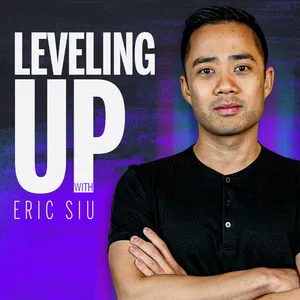
Free Daily Podcast Summary
Leveling Up with Eric Siu: Daily Summaries Delivered
by Eric Siu
Get key takeaways, quotes, and insights from Leveling Up with Eric Siu in a 5-minute read. Delivered straight to your inbox.
Latest Episodes
The most recent episodes — sign up to get AI-powered summaries of each one.
- 4 days ago7 min
The One File That Makes AI Actually Understand Your Brand (And Drive More Sales)
Here’s why Google’s new design.md standard could completely change how brands create content with AI agents. Right now most brands exist in formats AI can’t consistently understand. Your landing pages, ads, decks, and creative assets are scattered everywhere with no persistent design memory. Google’s new design.md format changes that by giving agents a structured way to understand your visual identity and generate assets that actually stay on-brand. In this video I break down how design.md works, why Google is trying to make it the default standard for AI-generated design, how we’re using it internally with agents, and why this becomes massively important for marketing teams trying to scale creative output without losing consistency. Chapters: Why AI currently cannot “see” your brand Google’s new design.md standard explained Why Google wants to own the format Real examples using ClickFlow and Single Grain How agents generate branded assets automatically Why open standards matter more than lock-in The massive impact on marketing teams Sales decks and personalized design workflows The GitHub repo with reusable design systems Using inspiration from top-performing websites Why design.md could become the industry standard How revenue agents change creative production
- 1 weeks ago8 min
Hermes Vs OpenClaw - Which One Makes More Money?
Here’s the real difference between OpenClaw and Hermes when it comes to actually making money with AI agents. OpenClaw has the bigger ecosystem, more integrations, more community support, and way more features. Hermes is newer, but it’s faster, more reliable, and learns alongside you over time through persistent memory and skill files. In practice, that means OpenClaw feels like the execution layer, while Hermes feels more like the brain. In this video I break down where each agent wins across reliability, security, features, and community, how we structure them inside our “single brain” system, why reliability matters more than features for business use cases, and the exact way we’re thinking about deploying agent fleets inside companies right now. Chapters: OpenClaw vs Hermes overview What OpenClaw already helped us achieve Why Hermes feels more stable The 4 categories that matter most How our team uses agents inside Slack Reliability problems with OpenClaw Security tradeoffs and risks Why OpenClaw still wins on community Feature comparison between both agents Why reliability matters most for business Hermes as the “brain” and OpenClaw as execution Final verdict on which agent wins today
- 1 weeks ago11 min
OpenClaw Just Replaced My ENTIRE Cold Email Operation
Here’s how one person can now run cold email infrastructure that used to require an entire team. Most outbound systems break because there are too many moving parts. You need lead sourcing, email verification, inbox warmup, campaign management, copywriting, optimization, and reporting all happening at once. In this video I show how agents inside a “single brain” system handle most of that work end-to-end while a human stays focused on judgment, strategy, and approvals. I also walk through how we’re using OpenClaw, Instantly, Whisper Flow, and recursive scoring systems to rewrite campaigns, manage infrastructure, QA sequences, and launch campaigns in parallel without needing multiple operators. Chapters Why cold email used to require a full team How the “single brain” system works Reviewing Instantly campaign performance AI rewriting and scoring email sequences Why humans still need to stay in the loop Incentives, personalization, and reply rates Running multiple campaign workflows in parallel Managing lead distribution and infrastructure Reviewing campaigns inside Instantly Fixing ICP targeting and send settings Live feedback and campaign optimization Why one person can now operate like a full outbound team How companies are building “world brains”
- 1 weeks ago11 min
Is It Game Over For OpenClaw
Here’s the real state of OpenClaw right now. OpenClaw became a critical part of how our team operates, but over the last couple months the reliability has noticeably dropped. Messages fail, automations break, gateways hang, and teams start losing trust in the system when it stops responding consistently. In this video I walk through Peter Steinberger’s public apology, the exact issues we’re seeing inside Slack and Telegram, why reliability matters more than features, and how we’re thinking about Hermes vs OpenClaw moving forward. I also break down the “brain vs execution” model, why competition between the two is actually healthy, and why I still believe autonomous agents are the future despite the current issues. Chapters Is it over for OpenClaw? The reliability problems we’re seeing Peter Steinberger’s apology Why SSR matters (secure, stable, reliable) The single brain + agent fleet setup Real Slack failures inside our team Telegram failures and broken responses Hermes as the alternative Brain vs execution model Why OpenClaw still matters Website deployed using OpenClaw Final thoughts on the future of agents
- 2 weeks ago7 min
This Happened 3 Times In 125 Years. AI Just Did It Again
Here’s why the “AI will cause mass unemployment” narrative is probably wrong. Every major wave of technology has triggered the same fear, and every time it’s played out differently. AI doesn’t just replace jobs, it shifts them. It removes repetitive work, increases productivity, and creates entirely new roles that didn’t exist before. In this video I walk through real historical data from radiology, agriculture, spreadsheets, and ATMs to show how job displacement actually works, why demand often increases, and how AI acts as a multiplier rather than a replacement. Chapters The mass unemployment narrative Radiology example (AI vs jobs) AI as a demand multiplier Drivers and task vs job thinking Agriculture automation (tractor era) Spreadsheets and job evolution ATM prediction vs reality Creative destruction explained Why AI likely creates more opportunity
- 2 weeks ago8 min
I Spent $7,500 on Claude Last Month (Here's The ROI)
Here’s why I spent $7,500 on AI tokens in a single month and why it was worth it. Most people hear that number and think it’s insane. But that spend replaced work that would’ve cost way more in headcount, made our team significantly more effective, and even uncovered $500K in savings that I acted on within days. This isn’t just “AI cost” it’s leverage across sales, coaching, product, and operations. In this video I break down what that spend actually gets you, real examples of how it’s used inside the company, the ROI behind it, and how to think about cost vs speed when choosing models. Chapters Why I spent $7,500 on tokens What that spend actually buys Using AI to coach your team ROI breakdown and savings Product and dev leverage What the first 3 months look like The “single brain” effect Frontier vs cheaper models Why you need to start now
- 3 weeks ago8 min
OpenClaw + Hermes is INSANE
Here’s why I’d take OpenClaw + Hermes over most marketers I’ve hired. The problem was never just talent — it was consistency. People forget things, need managing, and plateau once they get comfortable. These agents don’t. Hermes acts as the brain that monitors, improves, and keeps everything running, while OpenClaw handles execution. Together, they create a system that can run workflows like SEO, outbound, and content end-to-end with built-in accountability and continuous improvement. In this video I break down how they work together, what they actually replace inside a company, the limitations you need to be aware of, and how to start building your own setup. Chapters Why most marketers hit a ceiling OpenClaw vs Hermes (execution vs brain) Example workflows (SEO + outbound) Brain vs builder mental model Memory layer (Obsidian) Limitations and tradeoffs How to get started Why this is the future
- 3 weeks ago11 min
OpenClaw's New "Revenue Agents" Are INSANE
In this video I break down how we’re building this at Single Grain, how a fleet of agents sits on top of that brain to handle sales, SEO, content, recruiting, and ops, and why memory systems like Obsidian are critical to making it actually work. I also walk through what the first 90 days look like (it’s messy), how this system compounds over time, and real examples of how it’s already driving cost savings, pipeline, and inbound from enterprise companies. Chapters What the “world brain” is How a single brain connects all your data From insights to execution with AI The agent fleet running on top What the first 3 months look like Turning SOPs into AI “skills” Fat skills, thin harnesses explained Why memory systems matter (Obsidian) Infrastructure and local setup Agent fleet and sandboxing Real-world results and savings Why this becomes a massive advantage
Get Leveling Up with Eric Siu summaries in your inbox
Free AI-powered daily recaps. Key takeaways, quotes, and mentions — in a 5-minute read.
Get Free Summaries →Free forever for up to 3 podcasts. No credit card required.
You Might Also Like
Listeners also like.
Leveraging AI
Isar Meitis
Authority Hacker Podcast – AI & Automation for Small biz & Marketers
Gael Breton & Mark Webster - Full Stack Online Marketers
Startup Stories - Mixergy
Andrew Warner
AI Fire Daily
AIFire.co
How I AI
Claire Vo
AI Explored
Michael Stelzner, Social Media Examiner—AI marketing
Marketing School - Digital Marketing and Online Marketing Tips
Eric Siu and Neil Patel
Ahrefs Podcast
Ahrefs Podcast
Lenny's Podcast: Product | Career | Growth
Lenny Rachitsky
In the Pit with Cody Schneider | Marketing | Growth | Startups
Cody Schneider
Pivotal Clarity | An AI Podcast
Upekkha
AI-Branding Podcast
Mark de Grasse
About Leveling Up with Eric Siu
Leveling Up is a weekly interview series with entrepreneurs and marketers on the latest in business and marketing. Learn actionable strategies & tactics on how you can make your business grow and mistakes to avoid during your journey. Learn from individuals who have founded billion dollar companies to best-selling authors. Entrepreneur and host Eric Siu also shares insights and learnings along the way.
Customized Recaps
AI-powered recaps with compact key takeaways, quotes, and insights.
Straight to Your Inbox
Get key takeaways from Leveling Up with Eric Siu in a 5-minute read.
Save Hours Every Week
Stay current on your favorite podcasts without falling behind.
Frequently Asked Questions
What is Podzilla's Leveling Up with Eric Siu daily summary?
It's a free AI-powered email that summarizes new episodes of Leveling Up with Eric Siu as soon as they're published. You get the key takeaways, notable quotes, and links & mentions — all in a quick read.
How does the Leveling Up with Eric Siu podcast summary work?
When a new episode drops, our AI transcribes and analyzes it, then generates a personalized summary tailored to your interests and profession. It's delivered to your inbox every morning.
Is this an official Leveling Up with Eric Siu product?
No. Podzilla is an independent service that summarizes publicly available podcast content. We're not affiliated with or endorsed by Eric Siu.
Can I get summaries of other podcasts too?
Absolutely! The free plan covers up to 3 podcasts. Upgrade to Pro for 15, or Premium for 50. Browse our full catalog at /podcasts.
What topics does Leveling Up with Eric Siu cover?
Leveling Up with Eric Siu covers topics including Education, Business, Entrepreneurship, Self-Improvement. Our AI identifies the specific themes in each episode and highlights what matters most to you.
Start getting Leveling Up with Eric Siu summaries tomorrow morning.
Free forever for up to 3 podcasts. No credit card required.
Free forever for up to 3 podcasts. No credit card required.