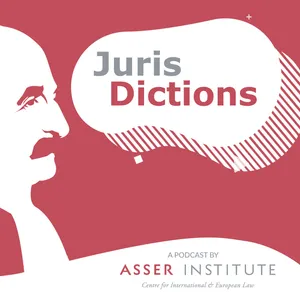
Free Daily Podcast Summary
JurisDictions: International law podcast: Daily Summaries Delivered
by T.M.C. Asser Instituut
How is it that a movie about a children’s toy can raise tensions over territorial sovereignty? And why is it that certain international disputes draw more global attention than others? This monthly educational podcast by the Asser Institute, research centre for international and European law, explores such questions. It focuses on the stories behind international legal concepts and issues that shape our world.
Latest Episodes
The most recent episodes — sign up to get AI-powered summaries of each one.
- Mar 10, 202643 min
Marketing Justice
We sometimes hear discussions that frame international dispute settlement in the language of markets. Consider the various discussions surrounding how international actors engage in ‘forum shopping’, looking for their preferred international dispute settlement venue amongst various available options. But what happens when we begin imagining courts and tribunals as active participants in this market? In what sense could we speak of courts and tribunals engaging in marketing? Guests Dr Georgia Antonopoulou, Assistant Professor in Commercial Dispute Resolution, Birmingham Law School, College of Arts and Law. Professor Christine Schwöbel-Patel, Warwick Law School, the University of Warwick Host Eduardo Silva de Freitas, PhD candidate at Erasmus University Rotterdam and junior researcher in private international law at the T.M.C. Asser Institute. Further reading Christine Schwöbel-Patel, 'Spectacle in international criminal law: the fundraising image of victimhood' (2016) 4 London Review of International Law 247. Christine Schwöbel-Patel, 'The ‘Ideal’ Victim of International Criminal Law' (2018) 29 European Journal of International Law 703. Georgia Antonopoulou, 'The ‘Arbitralization’ of Courts: The Role of International Commercial Arbitration in the Establishment and the Procedural Design of International Commercial Courts' (2023) 14 Journal of International Dispute Settlement 328. Georgia Antonopoulou, 'Forum Marketing in International Commercial Courts?' (2024) 44 Oxford Journal of Legal Studies 860.
- Dec 9, 202559 min
Strategic Litigation: An interview with Nani Jansen Reventlow
In this episode, Taylor Kate Woodcock, Researcher in Public International Law at the Asser Institute interviews Nani Jansen Reventlow, author and award-winning human rights lawyer specialised in strategic litigation at the intersection of human rights, social justice, and technology. Founder of Systemic Justice and the Digital Freedom Fund, Nani has overseen litigation worldwide, leading cases before national courts, the European Court of Human Rights, African Court on Human and Peoples Rights, and UN Human Rights Committee, amongst others. Nani joins Taylor to explain strategic litigation, her trajectory in the field and experiences working with marginalized communities in trauma informed ways, providing practical insights and hope for the pursuit of material, structural change through strategic litigation. For more information on Nani Jansen Reventlow’s recent and upcoming publications, see: · N Jansen Reventlow - Radical Justice: Building the world we need – Available in Dutch and for Pre-order in English. As a special treat for listeners, use discount codeJUSTICE15 here to get 15% off orders of 'Radical Justice' in English (discount code expires on 20 March 2027). · Read more about Intersectionality and Human Rights: Reimagining European Court of Human Rights Judgments – Edited by Nani Jansen Reventlow, Eddie Bruce-Jones, Lyn K. L. Tjoin Soei Len and Adam Weiss here.
- Oct 6, 202556 min
The Externalisation of Migration
In this episode, Flora Bensadon and Irem Cakmak are joined by Zoe Bantleman, Dr Kris van der Pas and Dr Annick Pijnenburg to discuss the externalisation of migration. What is meant by the externalisation of migration? What legal, political and moral considerations does it raise? And to what extent may contemporary externalisation efforts be seen as a wider pushback against international law? Note: From 20:10 Dr Van der Pas discusses the upcoming changes to the connection requirement in EU law and from 30:18 Dr Pijnenburg briefly discusses the Italy-Albania deal and litigation and again the connection requirement. There have been some developments since the podcast was recorded: The European Commission published its proposal to change the connection requirement and the Court of Justice of the EU ruled on a preliminary question that affects the Italy-Albania deal. Speakers Zoe Bantleman – Barrister, Legal Director of the Immigration Law Practitioners’ Association (ILPA), and DPHil Migration Studies Student, University of Oxford Dr Kris van der Pas – Postdoctoral Researcher, Tilburg University Dr Annick Pijnenburg – Assistant Professor, International and European Law, Radboud University Hosts Flora Bensadon – Intern, TMC Asser Institute Irem Cakmak – Intern, TMC Asser Institute
- Jul 30, 202545 min
‘The litmus test of Palestine’ - A conversation with Ammar Hijazi, Ambassador and Head of the Palestinian Mission to the Kingdom of the Netherlands
In a brand-new episode of JurisDictions, the Asser Institute’s international law podcast, researcher Dr Carl Lewis interviews Ammar Hijazi, Ambassador and Head of the Palestinian Mission to the Kingdom of the Netherlands and Permanent Representative of the State of Palestine to International Organizations in The Hague. One year after the International Court of Justice delivered its Advisory Opinion on the legal consequences arising from the policies and practices of Israel in the Occupied Palestinian Territory, including East Jerusalem (19 July 2024), Ambassador Ammar Hijazi reflects on his role as ambassador, the importance of pursuing justice within existing international legal mechanisms, as well as the need for states to show commitment to international law. “(…) today we see the final episodes of our erasure taking place in Palestine. These are now very clear, in terms of law. Everybody knows where everything stands. And it is up to States. Do they want this system to continue? Or do they want it to collapse on the basis of a few interests here and there, or on sheer power and bullying? That's a determination that is not up to the Palestinians. This is why it is a litmus test. Everybody's looking at Palestine.”
- Jun 27, 20251h 1m
Establishing the Special Tribunal for the Crime of Aggression against Ukraine: An Interview with H.E. Dr Anton Korynevych
For the first time in history, a dedicated tribunal is being established to investigate and prosecute the crime of aggression. Join us in this episode, as Dr Gabrielė Chlevickaitė, International Criminal Law researcher at the Asser Institute, interviews H.E. Dr Anton Korynevych, Ambassador -at-large in the Ministry of Foreign Affairs of Ukraine, on establishing the Special Tribunal for the Crime of Aggression against Ukraine. Should you wish to read more, the Asser Institute has also released a Report on the Special Tribunal, offering the first legal analysis of the 'Council of Europe model,' as well as broader legal and policy considerations.
- Mar 21, 202546 min
Rights, Transfers, and Transnational Law: Exploring Football's Legal and Regulatory Landscape
In this episode, we reflect on international sports law and the governance of football. Joined by Dr. Antoine Duval, we discuss the complexities of the football transfer system, particularly considering historical shifts following two landmark judgements: the Bosman (European Court of Justice, 1995) and the Diarra (Court of Justice of the European Union, 2024) rulings. How have these landmark rulings offered the possibility for the football transfer system to shift in favour of players? What even is a football transfer? And, more broadly, what legal and ethical issues arise around the ‘world's game' and football mega events like the upcoming 2034 FIFA Men’s World Cup, which will be hosted by Saudi Arabia? In this episode, we discuss all of this and more. Guest: Dr Antoine Duval, Senior Researcher in International Law, TMC Asser Institute Host and Editor: Flora Bensadon, Research Trainee, TMC Asser Institute Editor: Dr Carl Lewis, Researcher in Public International Law, TMC Asser Institute Further reading: A Duval, 'Football at a Crossroads' (2024) Verfassungsblog Bosman ruling (Case C415/93): Union royal belge des sociétés de football association ASBL, Royal club liégeois SA v Jean March Bosman and others and Union des associations européennes de football (UEFA) v Jean-Marc Bosman. Diarra ruling (Case C-650/22): Fédération internationale de football association (FIFA) v BZ. For further information, news and readings on questions of transnational sports law please visit the Asser International Sports Law Centre webpage.
- Dec 19, 202454 min
The Rules of Modern Warfare and Ancient Traditions
In this episode, we reflect on how Dharmic traditions, such as Buddhism and Hinduism, engaged with principles of humanity in warfare long before the codification of International Humanitarian Law (IHL) with the Geneva Conventions. Joined by Dr. Robert Heinsch, Dr. Raj Balkaran, and Dr. Christina Kilby, we consider key IHL concepts such as collateral damage and proportionality, while reflecting on what ancient philosophies, theologies and laws can teach us about ethical warfare today. By reflecting on various historical roots and traditions of humanitarian principles, the episode seeks to encourage engagement with the evolution and applications of the laws of armed conflict. What role do the principles of humanity, distinction and proportionality play in the law of armed conflict? How does the element of storytelling in the Sanskrit epics contribute to the dissemination of ethical values? How has religion influenced International Humanitarian Law, specifically the implementation of humanitarian principles? Guests: Dr. Robert Heinsch, Associate Professor in International Law at Leiden University Dr. Raj Balkaran, Scholar of Sanskrit Narrative Literature, Public Intellectual, Online Educator Dr. Christina Kilby, Associate Professor of Religion at James Madison University Editors: Host - Dr Carl Lewis, Researcher in Public International Law, TMC Asser Institute Co-host - Wamika Sachdev, Intern, Asser Institute Flora Bensadon, Intern, Asser Institute
- Apr 19, 20241h 13m
Gaza and the International Legal Community(?): South Africa v Israel at the ICJ
The International Court of Justice (ICJ) has now provided two orders of provisional measures in the Application of the Convention on the Prevention and Punishment of the Crime of Genocide in the Gaza Strip (South Africa v. Israel) case, following the further deterioration of the humanitarian situation in Gaza since the 26th of January 2024. But what are provisional measures? What does it mean to invoke a breach of an obligation owed to the ‘international community’? What implications follow from these proceedings beyond the peace palace? And in what sense could it be argued that the ICJ may be denying reality? In this episode, we discuss all of this and more. Guests: Dr León Castellanos-Jankiewicz, Senior Researcher in International Law at the TMC Asser Institute Dr Shahd Hammouri, Lecturer in Law at the University of Kent Dr Giulia Pinzauti, Assistant Professor in International Law at Leiden University Dr Sarah Thin, Assistant Professor in International and European Law at Radboud University Host: Dr Carl Lewis, Researcher in Public International Law, TMC Asser Institute
Get JurisDictions: International law podcast summaries in your inbox
Free AI-powered daily recaps. Key takeaways, quotes, and mentions — in a 5-minute read.
Get Free Summaries →Free forever for up to 3 podcasts. No credit card required.
You Might Also Like
Podcasts in similar categories.

Something You Should Know
Expert interviews and practical tips to improve your life, career, finances, and relationships.

Inside AsembleAI: DeepTech, AI & Science
Experts discuss AI's impact on business, product development, and leadership with researchers, founders, and executives.

Huberman Lab
Explores neuroscience and science-based tools for understanding and improving brain function, behavior, and health.

Big Ideas Lab
Inside Lawrence Livermore National Laboratory, uncover breakthroughs in science and technology shaping the future.

Gastropod
Explores the science and history behind food and farming, from ancient feasts to modern aquaculture and everything in between.

The Jordan B. Peterson Podcast
Explores how values, religion, and culture shape individuals and society through interviews and lectures.

The Science of Everything Podcast
Explores diverse topics in natural and social sciences through the lens of the scientific method.

The Rest Is Science
Hannah Fry and Michael Stevens explore puzzling scientific questions that challenge everyday assumptions about reality.
Plagues with Dr. Keith
A physician examines the science, history, and societal impact of major diseases and pandemics.

Somewhere in the Skies
A weekly exploration of UFO phenomena and unexplained aerial encounters hosted by an author and investigator.
Data Science With Sam
Data scientists and AI practitioners discuss real-world tools, deployments, and lessons in data science and emerging technology.

Discovery
Explores various topics in the field of science.
About JurisDictions: International law podcast
How is it that a movie about a children’s toy can raise tensions over territorial sovereignty? And why is it that certain international disputes draw more global attention than others? This monthly educational podcast by the Asser Institute, research centre for international and European law, explores such questions. It focuses on the stories behind international legal concepts and issues that shape our world.
Customized Recaps
AI-powered recaps with compact key takeaways, quotes, and insights.
Straight to Your Inbox
Get key takeaways from JurisDictions: International law podcast in a 5-minute read.
Save Hours Every Week
Stay current on your favorite podcasts without falling behind.
Frequently Asked Questions
What is Podzilla's JurisDictions: International law podcast daily summary?
It's a free AI-powered email that summarizes new episodes of JurisDictions: International law podcast as soon as they're published. You get the key takeaways, notable quotes, and links & mentions — all in a quick read.
How does the JurisDictions: International law podcast podcast summary work?
When a new episode drops, our AI transcribes and analyzes it, then generates a personalized summary tailored to your interests and profession. It's delivered to your inbox every morning.
Is this an official JurisDictions: International law podcast product?
No. Podzilla is an independent service that summarizes publicly available podcast content. We're not affiliated with or endorsed by T.M.C. Asser Instituut.
Can I get summaries of other podcasts too?
Absolutely! The free plan covers up to 3 podcasts, any in the catalog. Basic raises that to 15, Pro to 40 and Max to 100. Browse our full catalog at /podcasts.
How often does JurisDictions: International law podcast release new episodes?
JurisDictions: International law podcast publishes occasional. Our AI generates a summary within hours of each new episode.
What topics does JurisDictions: International law podcast cover?
JurisDictions: International law podcast covers topics including Science, Social Sciences. Our AI identifies the specific themes in each episode and highlights what matters most to you.
Start getting JurisDictions: International law podcast summaries tomorrow morning.
Free forever for up to 3 podcasts. No credit card required.
Free forever for up to 3 podcasts. No credit card required.