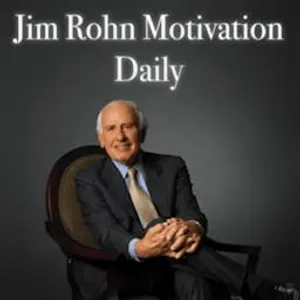
Free Daily Podcast Summary
Jim Rohn Motivation Daily: Daily Summaries Delivered
by Jim Rohn
Unlock the mindset of high achievers with the Jim Rohn Motivation podcast — your audio companion for powerful ideas on success, self-discipline, and personal growth. Dive into a curated collection of Jim Rohn’s most impactful talks, designed to spark clarity, build confidence, and help you create lasting change in your life and work. From goal-setting to leadership, each episode delivers timeless strategies you can apply every day. Whether you're chasing big dreams or just looking for direction, this podcast is for anyone serious about becoming their best self.
Latest Episodes
The most recent episodes — sign up to get AI-powered summaries of each one.
- Today33 min
How to Destroy a Bad Habit Without Willpower | Jim Rohn Motivation
I'm telling you — there's nothing wrong with you. The problem was never your character. It was never a lack of desire. The problem was that you were using the wrong tool.You were trying to defeat a habit with willpower. And willpower is a battery. Every battery drains. By evening, when you're tired and worn down, you have almost nothing left — and that is precisely when the craving shows up. Not in the morning when you're strong. In the evening, when you're empty.So of course you fail. Anybody would fail. You brought a battery to a fight that never ends.Here is the truth: a habit doesn't get tired, doesn't run out of charge, doesn't take the night off. You cannot out-discipline something that never sleeps. But you can rearrange the machine.This seminar walks through the things you must understand about how habits actually work — so you can stop fighting and start building.CHAPTERS0:00 Intro — There's nothing wrong with you0:28 Why willpower is a battery that always drains2:44 The machine: trigger, routine, reward4:26 The trigger — become a detective in your own life6:30 Eliminate the trigger before it fires8:52 Replace the routine, keep the trigger and reward11:57 Diagnose the real reward or the swap collapses13:58 Architecture over willpower: engineer your environment17:38 Ride the wave — the ten-minute pause19:59 The stress test and the trap of false confidenceWHY THE FIGHT WAS RIGGED FROM THE STARTMost people treat a bad habit like a duel — my willpower against the urge, whoever is stronger wins. But it was never a fair contest. The routine you keep attacking is only the road. What you're really chasing is the reward underneath: the relief, the comfort, the escape. Block the road with sheer effort and the traffic never stops coming. Eventually you get tired, and eventually you get run over.WATER ALWAYS WANTS TO GO SOMEWHEREYou don't dam a river. You dig it a new channel. Honor the trigger, honor the reward, and swap out only the middle. The stress still hits, the craving for relief still rises — but you send it down a walk around the block, ten deep breaths, a call to a friend. Get the diagnosis right and the machine learns the new path. Get it wrong — a glass of water for what was really boredom — and it collapses every time.HOW THE DISCIPLINED PEOPLE REALLY LIVEYou do not rise to the level of your goals. You fall to the level of your environment. The people who seem to have iron discipline almost never resist anything — they arranged the room so the battle never happened. Add friction to the wrong thing, remove it from the right thing, and use the ten-minute pause when the wave crests. That is willpower you never have to spend.WHAT TO DO THIS WEEKCatch the habit in the act once and write down the trigger — time, place, feeling, who you were with.Name the real reward underneath: relief, stimulation, connection, or rest.Remove the trigger from your home this weekend, while you're calm and clear-headed.Choose one replacement routine that delivers that same reward and place it within easy reach.Next time the urge arrives, don't say no — say "wait ten minutes," and watch it deflate.—Inspired by the teachings of Jim Rohn.#jimrohn #motivation #selfdevelopment #discipline #habits Learn more about your ad choices. Visit megaphone.fm/adchoices
- Yesterday37 min
Why Most Plans Fail in the First 30 Days | Jim Rohn Motivation
You've made plans before. You know you have. And most of them didn't survive the first month. The plan to get in shape. The plan to save money. The plan to start the business. You made it with real intention, real energy, real belief. And thirty days later, the plan was gone.Not failed dramatically. Just quietly abandoned. You went back to the old way, and you told yourself you'd start again later — when things settled down, when the timing was better, when you had more discipline.Here is the truth: the plan didn't die because you lacked willpower, and it didn't die because the plan was bad. Most plans that die in the first thirty days die for reasons that have everything to do with how the plan was built. You were set up to fail before you started.This seminar walks through six things you must understand about why plans collapse in their first month — and how to build one that doesn't.CHAPTERS0:00 Intro — the quietly abandoned plan3:26 The Real Cost of a Dead Plan6:45 #1 — Built for the Version of You That Doesn't Exist9:33 #2 — Too Much Change at Once12:38 #3 — Running on Motivation Instead of Structure15:34 #4 — What You Do the First Time You Slip19:00 The Never-Miss-Twice Story21:20 #5 — Who You Tell, and How23:00 #6 — No Room in the Plan for Real LifeDESIGN IS THE THING, NOT CHARACTERThe first thirty days are a test — but not of your character. They are a test of design. The person who makes the plan is rested, inspired, imagining a perfect future. The person who has to carry it out is tired, distracted, dealing with an imperfect present. When you size a plan for the planner, the executor cannot hold it. And every plan that dies quietly erodes something more valuable than a wasted month: your faith in your own ability to change.THE WORST DAY DECIDES EVERYTHINGA bad day always arrives, usually inside the first two weeks. The feeling always fades. The slip always comes. Life always intrudes. None of that is bad luck — it is simply what thirty days contains. The plans that last are built to bend: a full version for good days, a minimum version for hard ones, and a rule for what to do the moment you fall short so one lapse cannot take the whole thing down.HARDER TO QUIT IS THE WHOLE GAMEEverything you do to make quitting harder and continuing easier tilts the odds in your favor. Structure beats feeling. A witness who will actually ask beats a secret kept in the dark and beats a loud announcement that hands you the reward before you've earned it. Slow and permanent beats fast and temporary. Every single time.WHAT TO DO THIS WEEKPick one change — only one — and shrink it until you could do it on the worst realistic day of your month.Attach it to a fixed time, a fixed place, a fixed trigger, so it runs whether you feel like it or not.Make the rule now: never miss twice. Miss once, fine — come back the next day, no matter what.Tell two or three people the specific commitment, not the grand vision, and ask them to check on you.Write a minimum version of the plan for hard days, so a bad day becomes five minutes instead of a zero.—Inspired by the teachings of Jim Rohn.#jimrohn #motivation #selfdevelopment #discipline #habits Learn more about your ad choices. Visit megaphone.fm/adchoices
- Yesterday32 min
10 Lies Broke People Tell Themselves About Money | Jim Rohn Motivation
The most dangerous lies aren't the ones other people tell you. They're the ones you tell yourself, in your own voice, in the privacy of your own head. You believe them the way you believe the sun is going to come up. You never question them. You just carry them around, year after year, and wonder why nothing ever changes.Because broke is not a bank balance. Broke is a set of beliefs. The bank balance is just the shadow those beliefs cast on the ground. Hand a person money without changing the beliefs, and the money leaves, and the person ends up right back where they started.Here is the truth: the beliefs are the machine, and the money is only the output. If the machine is broken, it does not matter how much material you feed into it — you get the same result every time.This seminar walks through ten lies you must understand about money, and how each one quietly keeps a working person poor.CHAPTERS0:00 Intro — broke is a set of beliefs1:33 The machine behind every result3:38 #1 — The rich took it from the poor5:47 #2 — I'll worry about money later8:06 #3 — More money, more problems10:24 #4 — I'm not a numbers person12:43 #5 — I deserve to treat myself16:16 #6 — It's only a few dollars17:00 #7 — I'll never earn more than this20:48 #8 — Debt is a normal part of life23:15 #9 — I don't need to learn about moneyTHE PERMISSION SLIP DISGUISED AS WISDOMEvery lie here sounds reasonable. That's what makes it work. Each one wears the costume of maturity — it sounds like something a wise, humble, realistic person would say. But underneath the costume, each is a small permission slip to stay exactly where you are. Two people can begin in the identical circumstance and end up in opposite worlds ten years later, not because of luck, but because one believed money was scarce and the other believed it was available to anyone willing to earn it. The belief shaped the behavior, and the behavior built the world.ATTENTION IS THE WHOLE GAMERunning underneath these lies is one thread: the refusal to look. The person who says he isn't a numbers person, who dismisses a few dollars, who treats his income as a permanent ceiling — each is training himself to stop paying attention. And attention is the first thing every wealthy person developed, back when they had almost nothing. They watch the flow the way a captain watches the water. Treat the small amount well, and you become the kind of person a large amount can trust.WHAT TO DO TONIGHT- Look at exactly what you have and where it is going. Not next month. Tonight.- Track the small expenses for one month. Be shocked by the total, not any single line.- Once a week, sit down with what came in and what went out until it stops being uncomfortable.- Ask before any treat: do I deserve this more than I deserve freedom from money fear?- Attack your debt like it's on fire, because it is burning your future while you sleep.—Inspired by the teachings of Jim Rohn.#jimrohn #motivation #selfdevelopment #discipline #money Learn more about your ad choices. Visit megaphone.fm/adchoices
- 3 days ago34 min
10 Decisions You'll Regret Not Making Sooner | Jim Rohn Motivation
Not from what you did, but from what you didn't. The call you never made. The risk you never took. The words you swallowed. The door you stood in front of and never walked through. It's soft at first. But it lingers.Here's the hard truth. Most people don't fail because they made the wrong move. They fail because they made no move at all. They waited. They hesitated. They kept telling themselves there'd be more time. And the years slipped by while they stood still, guarding a life they never really chose.Here is the truth: real regret rarely comes from the things we tried and lost. It comes from the things we knew we should have done and never did. Not failure. Delay.This seminar walks through ten decisions you must understand about ending the waiting and choosing your life on purpose — while you still have the strength to build with the arms it frees.CHAPTERS0:00 Intro — the ache of what you didn't do1:47 #1 — Choose yourself first4:23 #2 — Cut loose the weight you outgrew7:08 #3 — Start before you feel ready9:49 #4 — Guard your time like currency12:22 #5 — Have the conversation you avoid15:10 #6 — Invest in yourself first18:03 #7 — Forgive and set the prisoner free20:53 #8 — Build your health before you're forced to23:47 #9 — Speak your dreams out loudWHY DELAY IS THE REAL THIEFNotice the thread running under all of it. Every one of these moves was available to you long before today. The permission you were waiting for never arrived because it was never coming. The clarity you wanted was hiding inside the action you refused to take. Fear disguises itself as patience, as loyalty, as being reasonable — and it charges you interest in years. What you delay does not sit still. The unspoken word festers. The unbuilt body sends a bill. The ungiven forgiveness scorches the one holding the match.THE COST YOU PAY IN PIECESYour time, your health, your peace, and your voice are not renewable. You can rebuild money. You cannot buy back a decade. Each of these decisions is really the same decision worn in different clothes: stop trading pieces of your one life for the comfort of not deciding. The people who wait always say the same thing at the end — I wish I'd started sooner, I wish I'd let go, I wish I'd spoken up. That sentence is optional. You get to write a different one.WHAT TO DO TONIGHT- Name the one conversation you've been avoiding and schedule it.- Set down one obligation you've quietly outgrown — no speech required.- Take one imperfect step toward the thing you keep postponing.- Write the wish you don't want at the end, then do its opposite this week.—Inspired by the teachings of Jim Rohn.#jimrohn #motivation #selfdevelopment #discipline #regret Learn more about your ad choices. Visit megaphone.fm/adchoices
- 3 days ago36 min
Stop Apologizing For The Word "No." | Jim Rohn Motivation
And then something happened. Somewhere between the age of two and the age you are right now, you learned that one small word carried a price. You said it, and people frowned. They pulled away. They looked disappointed. And you, being a person who wanted to be loved, started to believe that this little word was dangerous.So you began to trade it. You said yes when you meant no, because yes kept the peace. Yes made people smile. Yes kept the relationship intact, at least on the surface. And over the years, that trade became so automatic you stopped noticing you were making it. But the currency you were spending was yourself.Here is the truth: saying yes when you mean no never actually saves the relationship. It builds a wall out of resentment, one reluctant yes at a time.This seminar walks through the things you must understand about declining a request without declining a human being — and the method that lets you do it warmly.CHAPTERS0:00 Intro — the word you learned to fear1:43 No to the request is not no to the person3:11 Where the always-yes program was installed5:01 The trap in the split second after they ask6:31 Two kinds of discomfort: sharp vs. dull8:08 The man who couldn't say no10:28 Relationship vs. arrangement — the great clarifier14:14 The method: clarity, brevity, and the yes inside the no16:26 Delivery, silence, and giving your no promptly20:45 The false guilt of setting a boundary22:53 The hardest people and why their anger confirms youTHE WALL YOU BUILD OUT OF QUIET YESESA relationship built on a foundation of quiet dishonesty is not a relationship. It is a performance, and performances exhaust the performer until they want out. Every reluctant yes drains the vessel other people are counting on, and when the vessel runs dry, the very bonds you were protecting collapse anyway. You did not protect them. You poisoned them slowly, one avoided moment at a time.WHY YOUR NO IS THE GREAT CLARIFIERThere is a difference between a relationship and an arrangement. In an arrangement, someone values what you provide, and your no is met with anger and punishment. In a relationship, someone values who you are, and your no is met with respect. Saying no is how you find out which one you are standing in. The people who leave when you draw a line were there for the service, never for you.HOW A GOOD NO PROTECTS THE BONDA good no is clear and kind at once. It does not owe a long explanation, because every reason you offer becomes a door for argument. It attaches a no to the thing and a yes to the person. It is delivered calmly, then held in silence, and it is given promptly rather than left to fester. The guilt that follows is not proof of wrongdoing — it is the discomfort of doing something new.WHAT TO DO THIS WEEKCatch the tightening in your chest as the honest answer before your mouth lies.Say one clear no with no mountain of excuses attached.Wrap it in a genuine affirmation: no to the request, yes to the person.Deliver it calmly, then stop talking and let the silence stand.When guilt rises, name it as false guilt and walk forward anyway.—Inspired by the teachings of Jim Rohn.#jimrohn #motivation #selfdevelopment #discipline #boundaries Learn more about your ad choices. Visit megaphone.fm/adchoices
- 3 days ago31 min
Stop Chasing Motivation. Build the Machine. | Jim Rohn Motivation
You may not have called it that, but that's what you were doing. You were waiting for the feeling. That little spark that says, today's the day, today I've got it, today I'm going to move.And on the mornings when the spark shows up, you feel like a champion. But on the mornings when it doesn't, you feel like something is broken inside you. Nothing is broken inside you. You've just been chasing the wrong thing your entire life.Here is the truth: the people who accomplish remarkable things are not more motivated than you. They have simply stopped depending on motivation altogether. They've built a machine.This seminar walks through the single mechanic behind a life that produces whether you feel like it or not: the machine that runs on decisions made in advance.CHAPTERS0:00 Intro — you've been chasing a feeling2:27 Why the chasers assume wrong2:45 What a machine actually is5:00 The coin flip vs. the decision made in advance6:54 Why a machine is a free life, not a cold one8:06 The trigger — move the on switch out of your emotions9:48 The environment — stronger than your willpower14:20 Never miss twice — building for the bad day17:39 Momentum and the warm machine19:53 The young man with a schedule20:47 Compounding — why the consistent person laps the restA FACTORY DOESN'T WAIT TO FEEL INSPIREDA factory has a line, and the line runs. It doesn't ask itself every morning whether it's in the mood to manufacture. It just manufactures, because that's what it was built to do. Motivation is a feeling, and feelings are events — they happen and then they stop happening. You cannot build a permanent thing on a temporary foundation. A machine stands on its own. It doesn't need motivation the same way a good building doesn't need good weather. It's built to stand in the rain.YOU DON'T WIN THE BATTLE WITH WILLPOWER — YOU NEVER HAVE TO FIGHT ITMove the on switch out of your emotions and into your environment, where you can control it. Attach the work to a trigger that doesn't waver — a time, a place, a preceding action. Then arrange the field so the right thing is easy and the wrong thing is hard. Willpower is a small, tired battery that runs down by noon. The wise person doesn't rely on it. They make the environment do the enforcing, so the victory is nearly automatic.PROTECT THE PATTERN, NOT THE PERFECT DAYEvery machine hits a bad day. The chaser misses once, and one miss becomes two, and two becomes the end. The builder has a rule: never miss twice. On the worst day you don't run the whole machine — you keep the pilot light lit. One minute, one line, a few minutes at the desk. A machine that never fully shuts off never has to be restarted. And restarting is where most people lose the war. Keep it warm, and momentum does the rest — the habit takes over the job motivation used to do, and it never has moods.WHAT TO DO THIS WEEKPick ONE machine. Just one — not ten starting Monday.Name the trigger: a physical event, not a feeling. Coffee hits the desk, the machine begins.Clear the environment tonight so tomorrow's first step is nearly effortless.Write the never-miss-twice rule where you'll see it, and define your one-minute minimum for a bad day.Run it seven days straight before you judge it. The resistance you feel early is just the machine warming up.—Inspired by the teachings of Jim Rohn.#jimrohn #motivation #selfdevelopment #discipline #habits Learn more about your ad choices. Visit megaphone.fm/adchoices
- 5 days ago32 min
The Person You'll Be in Five Years Is Watching You Now | Jim Rohn Motivation
That person waiting for you five years down the road is not a stranger. They are not a matter of luck or chance or fortune. They are the direct result of decisions you are making right now, tonight, this week, in the small unremarkable moments you don't think anyone is paying attention to.And here is the thing most people never consider. That future person is watching. Not in some mystical sense, but in the sense that everything you do today is a letter you're writing to someone who will one day have to live inside the results of your habits, your choices, your standards, and your excuses.Here is the truth: there is no rough draft. Every day you live is the final version, already becoming the foundation the next version of you will have to stand on — whether that foundation is solid rock or shifting sand.This seminar unpacks the single mechanic behind who you become: the quiet, compounding accumulation of daily habits, and why the person you'll be in five years is the sum of them and not the sum of your intentions.CHAPTERS0:00 Intro — The future person is watching2:15 The machinery that traps you also frees you4:10 The great deception of the small decision5:49 You are already becoming someone — now, not someday6:53 Time is not something that happens to you7:59 The man who blamed a lack of time9:53 They inherit your habits, not your conditions11:25 Why willpower always runs out15:33 The delayed payment of every habit16:36 The ongoing war of two directions18:51 You are the author, not the victim21:33 The last dark stretch before the dawnTHE LETTER YOU ARE WRITING FORWARDEvery ordinary evening you spend is a message sent to someone at your mercy. That future self does not receive an explanation that you meant to start but the timing was bad. They open the door and walk into the house you built, and they either thank you or they curse you, and there is nothing left for them to change. The building is done. This is not judgment. It is dependence, and it should sober you and thrill you at once, because the pen has been in your hand the whole time.WHY THE QUIET THING BEATS THE LOUD THINGIntentions are loud but weak — they arrive full of energy and fade by afternoon. Habits are quiet but strong — they run on their own, asking no permission, building your future while your mind is busy elsewhere. A decision is expensive and drains you. A habit is free. That is why trying harder in the moment fails, and why reaching beneath the moment to rebuild the machinery itself is the only thing that keeps working after the motivation has left the building.THE LAST DARK STRETCH BEFORE THE DAWNThe cruelty of a habit is that you pay in advance, working long before you see the reward. The mercy is that once it is built, it pays you forever. Most people quit in the exact stretch where nothing looks like it's working — invisible, underneath the surface, minutes before the acceleration. The gap that later looks uncrossable was never talent. It was time, plus consistency, plus refusing to stop.WHAT TO DO TONIGHT- Run the template test: if today repeated 500 times, who would you become? Look at that person honestly.- Audit the automatic habits already running — the ones you do without deciding.- Name one habit that is quietly tearing you down, and one that is building you up.- Lay one brick tonight for no reward — because it is time to lay the brick, not because you feel like it.- Keep one small promise to yourself that nobody is around to hold you to.—Inspired by the teachings of Jim Rohn.#jimrohn #motivation #selfdevelopment #discipline #habits Learn more about your ad choices. Visit megaphone.fm/adchoices
- 5 days ago33 min
10 Small Wins That Rewire Your Confidence | Jim Rohn Motivation
Look at the confident person across the room. Most people assume that person was handed something they never received. But confidence is not a gift. It is a record.It is the accumulation of evidence you have gathered about yourself, over years, one small proof at a time. Every time you say you'll do something and then do it, that goes in a file your brain keeps on you. Every time you say you'll do it and then don't, that goes in the file too.And over a lifetime, that file becomes the source of what you call self-confidence — or the lack of it.Here is the truth: your brain grades you on completion, not intention. It is looking for a pattern, and it wants to know one thing — when this person says they will do something, do they do it?This seminar walks through ten small wins you must understand about rebuilding self-trust, one kept promise at a time.CHAPTERS0:00 Intro — Confidence is a record, not a gift2:06 Why small wins work when big goals don't5:18 #1 — Make your bed the moment you get up7:15 #2 — Finish one thing you've been putting off9:31 #3 — Do the first repetition today11:47 #4 — Keep one promise you made to another person14:17 #5 — Drop a complaint and take one action16:38 #6 — Give one honest compliment and mean it19:01 #7 — Do one hard thing before the easy things21:32 #8 — Sit with one uncomfortable feeling32:00 What to do tomorrowTHE FILE YOUR BRAIN IS ALREADY KEEPINGThere is an observer inside you who never stops watching. It does not care how noble your intentions were. It records only what you actually did. The person who has broken a thousand promises to themselves does not trust themselves — and of course they don't. They have the evidence. They have watched themselves quit, delay, and back out. The good news is that the same account can be filled the other way, small deposit by small deposit, until you become somebody who trusts their own word again.WHY THE SIZE OF THE WIN DOES NOT MATTERMost people wait for the big win to feel confident. They wait for the promotion, the transformation, the moment everything comes together. And the waiting is the mistake. The big goal, missed, does more damage than no goal at all, because now you have fresh proof that you say big things and don't deliver. The brain does not distinguish between a small kept promise and a large one. Both go in the same column. Both say the same thing: this person does what they say. So the fastest way to rebuild is a chain of tiny promises kept so consistently the brain stops doubting you.WHAT TO DO TOMORROWMake your bed the moment you get up.Clear one avoided task before the resistance dresses itself up as a reason.Do one repetition of the thing you keep postponing — one push-up, one page.Keep one small promise to another person you'd normally let slide.Do the hardest thing on your list first, before the easy busywork.—Inspired by the teachings of Jim Rohn.#jimrohn #motivation #selfdevelopment #discipline #confidence Learn more about your ad choices. Visit megaphone.fm/adchoices
About Jim Rohn Motivation Daily
Unlock the mindset of high achievers with the Jim Rohn Motivation podcast — your audio companion for powerful ideas on success, self-discipline, and personal growth. Dive into a curated collection of Jim Rohn’s most impactful talks, designed to spark clarity, build confidence, and help you create lasting change in your life and work. From goal-setting to leadership, each episode delivers timeless strategies you can apply every day. Whether you're chasing big dreams or just looking for direction, this podcast is for anyone serious about becoming their best self.
Customized Recaps
AI-powered recaps with compact key takeaways, quotes, and insights.
Straight to Your Inbox
Get key takeaways from Jim Rohn Motivation Daily in a 5-minute read.
Save Hours Every Week
Stay current on your favorite podcasts without falling behind.
Frequently Asked Questions
What is Podzilla's Jim Rohn Motivation Daily daily summary?
It's a free AI-powered email that summarizes new episodes of Jim Rohn Motivation Daily as soon as they're published. You get the key takeaways, notable quotes, and links & mentions — all in a quick read.
How does the Jim Rohn Motivation Daily podcast summary work?
When a new episode drops, our AI transcribes and analyzes it, then generates a personalized summary tailored to your interests and profession. It's delivered to your inbox every morning.
Is this an official Jim Rohn Motivation Daily product?
No. Podzilla is an independent service that summarizes publicly available podcast content. We're not affiliated with or endorsed by Jim Rohn.
Can I get summaries of other podcasts too?
Absolutely! The free plan covers up to 3 podcasts. Upgrade to Pro for 15, or Premium for 50. Browse our full catalog at /podcasts.
How often does Jim Rohn Motivation Daily release new episodes?
Jim Rohn Motivation Daily publishes daily. Our AI generates a summary within hours of each new episode.
What topics does Jim Rohn Motivation Daily cover?
Jim Rohn Motivation Daily covers topics including Education, Business, Self-Improvement. Our AI identifies the specific themes in each episode and highlights what matters most to you.
Start getting Jim Rohn Motivation Daily summaries tomorrow morning.
Free forever for up to 3 podcasts. No credit card required.
Free forever for up to 3 podcasts. No credit card required.