Free Daily Podcast Summary
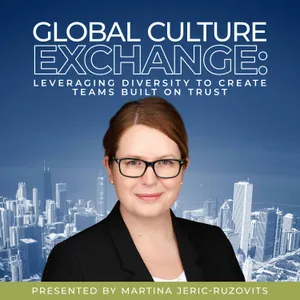
GLOBAL CULTURE EXCHANGE: Leverage diversity to create teams built on trust: Daily Summaries Delivered
by Martina Jeric-Ruzovits
Get key takeaways, quotes, and insights from GLOBAL CULTURE EXCHANGE: Leverage diversity to create teams built on trust in a 5-minute read. Delivered straight to your inbox.
Latest Episodes
The most recent episodes — sign up to get AI-powered summaries of each one.
- Apr 14, 202111 min
S01|EP09 - Formality vs Informality
In business context both formal and informal communication play a huge role in relationship building. As you never get a second chance for a first impression, it is important to know when to be formal and informal and how this varies across different cultures. In countries where relationships play a more important role, it's even more important to know when to be informal to show interest in your work and colleagues. In this Episode you'll learn: 👉 how a virtual workplace might changes the level of formality in business 👉 why formality is important in business and how it actually helps strengthen the relationships 👉 biggest differences between formal and informal communication and their advantages 👉 general cross-cultural guide when to be formal and informal *** Contact me! Martina Jeric-RuzovitsSend me an email WhatsApp Schedule a free call! 👇Free Discovery Call WHAT I do & HOW I can help 👇www.cross-cultural-communication.com www.casalinguae.com
- Feb 10, 202131 min
S01|EP08 - Interview with Robert Maisel about language
Robert Maisel speaks 5 languages: English, Spanish, Portuguese, Japanese and Mandarin Chinese. While Spanish is the only foreign language he learned from textbooks, he had to realise that he could not communicate with Argentina natives at first. He figured that learning through interaction with the actual society speaking the language is much more effective for him. So he learned the other foreign languages Portugese, Japanese and Mandarin Chinese mainly by this technique. His core motivation for learning languages is curiosity, passion and to be able to communicate, have an impact and to be impacted by other people. While it's essential to have a strong intrinsic motivation, external benefits such as more professional and personal opportunities and new relationships can be a motivation as well. Robert tips for language learners is: Think about your motivation thoroughly. And then: Go out and do it! Learn in whatever is the most effective way for you and don't be afraid to make mistakes. You'll learn in this Episode: 👉 why he chose those 5 languages to learn 👉 how he stayed motivated to learn the languages even in the face of adversity 👉 what aspect makes Portuguese and Spanish language more different than you think 👉 what Japanese and Spanish language surprisingly have in common 👉 what your focus needs to be if you want to be understood in Mandarin Chinese *** Contact me! Send me an email WhatsApp Schedule a free call! 👇 Free Discovery Call WHAT I do & HOW I can help 👇 www.cross-cultural-communication.com www.casalinguae.com
- Feb 10, 202138 min
S01|EP07 - Interview with Robert Maisel about culture
Robert is an American cross-cultural consultant, global mobility specialist, travel coach and blogger, speaking 5 different languages. He's been to 6 continents, 32 US States and 50 countries. He grew up in New York where there wasn't much cultural diversity. When he and his family moved to Michigan he got to know so many new cultures, religions and lifestyles. While he didn't travel much during childhood, his interest was triggered to travel more - not so much for tourist activities but to dive deep into the local cultures. Going to Argentina for his studies was very challenging as he never stayed long in a place away from home. As he became comfortable not being comfortable, he decided to go to Japan after his studies for an internship. He liked the country so much that he decided to work there for a couple of years. What fascinated him were the huge differences in values, beliefs and business practice of the Japanese culture in comparison to the USA. For example Japanese people value relationships and trust the highest which leads to long decision-making. Both sides need to understand the other cultures process, values, beliefs to find a common ground. You'll learn in this Episode: 👉 Why Robert is so excited about "afternoon tea" tradition in Argentina where he studied 👉 Why he is fascinated the most about Japan even though he, at first, understood the least about this culture 👉 How his favourite quote "live true to your values, the rest will follow" has proven to be true *** Contact me! Send me an email WhatsApp Schedule a free call! 👇 Free Discovery Call WHAT I do & HOW I can help 👇 www.cross-cultural-communication.com www.casalinguae.com
- Feb 10, 202143 min
S01|EP06 - Interview with Alexandra Paucescu
Alexandra is a diplomatic spouse from Romania currently living in Berlin. She lived in 4 countries, has a master in business and participated in a certified program called "cultural diplomacy and intercultural communication". Spending high school time in the US, she experienced a quite severe cultural shock. Luckily she integrated easily, also due to her open-mindedness, and made friendships that still last. After high school in the US she studied and worked in Romania before marrying her husband and moved to Vienna with him. As Vienna is quite close to Bucharest and they already had a few relationships there, the transition was quite easy. However, when they moved to Berlin, they were disappointed by the people being more distant and the city being more dirty than in Vienna. This was when Alexandra put the theories from her cultural studies in practice: She used her knowledge not only to understand the other culture but to take the best of the values, beliefs and behaviours from everybody. If you're open-minded, friendly and don't compare people and places you'll find the beauty of everything if you take the time. You'll learn in this Episode: 👉 how Alexandra grew up in Romania and spend high school years in the USA 👉 why the cultural transitions from Vienna (Austria) to Berlin (Germany) was quite hard 👉 why the integration in Louisiana (USA) was a lot easier than in Berlin 👉 how your level of expectations determine your experiences in a new location 👉 why an open mind is key when moving to another country *** Contact me! Send me an email WhatsApp Schedule a free call! 👇 Free Discovery Call WHAT I do & HOW I can help 👇 www.cross-cultural-communication.com www.casalinguae.com
- Dec 9, 202035 min
Culture Shock Series #5
Leading an international team requires a different set of skills in terms of communication and addressing issues within a team or company. The question that arises is whether you need to take a more aggressive or modest approach. Adapt your leadership style without losing authority. Want to know more? Listen to this episode! *** Contact me! Send me an email WhatsApp Schedule a free call! 👇 Free Discovery Call WHAT I do & HOW I can help 👇 www.cross-cultural-communication.com www.casalinguae.com
- Dec 9, 202031 min
Culture Shock Series #4
As an expat there are a few challenges you face when you move to another country, especially when you enter the business world. Dialects, body language and communication patterns that differ, the significance of small talk & social norms and taboos. Want to know more? Listen to this episode! *** Contact me! Send me an email WhatsApp Schedule a free call! 👇 Free Discovery Call WHAT I do & HOW I can help 👇 www.cross-cultural-communication.com www.casalinguae.com
- Dec 9, 202037 min
Culture Shock Series #3
Prepare your mindset for what's to come! Ask yourself what support you may require professionally & personally. Stay curious and open-minded, support your family to do the same and embrace the journey, as a family. Want to know more? Listen to this episode! *** Contact me! Send me an email WhatsApp Schedule a free call! 👇 Free Discovery Call WHAT I do & HOW I can help 👇 www.cross-cultural-communication.com www.casalinguae.com
- Nov 25, 202024 min
Culture Shock Series #2
Your adventure begins at home, well before you board the plane. Decisions have to be made, things to be researched. Logistics are a piece of cake! Think culture shock, taboos, social norms, food requirements, and healthcare. When you are young, you only pack your suitcase and the adventure begins. The older we become, the more we are thinking about what the future will bring. Therefore, being prepared does make a huge difference on how we feel. Every country is different. Even if the nuances are very little, to observe, to respect and to understand a culture helps to get easier in touch with the community. We always have to deal with challenges. At first sight, social norms can be the same but a closer look reveals that every culture has their (little) differences. To find out more about the differences, asking people can be the first step to feel more integrated in the community. Little things, which are normal to us and we are used to, can make the difference to feel like coming home. For example, housing is different in every country. To avoid being surprised or even disappointed, look up how people live in a country before you move. It does help to look online in forums to get information in real time. Ask people all the questions you have. When you start moving, take time to find a house and a school, if you have children, which suits you. Be open minded and you'll have a great time. Culture shocks can also happen after a few years when people find out that their expectations aren't met and the reality is different. Good preparation is the key. Being relaxed and having a positive mindset will make you feel at home. If it is possible, try to visit the country before moving to find out if you can imagine living there for a longer time. You will learn in this episode: 👉 Why it is good to have a checklist 👉 Why little nuances can make the difference 👉 How to find out more about housing and living in another country 👉 Why your mindset is very important to feel well *** Contact me! Send me an email WhatsApp Schedule a free call! 👇 Free Discovery Call WHAT I do & HOW I can help 👇 www.cross-cultural-communication.com www.casalinguae.com
Get GLOBAL CULTURE EXCHANGE: Leverage diversity to create teams built on trust summaries in your inbox
Free AI-powered daily recaps. Key takeaways, quotes, and mentions — in a 5-minute read.
Get Free Summaries →Free forever for up to 3 podcasts. No credit card required.
You Might Also Like
Listeners also like.

The Clash of Cultures
Alesia Kunz & Yara Rodriguez de Castro

Culture From the Heart
Darrell Amy and Larry Levine

CULTURS
Doni Aldine
Culture Encounters’ Podcast
Culture Encounters
Growth Hacking Culture
Ivan Palomino
The Culture Matters Podcast
Jay Doran
Building a Culture of Collaboration
Jigsaw Learning

Secrets From a Coach - Debbie Green & Laura Thomson's Podcast
Laura Thomson-Staveley & Debbie Green
The Culture Keepers
theculturekeepers

IMPACTFUL Teamwork
Julia Felton
Coaching Culture with Ben Herring
Ben Herring
The Crystal Clear Podcast
The Global Beth
About GLOBAL CULTURE EXCHANGE: Leverage diversity to create teams built on trust
WELCOME TO THE GLOBAL CULTURE EXCHANGE PODCAST! Positive intentions and listening without judgement are the keys to effective communication!Immerse yourself in the fascinating world of intercultural collaboration, workplace diversity, and building trust within teams. Our podcast is your ultimate source for inspiring conversations, practical tips, and proven methods to leverage diversity in your team and create a culture of trust and collaboration.✔️ Experience exciting interviews with leading experts, coaches, and business leaders who share their insights and experiences. ✔️ Discover how companies around the world tackle the opportunities and challenges of cultural diversity and develop innovative solutions to build strong and successful teams.✔️ Learn more about topics such as organizational culture, effective communication, coaching and consulting approaches, feedback culture, mindset change, and much more. My goal is to inspire, inform, and empower you to harness the diversity
Customized Recaps
AI-powered recaps with compact key takeaways, quotes, and insights.
Straight to Your Inbox
Get key takeaways from GLOBAL CULTURE EXCHANGE: Leverage diversity to create teams built on trust in a 5-minute read.
Save Hours Every Week
Stay current on your favorite podcasts without falling behind.
Frequently Asked Questions
What is Podzilla's GLOBAL CULTURE EXCHANGE: Leverage diversity to create teams built on trust daily summary?
It's a free AI-powered email that summarizes new episodes of GLOBAL CULTURE EXCHANGE: Leverage diversity to create teams built on trust as soon as they're published. You get the key takeaways, notable quotes, and links & mentions — all in a quick read.
How does the GLOBAL CULTURE EXCHANGE: Leverage diversity to create teams built on trust podcast summary work?
When a new episode drops, our AI transcribes and analyzes it, then generates a personalized summary tailored to your interests and profession. It's delivered to your inbox every morning.
Is this an official GLOBAL CULTURE EXCHANGE: Leverage diversity to create teams built on trust product?
No. Podzilla is an independent service that summarizes publicly available podcast content. We're not affiliated with or endorsed by Martina Jeric-Ruzovits.
Can I get summaries of other podcasts too?
Absolutely! The free plan covers up to 3 podcasts. Upgrade to Pro for 15, or Premium for 50. Browse our full catalog at /podcasts.
What topics does GLOBAL CULTURE EXCHANGE: Leverage diversity to create teams built on trust cover?
GLOBAL CULTURE EXCHANGE: Leverage diversity to create teams built on trust covers topics including Education, Business, Management. Our AI identifies the specific themes in each episode and highlights what matters most to you.
Start getting GLOBAL CULTURE EXCHANGE: Leverage diversity to create teams built on trust summaries tomorrow morning.
Free forever for up to 3 podcasts. No credit card required.
Free forever for up to 3 podcasts. No credit card required.