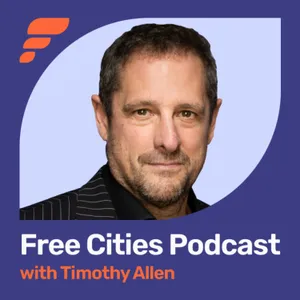
Free Daily Podcast Summary
Free Cities Podcast: Daily Summaries Delivered
by Timothy Allen
Get key takeaways, quotes, and insights from Free Cities Podcast in a 5-minute read. Delivered straight to your inbox.
Latest Episodes
The most recent episodes — sign up to get AI-powered summaries of each one.
- 4 days ago1h 14m
182 - Jailed for a Tweet | Lucy Connolly
12 Months in Peterborough Prison for One Deleted Post Lucy Connolly is a mother and childminder from Northampton. On the evening of the Southport murders in July 2024, she fired off an angry tweet, regretted it within hours, and deleted it. A week later, two police officers knocked on her door. Twelve and a half months later, she finally walked out of HMP Peterborough. Timothy Allen sits down with Lucy for a conversation about what happens when an ordinary mother becomes a national headline, the deleted tweet, the dawn raid, the magistrate's court video link, the women she met inside, the husband she came home to, and the country that locked her up while telling itself it still had free speech. Lucy is on license until March 2027, which means she has to watch every word she says, including in this conversation. She's not bitter. She's funnier than she has any right to be. And she has a lot to say about what Britain has quietly become. In this conversation: The Southport murders, the deleted tweet, and the week between writing it and the police arriving at the door Why Lucy is convinced her arrest was a political takedown of her husband, a Conservative councillor Section 19 of the Public Order Act 1986 — and why a tweet became a 31-month prison sentence HMP Peterborough, run by Sodexo, and how a private prison compares to the state-run HMP Drake Hall The women she met inside, including Virginia McCullough, who murdered her parents and lived with their bodies for four years The case of Peter Lynch, the grandfather who died at HMP Moorland after being jailed for the Southport disorder Ricky Jones, the Labour councillor who called for protesters' throats to be cut and walked free Why the police, in Lucy's view, have become politically captured and why serving officers are leaving in disgust Free speech, the First Amendment, and whether Britain has a way back Why she's not bitter, and why the worst thing that could happen to her had already happened years before Enjoy the conversation. Timestamps (audio version, includes Timothy's episode introduction): 0:00:30 - Introduction to episode 0:07:26 - Start of conversation 0:09:18 - The night of the Southport murders and the tweet 0:11:00 - What the tweet actually said, and how the media doctored it 0:13:50 - Why Lucy believes this was a political takedown of her Conservative councillor husband 0:17:30 - The first knock at the door, and the first arrest 0:20:46 - Section 19 of the Public Order Act 1986 0:23:30 - Released on bail, then re-arrested four days later 0:24:40 - Mr Khan, the complainant, and the second batch of tweets 0:27:30 - Charged, refused bail, video link to Crown Court 0:30:00 - Why Lucy refuses to accept her tweet was incitement 0:30:50 - Straight to HMP Peterborough and 12.4 months without going home 0:32:00 - The judge who said he didn't care about mitigation 0:36:00 - What prison is actually like, once you settle in 0:39:46 - HMP Peterborough (Sodexo) vs. HMP Drake Hall, why the private one was better 0:41:43 - Virginia McCullough, the woman who tried to buy Lucy's leggings 0:43:46 - "Pussy politics" and the unspoken rules of women's prison 0:46:13 - How prison changed her view of who actually ends up inside 0:48:21 - Was anyone actually radicalised by tweets? Or were the rioters always going to riot? 0:50:38 - Why Keir Starmer's response made it worse 0:53:23 - Authoritarianism, COVID, and the long shadow of 2020 0:55:39 - Real-world support vs. social media hate and the messages from prison 0:57:15 - Free speech, the First Amendment, and the Americans watching Britain in disbelief 1:00:55 - Probation, license, and being told she can't travel abroad 1:02:00 - Two-tier justice, Ricky Jones, and the case of the Labour councillor who walked free 1:04:30 - Why the police, in Lucy's view, have become politically captured 1:06:21 - The new hate crime departments and the resources Britain found for them 1:07:25 - Why she's not bitter 1:10:00 - Free speech as a non-negotiable 1:11:00 - Whether Britain has a way back Guest: Lucy Connolly — X / Twitter The Free Cities Podcast is the official podcast of the Free Cities Foundation hosted by Timothy Allen. New episodes every Friday. Long-form, in-person conversations with the builders, investors, residents, and thinkers shaping the future of Free Cities, charter cities, special economic zones, network states, private cities, and governance innovation w
- 1 weeks ago1h 57m
181 - Brazil's First Free City | Paloma Lecheta
The Free City That's Been 45 Years in the Making Paloma Lecheta is a Brazilian entrepreneur and co-founder of Founder Haus, a hub for what she calls healthy entrepreneurship in Jurerê Internacional, a private neighbourhood on the island of Florianópolis. After accelerating around 1,800 startups across Brazil, she is now part of a small group of founders trying to do for Brazil what Próspera is doing for Honduras, turn a quietly functioning private development into a formally recognised Free City. Timothy Allen sits down with Paloma in Honduras for a conversation about the 45-year-old Brazilian neighbourhood that has been running its own water, sewage, security and urban planning since 1980, the visionary banker who built it from raw beach scrub, and the new generation of founders now trying to give it the legal autonomy to match. The result is a story of a Free City that already exists, mostly hiding in plain sight, and the people quietly trying to formalise it before the rest of the world notices. In this conversation: The story of Péricles de Freitas Druck, the Brazilian banker who built a private city in 1980 with no reference points and 45 years before the charter cities movement existed Why philanthropy often fails to solve the problems it claims to, and why business may be the better tool Healthy entrepreneurship: why founder burnout is a business problem, not just a personal one How Jurerê Internacional privatised water, sewage, security and urban planning while staying within Brazilian law The brain drain problem: 1,200 millionaires left Brazil last year, and why most of them didn't want to Floripa 10, the proposed Digital Economic Zone that would give Jurerê formal regulatory autonomy Ipê City, Brazil's first pop-up city, and how Founder Haus, Peerbase and Tools for the Commons are stacking experiments on top of each other Why the difference between crazy and visionary is just execution Enjoy the conversation. Timestamps (Audio version only, includes Timothy's episode introduction): 0:00:29 - Introduction to episode 0:08:18 - Start of conversation 0:13:00 - Ciudad Morazán and why making money is part of doing good 0:17:00 - Why nonprofits can't pay well, and why the talent goes elsewhere 0:18:30 - The new wave of founders: DAOs, protocols, and rethinking what a company even is 0:20:08 - Ipê City and Jean Hansen: Brazil's first pop-up city and its first network state 0:22:30 - Founder Haus and the move to Florianópolis: building a hub for healthy entrepreneurship 0:28:30 - The story of Péricles de Freitas Druck: the banker who built a private city in 1980 0:31:00 - How Jurerê Internacional works: open neighbourhood, private services, contractual governance 0:36:00 - Running a city without taxes: how Habitasul funds infrastructure through services 0:39:00 - Becoming a Latin American node: 1,800 founders through Founder Haus in three years 0:46:00 - Floripa 10: the proposed Digital Economic Zone and why Brazil needs to compete 0:50:00 - Why 1,200 millionaires left Brazil last year, and why most of them didn't want to 0:53:00 - Lula, elections, and navigating governments without waiting for permission 0:58:00 - You don't choose your cards: founder strategy in a hostile jurisdiction 1:03:00 - Stacking experiments: Tools for the Commons, Peerbase, and the open-source approach to building cities 1:09:00 - Lessons from Próspera: legal framework, local community, and government revenue 1:11:00 - Why governments are people, and people respond to incentives 1:14:00 - The difference between crazy and visionary is execution 1:17:00 - The 45-year head start: Péricles as Brazil's pre-charter-cities visionary 1:25:00 - Why founders should be building cities now, and why timing matters Guest: Paloma Lecheta - LinkedIn | Founder Haus The Free Cities Podcast is the official podcast of the Free Cities Foundation hosted by Timothy Allen. New episodes every Friday. Long-form, in-person conversations with the builders, investors, residents, and thinkers shaping the future of free cities, charter cities, special economic zones, network states, private cities, and governance innovation worldwide. Listen & subscribe: freecities.fm | All platforms | Fountain.fm (bonus episodes & early access) Community: <a href="https://t.me/+im6
- 2 weeks ago1h 14m
180 - Why Bad Ideas Persist | Crémieux
IQ, Institutions & Why Every Country Is Run Poorly Crémieux is a pseudonymous statistician and writer with a large following on Substack and X. He likes to take widely cited studies, reopen the data, and argue the conclusions don't always hold up. His readers include Elon Musk and JD Vance, and his work circulates widely in tech and policy circles. Timothy Allen sits down with Crémieux in Honduras, for a wide-ranging conversation about IQ, institutions, fertility, biotech, agglomeration economies, and why he thinks every country on Earth, even Singapore, is run poorly. The result is part interview, part real-time error-correction service: every casual claim Timothy makes gets gently audited against the data, and the answers are usually "harsher, less equal, and less comforting than people want them to be." In this conversation: Why complex problems get clearer with honest inquiry and why the answers are usually harsher than people want The IQ data nobody wants to talk about, and why most "special" groups aren't statistically special at all Why El Salvador transformed without the people changing and what that says about institutions over genetics Honduras as a case study in self-imposed poverty: severance taxes, FDI delays, and 80% informal employment What predicts socialist tendencies (and why champagne socialists are a statistical blip) Voice vs exit: why Switzerland and Dubai work, and why one-world government would be a "global Honduras" The privacy-biotech tradeoff: Florida's Sunshine Genetics Act, China's biobank race, and the data we owe the future The unsolved problem at the heart of every charter city: how do you generate the agglomeration effects of San Francisco? Enjoy the conversation. Timestamps (Audio version only, includes Timothy's episode introduction): 0:00:29 - Introduction to episode 0:07:26 - Start of conversation: ChatGPT, distilling a guest's worldview, and the macro view 0:09:38 - Cremieux's philosophy: honest inquiry, good data, and harsher answers 0:11:58 - The IQ question: simple models, predictive power, and conversations nobody wants to have 0:13:19 - "Most things are not special": Nigerian immigrants, group differences, and what falls apart under scrutiny 0:14:01 - The macro view of the human condition: heritability, institutions, and El Salvador before and after Bukele 0:16:34 - Evolutionary biology vs evolutionary psychology, and the limits of data 0:20:06 - Religion as social technology: the Catholic Church, cousin marriage, and the Hajnal line 0:24:48 - Jordan Peterson, abstraction, and why getting too wacky means losing substance 0:26:13 - Honduras governed like a socialist hellhole: severance taxes, informal employment, and the Washington Consensus 0:30:06 - Property rights, El Zonte, and the development problem in Latin America 0:31:30 - Why Singapore and Israel got it right when the rest of the third world didn't 0:32:41 - What predicts socialism: poor mental health, downward mobility, and resentment 0:35:55 - The champagne socialist deviation, and why hypocrisy isn't really the point 0:38:27 - Paul Ehrlich, neo-Malthusianism, and how India sterilised more people in one year than the Nazis did in twelve 0:40:09 - Some people are just correct: knowing better, the data, and the difference 0:42:01 - ChatGPT modelling competing polities, and the IQ correlations of political ideology 0:44:46 - Why libertarians lose: bad at marketing, bad at organising, and the few good rules worth following 0:47:55 - Switzerland, Dubai, and exit over voice: "voice is annoying" 0:51:13 - Democracy: not a fan, but currently necessary 0:52:22 - "Every country is run poorly," even Singapore 0:55:28 - Patchworks, conquest, and why one-world government would be a "global Honduras" 0:56:50 - Privacy vs biotech: HIPAA, the Sunshine Genetics Act, and China's biobank advantage 1:00:10 - Why Sweden trusts its government, and the limits of giving up privacy 1:03:36 - Politicians lie: Robert Moses, LBJ, and whether good leaders can be liars 1:07:24 - Latin America, Chile, and why everywhere should be rich 1:08:20 - On Erick Brimen and Próspera: bullish, but agglomeration is the unsolved problem 1:09:08 - The unsolvable problem at the heart of every charter city: how do you build the next San Francisco? Guest: Crémieux - Twitter/X | Substack The Free Cities Podcast is the official podcast of the Free Cities Foundation hosted by Timothy Allen
- 3 weeks ago1h 15m
179 - Make Sealand Great Again | Liam Bates
Sealand, Sovereignty & Building Freedom Without Permission For nearly six decades, the Principality of Sealand has stood as one of the world’s most famous experiments in self-declared sovereignty: a former wartime sea fort occupied in 1967 by Paddy Roy Bates and still run by the Bates family today. What began as a pirate-radio outpost became a long-running test case in jurisdiction, legitimacy, and what it means to build freedom outside existing systems. Timothy Allen sits down with Prince Liam Bates of the Principality of Sealand, grandson of Paddy Roy Bates and part of the family still carrying the project forward. Liam tells the story of how Sealand emerged from the pirate radio era, survived court battles, repelled a coup attempt, and evolved from a rough offshore platform into a still-living symbol of independence, experimentation, and institutional persistence. In this conversation: What life on Sealand was really like, and why hardship helped forge its culture How Paddy Roy Bates turned a pirate-radio stronghold into a sovereignty project The legal case that shaped Sealand’s claim to being outside UK jurisdiction Why Sealand still matters as an early real-world test of opt-in governance How pirate radio, the BBC monopoly, and information freedom shaped its origins The role of family continuity in keeping long-term sovereignty projects alive What the 1978 coup attempt reveals about legitimacy, force, and state-like behavior Why Sealand is now exploring eCitizenship, online community, and new digital forms of nationhood This episode is a fascinating look at one of the most enduring edge cases in the freedom space - a project that sits somewhere between micronation, myth, legal anomaly, and genuine governance experiment. It is a conversation about sovereignty not as theory, but as something people try to live, defend, and pass on across generations. Timestamps (Audio version only, include's Timothy's episode introduction): 0:00:29 - Introduction to episode 0:08:19 - Start of conversation 0:10:45 - Life on Sealand: tough conditions and the spirit of adventure 0:16:08 - Paddy Roy Bates's ideology and early plans to make Sealand profitable 0:21:30 - UK territorial waters, legal precedent, and the pistol-shot court case 0:26:53 - Sealand eCitizenship, 1.5 million followers, and plans for a DAO 0:32:15 - Reclaiming land, territorial waters, and international maritime law parallels 0:37:38 - Pirate radio origins: Radio Essex, the BBC monopoly, and information freedom 0:43:00 - Growing up with sovereignty: school, conformity, and a different mindset 0:48:23 - The family fishing business and funding Sealand for decades 0:53:45 - Network states, opt-in communities, and Sealand's sovereign advantage 0:59:08 - Just doing it: incorporating in Sealand without asking permission 1:04:30 - The 1978 coup d'état: helicopter raid, treason trial, and German diplomacy 1:09:53 - Future vision: twin towers, reclaimed land, and a permanent island community Guest: Liam Bates - Twitter/X | Website The Free Cities Podcast is the official podcast of the Free Cities Foundation hosted by Timothy Allen. New episodes every Friday. Long-form, in-person conversations with the builders, investors, residents, and thinkers shaping the future of free cities, charter cities, special economic zones, network states, private cities, and governance innovation worldwide. Listen & subscribe: freecities.fm | All platforms | Fountain.fm (bonus episodes & early access) Community: Telegram | Free Cities Foundation newsletter | Free Cities Conference Support the show: Donate via Stripe | BTC: bc1q5jun0nzxzqepch84rqk0jnv0rd8uvns28df7mg | V4V podcast apps Lead show sponsor: Veritas Villages - Off-grid, energy self-sufficient communities for freedom-minded people in Latin America. Bitcoin accepted for property purchases. (Previous episodes with founder Patrick Hiebert: EP 156 | <a href="https://fountain.fm/episode/Fh6uGwZvVtPsYsR
- Apr 17, 20261h 20m
178 - 8 Hard Truths from 25 Years of Investing in Free Cities | Patri Friedman
Why Most Free City Projects Fail & What Actually Works After more than two decades investing in charter cities, seasteading, and governance innovation, Patri Friedman has arrived at a blunt conclusion: most attempts to build new societies fail not because of bad ideas, but because of poor execution. Timothy Allen sits down with the founder of The Seasteading Institute and General Partner at Pronomos Capital, the first venture capital fund dedicated to charter cities. Patri has spent 25 years exploring and investing in the Free Cities ecosystem and shares eight hard-earned lessons from trying to turn governance experiments into real, functioning jurisdictions. In this conversation: Why most projects fail at the execution stage, not the idea stage The critical difference between Layer 1 platforms (charter cities and Free Cities) and Layer 2 communities (network states, pop-ups, and nomad villages) Why seasteading remains conceptually powerful but economically impractical compared to land-based free cities The importance of building real economic engines before relying on legal or regulatory advantages Why founders in their 40s often outperform younger founders in this space The case for building for locals rather than digital nomads to ensure long-term stability How LARPing and over-theorizing can derail serious governance projects Why Próspera's survival under a hostile government in Honduras is the proof of concept the entire movement needed This episode is a grounded look at what it actually takes to build free cities - moving beyond theory into the realities of politics, economics, and long-term institutional change. Timestamps (Audio version only, include's Timothy's episode introduction): 0:00:29 - Introduction to episode 0:07:03 - Start of conversation 0:07:20 - Seasteading today: niche use cases vs reality 0:09:44 - Long-term seasteading, space-steading, and dynamic geography 0:12:56 - Why economics, not romance, determines what gets built 0:17:26 - Governance models in space and why Patri stays agnostic 0:20:04 - Lesson 1: Why Free City founders tend to be in their 40s, not their 20s 0:25:26 - AI, the 21st century, and the future of governance 0:39:23 - Lesson 2: Build for locals, not nomads 0:43:58 - Lesson 3: L1s and L2s are very different 0:49:29 - Lesson 4: You need a pipeline of countries because deals fall through 0:52:43 - Alpha City and the strategy of building multiple Free City projects 0:55:06 - Lesson 5: Near enemies, LARPing, and the cloud 1:00:03 - Network states, internet-first governance, and the limits of digital power 1:03:28 - Every successful Free City needs an economic engine 1:04:45 - Lesson 6: Pop-ups select for the rootless 1:07:09 - Lesson 7: Entrepreneurial lift first, legal arbitrage later at scale 1:14:15 - Lesson 8: Stop wonking: why theory is not the bottleneck 1:16:21 - Patri’s macro view: why Free Cities are finally starting to work 1:18:15 - Why Próspera may be the proof of concept the whole movement needed Guest: Patri Friedman - Twitter/X | Website The Free Cities Podcast is the official podcast of the Free Cities Foundation hosted by Timothy Allen. New episodes every Friday. Long-form, in-person conversations with the builders, investors, residents, and thinkers shaping the future of free cities, charter cities, special economic zones, network states, private cities, and governance innovation worldwide. Listen & subscribe: freecities.fm | All platforms | Fountain.fm (bonus episodes & early access) Community: Telegram | Free Cities Foundation newsletter | Free Cities Conference Support the show: Donate via Stripe | BTC: bc1q5jun0nzxzqepch84rqk0jnv0rd8uvns28df7mg | V4V podcast apps Lead show sponsor: Veritas Villages - Off-grid, energy self-sufficient communities for freedom-minded people in Latin America. Bitcoin accepted for property purchases. (Previous episodes with founder Patrick Hiebert: <a href="https://fountain.fm/episode/66NqAclTBh7FByI
- Apr 10, 20261h 15m
177 - The Próspera Master Plan | Gabriel Delgado
Inside Próspera's Survival, Legal Battle, and Vision for Governance as a Service Próspera is the world's most closely watched startup city - a Free City project on the Honduran island of Roatán operating under the ZEDE framework with its own civil code, tax structure, and regulatory system. After surviving years of political hostility from the previous Honduran government, it now faces a pivotal moment: a friendlier administration, an ongoing CAFTA arbitration, and a development roadmap that could reshape how governance experiments scale globally. In this episode, Timothy Allen sits down with Gabriel Delgado, co-founder and Chief Development Officer of Próspera. Gabe has worked in special economic zones since 2009 and launched Próspera in 2017. He pulls back the curtain on what the last several years have actually looked like - the political pressure, the decision to fight rather than retreat, and what comes next. In this conversation: The current legal status of Honduras's ZEDE framework and why it's more nuanced than the headlines suggest How Próspera survived a hostile government that made shutting it down a top political priority The ongoing CAFTA arbitration and what a deal with the new administration could look like Próspera's masterplan: a walkable, non-car-centric city on Roatán modelled on Hong Kong Plans for a Shenzhen-style nearshoring hub on the Honduran mainland connected by autonomous drone logistics Governance as a service: how Próspera's regulatory model could be licensed to other countries Why Próspera's success may be the single most important thing for the global Free Cities and charter cities movement Timestamps (Audio version only, include's Timothy's episode introduction): 0:00:29 - Introduction to episode 0:09:18 - Start of conversation 0:14:24 - Timothy's life in Próspera 0:19:30 - Building on the frontier 0:24:36 - The masterplan and city design 0:29:42 - Mainland vision and logistics 0:34:48 - Political pressure and survival 0:39:54 - Why Próspera matters globally 0:45:00 - Legal framework and ZEDE status 0:50:06 - Arbitration and legal protections 0:55:12 - Relationship with the new government 1:00:18 - Governance as a service 1:05:24 - Scaling the model internationally 1:10:30 - Why Próspera must succeed Guest: Gabriel Delgado-Ayau — x.com/gabedelgadoa | prospera.co The Free Cities Podcast is the official podcast of the Free Cities Foundation, hosted by Timothy Allen. New episodes every Friday. Long-form, in-person conversations with the builders, investors, residents, and thinkers shaping the future of free cities, charter cities, special economic zones, network states, private cities, and governance innovation worldwide. Listen & subscribe: freecities.fm | All platforms | Fountain.fm (bonus episodes & early access) Community: Telegram | Free Cities Foundation newsletter | Free Cities Conference Support the show: Donate via Stripe | BTC: bc1q5jun0nzxzqepch84rqk0jnv0rd8uvns28df7mg | V4V podcast apps Lead show sponsor: Veritas Villages — Off-grid, energy self-sufficient communities for freedom-minded people in Latin America. Bitcoin accepted for property purchases. (Previous episodes with founder Patrick Hiebert: EP 156 | EP 107) Links mentioned: Próspera | Become a resident or business owner in Prospera | ArkPad Próspera Resort | Free Cities Foundation Follow: Timothy Allen on X & Nostr | Free Cities Foundation on X & Nostr
- Apr 3, 20261h 17m
176 - Why Everything Feels Broken | James Price
“When Starmer came in in 2024, how many people across the entire British state changed jobs? Two hundred. One hundred ministers… and one hundred special advisors… And that’s it. And everybody else in that deep state stayed exactly the same.” - Timothy Allen sits down with James Price, former UK government adviser and political commentator, for a wide-ranging conversation on what it’s really like inside the machinery of the modern state. Drawing on his experience at the heart of government, James offers a candid perspective on why many institutions are increasingly struggling to deliver, how political incentives shape decision-making behind the scenes, and why problems that appear local to the UK may in fact be symptoms of a much broader systemic shift. The discussion explores the growing gap between what governments promise and what they can realistically achieve, the pressures created by cultural and demographic change, and whether traditional models of governance are equipped to handle the complexity of what’s coming next. Along the way, they touch on the limits of reform, the role of public perception, and what all of this might mean for those looking beyond the nation-state for alternative ways of organising society. Enjoy the conversation. - New ArkPad Seasteading Resort in Próspera: https://tinyurl.com/ArkPad - LEAD SPONSOR: Veritas Villages: https://www.veritasvillages.com/freecities Veritas Villages are building off-grid, energy self-sufficient communities for freedom lovers in Latin America. Bitcoin is accepted at all villages, including for the purchase of property. - Previous interviews with Patrick Hiebert, Founder of Veritas Villages: EP 156: https://fountain.fm/episode/66NqAclTBh7FByIX7lCq EP 107: https://fountain.fm/episode/Fh6uGwZvVtPsYsR53pTI - DONATE Bitcoin to the Free Cities Podcast: bc1q5jun0nzxzqepch84rqk0jnv0rd8uvns28df7mg - DONATE fiat currency to the Free Cities Podcast: https://buy.stripe.com/5kQ9AT90zeeY5JX7Jv4ow00 - Listen on Fountain.fm to subscribe for BONUS episodes & EARLY ACCESS: https://fountain.fm/show/xudG4tsYH5TimGLfAmqn All the Podcast Links: https://linktr.ee/FreeCitiesPodcast Free Cities Telegram Community: https://t.me/+im6c6r4jQkUzMjU0 Free Cities Conference: https://freecitiesconference.com/ Free Cities Foundation Newsletter: https://free-cities.org/subscribe - Podcasting apps that support Value-4-Value Bitcoin payments: https://podcastindex.org/apps?appTypes=app - TIMESTAMPS (Audio Version Only) 0:00:29 - Episode introduction 0:07:02 - Start of Conversation 0:08:36 - What is the real problem with modern government? 0:15:20 - Only 200 people change when governments change 0:16:46 - Why nothing works anymore and legitimacy is breaking down 0:19:03 - Bureaucracy as the real power: ministers as “viruses” 0:24:30 - Civil service incentives and resistance to change 0:29:00 - Government vs business: why execution fails 0:33:30 - Centralisation vs decentralisation 0:38:00 - Political cycles and economic reality 0:42:30 - Freedom vs control trade-offs 0:47:00 - Immigration and pressure on the system 0:51:30 - Democracy and loss of public trust 0:56:00 - The administrative state vs elected power 1:01:00 - Why reform keeps failing 1:08:00 - What replaces the current system? NOSTR: Timothy Allen: npub1gcf9ltaeu42f4tr20z3avkas04dezlx3jaudqsuu87gvmh686xasrvqjg0 Free Cities Foundation: npub1lsj8pmgedqqamt89c27tzjjnlf0wn7q7udjm7j2cl9xxz97eacns2mwpee - LEGACY SOCIAL MEDIA: James Price: https://x.com/jamespriceglos Timothy Allen: <a
- Mar 27, 20262h 52m
175 - The Last Free Place | Oswald Horowitz
“I will die at sea for sure. I’m not going back.” - Timothy Allen sits down with filmmaker Oswald Horowitz, the man behind the upcoming documentary The Legend of Landi, to trace the strange true story of Samuele Landi, an Italian tech entrepreneur who set out to live beyond the reach of the normal system on a rusty barge in international waters between Dubai and Iran. What begins as Oswald's quixotic quest to track Landi down, involving ignored Telegram messages, a ketchup-themed short film, a Croatian police ban, and a Dubai fisherman willing to sail forty miles offshore, opens out into something far bigger. Landi's life turns out to be nothing like the press had painted it, and the story takes turns that nobody could have scripted. This is a conversation about myth, obsession, sovereignty, and the kind of rare individuals willing to push past every frontier to find out whether real freedom can actually be built at sea. Enjoy the conversation. - New ArkPad Seasteading Resort in Próspera: https://tinyurl.com/ArkPad - LEAD SPONSOR: Veritas Villages: https://www.veritasvillages.com/freecities Veritas Villages are building off-grid, energy self-sufficient communities for freedom lovers in Latin America. Bitcoin is accepted at all villages, including for the purchase of property. - Previous interviews with Patrick Hiebert, Founder of Veritas Villages: EP 156: https://fountain.fm/episode/66NqAclTBh7FByIX7lCq EP 107: https://fountain.fm/episode/Fh6uGwZvVtPsYsR53pTI - DONATE Bitcoin to the Free Cities Podcast: bc1q5jun0nzxzqepch84rqk0jnv0rd8uvns28df7mg - DONATE fiat currency to the Free Cities Podcast: https://buy.stripe.com/5kQ9AT90zeeY5JX7Jv4ow00 - Listen on Fountain.fm to subscribe for BONUS episodes & EARLY ACCESS: https://fountain.fm/show/xudG4tsYH5TimGLfAmqn All the Podcast Links: https://linktr.ee/FreeCitiesPodcast Free Cities Telegram Community: https://t.me/+im6c6r4jQkUzMjU0 Free Cities Conference: https://freecitiesconference.com/ Free Cities Foundation Newsletter: https://free-cities.org/subscribe - Podcasting apps that support Value-4-Value Bitcoin payments: https://podcastindex.org/apps?appTypes=app - TIMESTAMPS (Audio Version Only) 0:00:29 – Introduction 0:08:24 – Start of conversation 0:09:56 – Why seasteading matters and how Oswald found the world 0:11:53 – Ephemeris and the search for a real seasteader 0:19:17 – Meeting Samuel Landi through Vít Jedlička 0:22:04 – Oswald’s strange strategy for getting invited on board 0:26:16 – Chasing Vít to Liberland 0:33:25 – Dubai, the failed yacht mission, and finding a way to the barge 0:39:39 – Arriving at Landi’s platform in the middle of nowhere 0:43:16 – The whisky test and first impressions of Landi 0:46:22 – Family, adventure, and why Landi chose the sea 0:51:57 – Media narratives, freedom, and why seasteading gets misread 0:55:13 – Living on the barge and why Landi chose barges over prototypes 1:02:26 – Landi’s death and the mystery after the storm 1:07:05 – The wreck, the survivors, and what really happened at sea 1:17:18 – Filming the wreck and Landi’s underwater afterlife 1:23:57 – Liberia, diplomacy, and the wider Landi backstory 1:31:28 – Berlusconi, exile, and the making of a fugitive pioneer 1:36:52 – Why Landi helped rescue Liberian girls in Oman 1:46:05 – Liberland, micronations, and whether new states can survive 1:55:17 – Landi’s family history and the idea of blood memory 2:03:56 – The sovereign individual, frontiers, and escaping the system 2:11:25 – Why pioneers are always treated like outlaws 2:22:09 – The ending of the film and the bronze head of Landi 2:31:47 – Why the monument matters and who it is really for 2:41:24 – Making art for the few people who will actually act 2:49:56 – Final thoughts on seasteading and Landi’s legacy -</p
Get Free Cities Podcast summaries in your inbox
Free AI-powered daily recaps. Key takeaways, quotes, and mentions — in a 5-minute read.
Get Free Summaries →Free forever for up to 3 podcasts. No credit card required.
You Might Also Like
Listeners also like.
Charter Cities Podcast
Mark Lutter

The New Founding Podcast
New Founding
The Staying Free Podcast
jonnyhodl

The Free Thought Project Podcast
The Free Thought Project

The Free Thought Project Podcast
The Free Thought Project
Edge City
Edge City
The Practical Liberty Podcast
Henry Bingaman
Free Thoughts
Libertarianism.org

Complete Liberty Podcast
Wes Bertrand

Libertarianism.UK Podcast
@Andy009Duncan
The Liberty Exchange
Libertarianism.org
The Free Thought Project Podcast
Free Thought
About Free Cities Podcast
The Free Cities Podcast is the official podcast of the Free Cities Foundation, hosted by Timothy Allen.Long-form, in-person conversations with the people building new jurisdictions and real-world pathways to more freedom: free private cities, intentional communities, charter cities, network states, and seasteading. We focus on what actually works, the legal structures, incentives, economics, and business models that turn freedom from an idea into a way of life. Builders and skeptics welcome.New episodes every Friday. Video and all links: https://linktr.ee/FreeCitiesPodcast
Customized Recaps
AI-powered recaps with compact key takeaways, quotes, and insights.
Straight to Your Inbox
Get key takeaways from Free Cities Podcast in a 5-minute read.
Save Hours Every Week
Stay current on your favorite podcasts without falling behind.
Frequently Asked Questions
What is Podzilla's Free Cities Podcast daily summary?
It's a free AI-powered email that summarizes new episodes of Free Cities Podcast as soon as they're published. You get the key takeaways, notable quotes, and links & mentions — all in a quick read.
How does the Free Cities Podcast podcast summary work?
When a new episode drops, our AI transcribes and analyzes it, then generates a personalized summary tailored to your interests and profession. It's delivered to your inbox every morning.
Is this an official Free Cities Podcast product?
No. Podzilla is an independent service that summarizes publicly available podcast content. We're not affiliated with or endorsed by Timothy Allen.
Can I get summaries of other podcasts too?
Absolutely! The free plan covers up to 3 podcasts. Upgrade to Pro for 15, or Premium for 50. Browse our full catalog at /podcasts.
How often does Free Cities Podcast release new episodes?
Free Cities Podcast publishes weekly. Our AI generates a summary within hours of each new episode.
What topics does Free Cities Podcast cover?
Free Cities Podcast covers topics including Technology, Philosophy, Culture, Society & Culture. Our AI identifies the specific themes in each episode and highlights what matters most to you.
Start getting Free Cities Podcast summaries tomorrow morning.
Free forever for up to 3 podcasts. No credit card required.
Free forever for up to 3 podcasts. No credit card required.